Sunday, 8 December 2013

Antiparallels, an Overlooked HS Beauty


I would think it is pretty fundamental in typical HS classrooms that students recognize that a line parallel to one of the sides of a triangle will cut the other two sides in a pair of angles which are congruent to the angles formed at the third side. Eventually they can prove that the triangle formed by the parallel line forms a triangle with the two sides similar to the original triangle.

Almost none of them, and perhaps very few of their teachers, know that there is a second type of line which can be drawn to cut the two sides which will also form a similar triangle, and thus must also form angles congruent to the two base angle of the original triangle. Its called the anti-parallel now, but it used to be called a subcontrary line, at least by Apollonius.

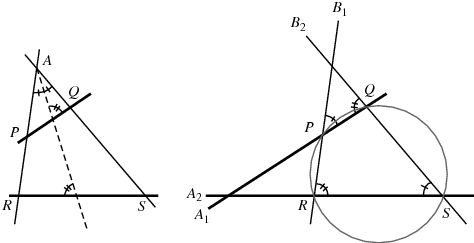
There are several nice ways to produce an antiparallel in a triangle. A nice general way is to use the two vertices of one leg and a point on one of the other two legs to construct a circle. The circle will then cut the other leg in a fourth point which is the other vertex of the antiparallel. These four point are the vertices of a cyclic quadrilateral, for which the opposite angles are supplementary. This makes it easy to see that the antiparallel forms angles on one leg congruent to the original angle on the other leg.
A second way is to draw an altitude from two of the vertices to the opposite sides. The segment connecting the feet of these two altitudes is also antiparallel to the third side.
*image from Wolfram Mathworld

If you construct the circumcircle of the triangle, the tangent at the vertex opposite a side will be anti-parallel to that side. (This doesn't strike me as a simple proof, but I may be overlooking something. I often do. If you have a simple proof, high school level for example, I would love to see and share it.)

Just as the median bisects all lines parallel to the base, its reflection in the angle bisector (called the symmedian) will bisect each anti-parallel.

The antiparallel shows up as the solution to an optimization problem that was first proved by Giovanni Fagnano in 1775: For a given acute triangle determine the inscribed triangle of minimal perimeter. Turns out the answer is the triangle formed by the three anti-parallels connecting the feet of the three altitudes, called the orthic triangle.

For slightly more advanced students who have been exposed to cones it is constructive to point out that for an oblique circular cone, (one in which the axis is not perpendicular to the base; and many students graduate from HS without ever having been made aware that such types of cones exist, much less those whose base is non-circular) there is more than one plane which will cut a circle. A cutting plane parallel to the base is one type, and of course by now you suspect that the other type is a plane anti-parallel to the base.
*image from Paramanand's Math Notes


Maybe soon I'll write about the anti-CENTER.

Addendum: After a comment by 1SAEED9, I realized that the proof that the tangent at the vertex opposite a side is antiparallel to that side.

It is easy to see that angles DBA and BCA both subtend the same arc, and thus are the same measure. By using the fact that CBA, DBA and EBD add up to 180 degrees, and the three interior angles of the triangle CBA, CAB, and BCA also add up to 180 degrees. Since BCA and DBA are congruent, when we subtract these from each side, and remove CBA from both sides we are left with the fact that EBD must be congruent to CAB. We can repeat this process on the opposite angle and we are done. Easier than I imagined.

Monday, 11 November 2013

Vinculum is a Collective Noun

I'm not a pedant. I'm really not... really!

Ok let me explain. Murray Bourne, who writes a really nice math blog called Square Circle Z, as part of his Interactive Math site, (Both are excellent, if you haven't been there, go there) wrote a tweet a couple of days ago that got me started. He wrote, "A 'vinculum' is a horizontal line indicating grouping. E.g. over the '14' in 14/99=0.141414... "

I could have shook my head a little on gone on to the next post, but I like Murray, and think he is probably an excellent teacher. So I sent a brief quibble, which on twitter ran to about three tweets. But I think he missed my point, or perhaps he just didn't think the distinction I was trying to make was important. So here I am trying to tell the world to change to my way of thinking, and I hope with more than 140 characters, I can explain what I mean, and why I think the distinction is important.
The fact is that the overbar in the notation of repeating decimals is the only reference students have for vinculum. I will suggest (encourage/plead) that teachers add the common uses of parentheses and brackets as part of their description of a vinculum .
Many US teachers know of no other representation of repeating decimal fractions, yet they seem to have been the last application of the bar, and seem not to have occurred until after 1930 in the US. In F. Cajori's A History of Mathematical Notations (1929) he points out two forms of marking repeating sequences in decimals but does not mention the overbar. Cajori credits John Marsh [Decimal Arithmetic Made Perfect, (London, 1742)] with being the first to use a symbol to indicate the repeat sequence. Marsh sometimes placed a single dot over the first number in the repeat sequence, and sometimes placed one on the first and last.

This was one of the most frequent in the early arithmetics in the US, possibly due to the fact that many of them were by British authors,  or near verbatim copies of their books. John Bonnycastle and other British came early to the country to work in the early universities.

Like many terms of mathematical interest, vinculum(vincula) is a term that used to be better known. It seems many teachers have only a very limited knowledge of the history of even common arithmetic notations.   I've previously wrote responses to a teacher who gave me flack because I used "reduce", leading me to write this blog, "On Reducing Fractions". And another complained when I suggested that the number one, has been, and could be, labeled a prime leading me to write, "One is Prime if we Wish it to Be."

As the title says, vinculum is a collective noun, like truck, or variable. My old Dodge is a truck. It's not the only kind of truck. Some people have new trucks. Some people even have Ford trucks. I know; but what can you say to them. It's not that I'm prejudice. My own sister drives a Ford and I still love her like a, well, like a sister. And x is a variable, but it's not the only variable, and it is not always a variable, sometimes it is just a letter at the beginning of xenophobe. And if you had a student who argued that y can't be the variable because x is the variable, you would want to give them a more complete explanation.

The horizontal bar above a repeating decimal, such as $.\overline{14}$ is an example of a vinculum. It is now almost the only term that people use that term for, I think because they think it is a name for the bar, rather than a description of it's role in that situation. Horizontal bars were once commonly used beneath repeating decimals, and in fact beneath algebraic expressions in the same way we use grouping symbols today.
In "The Constructive Arithmetic" by James A Christie (1865) he writes, "The bracket { }, or [ ], or horizontal bar (such as sometimes separates the numerator of a fraction from its denominator,) is sometimes employed as a vinculum." Later he writes :

His interpretation of vinculum is a little unusual, as it is generally interpreted as something like binder. One dictionaries etymology gives "from vincire, vinctum, to bind." I have read that it was the name used frequently for a hobble for the legs of cattle in the field to keep them from wandering off. It was something like manacles and meant to allow the animal to move but keep it from moving quickly.
In "A Treatise on Arithmetic: Through which the Entire Science Can be Most Expeditiously and Perfectly Learned, Without the Aid of a Teacher." By Noble Heath he gives :

On another web site I have written, "In the same year as the 29th NCTM yearbook(1964), Irving Adler obtained a copyright for A New Look At Arithmetic, and on page 220 he writes, 'To indicate a repeating decimal with a minimum of writing, it is customary to write only enough decimal places to include the repeating part once, and to identify the repeating part by underlining it. Thus the repeating decimal for $ \frac{211}{990}$  is therefore represented by $.\underline{213}$. '. It is worth mentioning that William Oughtred, the 16th Century mathematician indicated all decimals by underlining. "

Another example, or rather a hybrid of two of the former, also appeared in a book with a 1964 copyright. A A Klaf's Arithmetic Refresher was published a few years after his death by his family. The book is written in a question and answer style somewhat reminiscent of the classic dialogs of antiquity. On page 188 it asks, "How are recurring, circulation, or repeating decimals denoted?" It then goes on to answer, "b) by dots placed over the first and last figures of the recurring group." This is described exactly like the more common earlier usage, but the figure that follows includes dots, and then an arc above them, similar to what I have shown here. Similar arcs were used over groups of three numbers to indicate the periods (thousands, millions, etc) in some early use of Hindu-Arabic numerals. Gerber(980), who later became Pope Sylvester, referred to them as "Pythagorean Arcs."

A popular author of arithmetics in the US in the 19th century was Charles Davies. He was one of the original instructors at the US Military at West Point. In his New University Arithmetic (1860) he uses yet a different type of vinculum than all the others I have mentioned. Davies sets off the repeating digits with a pair of single quotes, so 1/6 would be written .1'6'.

The more general definition may be slipping from use, but I think it is worthwhile to preserve the distinction.  When a symbol is used to bind together other numbers or operations, it is acting as a vincula, whether it is the fraction bar, $\frac{a}{b}$, or the diagonal solidus between fractions, a/b, a parenthesis ln[4{3+2(x+y)}] or brackets.  And when I type two dollar signs around an expression in Latex to make it print it as pretty math, those dollar signs form a vinculum to bind that expression together so that the computer knows, "This is math, print it using the math library I mentioned in the header." 

ADDENDUM:  In the comments, Murray writes with about a problem many teachers have encountered, how do you write repeating decimals on a typewriter or word processor if you don't have $LaTex$ or an equation editor (often not available to middle school teachers and others who teach repeating decimals)? He suggest using a square bracket vinculum (in the manner of James A Christie) to set off the repeating part.  It seems a wonderful idea.  They are distinct, and in  this usage, not easily confused with other potential uses of brackets at that (or any other?) level.  So 1/11 would be .[09], and 1/6 would be .1[6]  and no special typesetting needed.  I think if middle school teachers all over the country started using this it might force the higher school teachers to adapt, or by that time, maybe a different notation wouldn't be a problem for the students.  Being told to switch, they would begin to realize that the notations used in math are matters of choice, after all, we didn't always use = for equal.  Well after I received this suggestion from Murray, one of my brilliant ex students (brilliant and my ex-student, no causative effect suggested), Jacob Coakwerll told me that in Russia, where he lived for an extended period of time, the repeating part is included in parenthesis, so 7/12=  0,58(3)  where the comma is used for the decimal seperatrix. 

I also just noticed that some of the "old" symbols mentioned here may not be extinct.    In answer to a question on Yahoo Answers asking, "what is the name of the repeating sign over decimals?"  The answers included, "I don't know if it has a name, i just call it a dot, cos my teacher taught me to put a dot over each number that repeats."    Another seemed to suggest that something like Murray's practice was already in use, "It's just called a bar. Sometimes you will see (6) instead of a bar above or underneath the number."  A Wikipedia article suggested that the parenthetical use is mostly in Europe.

I would love for folks in different area around the world to write and tell me how they do repeating decimals. I sent a twitter question out and here are some of the responses:
Thony Christie ‏@rmathematicus England, "Bar over the repeat period and a period after the last digit."  $0.\overline{23}.$
MathsEnVideo ‏@MathsEnVideo " In France: same as in the USA or with points over the period's digits."  $0.\dot{2}\dot{3}$
Dong Suk Smith, an ex-student of Korean origin remembers that there they use a dot over the repeating period digits.
A teaching friend who has lived and retired in Japan writes that his wife has never seen the over-line and that the Japanese seem to use a repetition of the repeating period followed by an ellipsis. 
Friday, 1 November 2013

Mobius Double Cross


As a grandfather, I always love being able to take time over the holidays to share entertaining math enrichments with the grandkids. Last Christmas I showed them this one and it was a big hit
 This, to me, is the greatest Mobius related activity I have ever seen.  I wrote about it briefly as part of a longer blog, but wanted to focus one on just this neat activity. (I have also included a link at the bottom to a nice Matt Parker video with a view others.   I got this from an Ivars Peterson article in the New York Times
Don't read the article until after you have tried it, He offers teasers of what the outcome could be. 

Start by cutting out a cross of paper.  Make the sides wide enough to do some cutting, one of them into thirds (sort of).


Now take ends of one cross and give them the standard half-twist to make a Mobius strip with a cross piece hanging on.  Now take the other crossing pair and fold them away from the Mobius loop to make a regular (non-twisted) loop.  It should look sort of like a twisted figure eight. 

Here is an image of what it may look like from one of his pages. 

Now draw a line trisecting the Mobius branch.  One line 1/3 of the way across the page should loop back around the loop and eventually make something like three paths on both sides of the strip.
Now cut along the trisected loop, then bisect the non-Mobius loop. 

Shake out all the twists and turns to be amazed.

A while after I wrote this, I came upon a video of a talk by Matt Parker in which he includes several demonstrations kids (of all ages) would enjoy using Mobius strips of different numbers of twists, including zero twists.

So if you are looking for a way to share your love of math over the holidays with young people, you could work up a nice routine with some of these.
 Enjoy!

Thursday, 31 October 2013

Not Just ANY Student, and not just any Royal Road

"The great mathematician Euclid is said to have told his students 'There is no royal road to geometry."  Thus begins an otherwise nice article in the Canadian Globe and Mail newspaper on line by Anna Stokke.  The article describes her concern with what she sees as a failure of the "hands-on, manipulative approach" to math education in Alberta, and across Canada.  After thirty years of teaching, I share many of her concerns.  Read the article for yourself here.

If Ms Stokke was just any journalist, I might commend her for her (somewhat sketchy) math history connection.  But she is NOT just any journalist. She is an assistant professor at the University of Winnipeg,  and a co-founder of the non-profit organization Archimedes Math School. (I know absolutely nothing about the Archimedes Math School except that it is named for an ancient Greek Mathematician and therefore suggests a connection to math-historical knowledge.)

Perhaps the requirements of producing text for print required editing the first quote down to a triviality, and so I can not be too critical of a bit of historical vagueness without knowing the nature of her task better than I do.  For most of her readers, I am sure the omission went without note and provided a little verbal quip to support the idea of greater analytic rigor in their children's education.

I, on the other hand, am retired, write mostly for teachers and students, and fully believe that one of the things that build the interest in mathematical studies for students are stories that make the math, and the mathematicians come alive.  Just as a million kids grew to learn and love baseball sitting on the couch with dad or mom watching the home team, hearing their stories of the heroes of their youth, and maybe even memories of their own exploits.  They lean the history, and the culture of the practice, and so are more willing to spend time learning to do it well.  Few kids complain about Dad helping them learn to hit better.  To me, math teachers have a mini-opportunity to do the same thing by mixing stories of the history and development of mathematics, the false starts, and the great insights, and the mysterious connections that intertwine mathematical (and scientific and social)  topics. 

So if you are a student learning the culture, or a teacher who wants to share it, here is a little bit more that might be told about the cast off "quip" at the start of  Ms Stokke's column:

So,  in the manor of Ms. Stokke, I will begin with a well known quote, ""Neither snow nor rain nor heat nor gloom of night stays these couriers from the swift completion of their appointed rounds."  Yeah you know that one; the U. S. Postal Service motto that is inscribed on the James Farley Post Office in New York City.  You can see part of it above the beautiful Corinthian Columns in this photo from Wikipedia.
Farley was the 53rd Postmaster General of the United States, but he didn't create the quote.  He may not have even ever have heard of it.  It was supplied by one of the architects who designed the building, and then carved into the face by a designer/artist who would go on to become a designer at DC Comics.  (do you think we have the kids attention yet?)
The quote itself was from a history written by Herodotus, a 5th century BC Greek.  The couriers he was speaking of were not the US Postal Service, but the riders on Persian King Darius I road throughout his empire.  Herodotus added, " "There is nothing in the world that travels faster than these Persian couriers."  This "Royal Road" throughout the Persian Empire was over 1600 miles long, and the riders could cover it in 7 days; a very early Pony Express.

Let one hundred plus years pass and Alexander the Great has a general named Ptolemy who decides when Alexander dies to make himself the ruler of Egypt, Ptolemy I.  Also in Alexandria about this time was a mathematician who was putting together all the mathematical knowledge of the Greeks into a set of "Elements" which could be used to derive other mathematical knowledge.  Ptolemy was a big fan, but a busy man, and he found the Elements difficult to digest. 
AND..... It was this student, Ptolemy I, whose continued requests for an "easier" way to learn the Elements" that supposedly moved Euclid to remind him that there was no "Royal Road", such as the one still stretching across Persia at that time, to speed the learning of mathematics.

Did it ever really happen? Maybe not. The first known record of the event comes over five centuries later at the pen of Proclus, around 450 AD.  Even if he never said it, we imagine he would have.

I usually closed this story by reminding my students of the lost guy driving in New York City looking for Carnegie Hall as the hour of his concert approached.  The seemingly empty streets held little hope when he saw a vagrant looking fellow leaning against the wall of a building, eyes closed.  He tapped his horn and when the guy opened his eyes, asked, " Can you tell me how to get to Carnegie Hall?"
The vagrant shook his head a moment, eyes closed, then opened them again to declare , "You gotta' practice man, you gotta' really practice."