Friday, 27 January 2017

On This Day in Math - January 27

Gallleo's Notbook with observation of Neptune?
*Starship Asterisk web site

It troubles me that we are so easily pressured by purveyors of technology into permitting so-called ‘progress’ to alter our lives without attempting to control it—as if technology were an irrepressible force of nature to which we must meekly submit.
~Hyman G. Rickover

The 27th day of the year; 273 = 19,683 which has a digit sum of 27. There is no larger number for which the sum of the digits of the cube is equal to the number .
In the 3n+1 or Collatz problem, the sequence for n = 27 takes 111 steps (41 steps through odd numbers), climbing to 9232 before descending to 1. The first starting number to exceed this height is 255.

27 is the smallest composite number which cannot be expressed as the sum of two primes.

I think it is nice that when you add the integers from 2 to 7, you get 27.... 2 + 3 + 4 + 5 + 6 + 7 = 27

EVENTS
1520 Off the Patagonian coast near a small peninsula called Punta Tombo, during Ferdinand Magellan’s voyage around the world, a crewman spied strange creatures swimming in the bay. He called them flightless geese, but scientists believe they were penguins of a sort classified as Spheniscus magellanicus.*VFR

1613 Galileo observed Neptune, but did not recognize it as a planet. Galileo's drawings show that he first observed Neptune on December 28, 1612, and again on January 27, 1613. On both occasions, Galileo mistook Neptune for a fixed star when it appeared very close—in conjunction—to Jupiter in the night sky; hence, he is not credited with Neptune's discovery. (The official discovery is usually cited as September 23, 1846, Neptune was discovered within 1° of where Le Verrier had predicted it to be.) During the period of his first observation in December 1612, Neptune was stationary in the sky because it had just turned retrograde that very day. This apparent backward motion is created when the orbit of the Earth takes it past an outer planet. Since Neptune was only beginning its yearly retrograde cycle, the motion of the planet was far too slight to be detected with Galileo's small telescope.*Wik A new theory says he may have known it was a planet. Professor David Jamieson, Head of the School of Physics at University of Melbourne is investigating the notebooks of Galileo from 400 years ago and believes that buried in the notations is the evidence that he discovered a new planet that we now know as Neptune. Galileo was observing the moons of Jupiter in the years 1612 and 1613 and recorded his observations in his notebooks. Over several nights he also recorded the position of a nearby star which does not appear in any modern star catalogue. "It has been known for several decades that this unknown star was actually the planet Neptune. Computer simulations show the precision of his observations revealing that Neptune would have looked just like a faint star almost exactly where Galileo observed it," Professor Jamieson says.
In one of his notebooks he noticed the movement of a background star (Neptune) on January 28 and a dot (in Neptune's position) drawn in a different ink suggests that he found it on an earlier sketch, drawn on the night of January 6, suggesting a systematic search among his earlier observations. However, any notification about the discovery hasn't been found. *onOrbit.com

1690 Newton returns to Cambridge after spending nearly a year in London serving as an MP from Cambridge University to the Convention Parliament. Declaring the throne vacant after James II escaped to France, the convention offered the throne to William and Mary jointly.According to some reports, his only comments were to complain about a cold draft in the chamber and request that the window be closed

1880 Thomas Edison received U.S. Patent No. 223,898, which was simply titled “Electric Lamp.” Edison did not truly "invent" the electric lightbulb. Prior to Edison’s invention lightbulbs lasted only a few hours and now they could last 50 to 60 days, making them practical. So it is entirely fair to say that Thomas Edison invented the first commercially useful lightbulb. *.ipwatchdog


1921, Albert Einstein suggested the possibility of measuring the universe, which startled the audience, with his address Geometry and Expansion given at the Prussian Academy of Sciences in Berlin. Applying certain results of the relativity theory, he came to the conclusion that if the real velocities of the stars (as could be actually measured) were less than the calculated velocities, then it would prove that real gravitations' great distances were smaller than the gravitational distances demanded by the law of Newton. From such divergence, the finiteness of the universe could be proved indirectly, and it would even permit the estimation of its size. *TIS
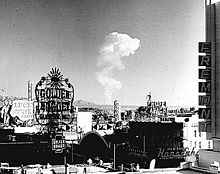
1951 Nuclear testing at the Nevada Test Site began with a 1-kiloton-of-TNT (4.2 TJ) bomb dropped on Frenchman Flat. During the 1950s, the mushroom clouds from the 100 atmospheric tests could be seen for almost 100 mi (160 km). The city of Las Vegas experienced noticeable seismic effects, and the distant mushroom clouds, which could be seen from the downtown hotels, became tourist attractions. St. George, Utah, received the brunt of the fallout of above-ground nuclear testing in the Yucca Flats/Nevada Test Site. Winds routinely carried the fallout of these tests directly through St. George and southern Utah. Marked increases in cancers, such as leukemia, lymphoma, thyroid cancer, breast cancer, melanoma, bone cancer, brain tumors, and gastrointestinal tract cancers, were reported from the mid-1950s through 1980. The vast majority—828 of the 928 total nuclear tests—were underground. *Wik

1994 Silicon Graphics Inc. co-founder Jim Clark leaves the company to start Mosaic Communications, the operation that later became Netscape Communications Corp. With Netscape cofounder Marc Andreesen, Clark helped popularize the World Wide Web by distributing the company's browser for free.*CHM

2003 Pioneer 10 was launched in 1972 . Pioneer 10 crossed the orbit of Saturn in 1976 and the orbit of Uranus in 1979. On June 13, 1983, Pioneer 10 crossed the orbit of Neptune, the outermost planet at the time, and so became the first man-made object to leave the proximity of the major planets of the solar system.

2012 An asteroid, 2012 BX34, passed within about 60,000km of Earth - less than a fifth of the distance to the Moon.The asteroid's path made it the closest space-rock to pass by the Earth since June 2011. The asteroid, estimated to be about 11m (36ft) in diameter, was first detected on Jan 25.*BBC website

2016 This is given as the official date of discovery by the GIMPS (Great Internet Mersenne Prime Search) project for the presently largest known prime number, called M49. The name could change since there may still be smaller Mersenne Primes between this and previously known ones. The previous record was in January of 2013. I am reminded at moments like this of a comment in Barlow's Number Theory (1811) which list all the then known Mersenne Primes up to M31. This number, "is the greatest that will ever be discovered, for, as they are merely curious without being useful it is not likely any person will attempt to find one beyond it." It is strange that we continue the search. It would be terrible if we did not. (Barlow actually listed the Perfect numbers associated with each Mersenne prime.)


BIRTHS

1701 Charles-Marie de La Condamine (27 Jan 1701; 4 Feb 1774) French naturalist and mathematician who became particularly interested in geodesy (earth measurement). He was put in charge by the King of France of an expedition to Equador to measure a meridional arc at the equator (1735-43). It was wished to determine whether the Earth was either flattened or elongated at its poles. He then accomplished the first scientific exploration of the Amazon River (1743) on a raft, studying the region, and brought the drug curare to Europe. He also worked on establishment of a universal unit of length, and is credited with developing the idea of vaccination against smallpox, later perfected by Edward Jenner. However, he was almost constantly ill and died in 1773, deaf and completely paralyzed. *TIS

1715 Caspar (or Kaspar) Neumann (14 September 1648 – 27 January 1715) was a German professor and clergyman from Breslau with a special interest in mortality rates.
He first did an apprenticeship as a pharmacist. He finished his higher school education at Breslau's Maria-Magdalen grammar school. In 1667 he became a student of theology at the university of Jena, and on Nov. 30, 1673 was ordained as a priest, having been requested as a traveling chaplain for Prince Christian, the son of Ernest I, Duke of Saxe-Gotha. On his return home, following a two-year journey through west­ern Ger­ma­ny, Switz­er­land, north­ern It­a­ly, and south­ern France, he became a court-chaplain at Altenburg, and married the daughter of J. J. Rabe, physician in ordinary to the prince of Saxe-Friedenstein. In 1678 he was made the deacon of St. Maria-Magdalen in Breslau and became pastor in 1689. *Wik He was a student of Erhard Weigel

1829 Isaac Roberts (27 Jan 1829; 17 Jul 1904) British astronomer who was a pioneer in photography of nebulae. In 1885 he had built an observatory with a 20 inch reflector. Using this instrument Roberts was to make considerable progress in the newly developing science of Astro-photography. He photographed numerous celestial objects including Orion Nebula on 15 Jan 1986 (90 minute exposure) and Pleiades. Undoubtedly his finest work was a photograph showing the spiral structure of the Great Nebula in Andromeda, M31 on 29 Dec 1888. In addition to his contribution to astro-photography, Roberts also devised a machine to be used to engrave stellar positions on copper plates, known as the Stellar Pantograver. He was also a geologist of some considerable note.*TIS

1831 Charles Lutwidge Dodgson, pen-name Lewis Carroll (27 Jan 1832, 14 Jan 1898), was an English logician, mathematician, photographer, and novelist, remembered for Alice's Adventures in Wonderland (1865) and its sequel. After graduating from Christ Church College, Oxford in 1854, Dodgson remained there, lecturing on mathematics and writing treatises until 1881. As a mathematician, Dodgson was conservative. He was the author of a fair number of mathematics books, for instance A syllabus of plane algebraical geometry (1860). His mathematics books have not proved of enduring importance except Euclid and his modern rivals (1879) which is of historical interest. As a logician, he was more interested in logic as a game than as an instrument for testing reason.*TIS (I once read that if Dodgson had not written "Alice", he would be remembered today for his photography, and if he had not done either of those, then, if he was remembered at all, it would be for his logic book. One of my favorite Lewis Carroll stories is about his gift of a book to Queen Victoria. Here is the version as it is told on the Mathworld page):
Several accounts state that Lewis Carroll (Charles Dodgson ) sent Queen Victoria a copy of one of his mathematical works, in one account, An Elementary Treatise on Determinants. Heath (1974) states, "A well-known story tells how Queen Victoria, charmed by Alice in Wonderland, expressed a desire to receive the author's next work, and was presented, in due course, with a loyally inscribed copy of An Elementary Treatise on Determinants," while Gattegno (1974) asserts "Queen Victoria, having enjoyed Alice so much, made known her wish to receive the author's other books, and was sent one of Dodgson's mathematical works." However, in Symbolic Logic (1896), Carroll stated, "I take this opportunity of giving what publicity I can to my contradiction of a silly story, which has been going the round of the papers, about my having presented certain books to Her Majesty the Queen. It is so constantly repeated, and is such absolute fiction, that I think it worth while to state, once for all, that it is utterly false in every particular: nothing even resembling it has occurred" (Mikkelson and Mikkelson)
And then, I learned that "Lewis Carroll coined 'chortle' in Through the Looking-Glass, in 1871." @OEDonline, Twitter

1870 Jules-Émile Verschaffelt (27 January 1870, Ghent – 22 December 1955) was a Belgian physicist. He worked at Kamerlingh Onnes’s laboratory in Leiden from 1894 to 1906 and once again from 1914 to 1923. From 1906 to 1914 he worked at the Vrije Universiteit Brussel and from 1923 to 1940 at the Ghent University. *Wik

1885 Franciszek Leja (January 27, 1885 in Grodzisko Górne near Przeworsk – October 11, 1979 in Kraków, Poland) Polish mathematician who greatly influenced Polish Mathematics in the period between the two World Wars.
He was born to a poor peasant family in the southeastern Poland. After graduating from the University of Lwów he was a teacher of mathematics and physics in high schools from 1910 until 1923, among others in Kraków. From 1924 until 1926 he was a professor at the Warsaw University of Technology and from 1936 until 1960 in the Jagiellonian University.
During the Second World War he lectured on the underground universities in Łańcut and Lezajsk. But after the German invasion of Poland in 1939 life there became extremely difficult. There was a strategy by the Germans to wipe out the intellectual life of Poland. To achieve this Germans sent many academics to concentration camps and murdered others. In one of such actions he was sent to the Sachsenhausen concentration camp which he fortunately survived.
Since 1948 he worked for the Institute of Mathematics of the Polish Academy of Sciences. He was a co-founder of the Polish Mathematics Society in 1919 and from 1963 until 1965 the chairman. Since 1931 he was a member of the Warsaw Science Society (TNW).
His main scientific interests concentrated on analytic functions, in particular the method of extremal points and transfinite diameters. *Wik

1900 Hyman George Rickover (27 Jan 1900; 8 Jul 1986) was a Polish-American naval officer who immigrated to the US (1906) and graduated from the Naval Academy in 1922. He eventually became an Admiral. He is known as the “Father of the Nuclear Navy” for his leadership to build the atomic-powered submarine, USS Nautilus (1954). He served on active duty with the United States Navy for more than 63 years, receiving exemptions from the mandatory retirement age due to his critical service in the building of the United States Navy's nuclear surface and submarine force. *TIS

1903 Howard Percy Robertson (27 Jan 1903 in Hoquiam, Washington, USA - 26 Aug 1961) made outstanding contributions to differential geometry, quantum theory, the theory of general relativity, and cosmology. He was interested in the foundations of physical theories, differential geometry, the theory of continuous groups, and group representations. He was particularly interested in the application of the latter three subjects to physical problems.
His contributions to differential geometry came in papers such as: The absolute differential calculus of a non-Pythagorean non-Riemannian space (1924); Transformation of Einstein space (1925); Dynamical space-times which contain a conformal Euclidean 3-space (1927); Note on projective coordinates (1928); (with H Weyl) On a problem in the theory of groups arising in the foundations of differential geometry (1929); Hypertensors (1930); and Groups of motion in space admitting absolute parallelism (1932). *SAU

1936 Samuel C.C. Ting(27 Jan 1936, ) Samuel Chao Chung Ting is an American physicist who shared, with Burton Richter, the Nobel Prize for Physics in 1976 for his discovery of a new subatomic particle, the J/psi particle.*TIS

1941 Beatrice Muriel Hill Tinsley (27 January 1941 – 23 March 1981) was a British-born New Zealand astronomer and cosmologist whose research made fundamental contributions to the astronomical understanding of how galaxies evolve, grow and die.
Tinsley completed pioneering theoretical studies of how populations of stars age and affect the observable qualities of galaxies. She also collaborated on basic research into models investigating whether the universe is closed or open. Her galaxy models led to the first approximation of what protogalaxies should look like.
In 1974 she received the American Astronomical Society's Annie J. Cannon Award in Astronomy, awarded for "outstanding research and promise for future research by a postdoctoral woman researcher", in recognition of her work on galaxy evolution.
In 1977, Tinsley, with Richard Larson of Yale, organized a conference on 'The Evolution of Galaxies and Stellar Populations'.
Shortly after, in 1978, she became the first female professor of astronomy at Yale University. Her last scientific paper, submitted to the Astrophysical Journal ten days before her death, was published posthumously that November, without revision. *Wik


DEATHS
1667 Gregorius Saint Vincent (8 Sept 1584 in Bruges, Belgium - 27 Jan 1667 in Ghent, Belgium). His Opus geometricum (1647) contains the most beautiful frontispiece of any mathematics text. In this work, Gregorius was the first to develop the theory of the geometric series and also the first to show that the area under a hyperbola is a logarithm. *VFR (in the frontispiece he claims to have squared the circle) The engraved frontispiece shows sunrays inscribed in a square frame being arranged by graceful angels to produce a circle on the ground: 'mutat quadrata rotundis'. There was uneasiness in the learned world because no one in that world still believed that under the specific Greek rules the quadrature of a circle could possibly be effected, and few relished the thought of trying to locate an error, or errors, in 1200 pages of text. Four years later, in 1651, Christiaan Huygens found a serious defect in the last book of 'Opus geometricum', namely in Proposition 39 of Book X, on page 1121. This gave the book a bad reputation.*SAU
Bob Mrotek wrote to point out that "The picture shows an angel holding a square frame and the light ray that passes through it forms a circle on the ground. This is ALWAYS the case no matter what the shape of the hole that the light passes through as long as there is enough focal length between the hole (depending on its size) and the ground. When you walk in the woods you will notice that the light passing through the odd shaped spaces between the leaves forms perfect circles on the ground. This is the camera obscura effect and most people never realize it."

1823 Charles Hutton (14 Aug 1737 in Newcastle-upon-Tyne, England - 27 Jan 1823 in London, England) was an English mathematician who wrote arithmetic textbooks. A textbook he wrote while at the Royal Military Academy, Woolwich was later adopted as the first math text by the USMA in West Point, NY and served as the principal math text for two decades. *Wik

1860 János Bolyai (15 Dec 1802; 27 Jan 1860) Hungarian mathematician and one of the founders of non-Euclidean geometry - geometry that does not include Euclid's axiom that only one line can be drawn parallel to a given line through a point not on the given line. His father, Farkas Bolyai, had devoted his life to trying to prove Euclid's famous parallel postulate. Despite his father's warnings that it would ruin his health and peace of mind, János followed in working on this axiom until, in about 1820, he came to the conclusion that it could not be proved. He went on to develop a consistent geometry (published 1882) in which the parallel postulate is not used, thus establishing the independence of this axiom from the others. He also did valuable work in the theory of complex numbers. *TIS
He once accepted a challenge to duel thirteen of his fellow cavalry officers on the condition that after each duel he would serenade the loser with a piece on his violin. He won all thirteen duels.
János had his own funeral card printed with a blank date and built his own coffin. Still alive six years later, he printed a new funeral card to replace the unused one. In his will he left instructions that an apple tree be planted on his grave in remembrance of Eve, Paris, and Newton. In 1911 his ashes were exhumed and laid into his father’s tomb. *robertnowlan

1860 Sir Thomas Makdougall Brisbane, Baronet (23 Jul 1773, 27 Jan 1860) British soldier and astronomical observer for whom the city of Brisbane, Australia, is named. He was Governor of NSW (1821-25). Mainly remembered as a patron of science, he built an astronomical observatory at Parramatta, Australia, made the first extensive observations of the southern stars since Lacaille in (1751-52) and built a combined observatory and magnetic station at Makerstoun, Roxburghshire, Scotland. He also conducted (largely unsuccessful) experiments in growing Virginian tobacco, Georgian cotton, Brazilian coffee and New Zealand flax.*TIS

1895 James Cockle (14 Jan 1819 in Great Oakley, Essex, England - 27 Jan 1895 in Bayswater, London, England) Cockle was remarkably productive as a mathematician publishing over 100 papers. He wrote papers on both pure and applied mathematics, as well as on the history of science. On the former topic he wrote on fluid dynamics and magnetism. Most of his work, however, was in pure mathematics where he studied algebra, the theory of equations, and differential equations. He had a collaborator on mathematical work, a Congregationalist minister named Robert Harley. *SAU

1947 Alexander Brown (5 May 1877 in Dalkeith, near Edinburgh, Scotland - 27 Jan 1947 in Cape Town, South Africa) In 1903 Brown was appointed as Professor of Applied Mathematics in the South African College. In 1911 he married Mary Graham; they had a son and a daughter. He remained in Cape Town until his death in 1947, but his status changed in 1918 when the South African College became the University of Cape Town.
He was a member of the Edinburgh Mathematical Society, joining the Society in December 1898. He contributed papers to meetings of the Society such as On the Ratio of Incommensurables in Geometry to the meeting on Friday 9 June 1905 and Relation between the distances of a point from three vertices of a regular polygon, at the meeting on Friday 11 June 1909, communicated by D C McIntosh.
Brown was elected a Fellow of the Royal Society of South Africa in 1918, was on its Council from 1931 to 1935 and again in 1941, was its Honorary Treasurer from 1936 to 1940, and President from 1942 to 1945. Alexander Brown was elected to the Royal Society of Edinburgh on 20 May 1907. *SAU

1965 Philip Franklin (October 5, 1898 in New York — January 27, 1965 in Belmont, Massachusetts) was an American mathematician and professor whose work was primarily focused in analysis.
His dissertation, The Four Color Problem, was supervised by Oswald Veblen. After teaching for one year at Princeton and two years at Harvard (as the Benjamin Peirce Instructor), Franklin joined the MIT Department of Mathematics, where he stayed until his 1964 retirement.
In 1922, Franklin gave the first proof that all planar graphs with at most 25 vertices can be four-colored.
In 1928, Franklin gave the first description of an orthonormal basis for L²([0,1]) consisting of continuous functions (now known as "Franklin's system").
In 1934, Franklin published a counterexample to the Heawood conjecture, this 12-vertex cubic graph is now known as the Franklin graph.
He was married to Norbert Wiener's sister Constance. *Wik

1972 Richard Courant (8 Jan 1888, 27 Jan 1972) German-American mathematician who, upon joining the faculty of New York University in 1934, began to build the nucleus of a small research group based on the Göttingen model he had experienced as a student of David Hilbert in Germany. Courant's published papers were in variational problems, finite difference methods, minimal surfaces, and partial differential equations. He encouraged the publication of mathematical texts and high quality monographs, such as Methods of Mathematical Physics by Courant and Hilbert. His leadership was commemorated in 1964 when the institute he founded was named the Courant Institute of Mathematical Sciences at New York University *TIS He died at age 84 of a stroke in New Rochelle, NY. Today it is named after him: The Courant Institute. *VFR

1995 Raphael Mitchel Robinson (November 2, 1911 – January 27, 1995) was an American mathematician.
In 1941, Robinson married his former student Julia Bowman. She became his Berkeley colleague and the first woman president of the American Mathematical Society.
He worked on mathematical logic, set theory, geometry, number theory, and combinatorics. Robinson (1937) set out a simpler and more conventional version of John Von Neumann's 1923 axiomatic set theory. Soon after Alfred Tarski joined Berkeley's mathematics department in 1942, Robinson began to do major work on the foundations of mathematics, building on Tarski's concept of "essential undecidability," by proving a number of mathematical theories undecidable. Robinson (1950) proved that an essentially undecidable theory need not have an infinite number of axioms by coming up with a counterexample Robinson's work on undecidability culminated in his coauthoring Tarski et al. (1953), which established, among other things, the undecidability of group theory, lattice theory, abstract projective geometry, and closure algebras.
Robinson worked in number theory, even employing very early computers to obtain results. For example, he coded the Lucas-Lehmer primality test to determine whether 2n − 1 was prime for all prime n less than 2304 on a SWAC. In 1952, he showed that these Mersenne numbers were all composite except for 17 values of n = 2, 3, 5, 7, 13, 17, 19, 31, 61, 89, 107, 127, 521, 607, 1279, 2203, 2281. He discovered the last 5 of these Mersenne primes, the largest ones known at the time.
Robinson wrote several papers on tilings of the plane, in particular a clear and remarkable 1971 paper "Undecidability and nonperiodicity for tilings of the plane" simplifying what had been a tangled theory.*Wik

2001 Robert Alexander Rankin (27 Oct 1915 in Garlieston, Wigtownshire, Scotland - 27 Jan 2001 in Glasgow, Scotland) At Cambridge Rankin began to undertake research in number theory on the difference between two successive primes which won him the Rayleigh Prize in 1939. He published four papers on The difference between consecutive prime numbers between this time and 1950. in 1939 he began to work with G H Hardy on the results of Ramanujan. Although Ramanujan had died nearly twenty years earlier, he had left a number of unpublished notebooks filled with theorems that Hardy and other mathematicians continued to study.
After an interruption during WWII, Rankin wrote over 100 research papers, mostly on the theory of numbers and the theory of functions. He wrote The modular group and its subgroups published in 1969 and Modular forms and functions which was published in 1977. The former of these is described by Rankin himself in the Preface, "This short course of lectures was given at the Ramanujan Institute for Advanced Study in Mathematics, in the University of Madras, in September 1968. The object of the course was to study the modular group and some of its subgroups, with help of algebraic rather than analytic or topological methods." He made a number of remarkable contributions to the theory of numbers have played a major part in the modern development of the topic. *SAU

2008 Irene Anne Stegun (February 9, 1919 – January 27, 2008) was a mathematician at the National Bureau of Standards who, with Milton Abramowitz, edited a classic book of mathematical tables called A Handbook of Mathematical Functions, widely known as Abramowitz and Stegun. When Abramowitz died of a heart attack in 1958, Stegun took over management of the project and finished the work by 1964, working under the direction of the NBS Chief of Numerical Analysis Philip J. Davis, who was also a contributor to the book. *Wik

2015 Charles Hard Townes (July 28, 1915 – January 27, 2015) was an American Nobel Prize-winning physicist and educator. Townes was known for his work on the theory and application of the maser, on which he got the fundamental patent, and other work in quantum electronics connected with both maser and laser devices. He shared the Nobel Prize in Physics in 1964 with Nikolay Basov and Alexander Prokhorov.
In a career that spanned six decades, Dr. Townes developed radar bombing systems and navigation devices during World War II, advised presidents and government commissions on lunar landings and the MX missile system, verified Einstein’s cosmological theories, discovered ammonia molecules at the center of the Milky Way, and created an atomic clock that measured time to within one second in 300 years. He died at the age of 99 in Berkeley, California*Wik *NY Times

Credits :
*CHM=Computer History Museum
*FFF=Kane, Famous First Facts
*NSEC= NASA Solar Eclipse Calendar
*RMAT= The Renaissance Mathematicus, Thony Christie
*SAU=St Andrews Univ. Math History
*TIA = Today in Astronomy
*TIS= Today in Science History
*VFR = V Frederick Rickey, USMA
*Wik = Wikipedia
*WM = Women of Mathematics, Grinstein & Campbell

Thursday, 26 January 2017

On This Day in Math - January 26


As for everything else, so for a mathematical theory: beauty can be perceived but not explained.
~Arthur Cayley


The 26th day of the year; 26 is the smallest non-palindrome with a palindromic square. (676). (What's the next smallest?)
Fermat's sandwich theorem states that 26 is the only number sandwiched between a perfect square number \(5^2=25\) and a perfect cubic number \(3^3 = 27\). According to Singh (1997), after challenging other mathematicians to establish this result while not revealing his own proof, Fermat took particular delight in taunting the English mathematicians Wallis and Digby with their inability to prove the result.*Wolfram Mathworld

When the single digits are raised to 26th power, only 526 contains all ten digits.  526 = 1490116119384765625

Their is a community called Twenty-six in Kentucky. An unincorporated community in Morgan County, the story is told that the community's first postmaster, Martha Rowland, submitted 25 possible community names, and then jotted down "26," which was the year she submitted the list — 1926. The post office was officially established in 1927, and closed in 1957. East of Lexington between Morhead and West Liberty.


EVENTS
1126 Adelard of Bath translates Muhammad ibn Mˆusˆa al-Khwˆarizmˆı’s Astronomical Tables into Latin. *VFR Yep, the guy who gave us "Algebra" was also a great astronomer.


1678 Phillipe de LaHire nominated to the Academy of Sciences. This geometer was so adept at synthetic techniques that he, together with Rolle, was hostile to the infinitesimal calculus when discussions of its value were raised in the Academy beginning in 1701*VFR (Kids studying the theorem bearing his name in intro calc seem fascinated to learn that Rolle was opposed to Calculus.)

In 1697, Isaac Newton received and solved Jean Bernoulli's brachistochrone problem. The Swiss mathematician Bernouilli had challenged his colleagues to solve it within six months. Newton not only solved the problem before going to bed that same night, but in doing so, invented a new branch of mathematics called the calculus of variations. He had resolved the issue of specifying the curve connecting two points displayed from each other laterally, along which a body, acted upon only by gravity, would fall in the shortest time. Newton, age 55, sent the solution to be published, at his request, anonymously. But the brilliant originality of the work betrayed his identity, for when Bernoulli saw the solution he commented, "We recognize the lion by his claw." *TIS

1738 Frederick the Great wrote Voltaire of his plan of study, “to take up again philosophy, history, poetry, music. As for mathematics, I confess to you that I dislike it; it dries up the mind. We Germans have it only too dry; it is a sterile field which must be cultivated and watered constantly, that it may produce”. Nonetheless, Frederick supported Euler at the Berlin Academy from 1741 to 1766.*VFR

1750 Danial Bernoulli writes to Euler to complain that d'Alembert's work on the wind had no experimental basis and ..his abstract speculations brought more shame than honor to mathematics. "After one has read his paper, one knows no more about the wind than he did before." * Thomas L. Hankins, Jean d'Alembert: science and the Englightenment; pg 3

1784 The idea that Benjamin Franklin preferred the turkey as the national bird of the United States comes from a letter he wrote to his daughter Sarah Bache on January 26, 1784, criticizing the choice of the Bald Eagle as the national bird and suggesting that a turkey would have made a better alternative. This letter to Franklin's daughter was written after Congress had spent six years choosing the eagle as the emblem of the newly formed country. Franklin's disapproval of the choice of the Bald Eagle appears evident, but may have been made with mock indignation, since it is not apparent that he ever officially advocated the use of the turkey as a national emblem. *Wik

1802 Congress passed an act calling for a library to be established within the U. S. Capitol. The collection was the forerunner of the Library of Congress. *VFR

1939 During the Fifth Washington Conference on Theoretical Physics at the George Washington University, Nobel Laureate Niels Bohr publicly announced the splitting of the uranium atom. The resulting “fission,” with its release of two hundred million electron volts of energy, heralded the beginning of the atomic age.
The announcement came just weeks after Otto Hahn and Fritz Strassmann, two of Bohr’s colleagues at Copenhagen, reported that they had discovered the element barium after bombarding uranium with neutrons. After receiving the news in a letter, physicist Lise Meitner and her cousin, Otto Frisch, correctly interpreted the results as evidence of nuclear fission. Frisch confirmed this experimentally on January 13, 1939. *atomicheritage.org

1946: The 1st astronomical radio interferometer observation was made by Ruby-Payne Scott * David Dickinson@Astroguyz

1949, the Hale telescope at Palomar Observatory sees first light under the direction of Edwin Hubble *Yovista
 

1952 EDVAC demonstrated. John Von Neumann was instrumental in designing this machine, which used the stored program concept. *VFR @rmathematicus disagrees and Tweets, " One of the biggest myths in comp hist. JvN only analyzed the design created by others, principally Eckert & Mauchly."
In an oral history interview by Nancy B. Stern, 28 October 1977, Eckert claims that von Neumann had an interest in keeping these ideas from becoming patented, and deaccentuates von Neumann's role in the development of the EDVAC. Eckert also discusses the ethical questions that were raised by the corporate funding of the University of Pennsylvania's computer research, and relates the reasons leading to his and John Mauchly's resignation from the faculty.


1963 France issued a stamp picturing the bathyscaph “Archimede.” Do you know why this name is appropriate? [Scott #1052] *VFR (image at top) On 15 July 1962, Archimede descended to 31,350 feet (9,560 m) into the Kurile-Kamchatcha Trench, making it the second deepest dive ever, at that point in time.

1984 The Fredkin Foundation announced it will award a prize of $100,000 for the first major mathematical discovery made by a computer. [News release at the Louisville AMS meeting] *VFR (Fredkin Foundation was established by Edward Fredkin, an artificial-intelligence expert at MIT. They offered another large prize for the first computer program which could defeat a Chess Grand Master)

1997 Electronic vs. Paper Books in S.F. Library
The New York Times chronicles the debate between electronic and paper books in an article about the new San Francisco public library. Critics complained that the library sacrificed too much book space for computer terminals and too many books for online information, lamenting as well the end of the traditional card catalog that has marked a move to the information age for many libraries.*CHM (Twenty-five years later such discussions continue as Kindle and on-line texts start to replace traditional paper.)

2015 Asteroid 2004 BL86 made a close pass by the earth on this night. This one was huge; twice as big as a cruise ship! It will be the closest of any known space rock this large until asteroid 1999 AN10 flies past Earth in 2027. A telescope of the Lincoln Near-Earth Asteroid Research (LINEAR) survey in White Sands, New Mexico initially discovered asteroid 2004 BL86 on January 30, 2004. *http://earthsky.org


BIRTHS
1862 Eliakim Hastings Moore (January 26, 1862 – December 30, 1932) was an American mathematician. He discovered mathematics through a summer job at the Cincinnati Observatory while in high school. When the University of Chicago opened its doors in 1892, Moore was the first head of its mathematics department, a position he retained until his death in 1931. His first two colleagues were Bolza and Maschke. The resulting department was the second research-oriented mathematics department in American history, after Johns Hopkins University.
Moore first worked in abstract algebra, proving in 1893 the classification of the structure of finite fields (also called Galois fields). Around 1900, he began working on the foundations of geometry. He reformulated Hilbert's axioms for geometry so that points were the only primitive notion, thus turning Hilbert's primitive lines and planes into defined notions. In 1902, he further showed that one of Hilbert's axioms for geometry was redundant. Independently, the twenty year old R.L. Moore (no relation) also proved this, but in a more elegant fashion than E. H. Moore used. When E. H. Moore heard of the feat, he arranged for a scholarship that would allow R.L. Moore to study for a doctorate at Chicago. E.H. Moore's work on axiom systems is considered one of the starting points for metamathematics and model theory. After 1906, he turned to the foundations of analysis. The concept of closure operator first appeared in his 1910 Introduction to a form of general analysis. He also wrote on algebraic geometry, number theory, and integral equations.
At Chicago, Moore supervised 31 doctoral dissertations, including those of George Birkhoff, Leonard Dickson, Robert Lee Moore (no relation), and Oswald Veblen. Birkhoff and Veblen went on to forge and lead the first-rate departments at Harvard and Princeton, respectively. Dickson became the first great American algebraist and number theorist. Robert Moore founded American topology. According to the Mathematics Genealogy Project, as of January 2011, E. H. Moore had over 14,900 known "descendants."
Moore convinced the New York Mathematical Society to change its name to the American Mathematical Society, whose Chicago branch he led. He presided over the AMS, 1901–02, and edited the Transactions of the American Mathematical Society, 1899–1907. He was elected to the National Academy of Sciences, the American Academy of Arts and Sciences, and the American Philosophical Society.
The American Mathematical Society established a prize in his honor in 2002. *Wik

1911 Polykarp Kusch (26 Jan 1911; 20 Mar 1993) German-American physicist who shared the Nobel Prize for Physics in 1955 for his accurate determination that the magnetic moment of the electron is greater than its theoretical value. This he deduced from researching the hyperfine structure of the energy levels in certain elements, and in 1947 found a discrepancy of about 0.1% between the observed value and that predicted by theory. Although minute, this anomaly was of great significance and led to revised theories about the interactions of electrons with electromagnetic radiation, now known as quantum electrodynamics. (He shared the prize with Willis E. Lamb, Jr. who performed independent but related experiments at Columbia University on the hyperfine structure of the hydrogen atom.)*TIS

1945 John Henry Coates, FRS (born 26 January 1945) is a mathematician who holds (since 1986) the position of Sadleirian Professor of Pure Mathematics at the University of Cambridge in the United Kingdom. He was elected a fellow of the Royal Society of London in 1985, and was President of the London Mathematical Society from 1988 to 1990. The latter organisation awarded him the Senior Whitehead Prize in 1997, for "his fundamental research in number theory and for his many contributions to mathematical life both in the UK and internationally".
Since 1986 Coates has worked in the Department of Pure Mathematics and Mathematical Statistics (DPMMS) of the University of Cambridge. In the last ten years he has focused on the study of various aspects of non-commutative Iwasawa theory, for instance, the study of the arithmetic of elliptic curves in nonabelian infinite extensions.*Wik


DEATHS
1630 Henry Briggs (Feb ? 1561, 26 Jan 1630) English mathematician who constructed the decimal-based common (Briggsian) logarithms that use base 10, and popularized them in Europe. John Napier had already introduced “natural” logarithms (1614) that use the base e (2.71...) [I think this is an error. Napier's log tables were not base e, nor any other particular base as they produced smaller log values for larger numbers, with log(107=0.]. Briggs visited Napier in 1616, and they agreed on the merit of using base 10. By 1624, Briggs had calculated logarithm tables to 14 decimal places, published in Arithmetica Logarithmica. These tables vastly simplified the task of mathematicians, astronomers and other scientists making otherwise long and tedious calculations. Briggs was professor of astronomy at Oxford from 1619. He is also credited with developing the modern method of long division. Briggs was strongly opposed to astrology, at a time when it was otherwise widely accepted by many scholars, including Napier. *TIS A story is told that when Briggs first journeyed to Scotland to meet Napier, after he was shown into the room they stood in silence for almost a quarter of an hour, "each beholding the other with admiration".

1697  Georg Mohr, (April 1, 1640 – January 26, 1697) (also Jorgen)Danish mathematician His only original contribution to geometry was the proof that any geometric construction which can be done with compass and straightedge can also be done with compasses alone, a result now known as the Mohr–Mascheroni theorem. He published his proof in the book Euclides Danicus, Amsterdam, 1672.

1721 Pierre-Daniel Huet (8 Feb 1630, 26 Jan 1721) French scholar, antiquary, scientist, and bishop whose incisive skepticism, particularly as embodied in his cogent attacks on René Descartes, greatly influenced contemporary philosophers. Huet wrote a number of philosophical works that asserted the fallibility of human reason in addition to scientific work in the fields of astronomy, anatomy, and mathematics. *TIS

1895 Arthur Cayley (16 Aug 1821, 26 Jan 1895)English mathematician who played a leading role in founding the modern British school of pure mathematics. He trained first as a lawyer, and from 1849, spent 14 years at the bar, during which time he maintained an interest in mathematics and published about 250 mathematical papers. In 1863, Cayley followed his passion and commenced a new career as professor of Pure Mathematics at Cambridge and during his tenure published 900 papers and notes covering nearly every aspect of modern mathematics. The legacy of his work in n-dimensional geometry was later applied in physics to the study of the space-time continuum. His work on matrices served as a foundation for quantum mechanics developed by Werner Heisenberg in 1925.*TIS Cayley died, at age 74, after a long illness that he bore with courage and resignation. He continued his creative activity up to the week of his death. *VFR

1929 Constantin Marie Le Paige (9 March 1852 in Liège, Belgium - 26 Jan 1929 in Liège, Belgium) worked on the theory of algebraic forms, a topic whose study was initiated by Boole in 1841 and then developed by Cayley, Sylvester, Hermite, Clebsch and Aronhold. In particular Le Paige studied the geometry of algebraic curves and surfaces, building on this earlier work. He is best known for his construction of a cubic surface given by 19 points.
Le Paige studied the generation of plane cubic and quartic curves, developing further Chasles's work on plane algebraic curves and Steiner's results on the intersection of two projective pencils.
The history of mathematics was another topic which interested Le Paige. He published Sluze's correspondence with Pascal, Huygens, Oldenburg and Wallis. *SAU

1942 Felix Hausdorff (8 Nov 1868 in Breslau, Germany (now Wrocław, Poland)
- 26 Jan 1942 in Bonn, Germany) worked in topology creating a theory of topological and metric spaces. He also worked in set theory and introduced the concept of a partially ordered set.
As a Jew his position became more and more difficult. In 1941 he was scheduled to go to an internment camp but managed to avoid being sent.
Bonn University requested that the Hausdorffs be allowed to remain in their home and this was granted. By October 1941 they were forced to wear the "yellow star" and around the end of the year they were informed that they would be sent to Cologne.
They were not sent to Cologne but in January 1942 they were informed that they were to be interned in Endenich. Together with his wife and his wife's sister, he committed suicide on 26 January. He wrote to a friend on Sunday 25 January:
Dear Friend Wollstein
By the time you receive these lines, we three will have solved the problem in another way - in the way which you have continually attempted to dissuade us. ...
What has been done against the Jews in recent months arouses well-founded anxiety that we will no longer be allowed to experience a bearable situation. ...
Forgive us, that we still cause you trouble beyond death; I am convinced that you will do what you are able to do (and which perhaps is not very much). Forgive us also our desertion! We wish you and all our friends will experience better times
Yours faithfully
Felix Hausdorff
On the night of Sunday 25 January all three took barbiturates. Both Hausdorff and his wife Charlotte were dead by the morning of the 26 January. Edith, Charlotte's sister, survived for a few days in a coma before dying. *SAU

1952 James Ireland Craig (24 Feb 1868 in Buckhaven, Fife, Scotland - 26 Jan 1952 in Cairo, Egypt) graduated from Edinburgh and Cambridge. He taught at Eton and Winchester and then went to work on the Nile Survey for the Egyptian government. He made some significant inventions in map projections. He was killed when a mob attacked the Turf Club in Cairo.*SAU

2007 Gregory Maxwell Kelly (5 June 1930 in Bondi, New South Wales, Australia - 26 Jan 2007 in Sydney, Australia) founded the thriving Australian school of category theory. With Samuel Eilenberg he formalized and developed the notion of an enriched category based on intuitions then in the air about making the homsets of a category just as abstract as the objects themselves. He subsequently developed the notion in considerably more detail in his 1981 monograph Basic Concepts of Enriched Category Theory. The explicitly foundational role of the category Set in his treatment is noteworthy in view of the folk intuition that enriched categories liberate category theory from the last vestiges of Set as the codomain of the ordinary external hom-functor.
In 1967 Kelly was appointed Professor of Pure Mathematics at the University of New South Wales. In 1972 he was elected a Fellow of the Australian Academy of Science. He returned to the University of Sydney in 1973, serving as Professor of Mathematics until his retirement in 1994. In 2001 he was awarded the Australian government's Centenary Medal. He continued to participate in the department as Professorial Fellow and Professor Emeritus until his death at age 76.
Kelly worked on many other aspects of category theory besides enriched categories, both individually and in a number of fruitful collaborations. His Ph.D. student Ross Street is himself a noted category theorist and early contributor to the Australian category theory school.*Wik


Credits :
*CHM=Computer History Museum
*FFF=Kane, Famous First Facts
*NSEC= NASA Solar Eclipse Calendar
*RMAT= The Renaissance Mathematicus, Thony Christie
*SAU=St Andrews Univ. Math History
*TIA = Today in Astronomy
*TIS= Today in Science History
*VFR = V Frederick Rickey, USMA
*Wik = Wikipedia
*WM = Women of Mathematics, Grinstein & Campbell

Wednesday, 25 January 2017

On This Day in Math - January 25

*Wik

Only a moment to cut off that head and a hundred years may not give us another like it.
~Count Joseph-Louis de Lagrange,
a Comment to Delambre on Lavoisier's execution, 8 May 1794.

The 25th day of the year; 25 is the smallest square that can be written as a sum of 2 squares. (What's the next?)

There are 25 primes less than 100.

 \(25 = 5^2\) and \(2.5 = \frac{5}{2} \) *Math Year-Round ‏@MathYearRound (are there other examples like this?)

There are exactly 25 square numbers less than or equal to 1,000,000 that are the sum of twin prime pairs. *prime curios

EVENTS
1635 Cardinal Richelieu widens the scope of the Paris literary union (established 1625) to the Academie francaise. *VFR

1770 A sealed paper delivered by mathematician/instrument maker James Short to the Royal Society on 30 April 1752 was opened after his death and read publicly on 25 Jan. 1770. It described a method of working object-lenses to a truly spherical form. It seems, from the journal of Lelande that this was done by eye. "from there by water to Surrey Street to see Mr Short who spoke to me about the difficulty in giving his mirrors a parabolic figure. It is done only by guess-work."
*Richard Watkins

1798, Benjamin Thompson (Count Rumford) presented a paper to the Royal Society, Enquiry concerning the Source of Heat which is excited by Friction, in which he presented the idea that heat represents a form of motion, as opposed to the prevailing idea of being a fluid. He had come to this conclusion from observation that the boring of cannon barrels produces heat from friction. *TIS

1839, Michael Faraday publicly announced for the first time the existence of photography as the subject of his Friday Evening Discourse at the Royal Institution. Faraday announced the "Daguerreotype" and Fox Talbot's "photogenic drawings" at the same time, and invited the audience to inspect the specimens displayed in the library. Fox Talbot returned the following week to read a more detailed paper describing his process. Faraday had been instrumental in founding and sustaining (1826) the Friday Evening Discourse series of lectures which continue to this day.*TIS

1931 Max Planck, Quoted in The Observer on this date, "I regard consciousness as fundamental. I regard matter as derivative from consciousness. We cannot get behind consciousness. Everything that we talk about, everything that we regard as existing, postulates consciousness. "

1955, Columbia University scientists developed an atomic clock accurate to within one second in 300 years. *TIS

1962 Professor Mina Reese, dean of graduate studies at CUNY, is named recipient of the MAA’s first Award for Distinguished Service to Mathematics. This award was made "for outstanding service to mathematics, other than mathematical research" and for "contributions [that] influence significantly the field of mathematics or mathematical education on a national scale." *Agnes Scott College Web page

1979 Robot violates Asimov's First Law, "A robot may not injure a human being or, through inaction, allow a human being to come to harm." Robert Williams of Michigan was the first human to be killed by a robot. He was 25 years old. The accident at the Ford Motor Company resulted in a \( $10 \) million dollar lawsuit. The jury deliberated for two-and-a-half hours before announcing the decision against Unit Handling Systems, a division of Litton Industries. It ordered the manufacturer of the one-ton robot that killed Williams to pay his family \( $10\) million dollars. The robot was designed to retrieve parts from storage, but its work was deemed too slow. Williams was retrieving a part from a storage bin when the robot's arm hit him in the head, killing him instantly. In the suit, the family claimed the robot had no safety mechanisms, lacking even a warning noise to alert workers that it was nearby. *CHM

2013 On January 25th Dr. Curtis Cooper of Central Missouri University discovered the 48th known Mersenne prime, 257,885,161-1, a 17,425,170 digit number. I have also seen the 23rd of January, so I shall use both dates until I figure out why two different dates reported.
Singer/Songwriter Helen Arney wrote a little Christmas song about it called Mersenne 48
"The first two verses go like this:
In January Professor Curtis Cooper found a number
Not an ordinary number, but a number that’s humungous...
...so I don’t want your mulled pies and you can keep your minced wine
All I want for Christmas is the world's biggest prime!

It's 2 to the power of 57885161 (minus one)
Mersenne 48 - the perfect gift for everyone
So give me oh give me this Christmas time
A seventeen million digit Christmas prime "

BIRTHS
1627 Robert Boyle (25 Jan 1627; 30 Dec 1691) Irish-English chemist and natural philosopher noted for his pioneering experiments on the properties of gases and his espousal of a corpuscular view of matter that was a forerunner of the modern theory of chemical elements. He was a founding member of the Royal Society of London. From 1656-68, he resided at Oxford where Robert Hooke, who helped him to construct the air pump. With this invention, Boyle demonstrated the physical characteristics of air and the necessity of air for combustion, respiration, and the transmission of sound, published in New Experiments Physio-Mechanical, Touching the Spring of the Air and its Effects (1660). In 1661, he reported to the Royal Society on the relationship of the volume of gases and pressure (Boyle's Law)*TIS

1736 Count Joseph-Louis de Lagrange (25 Jan 1736; 10 Apr 1813)Italian-French mathematician who made great contributions to the theory of numbers and to analytic and celestial mechanics. His most important book is Mécanique analytique (1788; "Analytic Mechanics"), the textbook on which all later work in this field is based.*TIS Lagrange died in his 76th year. He excelled in all fields of analysis and number theory and analytical and celestial mechanics. *SAU

1774 George Dollond (25 Jan 1774; 13 May 1852) British optician who invented a number of precision instruments used in astronomy, geodesy, and navigation. *TIS

1812 William Shanks (25 Jan 1812; June ? ,1882) English mathematician who spent numerous years manually calculating the value of pi. Shanks kept a boarding school at Houghton-le-Spring in a coal mining area near Durham. His calculation of pi reached 707 places by 1873, a feat unchallenged until the use of electronic computers. He used the formula:
pi/4 = 4 tan-1(1/5) - tan-1(1/239).
In 1944, Ferguson's new computation of pi showed Shanks had made a mistake in the 528th decimal place, invalidating the digits calculated beyond. Shanks had omitted two terms which caused his error. By the end of the twentieth century, computers could easily extend the results to over 2 billion places.*TIS

1843 Karl Hermann Amandus Schwarz (25 Jan 1843 in Hermsdorf, Silesia (now Poland)
- 30 Nov 1921 in Berlin, Germany) Schwarz worked on the conformal mapping of polyhedral surfaces onto the spherical surface and on a problem of the calculus of variation, namely surfaces of least area. In 1870 he produced work related to the Riemann mapping theorem. Although Riemann had given a proof of the theorem that any simply connected region of the plane can be mapped conformally onto a disc, his proof involved using the Dirichlet problem. Weierstrass had shown that Dirichlet's solution to this was not rigorous, see for details. Schwarz's gave a method to conformally map polygonal regions to the circle. Then, by approximating an arbitrary simply connected region by polygons he was able to give a rigorous proof of the Riemann mapping theorem. Schwarz also gave the alternating method for solving the Dirichlet problem which soon became a standard technique.
His most important work is a Festschrift for Weierstrass's 70th birthday. Schwarz answered the question of whether a given minimal surface really yields a minimal area. An idea from this work, in which he constructed a function using successive approximations, led Émile Picard to his existence proof for solutions of differential equations. It also contains the inequality for integrals now known as the 'Schwarz inequality', *SAU He was married to Marie Kummer, a daughter of the mathematician Ernst Eduard Kummer *Wik

1855 Gyula Vályi (5 January 1855 - 13 October 1913) was a Hungarian mathematician and theoretical physicist, a member of the Hungarian Academy of Sciences, known for his work on mathematical analysis, geometry, and number theory.*Wik

1870 Niels Fabian Helge von Koch (Stockholm, January 25, 1870 – ibidem, March 11, 1924) was a Swedish mathematician who gave his name to the famous fractal known as the Koch snowflake(at top), one of the earliest fractal curves to be described. Von Koch wrote several papers on number theory. One of his results was a 1901 theorem proving that the Riemann hypothesis is equivalent to a stronger form of the prime number theorem. He described the Koch curve in a 1904 paper entitled "On a continuous curve without tangents constructible from elementary geometry" (original French title: "Sur une courbe continue sans tangente, obtenue par une construction géométrique élémentaire"). *Wik

1917 Ilya Prigogine (25 Jan 1917; 28 May 2003) Russian-born Belgian physical chemist who received the Nobel Prize for Chemistry in 1977 for contributions to nonequilibrium thermodynamics, or how life could continue indefinitely in apparent defiance of the classical laws of physics. The main theme of Prigogine's work was the search for a better understanding of the role of time in the physical sciences and in biology. He attempted to reconcile a tendency in nature for disorder to increase (for statues to crumble or ice cubes to melt, as described in the second law of thermodynamics) with so-called "self-organisation", a countervailing tendency to create order from disorder (as seen in, for example, the formation of the complex proteins in a living creature from a mixture of simple molecules). *TIS

1924 Jack Carl Kiefer;(25 Jan 1924 in Cincinnati, Ohio, USA - 10 Aug 1981 in Berkeley, California, USA) Kiefer's main research area was the optimal design of experiments, and about half his 100 publications dealt with that topic. However he also wrote papers on a whole variety of topics in mathematical statistics including decision theory, inventory theory, stochastic approximation, queuing theory, nonparametric inference, estimation, sequential analysis, and conditional inference. His first paper Almost subminimax and biased minimax procedures written jointly with his fellow graduate student at Columbia, Peter Frank, was published in 1951. A paper Sequential minimax search for a maximum which Kiefer published in the Proceedings of the American Mathematical Society in 1953 was based on his master's thesis. The method of search proposed in the paper, namely the Fibonacci Search, became a widely used tool. *SAU

1952 Kenneth John Falconer FRSE (born 25 January 1952, -) is a mathematician working in mathematical analysis and in particular on fractal geometry . He is Professor of Pure Mathematics in the School of Mathematics and Statistics at the University of St Andrews.
He is known for his work on the mathematics of fractals and in particular sets and measures arising from iterated function systems, especially self-similar and self-affine sets. Closely related is his research on Hausdorff and other fractal dimensions. He formulated Falconer's conjecture on the dimension of distance sets and conceived the notion of a digital sundial. In combinatorial geometry he established a lower bound of 5 for the chromatic number of the plane in the Lebesgue measurable case. *Wik


DEATHS
1894 Emil Weyr (1 July 1848 in Prague, Bohemia (now Czech Republic) - 25 Jan 1894 in Vienna, Austria) His father Frantisek Weyr, was a professor of mathematics at a realschule (secondary school) in Prague from 1855. Emil was four years older than his brother Eduard Weyr who also became a famous mathematician. Emil attended the realschule in Prague where his father taught, then studied at the Prague Polytechnic from 1865 to 1868 where he was taught geometry by Vilém Fiedler.
He studied in Italy with Cremona and Casorati during the academic year 1870-71 returning to Prague where he continued to teach. In 1872 he was elected to be Head of the Union of Czech Mathematicians and Physicists. In 1875 he was appointed as professor of mathematics at the University of Vienna. He, together with his brother Eduard Weyr, were the main members of the Austrian geometric school. They were interested in descriptive geometry, then in projective geometry and their interests turned towards algebraic and synthetic methods in geometry. Among many works Emil Weyr published were Die Elemente der projectivischen Geometrie and Über die Geometrie der alten Aegypter.
Emil Weyr led the geometry school in Vienna throughout the 1880's up until his death. Together with Gustav von Escherich, Emil Weyr founded the important mathematical journal Monatshefte fuer Mathematik und Physik in 1890. The first volumes of the journal contain papers written by his brother Eduard. In 1891 Emil Weyr became one of the first 19 founder members of the Royal Czech Academy of Sciences. *SAU

1935 Alfred Loewy (20 June 1873, 25 Jan 1935) was a German mathematician who worked on representation theory. Loewy rings, Loewy length, and Loewy series are named after him.*Wik

1960 Beno Gutenberg (4 Jun 1889, 25 Jan 1960) American seismologist noted for his analyses of earthquake waves and the information they furnish about the physical properties of the Earth's interior. With Charles Richter, he developed a method of determining the intensity of earthquakes. Calculating the energy released by present-day shallow earthquakes, they showed that three-quarters of that energy occurs in the Circum-Pacific belt. *TIS

1973 Wilhelm Ljunggren (7 Oct 1905 in Oslo, Norway - 25 Jan 1973 in Oslo, Norway) was a Norwegian mathematician, specializing in number theory.
and in particular Diophantine equations. He showed that Ljunggren's equation,

X2 = 2Y4 − 1

has only the two integer solutions (1,1) and (239,13)
Ljunggren also posed the question of finding the integer solutions to the Ramanujan–Nagell equation

2n − 7 = x2

(or equivalently, of finding triangular Mersenne numbers) in 1943, independently of Srinivasa Ramanujan who had asked the same question in 1913. Ljunggren's publications are collected in a book edited by Paulo Ribenboim.*Wik

1994 Stephen Cole Kleene (5 Jan 1909, 25 Jan 1994)American mathematician and logician whose research was on the theory of algorithms and recursive functions. He developed the field of recursion theory with Church, Gödel, Turing and others. He contributed to mathematical Intuitionism which had been founded by Brouwer. His work on recursion theory helped to provide the foundations of theoretical computer science. By providing methods of determining which problems are soluble, Kleene's work led to the study of which functions can be computed.*TIS

1995 Albert William Tucker (28 November 1905 – 25 January 1995) was a Canadian-born American mathematician who made important contributions in topology, game theory, and non-linear programming.In the 1960s, he was heavily involved in mathematics education, as chair of the AP Calculus committee for the College Board (1960–1963), through work with the Committee on the Undergraduate Program in Mathematics (CUPM) of the MAA (he was president of the MAA in 1961–1962), and through many NSF summer workshops for high school and college teachers.
In the early 1980s, Tucker recruited Princeton history professor Charles Gillispie to help him set up an oral history project to preserve stories about the Princeton mathematical community in the 1930s. With funding from the Sloan Foundation, this project later expanded its scope. Among those who shared their memories of such figures as Einstein, von Neumann, and Gödel were computer pioneer Herman Goldstine and Nobel laureates John Bardeen and Eugene Wigner.
Albert Tucker noticed the leadership ability and talent of a young mathematics graduate student named John G. Kemeny, whose hiring Tucker suggested to Dartmouth College. Following Tucker's advice, Dartmouth recruited Kemeny, who became Chair of the Mathematics Department and later College President. Years later, Darthmouth College recognized Albert Tucker with an honorary degree. Tucker died in Highstown, N.J. in 1995 at age 89. *Wik

2000 Herta Taussig Freitag (December 6, 1908 - January 25, 2000) Herta obtained a job at a private high school, the Greer School, in upstate New York. There she met Arthur H. Freitag and they were married in 1950. Herta started teaching at Hollins College (now University) in Roanoke, VA in 1948. She received a Ph.D. degree from Columbia University in 1953 and the title of her dissertation was "The Use of the History of Mathematics in its Teaching and Learning on the Secondary Level."
During Herta's years at Hollins she was a frequent guest speaker at local schools and gave lectures at both Virginia and North Carolina Governor's Schools. She published numerous articles in The Mathematics Teacher, The Arithmetic Teacher, and The Mathematics Magazine. At the request of the National Council of Teachers of Mathematics, Professor Freitag wrote the monograph, The Number Story, with her husband. In 1962 she was the first woman to be President of the Maryland-District of Columbia-Virginia Section of the Mathematical Association of America (MAA). Professor Freitag received the Hollins' Algernon Sydney Sullivan Award, which is awarded for recognition of "extraordinary humane and scholarly achievement." She officially retired from Hollins in 1971 to spend time with her husband, who was ill. After his death in 1978, Hollins welcomed her back to the classroom as a leave replacement in 1979-1980 and as a teacher in the Master of Arts in Liberal Studies (MALS) program for several years. Professor Herta Freitag was the first faculty member to receive the Hollins Medal (1979) and the first recipient of the Virginia College Mathematics Teacher of the Year award (1980).
Professor Freitag was very proud of her perfect attendance at the International Conferences of the Fibonacci Association. Most of her work with Fibonacci numbers occurred after she retired, which demonstrates the fallacy of a commonly held belief that mathematicians complete their best work before the age of 40. Professor Freitag published more than thirty articles in the Fibonacci Quarterly after 1985. The November 1996 issue of the Fibonacci Quarterly was dedicated to "Herta Taussig Freitag as she enters her 89th year, in recognition of her years of outstanding service and achievement in the mathematics community through excellence in teaching, problem solving, lecturing and research." This award was given to celebrate her 89th birthday, since 89 is a Fibonacci number. *Biographies of Women Mathematicians, Agnes Scott College web site


Credits :
*CHM=Computer History Museum
*FFF=Kane, Famous First Facts
*NSEC= NASA Solar Eclipse Calendar
*RMAT= The Renaissance Mathematicus, Thony Christie
*SAU=St Andrews Univ. Math History
*TIA = Today in Astronomy
*TIS= Today in Science History
*VFR = V Frederick Rickey, USMA
*Wik = Wikipedia
*WM = Women of Mathematics, Grinstein & Campbell

Tuesday, 24 January 2017

On This Day in Math - January 24


* The art of photography

A mathematician's reputation rests on the number of bad proofs he has given.
~Abram S Besicovitch

The 24th day of the year; 24! (6.2044840173323943936 1023)is almost equal to Avogadro's Number, (6.022141×10^23).

 Also 12 + 22 +...+ 242 = 702 the only pyramidal number that is also a square., that mean 24 is the largest n such that the sum of the squares of the first n integers is a square number.

There are five regular polyhedra in three space, the Platonic solids. There are six regular 4-space polyhedra. Five of the 4-space polyhedra are analogs of the Platonic solids in 3-space, but there is also a 24-cell, with 24 octahedral faces w/o analog to the Platonic solids. Beyond 4-space, the number of regular polyhedra is always three.

The 24th dimension is the highest dimension for which the exact "kissing number", the number of spheres that can be placed around a central sphere so that they all are touching it, is known. For the 24th dimension, the "kissing number is 196,560. Beyond the fourth dimension, only the eighth and twenty-fourth are known exactly.

EVENTS
1544, a solar eclipse was viewed at Louvain, which was later depicted in the first published book illustration of the camera obscura in use. Dutch mathematician and astronomer Reinerus Gemma-Frisius viewed a solar eclipse using a hole in one wall of a pavillion to project the sun's image upside down onto the opposite wall. He published the first illustrationof a camera obscura, depicting his method of observation of the eclipse in De Radio Astronomica et Geometrica (1545). Several astronomers made use of such a device in the early part of the 16th century. Both Johannes Kepler and Christopher Scheiner used a camera obscura to study the activity of sunspots. The technique was known to Aristotle (Problems, ca 330 BC). *TIS

1672 (14 Jan 1671 OS) In a letter from John Wallis to Oldenberg, he discusses his joint solution with Huygens of the area between the cissoid and it's asymptote, "Let mee know whether what I have inserted from Mr. Hugens ... be to his content." The cissoid (called Cissoid of Diocles) area was found to be 3πa2 , where a is the radius of the circle. *Wallis Corr. (cissoid means "ivy-shaped)


1801 Joseph Piazzi sends letters to Bode in Berlin, Oriani in Milan, and Lelande in Paris regarding a newly sighted "comet without tail and envelope".  To Oriani he admits that :

I have announced this star as a comet, but since it is not accompanied by any nebulosity and, further, since its movement is so slow and rather uniform, it has occurred to me several times that it might be something better than a comet. But I have been careful not to advance this supposition to the public.
  *Wik

1870 Spectroscopy was a source of much excitement and interest in science in the last half of the 19th Century, but it created interest in the public sector as well. One example of the degree of the interest was the publication of a lengthy explanation of the topic in a seemingly unusual place, The Baptist Quarterly. The 20+ page article "claimed that the history, processes, achievements and possibilities of spectroscopy constitute "one of the marvels of the nineteenth century, and entitle it to the consideration of every thoughtful mind." *American History, Smithsonian

1889 Charles Darwin elected a Fellow of the Royal Society. *Friends of Darwin ‏@friendsofdarwin

1918 – The Gregorian calendar is introduced in Russia by decree of the Council of People's Commissars effective February 1 *Wik

1895 Karl Pearson first uses the term "Binomial Distribution" in Contributions to the Mathematical Theory of Evolution---II. Skew Variation in Homogeneous Material, Received by the Royal Society of London December 19, 1894, It would be read on January 24, 1895,” Philosophical Transactions of the Royal Society of London for the year MDCCCXCV. A footnote has: “This result seems of considerable importance, and I do not believe it has yet been noticed. It gives the mean square error for any binomial distribution, and we see that for most practical purposes it is identical with the value \( \sqrt{npq}\) , hitherto deduced as an approximate result, by assuming the binomial to be approximately a normal curve.” Jeff Miller, Earliest Known Uses of Some of the Words of Mathematics

1925, a motion picture of a solar eclipse was taken by the U.S. Navy from the dirigible Los Angeles. The craft was at an elevation of about 4,500-ft and positioned about 19 miles east of Montauk Point, Long Island, NY. This give a view of a total eclipse of the sun that lasted just over 2-min. Four astronomical cameras and a spectrograph were used as well as two moving picture cameras. This was the first time in the U.S. that a dirigible had been used as a platform for observation of a total eclipse of the sun. The first U.S. attempt to photograph one from an aircraft 10 Sep 1923 was unsuccessful due to cloudy conditions, but on 28 Apr 1930, a flight over California sponsored by the U.S. Naval Observatory recorded a total solar eclipse. *TIS

1948 IBM dedicates the Selective Sequence Electronic Calculator​ (SSEC). Later the SSEC was put on public display near the company's Manhattan headquarters so passers-by could watch its operational speed. Before its decommissioning in 1952, the SSEC produced the moon-position tables used for plotting the course of the 1969 Apollo flight to the moon. *CHM

1986Voyager 2 passes within 81,500 kilometres (50,600 mi) of Uranus. *Wik


BIRTHS
1679 Christian Freiherr von Wolff (24 Jan 1679; 9 Apr 1754) (baron) German philosopher, mathematician, and scientist who worked in many subjects but who is best known as the German spokesman of the Enlightenment, the 18th-century philosophical movement characterized by Rationalism. Wolff's first interest was mathematics. Though he made no original contribution to the discipline, he was important in the teaching of mathematics and instrumental in introducing the new mathematics into German universities. Later, as a philosopher, he developed the most impressive coherent system of his century. Thoroughly eclectic, influenced by Leibniz and Descartes, yet he continued fundamental themes of Aristotle. His system was important in making the discoveries of modern science known in Germany.
*TIS

1798 Karl Georg Christian von Staudt (January 24, 1798 – June 1, 1867) was a German mathematician born in the Free Imperial City of Rothenburg, which is now called Rothenburg ob der Tauber in Germany. From 1814 he studied in Gymnasium in Ausbach. He attended the University of Göttingen from 1818 to 1822 where he studied with Gauss who was director of the observatory. Staudt provided an ephemeris for the orbits of Mars and the asteroid Pallas. When in 1821 Comet Nicollet-Pons was observed, he provided the elements of its orbit. These accomplishments in astronomy earned him his doctorate from University of Erlangen in 1822.
The book Geometrie der Lage (1847) was a landmark in projective geometry. As Burau (1976) wrote, "Staudt was the first to adopt a fully rigorous approach. Without exception his predecessors still spoke of distances, perpendiculars, angles and other entities that play no role in projective geometry."
Furthermore, this book uses the complete quadrangle to "construct the fourth harmonic associated with three points on a straight line", the projective harmonic conjugate. *Wik (TIS gives birthdate as Jan 23)

1863 August Adler (24 Jan 1863 in Opava, Austrian Silesia (now Czech Republic)-17 Oct 1923 in Vienna, Austria) In 1906 Adler applied the theory of inversion to solve Mascheroni construction problems in his book Theorie der geometrischen Konstruktionen published in Leipzig. In 1797 Mascheroni had shown that all plane construction problems which could be made with ruler and compass could in fact be made with compasses alone. His theoretical solution involved giving specific constructions, such as bisecting a circular arc, using only a compass.
Since he was using inversion Adler now had a symmetry between lines and circles which in some sense showed why the constructions needed only compasses. However Adler did not simplify Mascheroni proof. On the contrary, his new methods were not as elegant, either in simplicity or length, as the original proof by Mascheroni.
This 1906 publication was not the first by Adler studying this problem. He had published a paper on the theory of Mascheroni's constructions in 1890, another on the theory of geometrical constructions in 1895, and one on the theory of drawing instruments in 1902. As well as his interest in descriptive geometry, Adler was also interested in mathematical education, particularly in teaching mathematics in secondary schools. His publications on this topic began around 1901 and by the end of his career he was publishing more on mathematical education than on geometry. Most of his papers on mathematical education were directed towards teaching geometry in schools, but in 1907 he wrote on modern methods in mathematical instruction in Austrian middle schools. He produced various teaching materials for teaching geometry in the sixth-form in Austrian schools such as an exercise book which he published in 1908. *SAU

1872 Morris William Travers (24 Jan 1872; 25 Aug 1961)
English chemist who, while working with Sir Willam Ramsay in London, discovered the element krypton (30 May 1898). The name derives from the Greek word for "hidden." It was a fraction separated from liquified air, which when placed in a Plücker tube connected to an induction coil yielded a spectrum with a bright yellow line with a greener tint than the known helium line and a brilliant green line that corresponded to nothing seen before.*TIS

1882 Harold Delos Babcock (24 Jan 1882(Edgerton,Wisconsin) - 8 Apr 1968) American astronomer who with his son, Horace, invented the solar magnetograph (1951), for detailed observation of the Sun's magnetic field. With their magnetograph the Babcocks measured the distribution of magnetic fields over the solar surface to unprecedented precision and discovered magnetically variable stars. In 1959 Harold Babcock announced that the Sun reverses its magnetic polarity periodically. Babcock's precise laboratory studies of atomic spectra allowed others to identify the first "forbidden" lines in the laboratory and to discover the rare isotopes of oxygen. With C.E. St. John he greatly improved the precision of the wavelengths of some 22,000 lines in the solar spectrum, referring them to newly-determined standards.*TIS

1891 Abram Samoilovitch Besicovitch (24 Jan 1891 in Berdyansk, Russia -2 Nov 1970 in Cambridge, Cambridgeshire, England) Besicovitch left Petrograd for Copenhagen in 1924 and there worked with Harald Bohr. He had been awarded a Rockefeller Fellowship but his applications for permission to work abroad had been refused. He escaped across the border with a colleague J D Tamarkin under the cover of darkness. He managed to reach Copenhagen where he was supported financially for a year with the Rockefeller Fellowship. His interest in almost periodic functions came about through this year spent working with Harald Bohr. After he visited Oxford in 1925 Hardy, who quickly saw the mathematical genius in Besicovitch, found a post for him in Liverpool. At Cambridge Besicovitch lectured on analysis in most years but he also gave an advanced course on a topic which was directly connected with his research interests such as almost periodic functions, Hausdorff measure, or the geometry of plane sets. Besicovitch was famous for his work on almost periodic functions, his interest in which, as we mentioned above, came from his time in Copenhagen with Harald Bohr. In 1932 he wrote an influential text Almost periodic functions covering his work in this area.
One of the achievements, with which he will always be associated, was his solution of the Kakeya problem on minimising areas. The problem had been posed in 1917 by a Japanese mathematician S Kakeya and asked what was the smallest area in which a line segment of unit length could be rotated through 2p. Besicovitch proved in 1925 that given any e, an area of less than e could be found in which the rotation was possible. The figures that resulted from Besicovitch's construction were highly complicated, unbounded figures.
Other areas on which Besicovitch worked included geometric measure theory, Hausdorff measure, real function theory, and complex function theory. In addition to this work on deep mathematical theories, Besicovitch loved problems, particularly those which could be stated in elementary terms but which proved resistant to attack. Often he showed that the "obvious solution" to certain problems is false. An example of such a problem is the Lion and the Man problem posed by Richard Rado in the mid 1920s. *SAU
On his 36th birthday, feeling that his most fertile years were behind him, mathematician Abram Besicovitch said, “I have had four-fifths of my life.”
At age 59 he was elected to the Rouse Ball Chair of Mathematics at Cambridge.
When J.C. Burkill reminded him of his earlier remark, he said, “Numerator was correct.” *Greg Ross, Futility Closet

1902 Oskar Morgenstern (24 Jan 1902; 26 Jul 1977) German-American economist and mathematician who popularized "game theory" which mathematically analyzes behaviour of man or animals in terms of strategies to maximize gains and minimize losses. He coauthored Theory of Games and Economic Behavior (1944), with John von Neumann, which extended Neumann's 1928 theory of games of strategy to competitive business situations. They suggested that often in a business situation ("game'), the outcome depends on several parties ("players"), each estimating what all of the others will do before determining their own strategy. Morgenstern was a professor at Vienna University, Austria, from 1931 until the Nazi occupation in 1938), when he fled to America and joined the faculty at Princeton University. His later publications included works on economic prediction and aspects of U.S. defence.*TIS

1912 Nils Aall Barricelli (January 24, 1912; Rome–January 27, 1993) was a Norwegian-Italian mathematician.
Barricelli's early computer-assisted experiments in symbiogenesis and evolution are considered pioneering in artificial life research. Barricelli, who was independently wealthy, held an unpaid residency at the Institute for Advanced Study in Princeton, New Jersey in 1953, 1954, and 1956. He later worked at the University of California, Los Angeles, at Vanderbilt University (until 1964), in the Department of Genetics of the University of Washington, Seattle (until 1968) and then at the Mathematics Institute of the University of Oslo. Barricelli published in a variety of fields including virus genetics, DNA, theoretical biology, space flight, theoretical physics and mathematical language. *Wik

1914 Vladimir Petrovich Potapov (24 Jan 1914 in Odessa, Ukraine - 21 Dec 1980 in Kharkov, Russia) In 1948 Potapov was invited to the Pedagogical Institute at Odessa. He soon became Head of Mathematics and, from 1952, Dean of the Faculty of Physics and Mathematics. He used his position to invite Livsic and others to the Institute.
During the 1950s Potapov worked on the theory of J-contractive matrix functions and the analysis of matrix functions became his main work. He published papers on the multiplicative theory of analytic matrix functions in the years 1950-55 which contain work from his doctoral thesis. He also worked on interpolation problems.
From 1974 Potapov lectured at Odessa Institute of National Economy, then he went to Kharkov to head the Department of Applied Mathematics at the Institute for low temperature physics. *SAU

1931 Lars V. Hörmander (24 Jan 1931 - ) Swedish mathematician who was awarded the Fields Medal in 1962 for his work on partial differential equations. Spending five years in writing, he produced a text The analysis of linear partial differential operators, in four volumes (1983-85). Between 1987 and 1990 he served as a vice president of the International Mathematical Union. In 1988 Hörmander was awarded the Wolf Prize. Hörmander's text, An Introduction to Complex Analysis in Several Variables, has become a classic dealing with the theory of functions of several complex variables. It developed from lecture notes of a course which he gave in Stanford in 1964 and published in book form two years later, with updates in 1973 and 1990.*TIS

1941 Dan Shechtman (January 24, 1941 in Tel Aviv - ) is the Philip Tobias Professor of Materials Science at the Technion – Israel Institute of Technology, an Associate of the US Department of Energy's Ames Laboratory, and Professor of Materials Science at Iowa State University. On April 8, 1982, while on sabbatical at the U.S. National Bureau of Standards in Washington, D.C., Shechtman discovered the icosahedral phase, which opened the new field of quasiperiodic crystals. He was awarded the 2011 Nobel Prize in Chemistry for "the discovery of quasicrystals". *Wik

1947 Michio Kaku (January 24, 1947 - ) is an American theoretical physicist, the Henry Semat Professor of Theoretical Physics in the City College of New York of City University of New York, the co-founder of string field theory, and a "communicator" and "popularizer" of science. He has written several books about physics and related topics; he has made frequent appearances on radio, television, and film; and he writes extensive online blogs and articles.*Wik


DEATHS
1860 James Pollard Espy (9 May 1785, 24 Jan 1860) American meteorologist who was one of the first to collect meteorological observations by telegraph. He gave apparently the first essentially correct explanation of the thermodynamics of cloud formation and growth. Every great atmospheric disturbance begins with a rising mass of heated, thus less dense air. While rising, the air mass dilates and cools. Then, as water vapour precipitates as clouds, latent heat is liberated so the dilation and rising continues until the moisture of the air forming the upward current is practically exhausted. The heavier air flows in beneath, and, finding a diminished pressure above it, rushes upward with constantly increasing violence. Water vapor precipitated during this atmospheric disturbance results in heavy rains.*TIS

1865 Samuel Hunter Christie (22 March 1784 – 24 January 1865) was a British scientist and mathematician.
He studied mathematics at Trinity College, Cambridge, where he won the Smith's Prize and was second wrangler. It may help to understand the difficulty of this exam by looking at some of the great achievers who did NOT win Senior Wrangler. A short list of Second Wranglers, include Alfred Marshall, James Clerk Maxwell, J. J. Thomson, and Lord Kelvin.
Those who have finished between third and 12th include Karl Pearson and William Henry Bragg (third), George Green and G. H. Hardy (fourth), Adam Sedgwick (fifth), John Venn (sixth), Bertrand Russell and Nevil Maskelyne (seventh), Thomas Malthus (ninth), and John Maynard Keynes (12th).

Christie was particularly interested in magnetism, studying the earth's magnetic field and designing improvements to the magnetic compass. Some of his magnetic research was done in collaboration with Peter Barlow. He became a Fellow of the Royal Society in 1826, delivered their Bakerian Lecture in 1833 and served as their Secretary from 1837 to 1853. In 1833 he published his 'diamond' method, the forerunner of the Wheatstone bridge, in a paper on the magnetic and electrical properties of metals, as a method for comparing the resistances of wires of different thicknesses. However, the method went unrecognized until 1843, when Charles Wheatstone proposed it, in another paper for the Royal Society, for measuring resistance in electrical circuits. Although Wheatstone presented it as Christie's invention, it is his name, rather than Christie's, that is now associated with the device.
Christie taught mathematics at the Royal Military Academy, Woolwich, from 1838 until his retirement in 1854.[1] He died at Twickenham, on 24 January 1865. *Wik

1877 Johann Christian Poggendorff (29 December 1796 – 24 January 1877), was a German physicist and science historian born in Hamburg. By far the greater and more important part of his work related to electricity and magnetism. Poggendorff is known for his electrostatic motor which is analogous to Wilhelm Holtz's electrostatic machine. In 1841 he described the use of the potentiometer for measurement of electrical potentials without current draw.
Even at this early period he had conceived the idea of founding a physical and chemical scientific journal, and the realization of this plan was hastened by the sudden death of Ludwig Wilhelm Gilbert, the editor of Gilbert's Annalen der Physik, in 1824 Poggendorff immediately put himself in communication with the publisher, Barth of Leipzig. He became editor of Annalen der Physik und Chemie, which was to be a continuation of Gilbert's Annalen on a somewhat extended plan. Poggendorff was admirably qualified for the post, and edited the journal for 52 years, until 1876. In 1826, Poggendorff developed the mirror galvanometer, a device for detecting electric currents.
He had an extraordinary memory, well stored with scientific knowledge, both modern and historical, a cool and impartial judgment, and a strong preference for facts as against theory of the speculative kind. He was thus able to throw himself into the spirit of modern experimental science. He possessed in abundant measure the German virtue of orderliness in the arrangement of knowledge and in the conduct of business. Further he had an engaging geniality of manner and much tact in dealing with men. These qualities soon made Poggendorff's Annalen (abbreviation: Pogg. Ann.) the foremost scientific journal in Europe.
In the course of his fifty-two years editorship of the Annalen Poggendorff could not fail to acquire an unusual acquaintance with the labors of modern men of science. This knowledge, joined to what he had gathered by historical reading of equally unusual extent, he carefully digested and gave to the world in his Biographisch-literarisches Handworterbuch zur Geschichte der exacten Wissenschaften, containing notices of the lives and labors of mathematicians, astronomers, physicists, and chemists, of all peoples and all ages. This work contains an astounding collection of facts invaluable to the scientific biographer and historian. The first two volumes were published in 1863; after his death a third volume appeared in 1898, covering the period 1858-1883, and a fourth in 1904, coming down to the beginning of the 20th century.
His literary and scientific reputation speedily brought him honorable recognition. In 1830 he was made royal professor, in 1838 Hon. Ph.D. and extraordinary professor in the University of Berlin, and in 1839 member of the Berlin Academy of Sciences. In 1845, he was elected a foreign member of the Royal Swedish Academy of Sciences.
Many offers of ordinary professorships were made to him, but he declined them all, devoting himself to his duties as editor of the Annalen, and to the pursuit of his scientific researches. He died at Berlin on 24 January 1877.
The Poggendorff Illusion is an optical illusion that involves the brain's perception of the interaction between diagonal lines and horizontal and vertical edges. It is named after Poggendorff, who discovered it in the drawing of Johann Karl Friedrich Zöllner, in which he showed the Zöllner illusion in 1860. In the picture to the right, a straight black line is obscured by a dark gray rectangle. The black line appears disjointed, although it is in fact straight; the second picture illustrates this fact.*Wik

1914 Sir David Gill (12 Jun 1843, 24 Jan 1914) Scottish astronomer known for his measurements of solar and stellar parallax, showing the distances of the Sun and other stars from Earth, and for his early use of photography in mapping the heavens. His early training in timekeeping as a watchmaker led to astronomy and he designed, equipped, and operated a private observatory near Aberdeen. To determine parallaxes, he perfected the use of the heliometer, a telescope that uses a split image to measure the angular separation of celestial bodies. In 1877, Gill and his wife measured the solar parallax by observing Mars from Ascension Island. He was appointed Her Majesty's Astronomer at the Cape of Good Hope (1879-1906). Gill also made geodetic surveys of South Africa. In fact he carried out all of the observations to measure the distances to stars in terms of the standard meter. His precise redetermination of the solar parallax was used for almanacs until 1968. *TIS

1930 Adolf Kneser (19 March 1862 in Grüssow, Mecklenburg, Germany - 24 Jan 1930 in Breslau, Germany (now Wrocław, Poland)) He is remembered most for work mainly in two areas. One of these areas is that of linear differential equations; in particular he worked on the Sturm-Liouville problem and integral equations in general. He wrote an important text on integral equations. The second main area of his work was the calculus of variations. He published Lehrbruch der Variationsrechnung (Textbook of the calculus of variations) (1900) and he gave the topic many of the terms in common use today including 'extremal' for a resolution curve, 'field' for a family of extremals, 'transversal' and 'strong' and 'weak' extremals *SAU

1955 Percy John Heawood (8 September 1861 Newport, Shropshire, England - 24 January 1955 Durham, England) was a British mathematician. He devoted essentially his whole working life to the four color theorem and in 1890 he exposed a flaw in Alfred Kempe's proof, that had been considered as valid for 11 years. With the four color theorem being open again he established the five color theorem instead. The four color theorem itself was finally established by a computer-based proof in 1976. *Wik

1961 Albert Carlton Gilbert (15 Feb 1884, 24 Jan 1961) was an American inventor who patented the Erector set after he founded the A.C. Gilbert Co. New Haven, Connecticut (1908) to manufacture boxed magic sets. In 1913, he introduced Erector Sets. Similar construction toys then existed, such as Hornby's Meccano set made in England. Meccano sets included pulleys, gears, and several 1/2" wide strips of varying length with holes evenly spaced on them. Gilbert needed something unique for his Erector sets, so he created the square girder, made using several 1" wide strips with triangles cut in them. These had their edges bent over so 4 strips could be screwed together to form a very sturdy square girder. Over the next 40 years, some 30 million Erector Sets were sold.*TIS
Gilbert was also an accomplished athlete, he broke the world record for consecutive chin-ups in 1900 and distance record for running long dive in 1902. He invented the pole vault box and set two world records in the pole vault including a record for 12' 3" (3.66 meters) at the Spring meet of the Irish American Athletic Club, held at Celtic Park, Queens, New York, in 1906. He tied for gold with fellow American Edward Cook at the 1908 Summer Olympics in London for pole vaulting. *Wik

1982 Karol Borsuk (8 May 1905 in Warsaw, - 24 Jan 1982 in Warsaw) Borsuk introduced the important concept of absolute neighbourhood retracts in his doctoral dissertation, published in 1931, which was to lead to new and fruitful ideas in metric differential geometry. In 1936 he introduced the notion of cohomotopy groups, which could be said to mark the beginning of stable homotopy theory.   Shape theory grew up at the same time as infinite-dimensional topology and the interaction between the two fields was of great mutual benefit. He was important for the many deep questions which Borsuk posed which stimulated most of the top mathematicians working in the area. *SAU

1988 Moritz Werner Fenchel (3 May 1905 – 24 January 1988) was a mathematician known for his contributions to geometry and to optimization theory. Fenchel established the basic results of convex analysis and nonlinear optimization theory which would, in time, serve as the foundation for Nonlinear programming. A German-born Jew and early refugee from Nazi suppression of intellectuals, Fenchel lived most of his life in Denmark. Fenchel's monographs and lecture notes are considered influential. *Wik

2016 Marvin Minsky (August 9, 1927 - January 24, 2016 (aged 88)) Biochemist and the founder of the MIT Artificial Intelligence Project. Marvin Minsky has made many contributions to AI, cognitive psychology, mathematics, computational linguistics, robotics, and optics. He holds several patents, including those for the first neural-network simulator (SNARC, 1951), the first head-mounted graphical display, the first confocal scanning microscope, and the LOGO "turtle" device. His other inventions include mechanical hands and the "Muse" synthesizer for musical variations (with E. Fredkin). In recent years he has worked chiefly on imparting to machines the human capacity for commonsense reasoning. *TIS He died in Boston of a cerebral hemorrhage .


Credits :
*CHM=Computer History Museum
*FFF=Kane, Famous First Facts
*NSEC= NASA Solar Eclipse Calendar
*RMAT= The Renaissance Mathematicus, Thony Christie
*SAU=St Andrews Univ. Math History
*TIA = Today in Astronomy
*TIS= Today in Science History
*VFR = V Frederick Rickey, USMA
*Wik = Wikipedia
*WM = Women of Mathematics, Grinstein & Campbell