Thursday, 25 May 2017

An Incredibly Simple Method that Certain Quadratics are Not Factorable.


Almost four years ago my friend, Dave Renfro, sent me a packet of papers from his searching in the archives of old journals. I was on vacation at the time and on my return somehow put t hem away in the stacks beneath my library area. Four years later my wife was organizing my life as she occasionally does, and pulled them out for me to see if they were to keep, or throw out.

The first article I pulled out of  the thick packet was written about the time I was just being introduced to Algebra, in 1957 in the Mathematics Magazine. It was written by a Doyne Holder from Kinkaid School, in Houston, Tx. Amazingly, I spent a pretty full lifetime of studying and teaching mathematics and never had this insight, so it may also be true of other teachers. For them, walking in my footsteps, I share this beautiful little gem:

If a Quadratic of the form ax2 + bx + c, if all three coefficients a, b, and c are odd, then the quadratic is not factorable over the integers.

The proof is as simple as the ideas of quadratic multiplication. Assume the factors are mx+r and nx+s, then it must be true that

a=m*n and

c= r*s
And b = m*s + n*r, and since all of m,n,r, and s are odd, m*s is odd, and n*r is odd, but the sum of two odds can not be odd, and so b can not be odd.

He went on to show that for a larger degree polynomial, a similar proof exists that if the coefficient of the highest power, as well as the constant term and the linear coefficient are all odd, it is also impossible to factor the polynomial over the integers. This I will leave for the reader to enjoy the self discovery. If anyone gets terribly stuck I can supply a not too subtle clue, and if needed, the complete very short proof.

And now to dive into the rest of Dave's packet.... no treasure like an old math paper rediscovered.

On This Day in Math - May 25


Some people are always critical of vague statements. 
I tend rather to be critical of precise statements; 
they are the only ones which can correctly be labeled wrong.

~ Raymond Smullyan on criticism

The 145th day of the year; 145= 1! + 4! + 5!. There are only four such numbers in base ten. 1, 2 and 145 are three of them, what's the fourth? Such numbers are called factorions, a term created by Cliff Pickover in 1995  (**answer at bottom of post)

145 is the result of 34 + 43, making it a Leyland number. a number of the form xy + yx where x and y are integers greater than 1. They are named after the British number theorist, Paul Leyland. (There are ten days of the year that are Leyland numbers)

Prime Curios points out several curiosities related to 145, The 145th prime number is 829 and their concatenation, 145829 is prime. And the largest prime factor of 145, is 1+4+5+8+2+9. and 149 is congruent to 1 in mod 8, mod 2, and mod 9.


EVENTS

1581 John Dee, mathematician and mystic, first saw spirits in his crystal globe. [Daniel Cohen, Masters of the Occult , Dodd and Mead, 1971, p. 28] *VFR

1694 Isaac Newton to Nathaniel Hawes: “A Vulgar Mechanick can practice what he has been taught or seen done, but if he is in an error he knows not how to find it out and correct it, and if you put him out of his road, he is at a stand; Whereas he that is able to reason nimbly and judiciously about figure, force and motion, is never at rest till he gets over every rub.” Westfall takes this as the title of his fabulous biography of Newton, Never at Rest. Reportedly he received one of the early Golden Fleece Awards of Senator Proxmire for a grant to write this book. [But we have been unable to find a reference for this last statement.] *VFR


1721 John Copson of High Street in Philadelphia posted an offering in the American Weekly Mercury on this date announcing that he would open an office to provide fire insurance for "vessels, goods, and merchandise."  With that, he became the first Insurance agent in continental America.  *Kane, First Famous Facts

1747 Benjamin Franklin describes his electrical experiments in a letter to Peter Collinson. " Hence have arisen some new Terms among us. .... Or rather B is electrised plus and A minus. And we daily in our Experiments electrise Bodies plus or minus as we think proper. These Terms we may use till your Philosophers give us better. To electrise plus or minus, no more needs to be known than this; that the Parts of the Tube or Sphere, that are rub'd, do, in the Instant of the Friction, attract the Electrical Fire, and therefore take it from the Thing rubbing: the same Parts immediately, as the Friction upon them ceases, are disposed to give the Fire they have received, to any Body that has less."  *Collinson, "Experiments and Observations on Electricity Made at Philadelphia in America."

1832 Galois writes to his friend, Auguste Chevalier, about his broken romance for Stephanie. The fatal duel looms only five days away. Mario Livio tells the story wonderfully in "The Equation That Couldn't be Solved".


1842 Johann Christian Doppler (1803–1853) presented a lecture on
the Doppler effect. It was first experimentally verified in 1845 using a locomotive drawing an open car with several trumpeters. *VFR

1844 the first news communicated by telegraph in the U.S. was sent 80 miles to the Baltimore Patriot, Maryland, from Washington, D.C. giving the information that "One o'clock. There has just been made a motion in the House to go into committee of the whole on the Oregon question. Rejected. Ayes 79 - Nays 86." This was just one day after Samuel Morse transmitted his famous "What hath God wrought!" message from the U.S. Supreme Court room and opened America's first telegraph line linking Washington and Baltimore.*TIS


1862 Caricature published to celebrate first aerial photographer, Nadar, was Published in Le Boulevard. Nadar "elevating photography to the condition of art", caricature by Honoré Daunier. The first known aerial photograph was taken in 1858 by French photographer and balloonist, Gaspar Felix Tournachon, known as "Nadar". In 1855 he had patented the idea of using aerial photographs in mapmaking and surveying, but it took him 3 years of experimenting before he successfully produced the very first aerial photograph. It was a view of the French village of Petit-Becetre taken from a tethered hot-air balloon, 80 meters above the ground. This was no mean feat, given the complexity of the early collodion photographic process, which required a complete darkroom to be carried in the basket of the balloon! Unfortunately, Nadar's earliest photographs no longer survive, and the oldest aerial photograph known to be still in existence is James Wallace Black's image of Boston from a hot-air balloon, taken in 1860. Following the development of the dry-plate process, it was no longer necessary carry so much equipment, and the first free flight balloon photo mission was carried out by Triboulet over Paris in 1879. *History of Aerial Photography

1946 The Soviet Union issued two stamps to celebrate the 125th anniversary of Pafnuti Lvovich Chebyshev (1821–1894). [Scott #1050-1].*VFR (see May 16th Births)

1961 the formal announcement of an American lunar landing was made by President John F. Kennedy speaking to the Congress: "I believe that this nation should commit itself to achieving the goal, before this decade is out, of landing a man on the Moon and returning him safely to the Earth. No single space program in this period will be more impressive to mankind, or more important in the long-range exploration of space; and none will be so difficult or expensive to accomplish." *TIS

1968
The Gateway Arch in St Louis, Missouri was inaugurated on this date by U S Vice President, Hubert Humphrey. Although it is often mistaken for a parabola, the arch is built in the form of an inverted, weighted catenary arch. It is the world's tallest arch, the tallest man-made monument in the Western Hemisphere, and Missouri's tallest accessible building. Built as a monument to the westward expansion of the United States,the centerpiece of the Jefferson National Expansion Memorial and has become an internationally famous symbol of St. Louis. Appropriately, Thomas Jefferson is credited for the first use of the term catenary in English in correspondence with Thomas Paine on bridge construction.. *Wik *@HistoryTime_

2142 The next total solar eclipse in Ostend, Belgium. The last total solar eclipse took place more than 11 centuries ago, 29 September 878. But only 9 years later, on 14 June 2151, there will be another one. *NASA Solar Eclipse Catalog (I know I can hardly wait!)


BIRTHS

1828 Karl Peterson (25 May 1828 in Riga, Russia (now Latvia) - 19 April 1881 in Moscow, Russia)
was a Latvian mathematician worked in differential geometry and partial differential equations.  .. by means of a uniform general method, he deduced nearly all the devices known at that time for finding general solutions of different classes of equations.
Largely because he was not at a university his results were not well known but they did influence Egorov in Moscow, but Peterson gained an international reputation only when Darboux and Bianchi used his results.
*SAU

1873 Michele Angelo Besso (25 May 1873 Riesbach – 15 March 1955 Genoa) was a Swiss/Italian engineer of Jewish Italian (Sephardi) descent. He was a close friend of Albert Einstein during his years at the Federal Polytechnic Institute in Zurich, today the ETH Zurich, and then at the patent office in Bern. Besso is credited with introducing Einstein to the works of Ernst Mach, the sceptical critic of physics who influenced Einstein's approach to the discipline. Einstein called Besso "the best sounding board in Europe" for scientific ideas.
In a letter of condolence to the Besso family Albert Einstein wrote his now famous quote "Now Besso has departed from this strange world a little ahead of me. That means nothing. People like us, who believe in physics, know that the distinction between past, present and future is only a stubbornly persistent illusion" *Wik

1919 Raymond Merrill Smullyan ( May 25, 1919 -  ) is an American mathematician, concert pianist, logician, Taoist philosopher, and magician. His first career (like Persi Diaconis a generation later) was stage magic. He then earned a BSc from the University of Chicago in 1955 and his Ph.D. from Princeton University in 1959. He is one of many logicians to have studied under Alonzo Church. Smullyan is the author of many books on recreational mathematics, recreational logic, etc. Most notably, one is titled "What Is the Name of This Book?". *Wik For example the book is described on the cover as follows:"Beginning with fun-filled monkey tricks and classic brain-teasers with devilish new twists, Professor Smullyan spins a logical labyrinth of even more complex and challenging problems as he delves into some of the deepest paradoxes of logic and set theory, including Gödel's revolutionary theorem of undecidability."
Martin Gardner described this book in Scientific American as:"The most original, most profound and most humorous collection of recreational logic and mathematics problems ever written."


1954 Clyde P. Kruskal (born May 25, 1954) is an American computer scientist,[1][2] working on parallel computing architectures, models, and algorithms. He got his A.B. degree in mathematics and computer science from Brandeis University, M.Sc. (1978) and Ph.D. (1981) from New York University under Jack Schwartz. Since then he has worked as assistant professor at University of Illinois (1981–85) and University of Maryland, College Park (1985–88), as associate professor (1988–). He has published extensively, becoming an ISI highly cited researcher. His father was the world-renowned mathematician Martin Kruskal. *Wik

DEATHS

1555 Gemma Frisius ; (December 9, 1508–May 25, 1555) was a Dutch mathematician who applied his mathematical expertise to geography, astronomy and map making. He became the leading theoretical mathematician in the Low Countries.*SAU Frisius created or improved many instruments, including the cross-staff, the astrolabe and the astronomical rings. His students included Gerardus Mercator (who became his collaborator), Johannes Stadius, John Dee, Andreas Vesalius and Rembert Dodoens.*Wik
It was Frisius who created the modern symbol for degrees, o , in the 1569 edition of Arithmeticae practicae moethodus facilis. *Cajori 
 Math Historian Thony Christie informed me that "Regnier Gemma Frisius", a name sometimes used for him (and I had) was not his name. "His birth name was Jemme Reinerzoon, i.e. Jemma son of Reiner, his humanist name simply Gemma Frisius."

1676 Johann Rahn (10 March 1622 in Zürich, Switzerland - 25 May 1676 in Zürich, Switzerland)
was a Swiss mathematician who was the first to use the symbol "÷",called an obelus, for a division symbol in Teutsche Algebra (1659). The invention is also sometimes credited to British Mathematician John Pell who was Rahn's tutor for a while. The book, written in German, contains an example of Pell's equation also. Here is more on the various symbols used for division

1956 Johann Radon (16 December 1887 – 25 May 1956) worked on the calculus of variations, differential geometry and measure theory. 
Radon is known for a number of lasting contributions, including:
  • his part in the Radon–Nikodym theorem;
  • the Radon measure concept of measure as linear functional;
  • the Radon transform, in integral geometry, based on integration over hyperplanes — with application to tomography for scanners (see tomographic reconstruction);
  • Radon's theorem, that d + 2 points in d dimensions may always be partitioned into two subsets with intersecting convex hulls
  • the Radon-Hurwitz numbers.
  • He is possibly the first to make use of the so called Radon-Riesz property. *Wik

1989 Ruby Violet Payne-Scott, (28 May 1912 – 25 May 1981) was an Australian pioneer in radiophysics and radio astronomy, and was the first female radio astronomer.
One of the more outstanding physicists that Australia has ever produced and one of the first people in the world to consider the possibility of radio astronomy, and thereby responsible for what is now a fundamental part of the modern lexicon of science, she was often the only woman in her classes at the University of Sydney.
Her career arguably reached its zenith while working for the Australian government's Commonwealth Scientific and Industrial Research Organisation (then called CSIR, now known as CSIRO) at Dover Heights, Hornsby and especially Potts Hill in Sydney. Some of her fundamental contributions to solar radio astronomy came at the end of this period. She is the discoverer of Type I and Type III bursts and participated in the recognition of Type II and IV bursts.
She played a major role in the first-ever radio astronomical interferometer observation from 26 January 1946, when the sea-cliff interferometer was used to determine the position and angular size of a solar burst. This observation occurred at either Dover Heights (ex Army shore defence radar) or at Beacon Hill, near Collaroy on Sydney's north shore (ex Royal Australian Air Force surveillance radar establishment - however this radar did not become active until early 1950).[4]
During World War II, she was engaged in top secret work investigating radar. She was the expert on the detection of aircraft using PPI (Plan Position Indicator) displays. She was also at the time a member of the Communist Party and an early advocate for women's rights. The Australian Security Intelligence Organisation (ASIO) was interested in Payne-Scott and had a substantial file on her activities, with some distortions.
*Wik


**The fourth factorion is 40585 = 4! + 0! + 5! + 8! + 5!

Credits
*CHM=Computer History Museum
*FFF=Kane, Famous First Facts
*NSEC= NASA Solar Eclipse Calendar
*RMAT= The Renaissance Mathematicus, Thony Christie
*SAU=St Andrews Univ. Math History
*TIA = Today in Astronomy
*TIS= Today in Science History
*VFR = V Frederick Rickey, USMA
*Wik = Wikipedia
*WM = Women of Mathematics, Grinstein & Campbell

Wednesday, 24 May 2017

On This Day in Math - May 24


 Hence no force, however great, 
can stretch a cord, however fine,
into a horizontal line 
which is accurately straight:
there will always be a bending downwards.
~William Whewell

The 144th day of the year; 144 is the only non-trivial square in the Fibonacci Sequence.In fact, there are only four  Fibonacci numbers that are  perfect powers, 0, 1, 8, and 144. And we haven't known that for so very long. Here is the story from , Professor Stewart's Incredible Numbers.

\(144^5 = 27^5 + 84^5 + 110^5 + 133^5 \) This counter-example disproved Euler's Conjecture that n nth powers are needed to sum to an nth power. It is also part of one of the shortest papers ever published in a math journal(two sentences)

(Squares are important in knowing if a number, n is Fibonacci or not. N is Fibonacci IFF one or both of \(5n^2 \pm 4\) is a perfect square. )

144 is also the smallest square number which is also a square when its digits are reversed 144 = 12 2 while 441= 212

The sum of the first 144 decimal digits of pi (don't use the 3.) is 666, "The Number of the Beast."  One person wrote that they thought that was gross!  (  sorry   :-{  , bad pun)

144 is the only year day that is a square number that is the perimeter of a primitive Pythagorean Triangle.  (16, 63, 65) *Benjamin Vitale@BenVitale


EVENTS

997 Al-Bırunı in Kath and Abul-Wafa in Baghdad simultaneously watch a lunar eclipse. The time obtained by this prearranged cooperation allowed them to determine the difference in longitude between the cities. *VFR

1032 The renowned Arab scientist Ibn Sina noted, “I saw Venus as a spot on the surface of the sun,” This is the first known record of witnessing the transit of Venus. The first recorded observation of a transit of Venus was made by Jeremiah Horrocks from his home at Carr House in Much Hoole, near Preston in England, on 4 December 1639. Kepler predicted the 1761 transit of Venus, the first such prediction in Western recorded history, and one that inspired several astronomical expeditions. *Sky and Telescope (A.M.S ‏@amoshaye pointed out that he was NOT Arabic, {Persian I believe}. It was once common to lump mid-eastern scholars who wrote in Arabic as Arabian. I write in English, but am not English, a fact that I, and all of England are equally grateful for.)

1543 An advance copy of his work De revolutionibus orbium coelestium was presented to Copernicus. On the same day he died. *VFR

1547 Ferrari replied to Tartaglia’s letter of 21 April 1547 by sending 31 challenge problems of his own. Tartaglia solved all but the five dealing with cubic equations. *VFR  For more on this "math wars" story, see this Renaissance Mathematicus blog.

1626 Manhattan bought from the Indians for \($24 \) *VFR {In 1626 Peter Minuit bought Manhattan island from the local Indians for a load of cloth, beads, hatchets, and other odds and ends then worth 60 Dutch guilders. Estimated to have been worth  \($24 \) Dollars at a much later time. If we convert that to silver prices at the time, you could purchase about 18 Troy ounces of Silver.. Today the price of silver is about  \($35 \) per ounce, so .. not such a good investment in that sense... }

1683 The Ashmolean, Britain's first Museum, first opened to the public on 24 May 1683. *Ashmolean (in full the Ashmolean Museum of Art and Archaeology) on Beaumont Street, Oxford, England, is the world's first university museum. Its first building was built in 1678–1683 to house the cabinet of curiosities Elias Ashmole gave Oxford University in 1677. *Wik

1844 Samuel F. B. Morse dispatched the first telegraphic message over an experimental line from Washington, D.C., to Baltimore. The message, taken from the Bible, Numbers 23:23 and recorded on a paper tape had been suggested to Morse by Annie Ellsworth, the young daughter of a friend. {Nice to have influential friends, she was the teenage daughter of the Commissioner of Patents. Congress appropriated $30,000  for a telegraph wire to be strung the 80 miles between Washington and Baltimore}..Morse sent the message from the chamber of the Supreme Court, then in the United States Capitol, to his assistant Albert Vail at the Mount Clair depot in Baltimore in 1844.*Library of Congress

A photo of the actual paper tape with raised dots and dashes in the Library of Congress is here. Across the top of this artifact of his historic achievement Morse has given credit to Annie Ellsworth for suggesting the message.

Wolfram alpha will let you convert any message to Morse code, or from Morse code by typing [Morse code "input"] to encode, or Morse Code message to decode.


1883 Brooklyn Bridge was opened over the East River, New York City, USA, of a breadth of 1,600 feet, navigable water with a single span. What was then regarded as the greatest engineering feat still stands in service today, and remains the world's only stone-towered, steel cabled bridge. Twice the size of the Niagara Suspension Bridge and four times the longest non-extension spans ever attempted, the total length of this colossal structure is 6,927 ft. The road bed is 80 feet wide, and at an elevation of 186 feet above high water. John Roebling, and after his death his son Washington Roebling, worked on its construction for 13 years. *TIS
Contrary to the New York Times Magazine of 27 March 1983, the cables hang in the shape of parabolas, not catenaries. *VFR

1937 A temporary science exhibition called Le Palais de la Decouverte opened its doors in the west wing of the Grand Palais in time for the 1937 International Exposition of Art and Technology in Modern Life, which was to be held in Paris. It was primarily the inspiration of French physicist Jean Perrin, who won the Nobel prize in 1926 for his work on the atom. An interesting mathematical anecdote relates to the museum.
The museum contains a circular room known as the "pi room". On its wall is inscribed 707 digits of the number π. The digits are large wooden characters attached to the dome-like ceiling. The digits were based on an 1853 calculation by English mathematician William Shanks, which included an error in the 528th digit. The error was detected in 1946 and corrected in 1949
Shank's 707 digits was the record at that time, taken from his teacher William Rutherford, whose record was 404 digits.His record, now adjusted to the 528 digits he had right, was the last record of hand computation.  D. F. Ferguson's 1946 calculation of 606 digits was done with a desk top calculating machine.


1961 MIT's Clark Begins Work on LINC Computer :
Wes Clark began his work on LINC, or the Laboratory Instrument Computer, at MIT's Lincoln Laboratory. His plan was to create a computer for biomedical research, that was easy to program and maintain, that could be communicated with while it operated, and that could process biotechnical signals directly. Building on his previous experience in developing the Whirlwind, TX-0, and other early computers, Clark set to work on one of the earliest examples of a "user friendly" machine -- setting the standard for personal computer design in the following decades. *CHM

1965, Hansard, the official record of all English parliamentary debates, recorded in an Appendix the statement by Mr Jay (President of the Board of Trade) saying he was impressed by the case for adoption of the metric system - by a long-term, gradual, voluntary process - and was arranging for the British Standards Institution to investigate. Eventually, as a member of the European Common Market, the transition to the metric system for trade and commerce became obligatory.*TIS

1973 French mathematicians Jean Guilloud and Mlle. Martine Bouyer computed π on a CDC 7600 computer to one million decimal places, the greatest accuracy to (that) date. The value was not verified until September 3, 1973. It is published in a 400 page book. *VFR

1983 Marshall Stone received the National Medal of Science, the nation’s highest scientific honor, “for his original synthesis of analysis, algebra and topology into the new, vital area of functional analysis, in modern mathematics.” Notices AMS, v. 30, p. 485, contains more information. *VFR

2014 NASA predicts a never before seen meteor shower. The shower is the May Camelopardalids (a faint constellation near the North Star), caused by dust from periodic comet 209P/LINEAR. No one has ever seen it before, but this year the Camelopardalids could put on a display that rivals the well-known Perseids of August.
"Some forecasters have predicted more than 200 meteors per hour," *science.nasa.gov


BIRTHS


1544 William Gilbert (24 May 1544 – 30 November 1603)  English scientist, the "father of electrical studies" and a pioneer researcher into magnetism, who spent years investigating magnetic and electrical attractions. Gilbert coined the names of electric attraction, electric force, and magnetic pole. He became the most distinguished man of science in England during the reign of Queen Elizabeth I. Noting that a compass needle not only points north and south, but also dips downward, he thought the Earth acts like a bar magnet. Like Copernicus, he believed the Earth rotates on its axis, and that the fixed stars were not all at the same distance from the earth. Gilbert thought it was a form of magnetism that held planets in their orbits. *TIS  "Gilbert shall live, till Load-stones cease to draw,   Or British Fleets the boundless Ocean awe. ~ John Dryden


1640 John Mayow (24 May 1640 - October 1679 ) English chemist and physiologist who, about a hundred years before Joseph Priestley and Antoine-Laurent Lavoisier, identified spiritus nitroaereus (oxygen) as a distinct atmospheric entity. He further recognized the role of oxygen in the combustion of metals. His medical writings include a remarkably correct anatomical description of respiration. *TIS  {It is said that he observed a mouse in a sealed jar with a candle, and as the candle flame was going out, the mouse fainted...}


1686 Daniel Gabriel Fahrenheit (24 May 1686 – 16 September 1736) German physicist and maker of scientific instruments. He is best known for inventing the alcohol thermometer (1709) and mercury thermometer (1714) and for developing the Fahrenheit temperature scale. He devoted himself to the study of physics and the manufacture of precision meteorological instruments. He discovered, among  other things, that water can remain liquid below its freezing point and that the boiling point of  liquids varies with atmospheric pressure.*TIS

1794 William Whewell,  (24 May 1794 – 6 March 1866)  British scientist, best known for his survey of the scientific method and for creating scientific words. He founded mathematical crystallography and developed Mohr's classification of minerals. He created the words scientist and physicist by analogy with the word artist. They soon replaced the older term natural philosopher. (actually the use of scientist was a very slow process often not well received.)  Other useful words were coined to help his friends: biometry for Lubbock; Eocine, Miocene and Pliocene for Lyell; and for Faraday, anode, cathode, diamagnetic, paramagnetic, and ion (whence the sundry other particle names ending -ion). In metereology, Whewell devised a self-recording anemometer. He was second only to Newton for work on tidal theory. He died as a result of being thrown from his horse*TIS  
 In a single letter to Faraday on 25 April, 1834;  he invented the terms cathode, anode and ion.  The letter is on display at the Wren Library at Trinity College, Cambridge, UK.


1820  William Chauvenet (24 May 1820, Milford, Pennsylvania - 13 December 1870, St. Paul, Minnesota) was born on a farm near Milford, Pennsylvania, in 1820 and was raised in Philadelphia. Early in life he exhibited a knack for mathematics and all things mechanical, and he attended Yale University. Entering Yale at age 16, he graduated in 1840 with high honors and soon after began his scholarly career by assisting a professor at Girard College in Philadelphia, Pennsylvania in a series of magnetic observations. In 1841 he was appointed professor of mathematics in the U.S. Navy and for a few months served on the U.S. steamer Mississippi, where he taught midshipmen. He later taught at and was instrumental in the establishment of the U.S. Naval Academy at Annapolis, Maryland.*Wik

1903  Władysław Roman Orlicz (May 24, 1903 in Okocim, Austria-Hungary (now Poland) – August 9, 1990 in Poznań, Poland) was a Polish mathematician of Lwów School of Mathematics.  His main interest was topology. *Wik

1909 Karl Heinrich Weise (24 May 1909 in Gera, Thüringen, Germany, 15 April 1990 in Kiel, Germany) Weise's mathematical work was mainly on questions from differential geometry and topology. In 1951, jointly with Robert König, he published the book Mathematische Grundlagen der Höheren Geodäsie und Kartographie.
Weise acted as supervisor of PhD students from a wide range of mathematical fields, a dozen of them went on to become professors, among them Wolfgang Gaschütz (finite groups), Wolfgang Haken (knot theory and the solution of the four-colour-problem), Wilhelm Klingenberg (differential geometry) and Jens Mennicke (topology). Let us look in a little more detail at Weise's influence on one of these students, Wolfgang Haken, who studied mathematics, physics and philosophy at the University of Kiel. Haken attended Heinrich Heesch's talk on his contributions to the Four Colour Problem, but he was most enthused by Weise's lectures on topology. In these lectures, Weise described three long-standing unsolved problems - the Poincaré Conjecture, the Four Colour Problem, and a problem on knot theory. Haken decided to attempt to solve all three problems and began this challenge while studying for a doctorate at Kiel with Weise as his thesis advisor. His thesis, submitted in 1953, was Ein topologischer Satz über die Einbettung (d-1)-dimensionaler Mannigfaltigkeiten in d-dimensionale Mannigfaltigkeiten. He had solved the knot theory problem and this led to his appointment at the University of Illinois in the United States. Eventually, assisted by Kenneth Appel, he solved the Four Colour Problem in 1976 with the aid of computer techniques.
Weise was retired on 30 September1977, and in the following year the Christian Albrechts Universität conferred on him the title of 'Ehrensenator' (honorary senator). *SAU

1914 Federico Cafiero (24 May 1914 in Riposto, Catania, Sicily, 7 May 1980 in Naples, Italy) Cafiero played an important role in building a vigorous mathematical school at Naples which included (in alphabetical order) Luigi Albano, Ugo Barbuti, Antonio Chffi, Paolo De Lucia, Nicola Fedele, Renato Fiorenza, Francesco Guglielmino, Giuseppe Pulvirenti, Giuseppe Santagati and Antonio Zitarosa. We have already seen that Cafiero made contributions to the theory of ordinary differential equations and to the theory of measure and integration.
Two notable awards the Cafiero received for his mathematical contributions were the Tenore prize of the Accademia Pontaniana (awarded in 1953 for his monograph Funzioni additive d'insieme e integrazione negli spazi astratti) and the Golden medal 'Benemeriti della Scuola, della Cultura, dell'Arte' which he received from the President of the Italian Republic in 1976. *SAU


DEATHS


1543 Nicolaus Copernicus (19 February 1473 – 24 May 1543) Polish astronomer who proposed that the planets have the Sun as the fixed point to which their motions are to be referred; that the Earth is a planet which, besides orbiting the Sun annually, also turns once daily on its own axis; and that very slow, long-term changes in the direction of this axis account for the precession of the equinoxes    *TIS     An advance copy of his work De revolutionibus orbium coelestium was presented to Copernicus. On the same day he died. *VFR  Over 450 years after his death, Copernicus was reburied in the cathedral at Frombork on Poland’s Baltic coast. The astronomer whose ideas were once declared heresy by the Vatican—was reburied with full religious honors. 


1659 Georg Ernst Stahl (22 October 1659 – 24 May 1734 [NS}) was a German chemist, physician and philosopher. He was a supporter of vitalism, and until the late 18th century his works on phlogiston were accepted as an explanation for chemical processes
Stahl used the works of Johann Joachim Becher to help him come up with explanations of chemical phenomena. The main theory that Stahl got from J. J. Becher was the theory of phlogiston. This theory did not have any experimental basis before Stahl. He was able to make the theory applicable to chemistry.[4] Becher's theories attempted in explaining chemistry as comprehensively as seemingly possible through classifying different earths according to specific reactions. Terra pinguis was a substance that escaped during combustion reactions, according to Becher.[10] Stahl, influenced by Becher's work, developed his theory of phlogiston.People who dismiss Phlogiston theory as early ignorance should read The Renaissance Mathematicus blog, The Phlogiston Theory – Wonderfully wrong but fantastically fruitful.

1843  Sylvestre François Lacroix (April 28, 1765, Paris – May 24, 1843) was the writer of important textbooks in mathematics and through these he made a major contribution to the teaching of mathematics throughout France and also in other countries. He published a two volume text Traité de calcul differéntiel et du calcul intégral (1797-1798) which is perhaps his most famous work. In the first of these volumes Lacroix introduces for the first time the expression "analyic geometry" writing:-
There exists a manner of viewing geometry that could be called géométrie analytique, and which would consist in deducing the properties of extension from the least possible number of principles, and by truly analytic methods.
He expanded his masterpiece to three volumes for the second edition published between 1810 and 1819.
 Lacroix's texts had an influence beyond France,... and it was through English translations of Traité élémentaire de calcul differéntiel et du calcul intégral by Babbage, Peacock and Herschel that the 'new continental mathematics' entered universities in Britain. It is interesting that Lacroix held the view that algebra and geometry:-
... should be treated separately, as far apart as they can be, and that the results in each should serve for mutual clarification, corresponding, so to speak, to the text of a book and its translation.
His texts appeared in many editions for over 50 years .  *SAU

1896 Luigi Menabrea (4 Sept 1809 in Chambéry, Savoy, France - 24 May 1896 in St Cassin (near Chambéry), France) was a French-born soldier and engineer who made contributions to elasticity theory and became prime-minister of Italy. *SAU

1904 Cecil John Alvin Evelyn (25 August 1904 in London, England, 24 May 1976 in Deptford, Kent, England) He graduated with a B.A. in 1927. At Oxford he had become friendly with Hubert Linfoot who was one year older than Evelyn. Linfoot graduated in 1926 but had remained at Oxford undertaking research advised by G H Hardy. Both Evelyn and Linfoot were interested in number theory at this time and they worked together.
Between 1929 and 1933, Evelyn and Linfoot produced six joint papers, all with the title On a problem in the additive theory of numbers.
A book was to be Evelyn's final mathematical publication. He published the book (with G B Money-Coutts and J A Tyrrell) The seven circles theorem and other new theorems (1974) which was translated into French and published as (with G B Money-Coutts and J A Tyrrell) Le théorème des sept cercles (1975). R D Nelson, Ampleforth College, York, writes :-
This elegant book will please all geometers, amateur and professional, and deserves a place in every library. Using a variety of essentially elementary methods, the authors present and prove a number of new or little known theorems in plane geometry. To emphasise the aesthetic appeal of these results and to assist the argument in places, over forty of its pages carry diagrams of high quality. The book has three independent sections but the style of writing is uniform. The authors invite and sometimes require the co-operation of the reader as he works through the book and, in this way, they prepare him for the intricacies of the final and most difficult section. The first part re-introduces an algebra of vectors, due to Silberstein, in which the laws of addition and equivalence are such that few of the usual properties are obvious. For example, associativity of addition requires two applications of Desargues' theorem for its proof. No use is made of this algebra. The second section opens with a delightful new theorem concerning seven Pascal lines derived from a heptagon inscribed in a conic. This is followed by a number of extensions and generalisations of the theorems of Pascal and Brianchon. ... Finally there are four new theorems about closed chains of six circles ... In the first theorem each circle touches a seventh, in the second the circles alternately touch a pair of parallel lines, in the third each circle touches two of the sides of a triangle and in the fourth each circle touches two out of three fixed circles making a configuration of nine circles in all. The first theorem, beautifully proved by inversion, gives the book its title.


The remarkable thing about this book is that the theorem of the title is an elementary geometry theorem which appears to have been first discovered by the authors of this book. The theorem concerns six circles, all inside and touching a seventh circle. These six circles all touch each other. Join each of the six points on the outer circle where the six inner circles touch it, to the point of contact directly opposite it. The theorem states that these three lines are concurrent. *SAU


*CHM=Computer History Museum
*FFF=Kane, Famous First Facts
*NSEC= NASA Solar Eclipse Calendar
*RMAT= The Renaissance Mathematicus, Thony Christie
*SAU=St Andrews Univ. Math History
*TIA = Today in Astronomy
*TIS= Today in Science History
*VFR = V Frederick Rickey, USMA
*Wik = Wikipedia
*WM = Women of Mathematics, Grinstein & Campbell

Tuesday, 23 May 2017

On This Day in Math - May 30


The best review of arithmetic 
consists in the study of algebra.
~Florian Cajori

The 150th day of the year; 150 is the largest gap between consecutive twin prime pairs less than a thousand. It occurs between {659, 661} and {809, 811}. *Prime Curios

A Poly divisible number is an n-digit number so that for the first digit is divisible by one, the first two digits are divisible by two, the first three digits are divisible by three, etc up to n. There are 150 three-digit poly divisible numbers. Hat tip to Derek Orr .

150 is a common estimate of Dunbar's Number; Dunbar's number is a suggested cognitive limit to the number of people with whom one can maintain stable social relationships—relationships in which an individual knows who each person is and how each person relates to every other person. This number was first proposed in the 1990s by British anthropologist Robin Dunbar, who found a correlation between primate brain size and average social group size. By using the average human brain size and extrapolating from the results of primates, he proposed that humans can comfortably maintain only 150 stable relationships. Dunbar explained it informally as "the number of people you would not feel embarrassed about joining uninvited for a drink if you happened to bump into them in a bar" *Wik


EVENTS

1667 After much debate about the presence of a woman at a Royal Society meeting, the Duchess of Newcastle was allowed to observe a demonstration of a "experiments of colours", the "weighing of air in an exhausted receiver", and "the dissolving of flesh with a certain liquor of Mr. Boyle's suggesting." This was probably the first visit by a woman to the Royal Society. The Duchess, Margaret Cavendish, was a competent scientist in her own right. Her prolific writings in the nature of science earned her the nickname “Mad Madge”. I have a note from VFR that she was elected to FRS, but can not confirm, the note says "No other woman was elected FRS until 1945" .

1765 "Ms. Catherine Price, Daughter of the late Dr. Halley " was paid a sum of 100 Pounds for "causing to be delivered to the Commissioners of the Longitude, several of the said Dr. oHalley's manuscript papers, which... may lead to discoveries useful to navigation." *Derek Howse, Britain's Board of Longitude, the Finances

1832 Galois mortally wounded by a gunshot wound to the abdomen in a duel of honor. He was left for dead after the duel but a peasant took him to a hospital. *VFR

The infamous duel with Pescheux d'Herbinville took place near the Glassier pond in the southern suburb of Gentilly. The duel was over Galois's involvement with Stéphanie-Félicie Poterine du Motel, who was d'Herbinville's fiancée, but it has been claimed that the affair was a political frame-up by government agents in order to eliminate Galois He died in the Cochin Hospital – this is now at 27 Rue du Faubourg St. Jacques, 14e, but I don't know how long it has been there. He was buried in a common grave at Montparnasse Cemetery, but no trace of the grave remains.

1903 Minor planet (511) Davida Discovered 1903 May 30 by R. S. Dugan at Heidelberg. Named by the discoverer in honor of David P. Todd (1855-1939), professor of astronomy and director of the Amherst College Observatory (1881-1920). David Todd was the husband of Mabel Todd, who wrote books about solar eclipses. David has also a drawing of a painting of a solar eclipse in one of his books. *NSEC


BIRTHS

1423 Georg von Peurbach (or Peuerbach) (May 30, 1423 in Peuerbach near Linz – April 8, 1461 in Vienna)  He worked on trigonometry astronomy, and was the teacher of Regiomontanus. *VFR
He promoted the use of Arabic numerals (introduced 250 years earlier in place of Roman numerals), especially in a table of sines he calculated with unprecedented accuracy. He died before this project was finished, and his pupil, Regiomontanus continued it until his own death. Peurbach was a follower of Ptolomy's astronomy. He insisted on the solid reality of the crystal spheres of the planets, going somewhat further than in Ptolomy's writings. He calculated tables of eclipses in Tabulae Ecclipsium,observed Halley's comet in Jun 1456 and the lunar eclipse of 3 Sep 1457 from a site near Vienna. Peurbach wrote on astronomy, his observations and devised astronomical instruments. *TIS  The Renaissance Mathematicus has a nice piece about Peurbach and his life... the kind of detail that comes from a passion for his subject.  Check it out. 

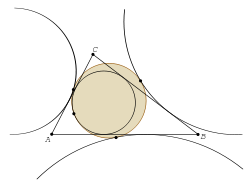
1800 Karl Wilhelm Feuerbach (30 May 1800 – 12 March 1834) born in Jena, Germany. His mathematical fame rests entirely on three papers. Most important was this contribution to Euclidean geometry: The circle which passes through the feet of the altitudes of a triangle touches all four of the circles which are tangent to the three sides; it is internally tangent to the inscribed circle and externally tangent to each of the circles which touches the sides of the triangle externally. *VFR

The circle is also commonly called the Nine-point circle. It passes through the feet of the altitudes, the midpoints of the three sides, and the point half way between the orthocenter and the vertices.


1814 Eugene Charles Catalan (30 May 1814 – 14 February 1894) was a Belgian mathematician who defined the numbers called after him, while considering the solution of the problem of dissecting a polygon into triangles by means of non-intersecting diagonals. *SAU The Catalan numbers have a multitude of uses in combinatorics.

1889 Paul Ernest Klopsteg (May 30, 1889 – April 28, 1991) was an American physicist. The asteroid 3520 Klopsteg was named after him and the yearly Klopsteg Memorial Award was founded in his memory.
He performed ballistics research during World War I at the US Army's Aberdeen Proving Grounds in Maryland. He applied his knowledge of ballistics to the study of archery.
He was director of research at Northwestern University Technical Institution. From 1951 through 1958 he was an associate director of the National Science Foundation and was president of the American Association for the Advancement of Science from 1958 through 1959.*Wik

1908 Hannes Olof Gösta Alfvén (30 May 1908 in Norrköping, Sweden; 2 April 1995 in Djursholm, Sweden) Alfvén developed the theory of magnetohydrodynamics (MHD), the branch of physics that helps astrophysicists understand sunspot formation and the magnetic field-plasma interactions (now called Alfvén waves in his honor) taking place in the outer regions of the Sun and other stars. For this pioneering work and its applications to many areas of plasma physics, he shared the 1970 Nobel Prize in physics. *DEBORAH TODD AND JOSEPH A. ANGELO, JR., A TO Z OF SCIENTISTS IN SPACE AND ASTRONOMY


DEATHS

1778 (François Marie Arouet) Voltaire (21 November 1694 – 30 May 1778) was a French author who popularized Isaac Newton's work in France by arranging a translation of Principia Mathematica to which he added his own commentary (1737). The work of the translation was done by the marquise de Châtelet who was one of his mistresses, but Voltaire's commentary bridged the gap between non-scientists and Newton's ideas at a time in France when the pre-Newtonian views of Descartes were still prevalent. Although a philosopher, Voltaire advocated rational analysis. He died on the eve of the French Revolution.*TIS

1912 Wilbur Wright  (April 16, 1867 – May 30, 1912), American aviation pioneer, who with his brother Orville, invented the first powered airplane, Flyer, capable of sustained, controlled flight (17 Dec 1903). Orville made the first flight, airborn for 12-sec. Wilbur took the second flight, covering 853-ft (260-m) in 59 seconds. By 1905, they had improved the design, built and and made several long flights in Flyer III, which was the first fully practical airplane (1905), able to fly up to 38-min and travel 24 miles (39-km). Their Model A was produced in 1908, capable of flight for over two hours of flight. They sold considerable numbers, but European designers became strong competitors. After Wilbur died of typhoid in 1912, Orville sold his interest in the Wright Company in 1915 *TIS

1926 Vladimir Andreevich Steklov (9 January 1864 – 30 May 1926)  made many important contributions to applied mathematics. In addition to the work for his master's thesis and his doctoral thesis referred to above, he reduced problems to boundary value problems of Dirichlet type where Laplace's equation must be solved on a surface. He wrote General Theory of Fundamental Functions in which he examined expansions of functions as series in an infinite system of orthogonal eigenfunctions. In fact the term "Fundamental Functions", which is due to Poincaré, means eigenfunctions in today's terminology.
Steklov was not the first to examine series expansions in terms of infinite sets of orthogonal eigenfunctions, of course Fourier had examined a special case of this situation many years before. Steklov, however, produced many papers on this topic which led him to a general theory to replace the special cases examined by others. He studied a generalisation of Parseval's equality for Fourier series to his general setting showing this to be a fundamental property. In all his list of publications contains 154 items. *SAU

1943 Anderson McKendrick (September 8, 1876 - May 30, 1943) trained as a medical doctor in Glasgow and came to Edinburgh as Superintendent of the College of Physicians Laboratory. He made some significant mathematical contributions to biology. *SAU

1964 Leo Szilard (11 Feb 1898; 30 May 1964 at age 66) Hungarian-American physicist who, with Enrico Fermi, designed the first nuclear reactor that sustained nuclear chain reaction (2 Dec 1942). In 1933, Szilard had left Nazi Germany for England. The same year he conceived the neutron chain reaction. Moving to N.Y. City in 1938, he conducted fission experiments at Columbia University. Aware of the danger of nuclear fission in the hands of the German government, he persuaded Albert Einstein to write to President Roosevelt, urging him to commission American development of atomic weapons. In 1943, Major General Leslie Groves, leader of the Manhattan Project designing the atomic bomb, forced Szilard to sell his atomic energy patent rights to the U.S. government. *TIS Frederik Pohl , talks about Szilard's epiphany about chain reactions in Chasing Science (pg 25),
".. we know the exact spot where Leo Szilard got the idea that led to the atomic bomb. There isn't even a plaque to mark it, but it happened in 1938, while he was waiting for a traffic light to change on London's Southampton Row. Szilard had been remembering H. G. Well's old science-fiction novel about atomic power, The World Set Free and had been reading about the nuclear-fission experiment of Otto Hahn and Lise Meitner, and the lightbulb went on over his head."

1992 Antoni Zygmund (December 25, 1900 – May 30, 1992) Polish-born mathematician who created a major analysis research centre at Chicago, and recognized in 1986 for this with the National Medal for Science. In 1940, he escaped with his wife and son from German controlled Poland to the USA. He did much work in harmonic analysis, a statistical method for determining the amplitude and period of certain harmonic or wave components in a set of data with the aid of Fourier series. Such technique can be applied in various fields of science and technology, including natural phenomena such as sea tides. He also did major work in Fourier analysis and its application to partial differential equations. Zygmund's book Trigonometric Series (1935) is a classic, definitive work on the subject.


Credits :
*CHM=Computer History Museum
*FFF=Kane, Famous First Facts
*NSEC= NASA Solar Eclipse Calendar
*RMAT= The Renaissance Mathematicus, Thony Christie
*SAU=St Andrews Univ. Math History
*TIA = Today in Astronomy
*TIS= Today in Science History
*VFR = V Frederick Rickey, USMA
*Wik = Wikipedia
*WM = Women of Mathematics, Grinstein & Campbell