Sunday, 26 August 2018

On This Day in Math - August 26

Thanks for the great memories, Students of Lakenheath

Perhaps... some day the precision of the data will be brought so far that the mathematician will be able to calculate at his desk the outcome of any chemical combination, in the same way, so to speak, as he calculates the motions of celestial bodies.
~Antoine-Laurent Lavoisier


The 238th day of the year; 238 is an untouchable number, The untouchable numbers are those that are not the sum of the proper divisors of any number. 2 and 5 are untouchable, can you find the next one? (four is not untouchable, for example since 1+3=4 and they are the proper divisors of 9) Five is the only known odd untouchable number.

also 238 is also the sum of the first 13 primes, and its digits add up to ........wait for it.... 13 (2+3+8 = 13 and 238 = sum of first 13 primes).

 23=8 (We are tentatively calling these "power equation numbers") *Derek Orr 


EVENTS

1735 Euler’s Konisburg bridge solution, "The Solution of a problem related to the Geometry of Position", was presented to the St. Petersburg Academy on August 26, 1735. He showed that there were no continuous walks across the seven bridges across the Pregel River in Konisburg. It is often cited as the earliest paper in both topology and graph theory.*VFR


1768 Capt. James Cook began the first circumnavigation of the globe. *VFR Cook and his ninety-eight foot bark, Endeavour, carried the Venus transit observation crew mounted by the Royal Society, led by a future Royal Soc. President, Joseph Banks. They would erect an observation station at Point Venus in Tahiti to observe the June 3, 1769 observation under clear blue skys. *Timothy Ferris, Coming of Age in the Milky Way

1770 Lagrange, in a letter to d’Alembert, first uses the notation f‘ (x) for the derivative. He first used it in print in a paper published in 1772. Although Lagrange used the notation in his diagramless Mecanique Analytique (1788), it did not catch on until after he used it in his Theorie de functions analytiques (1797). *Oeuvres de Lagrange, 13, p. 181.

1774 John Adams notes in his diary that he had toured Princeton’s library with Professor Euston (William Churchill Houston, first professor of mathematics and natural philosophy) and then into the “apparatus room” where he saw the “most beautiful machine”. It was an orrery made by David Rittenhouse, a renowned American astronomer, inventor, clockmaker, mathematician, surveyor, scientific instrument craftsman and public official. Professor Houston served in combat in the revolution when Princeton was closed by the occupation of the British. After the college was reopened, he returned to teaching but was soon selected to represent New Jersey as a representative to the Continental Congress, and then to the Constitutional Convention. He died shortly after the close of the Constitutional Convention. *The Teaching and History of Mathematics in The United States, F. Cajori (pgs 71-72)

1831 Darwin had been committed to a life as a clergyman when he received a letter from George Peacock inviting him to sail with Captain Fitzroy. The rest, as they say, is history.
My dear Sir
I received Henslow’s (Darwin's botany professor) letter last night too late to forward it to you by the post, a circumstance which I do not regret, as it has given me an opportunity of seeing Captain Beaufort at the admiralty (the Hydrographer) & of stating to him the offer which I have to make to you: he entirely approves of it & you may consider the situation as at your absolute disposal: I trust that you will accept it as it is an opportunity which should not be lost & I look forward with great interest to the benefit which our collections of natural history may receive from your labours
The circumstances are these
Captain Fitzroy (a nephew of the Duke of Graftons) sails at the end of September in a ship to survey in the first instance the S. Coast of Terra del Fuego, afterwards to visit the South Sea Islands & to return by the Indian Archipelago to England: The expedition is entirely for scientific purposes & the ship will generally wait your leisure for researches in natural history &c: Captain Fitzroy is a public spirited & zealous officer, of delightful manners & greatly beloved by all his brother officers: he went with Captain Beechey and  spent 1500£ in bringing over and educating at his own charge 3 natives of Patagonia:f2 he engages at his own expense an artist at 200 a year to go with him: you may be sure therefore of having a very pleasant companion, who will enter heartily into all your views
The ship sails about the end of September you must lose no time in making known your acceptance to Captain Beaufort, Admiralty hydr I have had a good deal of correspondence about this matter, whof3 feels in common with myself the greatest anxiety that you should go. I hope that no other arrangements are likely to interfere with it
Captain will give you the rendezvous & all requisite information: I should recommend you to come up to London, in order to see him & to complete your arrangements I shall leave London on Monday: perhaps you will have the goodness to write to me at Denton, Darlington, to say that you will go.
The Admiralty are not disposed to give a salary, though they will furnish you with an official appointment; & every accommodation: if a salary should be required however I am inclined to think that it would be granted
Believe me | My dear Sir | Very truly yours | Geo Peacock

If you are with Sedgwick I hope you will give my kind regards to him

In 1895, electricity was first transmitted commercially from the first large-scale utilization of Niagara Falls power, the current being used by the Pittsburgh Reduction Company in the electrolytic production of aluminium metal from its ore. Buffalo subsequently received power for commercial use on 15 Nov 1896. The equipment was the result of a contract made on 24 Oct 1893 whereby Westinghouse Electric and Manufacturing Company of Pittsburgh, Pa., would install three 5,000-hp generators producing two-phase currents at 2,200 volts, 25 hertz. The first such tuboalternator unit was completed within 18 months. Prior capacity had been limited to generators no larger than 1,000 hp.*TIS

1966 Professor Stephen Smale, who received the Fields medal ten days earlier, condemned American military intervention in Vietnam and Soviet intervention in Hungary at a news conference in Moscow. For Smale’s fascinating personal account see “On the Steps of Moscow University,” The Mathematical Intelligencer, 6, no. 2, pp. 21–27. *VFR

1984 Miss Manners​ addresses computer correspondence
Miss Manners confronts a new realm of etiquette in her August 26 column as she responded to a reader's concern about typing personal correspondence on a personal computer. The concerned individual said that using the computer was more convenient but that they were worried about the poor quality of her dot-matrix printer and about copying parts of one letter into another.
Miss Manners replied that computers, like typewriters, generally are inappropriate for personal correspondence. In the event a word processor is used, she warned, the recipient may confuse the letter for a sweepstakes entry. And, she noted, if any one of your friends ever sees that your letter to another contains identical ingredients, you have will no further correspondence problems.*CHM

2005 Two scientists from the Université Pierre et Marie Curie, in Paris published a paper in Physical Review Letters with the title: "Fragmentation of Rods by Cascading Cracks: Why Spaghetti Does Not Break in Half," to answer that nagging question of all Italian cooks: why, when you bend dry spaghetti, it often breaks into more than two pieces. A popular anectdote says that Richard Feynman had pondered the question without solution. *Improbable Research


BIRTHS

1728 Johann Heinrich Lambert (August 26, 1728 – September 25, 1777) was born in Mulhouse, Alsace. His most famous results are the proofs of the irrationality of π and e  *VFR In 1766, Lambert wrote Theorie der Parallellinien, a study of the parallel postulate. By assuming that the parallel postulate was false, he deduced many non-euclidean results. He noticed that in this new geometry the sum of the angles of a triangle increases as its area decreases. Lambert conjectured that e and p are transcendental, though this was not proved for another century. He is responsible for many innovations in the study of heat and light, devised a method of measuring light intensity, as well as working on the theory of probability.*TIS (Lambert's credit for a vigorous proof of the irrationality of π is generally agreed to, but  Euler Scholar Ed Sandifer has written that Euler's proof was fully rigorous prior to Lambert.  *How Euler Did It, Feb 2006).

1740 Joseph-Michel Montgolfier (26 Aug 1740; 26 Jun 1810)French balloon pioneer, with his younger brother, Étienne. An initial experiment with a balloon of taffeta filled with hot smoke was given a public demonstration on 5 Jun 1783. This was followed by a flight carrying three animals as passengers on 19 Sep 1783, shown in Paris and witnessed by King Louis XVI. On 21 Nov 1783, their balloon carried the first two men on an untethered flight. In the span of one year after releasing their test balloon, the Montgolfier brothers had enabled the first manned balloon flight in the world.*TIS

Jacques Louis David
1743 Antoine-Laurent Lavoisier (26 August 1743 – 8 May 1794) French scientist, the "father of modern chemistry," was a brilliant experimenter also active in public affairs. An aristocrat, he invested in a private company hired by the government to collect taxes. With his wealth he built a large laboratory. In 1778, he found that air consists of a mixture of two gases which he called oxygen and nitrogen. By studying the role of oxygen in combustion, he replaced the phlogiston theory. Lavoisier also discovered the law of conservation of mass and devised the modern method of naming compounds, which replaced the older nonsystematic method. During the French Revolution, for his involvement with tax-collecting, he was guillotined.*TIS
"This great double portrait at right was painted when the artist, at the peak of his powers, had become the standard-bearer of French Neoclassicism. Lavoisier is known for his pioneering studies of oxygen, gunpowder, and the chemical composition of water. In 1789 he published a treatise on chemistry illustrated by his wife, who is believed to have been David's pupil." *Metropolitan Museum of Art 

1875 Giuseppe Vitali (26 August 1875 – 29 February 1932) was an Italian mathematician who worked in several branches of mathematical analysis. He was the first to give an example of a non-measurable subset of real numbers, see Vitali set. His covering theorem is a fundamental result in measure theory. He also proved several theorems concerning convergence of sequences of measurable and holomorphic functions. Vitali convergence theorem generalizes Lebesgue's dominated convergence theorem. Another theorem bearing his name gives a sufficient condition for the uniform convergence of a sequence of holomorphic functions on an open domain D⊂ℂ to a holomorphic function on D. This result has been generalized to normal families of meromorphic functions, holomorphic functions of several complex variables, and so on. *Wik

1882 James Franck (26 Aug 1882; 21 May 1964) German-born American physicist who shared the Nobel Prize for Physics in 1925 with Gustav Hertz for research on the excitation and ionization of atoms by electron bombardment that verified the quantized nature of energy transfer.*TIS
In 1933, after the Nazis came to power, Franck, being a Jew, decided to leave his post in Germany and continued his research in the United States, first at Johns Hopkins University in Baltimore and then, after a year in Denmark, in Chicago. It was there that he became involved in the Manhattan Project during World War II; he was Director of the Chemistry Division of the Metallurgical Laboratory[5] at the University of Chicago. He was also the chairman of the Committee on Political and Social Problems regarding the atomic bomb; the committee consisted of himself and other scientists at the Met Lab, including Donald J. Hughes, J. J. Nickson, Eugene Rabinowitch, Glenn T. Seaborg, J. C. Stearns and Leó Szilárd. The committee is best known for the compilation of the Franck Report, finished on 11 June 1945, which recommended not to use the atomic bombs on the Japanese cities, based on the problems resulting from such a military application.*Wik

1886 Jerome C. Hunsaker (26 Aug 1886; 10 Sep 1984)American aeronautical engineer who made major innovations in the design of aircraft and lighter-than-air ships, seaplanes, and carrier-based aircraft. His career had spanned the entire existence of the aerospace industry, from the very beginnings of aeronautics to exploration of the solar system. He received his master's degree in naval architecture from M.I.T. in 1912. At about the same time seeing a flight by Bleriot around Boston harbour attracted him to the fledgling field of aeronautics. By 1916, he became MIT's first Ph.D. in aeronautical engineering. He designed the NC (Navy Curtiss) flying boat with the capability of crossing the Atlantic. It was the largest aircraft in the world at the time, with four engines and a crew of six.*TIS

1899 Wolfgang Krull (26 August 1899 - 12 April 1971) proved the Krull-Schmidt theorem for decomposing abelian groups and defined the Krull dimension of a ring.*SAU

1918 Katherine Coleman Goble Johnson (August 26, 1918 in White Sulphur Springs, W. Va {pop 800)- Feb 24, 1980) is an American physicist, space scientist, and mathematician who contributed to America's aeronautics and space programs with the early application of digital electronic computers at NASA.
 As the small town she was born in had no schools for blacks beyond the eighth grade, her father sent her and her siblings to Institute, West Virginia, for high school. She graduated from the historically black West Virginia State College and taught at black public schools before becoming one of three black students to integrate West Virginia graduate schools in 1939.   
Known for accuracy in computerized celestial navigation, she calculated the trajectory for Project Mercury and the 1969 Apollo 11 flight to the Moon. From 1953 through 1958, Johnson worked as a "computer" for NACA (later to become NASA), doing analysis for topics such as gust alleviation for aircraft. She calculated the trajectory for the space flight of Alan Shepard, the first American in space, in 1959. She also calculated the launch window for his 1961 Mercury mission. She plotted backup navigational charts for astronauts in case of electronic failures. In 1962, when NASA used computers for the first time to calculate John Glenn's orbit around Earth, officials called on her to verify the computer's numbers (other versions say it was Glenn himself who requested she check the data).
On November 24, 2015, President Barack Obama her with the Presidential Medal of Freedom and cited as a pioneering example of African American women in STEM *Wik  NASA announced her death at 101 on Feb 24, 2020. 

1951 Edward Witten (26 Aug 1951, )American mathematical physicist who was awarded the Fields Medal in 1990 for his work in superstring theory. This is work in elementary particle theory, especially quantum field theory and string theory, and their mathematical implications. He elucidated the dynamics of strongly coupled supersymmetric field. The deep physical and mathematical consequences of the electric-magnetic duality thus exploited have broadened the scope of Mathematical Physics. He also received the Dirac Medal from the International Centre for Theoretical Physics (1985) and the Dannie Heineman Prize from the American Physical Society (1998), among others.*TIS


DEATHS

1349 Thomas Bradwardine, (c. 1290-26 August 1349) archbishop of Canterbury, died of the plague. This medieval mathematical physicist studied the notion of change. *VFR Bradwardine was a noted mathematician as well as theologian and was known as 'the profound doctor'. He studied bodies in uniform motion and ratios of speed in the treatise De proportionibus velocitatum in motibus (1328). This work takes a rather strange line between supporting and criticising Aristotle's physics. Perhaps it is not really so strange because Aristotle views were so fundamental to learning at that time that perhaps all that one could expect of Bradwardine was the reinterpretation of Aristotle's views on bodies in motion and forces acting on them. It is likely that his intention was not to criticise Aristotle but rather to justify mathematically a reinterpretation of Aristotle's statements. He was also the first mathematician to study "star polygons". They were later investigated more thoroughly by Kepler *SAU A star polygon {p/q}, with p,q positive integers, is a figure formed by connecting with straight lines every qth point out of p regularly spaced points lying on a circumference. The number q is called the density of the star polygon. Without loss of generality, take q less than p/2. *Wolfram MathWorld


1572 Peter Ramus (1515 – 26 August 1572) was cruelly murdered, by hired assassins, during the St. Bartholomew’s Day Massacre. He was an early opponent of the teachings of Aristotle. *VFR Peter Ramus was a French mathematician who wrote a whole series of textbooks on logic and rhetoric, grammar, mathematics, astronomy, and optics. His assassination was due to religious conflict.

1865 Johann Encke (23 Sep 1791, 26 Aug 1865) German astronomer who established the period of Encke's Comet at 3.3 years (shortest period of any known). *TIS He also discovered the gap in the A-ring of Saturn and determent an accurate value of the solar parallax. The Royal Society
mentioned the death to be 26 or 28 August 1865. *NSEC

1929 Thomas John l'Anson Bromwich (8 Feb 1875 in Wolverhampton, England - 26 Aug 1929 in Northampton, England) He worked on infinite series, particularly during his time in Galway. In 1908 he published his only large treatise An introduction to the theory of infinite series which was based on lectures on analysis he had given at Galway. He also made useful contributions to quadratic and bilinear forms and many consider his algebraic work to be his finest. In a series of papers he put Heaviside's calculus on a rigorous basis treating the operators as contour integrals*SAU G. H. Hardy described him as the “best pure mathematician among the applied mathematicians at Cambridge, and the best applied mathematician among the pure mathematicians.” *VFR

1961 Howard Percy Robertson (27 Jan 1903 in Hoquiam, Washington, USA - 26 Aug 1961) made outstanding contributions to differential geometry, quantum theory, the theory of general relativity, and cosmology. He was interested in the foundations of physical theories, differential geometry, the theory of continuous groups, and group representations. He was particularly interested in the application of the latter three subjects to physical problems.
His contributions to differential geometry came in papers such as: The absolute differential calculus of a non-Pythagorean non-Riemannian space (1924); Transformation of Einstein space (1925); Dynamical space-times which contain a conformal Euclidean 3-space (1927); Note on projective coordinates (1928); (with H Weyl) On a problem in the theory of groups arising in the foundations of differential geometry (1929); Hypertensors (1930); and Groups of motion in space admitting absolute parallelism (1932). *SAU

1977 Robert Schatten (January 28, 1911 – August 26, 1977) His principal mathematical achievement was that of initiating the study of tensor products of Banach spaces. The concepts of crossnorm, associate norm, greatest crossnorm, least crossnorm, and uniform crossnorm, all either originated with him or at least first received careful study in his papers. He was mainly interested in the applications of this subject to linear transformations on Hilbert space. In this subject, the Schatten Classes perpetuate his name. Schatten had his own way of making abstract concepts memorable to his elementary classes. Who could forget what a sequence was after hearing Schatten describe a long corridor, stretching as far as the eye could see, with hooks regularly spaced on the wall and numbered 1, 2, 3, ...? "Then," Schatten would say, "I come along with a big bag of numbers over my shoulder, and hang one number on each hook." This of course was accompanied by suitable gestures for emphasis. *SAU

1992 Daniel E. Gorenstein (January 1, 1923 – August 26, 1992) was an American mathematician. He earned his undergraduate and graduate degrees at Harvard University, where he earned his Ph.D. in 1950 under Oscar Zariski, introducing in his dissertation a duality principle for plane curves that motivated Grothendieck's introduction of Gorenstein rings. He was a major influence on the classification of finite simple groups.
After teaching mathematics to military personnel at Harvard before earning his doctorate, Gorenstein held posts at Clark University and Northeastern University before he began teaching at Rutgers University in 1969, where he remained for the rest of his life. He was the founding director of DIMACS in 1989, and remained as its director until his death.
Gorenstein was awarded many honors for his work on finite simple groups. He was recognised, in addition to his own research contributions such as work on signalizer functors, as a leader in directing the classification proof, the largest collaborative piece of pure mathematics ever attempted. In 1972 he was a Guggenheim Fellow and a Fulbright Scholar; in 1978 he gained membership in the National Academy of Sciences and the American Academy of Arts and Sciences, and in 1989 won the Steele Prize for mathematical exposition. *Wik

1998 Frederick Reines (16 Mar 1918, 26 Aug 1998) American physicist who was awarded the 1995 Nobel Prize for Physics for his detection in 1956 of neutrinos, working with his colleague Clyde L. Cowan, Jr. The neutrino is a subatomic particle, a tiny lepton with little or no mass and a neutral charge which had been postulated by Wolfgang Pauli in the early 1930s but had previously remained undiscovered. (Reines shared the Nobel Prize with physicist Martin Lewis Perl, who discovered the tau lepton.)*TIS

Credits :
*CHM=Computer History Museum
*FFF=Kane, Famous First Facts
*NSEC= NASA Solar Eclipse Calendar
*RMAT= The Renaissance Mathematicus, Thony Christie
*SAU=St Andrews Univ. Math History
*TIA = Today in Astronomy
*TIS= Today in Science History
*VFR = V Frederick Rickey, USMA
*Wik = Wikipedia
*WM = Women of Mathematics, Grinstein & Campbell

Saturday, 25 August 2018

Totients, Eulers Phi Function (Unlike Lightning, they always strike at least twice)


The totient of an integer, N, is the number of integers Less than N which are relatively prime to N, that is, they share no common factors. The symbol for the Totient (by the way, the word is pronounced to rhyme with "quotient"... I didn't know that for a long time) of N is usually the greek letter Φ. We would write Φ(10)=4, to indicate there are four numbers less than 10 which have no factor in common with the number ten. The four numbers 1,3,7, and 9 are called the totitives of 10. The image at top shows a graph of Φ(n) for each n.
Euler showed that if a number n had prime factors p, q, and r; then the totient would equal N(1-1/p)(1-1/q)(1-1/r). It doesn't matter if it has some prime factors more than once, you only use each factor once in the calculation. As an example, 20 factors to 2x2x5, but the number of prime factors is found by 20 (1-1/2)(1-1/5) = 8; with totatives of 1, 3, 7, 9, 11, 13, 17, and 19. The word totient is drawn from the Latin root tot for "so much", and probably to the Greek tosos, "so great". The word tot is still used occasionally for a mark made beside a list to acknowledge receipt, and is sometimes called a "tot mark"(pronounced with a long o, like tote). Euler defined the rule for the number of totients around 1761 in proving what we now call the "Euler-Fermat" theorem. Euler didn't use the word totient. That term was introduced by J J Sylvester, (According to Graham, Knuth and Patashnik, "Concrete Mathematics") who had a habit of making up new words for math terms. "The reference they give is to a paper from 1883: "On the number of fractions contained in any 'Farey series' of which the limiting number is given".
The name "PHI" for the function was created by Gauss in his Disquitiones arithmeticae .
Here is a list of the first few integers, their totients, and their totitives...

N_____Φ(N)______ totitives

1_____ 1 ____ 1

2_____ 1 ____ 1

3_____ 2 _____ 1,2

4_____ 2 _____ 1,3

5_____ 4 _____ 1,2,3,4

6_____ 2 ______1, 5

7_____ 6 ______1.2.3.4.5.6

8_____ 4 ______ 1,3,5,7
There is actually an interesting unproven math theorem about totients. It seems that any number that appears in the sequence of Φ(N) must appear at least twice. It has been proven that if there is an exception, it must have more than 10,000 digits. This is sometimes called the Carmichael Conjecture after R. D. Carmichael.

On This Day in Math - August 25


The lecturer should give the audience full reason to believe that all his powers
have been exerted for their pleasure and instruction.
~Michael Faraday


The 237th day of the year; it would be a singularly uninteresting number (3 x 79) except that the room number in the film, "The Shining" was switched from 217 in the novel to 237 for the film? It seems that the Timberline Lodge had a room 217 but no room 237, so the hotel management asked Kubrick to change the room number because they were afraid their guests might not want to stay in room 217 after seeing the film. *Visual Memory.co.uk

Derek Orr added, 237 = 44th prime + 44 = 193 + 44 What's the next number that equals the n-th prime + n?


EVENTS

1609 Galileo leads a procession of Venetian Senators across the Piazza San Marco and up the Campanile for their first look through a telescope. In his words,
"to detect sails and vessels on the sea, so far away that coming under full sail toward the harbor, two hours or more passed before they could be seen without my eyeglass"
*Timothy Ferris, Coming of Age in the Milky Way
Thony Christie, the Renaissance Mathematicus suggests that his actually happened on the 21st of August. This was about two weeks after Thomas Harriott had drawn sketches of the moon through his telescope. Thony suggests that Galileo would not turn his telescope to the heavens for several more months.
He gives the 25th as the day that Galileo is granted a lifetime contract as professor for mathematics at the University of Padua with a salary of 1000 Florins but with the subsidiary clause that he would never receive a raise in salary.
Fresco by Bertini of Galileo showing the Doge of Venice how to use the telescope 
*ESA space history

1664 Hooke writes to Boyle about new experiments he is performing in the damaged steeple of Old St. Pauls.  One involves a 180 foot long pendulum with a four pound weight that swings with a 12 second period. *Lisa Jardine, Ingenious Pursuits pg 65

1691 Edmund Halley delivers paper at Royal Society describing a diving bell he had built for exploration of the “Guynie Friggott”, a Royal African Company ship which foundered on the south coast near Pagham around 1 April 1691:
"The Diving tub [a truncate cone] was made 5 foot at Bottom where it was open, 3 foot at top and 5 foot deep… and under the bell by three ropes I fastned a stage about 2½ foot below to stand on… Within the bell I placed a bench about a foot from the bottom for the men below to sitt on when they should be cold and where a man might sett with all his clouths at any depth drie. I made likewise in the top of the bell a window to let in the light which was very thick and strong but as clear glass as could be gotten, and I placed a small Cock in the same crown of the bell to let out the hot & effete air unfitt for further respiration."
*© Science Museum/Science & Society Picture Library, 
Robert Hooke was unimpressed, declaring Halley’s paper “the Same wth what I Shewed ye Society 25 years Since”.   * Beverley Brown, Halley's Log Blog


1835 "The Great Moon Hoax" refers to a series of six articles that were published in The Sun, a New York newspaper, beginning on August 25, 1835, about the supposed discovery of life and even civilization on the Moon. The discoveries were falsely attributed to Sir John Herschel, perhaps the best-known astronomer of his time.
The story was advertised on August 21, 1835, as an upcoming feature allegedly reprinted from The Edinburgh Courant. The first in a series of six was published four days later on August 25.

The headline read:
“GREAT ASTRONOMICAL DISCOVERIES LATELY MADE
BY SIR JOHN HERSCHEL, L.L.D. F.R.S. &c.
At the Cape of Good Hope
[From Supplement to the Edinburgh Journal of Science]"


The articles described fantastic animals on the Moon, including bison, goats, unicorns, bipedal tail-less beavers and bat-like winged humanoids ("Vespertilio-homo") who built temples. There were trees, oceans and beaches. These discoveries were supposedly made with "an immense telescope of an entirely new principle."

The author of the narrative was ostensibly Dr. Andrew Grant, the traveling companion and amanuensis of Sir John Herschel, but Grant was fictitious.
Portrait of a man-bat ("Vespertilio-homo"), from an edition of the Moon series published in Naples

Eventually, the authors announced that the observations had been terminated by the destruction of the telescope, by means of the Sun causing the lens to act as a "burning glass," setting fire to the observatory. *Wik

1875 Smithsonian Secretary Joseph Henry writes to Johns Hopkins President Daniel Gilman is first to suggest Sylvester for the proposed Chair of Mathematics: "Prof. Sylvester of London who intimates a willingness to accept a chair in your university provided one were tendered to him : he is one of the very first living mathematicians and his appointment would give a celebrity to the institution which would at once direct it to the attention of the whole scientific world." *Karen Hunger Parshall, David E. Rowe ; The Emergence of the American Mathematical Research Community, 1876-1900

1893 Eliakim Hastings Moore was apparently the first person to use the English word "field" in its modern mathematical sense and the first to allow for a finite field. He coined the expressions "field of order s" and "Galois-field of order s = qn." All were included in a paper presented to the Congress of Mathematics at Chicago #OTD. They would appear in print when the paper was published December in the Bulletin of the New York Mathematical Society. *Jeff Miller, Earliest Known Uses of Some of the Words of Mathematics

1955 The People’s Republic of China issued stamps honoring the mathematician Tsu Chung-chih (429–500), and astronomers Chang Heng (78–139) and Chong Sui (683–727) and physicist Li Shih-chen (1518–1593). [Scott #246, #245, #247, #248 respectively] *VFR

1959 The National Medal of Science was authorized by act of Congress (73 Stat. L. 431) for out-standing contribution in the physical, biological, mathematical, and engineering sciences on the basis or recommendation of the National Academy of Sciences. President Kennedy made the first presentation February 17, 1963, to the Hungarian-born aerodynamicist Theodor von Karmen. [Kane, p. 373] Godel received one in 1975. Marston Morse did also. Did any other mathematicians? *VFR A list of laureates is here

1976 The Board of Governors of the MAA awarded an honorary life membership to Martin Gardner “for the substantial contributions he has made to the public appreciation of mathematics by his superb exposition in his texts and his column ‘Mathematical Games’ ” in the Scientific American. Gardner was both honored and embarrassed to receive this award, for he had never taken a mathematics course in college. “I consider myself more a journalist and popularizer of mathematics than a genuine mathematician.” While true, he has probability done more than anyone else to popularize mathematics. *VFR

In 1981, the U.S. spacecraft Voyager II came within 63,000 miles (100,000 km) of Saturn's cloud cover, sending back data and pictures of the ringed planet in its closest approach to Saturn, showing not a few, but thousands of rings. Photographs were also sent back of a number of Saturn's moons. The space probe was launched on 20 Aug 1977, and visited Jupiter on 9 Jul 1979, and continued on to Uranus (24 Jan 1986) and Neptune (25 Aug 1989) before leaving the Solar System. Having a nuclear power source, the space probe continues to study ultraviolet sources among the stars, and its fields and particles instruments continue to search for the boundary between the Sun's influence and interstellar space.*TIS

2012 Voyager 1 had crossed the heliopause and entered interstellar space on August 25, 2012, making it the first human-made object to do so. Moving with relative velocity to the Sun of about 17 km/s *Wik

2014 The Pluto-bound New Horizons spacecraft is now well over halfway through its journey to Pluto. Motoring along at 57,900 km/hr (36,000 mph), it will travel more than 4.8 billion km (3 billion miles) to fly past Pluto and its moons Nix, Hydra and Charon in July 2015.The next planetary milestone for New Horizons will be the orbit of Neptune, which it crosses on Aug. 25, 2014, exactly 25 years after Voyager 2 made its historic exploration of that giant planet. *Universe Today (Hat tip to David Dickinson@Astroguyz


BIRTHS

1561 Philippe van Lansberge (25 August 1561 – 8 December 1632) was a Flemish clergyman who wrote on mathematics and astronomy. He calculated π to 28 places by a new method. Lansberge's work on astronomy followed Copernicus. He wrote works supporting Copernicus's theories in both 1619 and 1629. However he did not accept Kepler's ellipse theories and he published astronomical tables which he hoped would support Copernicus over Kepler. *SAU He may also have been one of the earliest (1604) to write Q.E.D to abbreviate the Latin phrase "quod erat demonstrandum". *Wik Does anyone have information on what his "new method" for calculating pi was?

1699 Charles-Étienne Camus (25 August 1699 – 2 February 1768) was a French mathematician who worked on mechanics and cartography and published an important textbook: Cours de mathématiques.*SAU

1844 Thomas Muir (25 August 1844 – 21 March 1934) He is noted for a four volume work on the history of determinants. *VFR He also proved an important lemma about determinants of skew symmetric matrices.

1867 Gury Vasilievich Kolosov (25 August 1867 - 7 November 1936) was a Russian mathematician who worked on the theory of elasticity.*SAU In 1907 Kolosov derived the solution for stresses around an elliptical hole. It showed that the concentration of stress could become far greater, as the radius of curvature at an end of the hole becomes small compared with the overall length of the hole.*Wik

1867 Hendrik De Vries (25 Aug 1867 in Amsterdam, The Netherlands - 3 March 1954 in Binyamina, Israel)"Paul Bockstable describes de Vries's contributions:
Even greater emphasis was placed on the historical development of mathematical sciences in the historical writings of Hendrik de Vries (1867-1954), professor at the Municipal University of Amsterdam. His lectures took in algebra and analysis, but from 1921-22 onwards, he focussed increasingly on his preferred field, giving public lectures on the development of geometry. These culminated in a series of articles in the Nieuw Tijdschrift voor Wiskunde (New Journal of Mathematics), which were later collected, together with some other items, in a three volume publication entitled 'Historische Studien' (1926). De Vries wrote in the introduction that he wanted to focus attention on the historical development of very precisely defined topics, even specific problems or theorems. He pointed out the didactic benefits that the historical approach to mathematical problems could offer.
He continued to publish Historical studies, and as examples we give the title of a small number of these later articles: On the contact and intersection of circles and conic sections (1946), How analytic geometry became a science (1948), On the infinite and the imaginary, or "surrealism" in mathematics (1949), and On relations and transformations (1949).*SAU

1880 Joshua Lionel Cowen (25 Aug 1880; 8 Sep 1965) American inventor of electric model trains who founded the Lionel Corporation (1901), which became the largest U.S. toy train manufacturer. At age 18, he had invented a fuse to ignite the magnesium powder for flash photography, which the Navy Department bought from him to be a fuse to detonate submarine mines. He designed an early battery tube light, but without practical application. (His partner, Conrad Hubert, to whom he gave the rights improved it and founded the Eveready Flashlight Company.) At age 22, he created a battery-powered train engine intended only as an eye-catcher for other goods in a store window. To his surprise, many customers wanted to purchase the toy train. Thus he started a model railroad company. *TIS (For Xander)

1898 Helmut Hasse (25 August 1898 – 26 December 1979) was a German mathematician working in algebraic number theory, known for fundamental contributions to class field theory, the application of p-adic numbers to local classfield theory and diophantine geometry (Hasse principle), and to local zeta functions.

1902 Seishi Kikuchi (August 25, 1902 – November 12, 1974) was a Japanese physicist, known for his explanation of the Kikuchi lines that show up in diffraction patterns of diffusely scattered electrons. *Wik

1924 Harlan James Smith (August 25, 1924 – October 17, 1991)
Harlan J. Smith was an American astronomer born in Wheeling, West Virginia, the son of Paul and Anna McGregor Smith.
In 1963 he was named chair of the University of Texas astronomy department where he also became the director of the McDonald Observatory. At the observatory he oversaw the construction of the 2.7m telescope he had persuaded NASA to build in support of planetary missions. From 1966 until 1970 he was a member of the Committee on the Large Space Telescope, an ad hoc group formed by the National Academy of Sciences, the work of which resulted in the Hubble Space Telescope. He also was the chairperson of the NASA Space Science Board from 1977 until 1980, and there helped propose NASA's Great Observatories program. He retired in 1989.
During his career he studied variable stars, the radio emission from planets, as well as photometry and astronomical instruments. With Dorrit Hoffleit, he was the first to observe the optical variability of quasars, and discovered a class of variable stars known as Delta Scuti variables.
He was an enthusiastic proponent of educating the public on astronomy, and developed the radio program "Star Date". He also developed "The Story of the Universe", a series of educational films. He was also a proponent of international cooperation, particularly with China which he visited several times. He served as co-editor of the Astronomical Journal as well as acting secretary for the American Astronomical Society. *TIA

1964 Maxim Lvovich Kontsevich (25 August 1964) is a Russian mathematician. He is a professor at the Institut des Hautes Études Scientifiques and a distinguished professor at the University of Miami. He received the Henri Poincaré Prize in 1997, the Fields Medal in 1998, and the Crafoord Prize in 2008. His work concentrates on geometric aspects of mathematical physics, most notably on knot theory, quantization, and mirror symmetry. His most famous result is a formal deformation quantization that holds for any Poisson manifold. He also introduced knot invariants defined by complicated integrals analogous to Feynman integrals. In topological field theory, he introduced the moduli space of stable maps, which may be considered a mathematically rigorous formulation of the Feynman integral for topological string theory. These results are a part of his "contributions to four problems of geometry" for which he was awarded the Fields Medal in 1998. *Wik


DEATHS

1679 Jonas Moore was an English man of science important for his support of mathematics and astronomy.*SAU He seems to have been the first to use "cot" for the cotangent function. He also founded the Royal Mathematical School at Christ's Hospital with Samual Pepys to train young men in the mathematics of navigation. *Wik He made critical contributions to the draining of the fens in England (making my drive from Lakenheath to Stoke Ferry much easier) and was instrumental in convincing Charles II to create the Royal Observatory and appoint Flamsteed as Astronomer Royal. *The day that Jonas died, Renaissance Mathematicus.

1819 James Watt (19 Jan 1736,25 Aug 1819) Scottish instrument maker and inventor whose steam engine contributed substantially to the Industrial Revolution. In 1763 he repaired the model of Newcomen's steam engine belonging to Glasgow University, and began experiments on properties of steam. The Newcomen engine was simple in design: it acted as a pump and a jet of cold water was used to condense the steam. Watt improved on this design by adding a separate condenser and a system of valves to make the piston return to the top of the cylinder after descending. He took out a patent for the separate condenser in 1769. He later adapted the engine to rotary motion, making it suitable for a variety of industrial purposes, and invented the flywheel and the governor.*TIS

1822 Sir William (Frederick) Herschel (15 Nov 1738, 25 Aug 1822) German-born British astronomer, the founder of sidereal astronomy for the systematic observation of the heavens. In 1773, Herschel made and began using his first telescope. With it he began a project that would continue for the rest of his life: that of systematically studying the sky. Through this study he discovered the planet Uranus, many new nebulae, clusters of stars and binary stars. Herschel hypothesized that nebulae are composed of stars, developed a theory of stellar evolution and was the first person to correctly describe the form of our Galaxy, the Milky Way. He discovered the Saturnian satellites Mimas and Enceladus (1789) and the Uranian satellites Titania and Oberon (1787). He was probably the most famous astronomer of the 18th century.*TIS

1867 Michael Faraday(22 September 1791 – 25 August 1867) died at Hampton Court, Middlesex, England. English physicist and chemist whose many experiments contributed greatly to the understanding of electromagnetism. Although one of the greatest experimentalists, he was largely self-educated. Appointed by Sir Humphry Davy as his assistant at the Royal Institution, Faraday initially concentrated on analytical chemistry, and discovered benzene in 1825. His most important work was in electromagnetism, in which field he demonstrated electromagnetic rotation and discovered electromagnetic induction (the key to the development of the electric dynamo and motor). He also discovered diamagnetism and the laws of electrolysis. He published pioneering papers that led to the practical use of electricity, and he advocated the use of electric light in lighthouses. *TIS

1908 Antoine-Henri Becquerel (15 Dec 1852, 25 Aug 1908) Antoine-Henri Becquerel was a French physicist who discovered radioactivity. In 1903 he shared the Nobel Prize for Physics with Pierre and Marie Curie. His early researches were in optics, then in 1896 he accidentally discovered radioactivity in fluorescent salts of uranium. He left some uranium mineral crystals in a drawer on a plate in black paper. Later, he developed the plate and found it was fogged, even though the crystals without ultraviolet radiation from sunlight were not fluorescing. Thus the salt was a source of a penetrating radiation. Three years afterwards he showed that it consists of charged particles that are deflected by a magnetic field. Initially, the rays emitted by radioactive substances were named after him. *TIS

1921 Peter Cooper Hewitt (May 5, 1861 – August 25, 1921) was an American electrical engineer and inventor, who invented the first mercury-vapor lamp in 1901. Hewitt was issued U.S. patent #682692 on September 17, 1901.
In 1902 Hewitt developed the mercury arc rectifier, the first rectifier which could convert alternating current power to direct current without mechanical means. It was widely used in electric railways, industry, electroplating, and high-voltage direct current (HVDC) power transmission. Although it was largely replaced by power semiconductor devices in the 1970s and 80s, it is still used in some high power applications.
In 1907 he developed and tested an early hydrofoil. In 1916, Hewitt joined Elmer Sperry to develop the Hewitt-Sperry Automatic Airplane, one of the first successful precursors of the UAV. *Wik

1956 George Washington Pierce (11 Jan 1872, 25 Aug 1956) American inventor who was a pioneer in radiotelephony and a noted teacher of communication engineering. He did work that led to the practical application of a variety of experimental discoveries in piezoelectricity and magnetostriction. He developed the Pierce oscillator, which utilizes quartz crystal to keep radio transmissions precisely on the assigned frequency and to provide similar accuracy for frequency meters. His other accomplishments include the mathematical calculation of the radiation properties of radio antennae; invention of the mercury-vapor discharge tube, which was the forerunner of the thyratron; invention of a method of recording sound on film; and sound generation by bats and insects. *TIS

2005 Ruth Aaronson Bari (November 17, 1917 – August 25, 2005) was an American mathematician known for her work in graph theory and homomorphisms. The daughter of Polish-Jewish immigrants to the U.S., she was a professor at George Washington University beginning in 1966. She was the mother of environmental activist Judi Bari, science reporter Gina Kolata and art historian Martha Bari.*Wik

Neil Alden Armstrong, (August 5, 1930, August 25, 2012) U.S. astronaut, was the first man to walk on the moon (20 Jul 1969, Apollo 11). He served as a Navy pilot during the Korean War, then joined the National Advisory Committee for Aeronautics (which became NASA), as a civilian test pilot. In 1962, he was the first civilian to enter the astronaut-training program. He gained experience as command pilot of the Gemini 8 mission, which accomplished the first physical joining of two orbiting spacecraft. Later he was commander of the Apollo 11 lunar mission. From 1971, he worked as professor of aerospace engineering at the University of Cincinnati. He was a member of the commission that investigated the 1986 Challenger space shuttle disaster.*TIS Armstrong died following complications resulting from cardiovascular procedures. *Mercury News


Credits :
*CHM=Computer History Museum
*FFF=Kane, Famous First Facts
*NSEC= NASA Solar Eclipse Calendar
*RMAT= The Renaissance Mathematicus, Thony Christie
*SAU=St Andrews Univ. Math History
*TIA = Today in Astronomy
*TIS= Today in Science History
*VFR = V Frederick Rickey, USMA
*Wik = Wikipedia

Friday, 24 August 2018

On This Day in Math - August 24


The shortest path between two truths in the real domain passes through the complex domain.
~Jacques Salomon Hadamard


The 236th day of the year; 236 is the sum of twelve consecutive primes, 3 + 5 + 7 + 11 + 13 + 17 + 19 + 23 + 29 + 31 + 37 + 41

And 236 is the number of possible positions in Othello after 2 moves by both players. *Erich Friedman (Students might try to figure out how many possible positions are there in tic-tac-toe after 2 moves by each player. Entice them with this number fact from Cliff Pickover @pickover )


EVENTS

79 Thousands were killed when the cities of Pompeii and Herculaneum were buried by the eruption of Mount Vesuvius.*VFR An estimated 20,000 people died. When discovered, the sites became astonishing archaeological time capsules.

1563 Tycho Brahe watched a spectacular conjunction of Jupiter and Saturn, and found that the time of the closest approach was days away from the predictions in the Ptolemaic Tables. He emerged from the experience with a life long passion for accuracy and exactitude and a devotion to the verdict of the sky. *Timothy Ferris, Coming of Age in the Milky Way

1609 Galileo presented this telescope to the Doge in the Presence Chamber of the Doge's Palace and was confirmed in the professorship for life with his salary doubled! [Letter of 29 Aug 1609 from Galileo to his brother‑in‑law in Florence, quoted in Fahie, pp. 82‑83.] '... an object which is at a distance of nine miles will appear as if it were only one mile away, ... one can detect ships and sails of the enemy at sea ... we can see him two or more hours earlier than he can possibly see us, ....' [Galileo's letter to the Doge on 24 Aug 1609, quoted in Scandone, pp.12‑14 ; in Van Helden, pp. 7-8]. Through the connections of his friend Paolo Sarpi, Galileo presents an eight-powered telescope to the Venetian Senate. He is rewarded by a doubling of his salary and life- tenure at the University of Padua. He is disappointed by the fine print. *Galileo Project (I love the idea that the Greek name "telescope" was created by an actual Greek mathematician. It was created in 1611 by the Greek mathematician Giovanni Demisiani for one of Galileo Galilei's instruments presented at a banquet at the Accademia dei Lincei.)

1654 Pascal wrote a letter to Fermat, discussing Fermat’s solution to the “problem of points.”

I was not able to tell you my entire thoughts regarding the problem of the points
by the last post,and at the same time, I have a certain reluctance at doing it for fear lest
this admirable harmony which obtains between us and which is so dear to me should
begin to flag, for I am afraid that we may have different opinions on this subject. I
wish to lay my whole reasoning before you, and to have you do me the favor to set me
straight if I am in error or to indorse me if I am correct. I ask you this in all faith and
sincerity for I am not certain even that you will be on my side.
When there are but two players, your theory which proceeds by combinations is
very just. But when there are three, I believe I have a proof that it is unjust that you
should proceed in any other manner than the one I have. But the method which I
have disclosed to you and which I have used universally is common to all imaginable
conditions of all distributions of points, in the place of that of combinations (which I do
not use except in particular cases when it is shorter than the general method), a method
Which is good only in isolated cases and not good for others.
I am sure that I can make it understood, but it requires a few words from me and a
little patience from you. (I wish I had known this phrase early in my teaching career… it seems it would have been frequently handy)
*http://www.york.ac.uk/depts/maths/histstat/pascal.pdf

1731 Darwin receives a letter from his old teacher, J S Henslow, that will change his life: "I have been asked by Peacock who will read & forward this to you from London to recommend him a naturalist as companion to Capt Fitzroy employed by Government to survey the S. extremity of America— I have stated that I consider you to be the best qualified person I know of who is likely to undertake such a situation— I state this not on the supposition of yr. being a finished Naturalist, but as amply qualified for collecting, observing, & noting any thing worthy to be noted in Natural History." *DarwinProject  


1775 Imen, Vtin, Caapan... Now you can count to three in the language of the native Americans living around Angel Island in San Francisco Bay. On this date the ship carrying Fr. Vicnete Maria, who spoke several native languages quite fluently interviewed them and recorded their responses for counting to 14. Later records of similar interviews in nearby regions match up very well to support the authenticity of this earliest known record of Native American numbers in the west. *Barbanabas Hughes.

1971 The Soviet Union issued a stamp for the centenary of the birth of the British physicist, Ernest Rutherford. Beside his picture is a diagram of the movement of atomic particles which involves a hyperbola. [Scott #3888].*VFR

2006 And then there were only eight.... the International Astronomical Union decided to rescind Pluto’s status as a planet and reclassify it as another entity called a “dwarf planet”. *FFF, pg 537
I have been told that as early as 1980 at a celebration of the discovery, Brian Marsden, a long time opponent of Pluto as a planet, had said, "I will kill your Planet if it's the LAST thing I DO!". (I'm told this story is in :The Case for Pluto, by Alan Boyle)


BIRTHS
1556 Sophie Brahe, also known as Sophia Thott (24 August 1556 – 1643), was a Danish horticulturalist and student of astronomy, chemistry, and medicine, best known for assisting her brother Tycho Brahe with his astronomical observations.
She was born in Knudsturp, as the youngest of ten children, to Otte Brahe, advisor to the King of Denmark; and Beate Bille Brahe, leader of the royal household for Queen Sophie. Famous astronomer Tycho Brahe, 10 years her senior, was Sophie's oldest brother. When she was 17, she started assisting her brother with his astronomical observations in 1573, and helped him with the work that became the basis for modern planetary orbit predictions. She frequently visited his observatory Uranienborg, on the then-Danish island of Hveen. Tycho wrote that he had trained her in horticulture and chemistry, but he told her not to study astronomy. He expressed with pride that she learned astronomy on her own, studying books in German, and having Latin books translated with her own money so that she could also study them. Brother and sister were united by their work in science, and by their family's opposition to science as an appropriate activity for members of the aristocracy. Tycho referred with admiration to her 'animus invictus', her "determined mind" *Wik


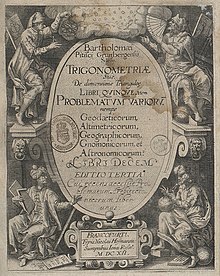
1561 Bartholomeo Pitiscus born. He coined the word “Trigonometry,” and first used it in print in 1595.*VFR Pitiscus achieved fame with his influential work written in Latin, called Trigonometria: sive de solutione triangulorum tractatus brevis et perspicuus (1595, first edition printed in Heidelberg), which introduced the word "trigonometry" to the English and French languages, translations of which had appeared in 1614 and 1619, respectively. It consists of five books on plane and spherical trigonometry. Pitiscus is sometimes credited with inventing the decimal point, the symbol separating integers from decimal fractions, which appears in his trigonometrical tables and was subsequently accepted by John Napier in his logarithmic papers (1614 and 1619).*Wik

1846 Professor Enoch Beery Seitz, the most distinguished mathematician of his day (Fairfield county, Ohio, August 24, 1846,- Kirksville, Missouri, October 8, 1883) He began his mathematical course in 1872 by contributing solutions to the problems proposed in the "Stairway" department of the Schoolday Magazine, conducted by Artemas Martin. His masterlv and original solutions to difflcult Average and Probability problems, poon attracted universal attention among mathematicians.  Dr. Martin, being desirous to know what works he had treating on that difflcult subject, was greatly surprised to learn that he had no works upon the subject, but had learned what he knew about that difficult department of mathematical science by studying the problems and solutions in the Shohlday Magazine. He then contributed to the Analyst, the Mathematical Visitor, the Mathematical Magazine, the School Visitor, and the Educational limes, of London, England.
He took a mathematical course in the Ohio Wesleyan University in 1870, but did not finish it or graduate. In 1879,he was elected one of the teachers in the Greenville High School, which position he held till 1879. On the 24th of June, 1875, he married Miss Anna E. Kerlin, one of Dark county's most refined ladies. In 1879, he was elected to the chair of mathematics in the Missouri State Normal schlool, Kirksville, Missouri. During his first year as chair, he solved a problem posed by Professor Woolhouse in 1864 concerning the probability of firing a musket ball through the air at random. In the same vein, Seitz proposed a similar problem to the editor Artemis Martin in The Mathematical Visitor. Because of its difficulty, the problem received a great deal of attention and notoriety. Perhaps inspired by the Greenville hometown legend Annie Oakly and her rifleman ship, Seitz offered the problem:

"A cube is thrown into the air and a random shot fired through it; find the chance that the shot passes through the opposite side."

After nearly a year with no solutions forthcoming, Seitz published his own solution in The Mathematical Visitor:
He remained at Kirksville until his death death from that "demon of death," typhoid fever on the 8th of October, 1883.
On March the llth, 1880,he was elected a member of the London Mathematical Society, being the fifth American so honored. 
He is often called "Teacher of the Great", for his many distinguished students: "When Professor Seitz went to Kirksville, in spite of the youth of the institution, he found an enthusiastic and capable body of students. He entered upon his work with his usual energy and the results of it are still felt throughout the country. He had in his class in algebra at one time, in the autumn of 1880, John J. Pershing who was destined to be the head of the armies of the United States In the World War, and Enoch Crowder who became head of the draft boards in the same conflict. He also had as a student at Kirksville. B F. Carroll, who later became governor of the state of Iowa, and John. R. Kirk who became president of the same institution in which he was then a student of Professor Seitz." *Obit in The Herald-Advertiser of Huntington, W.Va.

Rudolf Oskar Robert Williams Geiger (24 Aug 1894, 22 Jan 1981) German meteorologist, one of the founders of microclimatology, the study of the climatic conditions within a few metres of the ground surface. His observations, made above grassy fields or areas of crops and below forest canopies, elucidated the complex and subtle interactions between vegetation and the heat, radiation, and water balances of the air and soil.*TIS

1943 Karen Keskulla Uhlenbeck (born August 24, 1942) is an American mathematician and a founder of modern geometric analysis. She is a professor emeritus of mathematics at the University of Texas at Austin, where she held the Sid W. Richardson Foundation Regents Chair. She is currently a Distinguished Visiting Professor at the Institute for Advanced Study and a visiting senior research scholar at Princeton University.

Uhlenbeck won the 2019 Abel Prize for "her pioneering achievements in geometric partial differential equations, gauge theory, and integrable systems, and for the fundamental impact of her work on analysis, geometry and mathematical physics." She is the first woman to win the prize since its inception in 2003.


DEATHS

1595 Thomas Digges (1546?, 24 Aug 1595)
English astronomer and mathematician who (with his father, Leonard) was a pioneer in the use of the telescope. He was the leader of the English Copernicans. His observations of the new star of 1572, published in his Alae seu scalae mathematicae (1573) were second only to Tycho Brahe in accuracy. He used his observations of the supernova to justify the heliocentric system. In mathematics, he wrote on platonic and archimedian solids. *TIS After his father's death he was adopted and taught by John Dee. Digges was one of the first to translate (parts of) Copernicus into English. *Renaissance Mathematicus His father, Leonard Diggs, was also a fine mathematician, and often cited as the inventor (and namer) of the theodolite.
Thomas was the first to expound the Copernican system in English but discarded the notion of a fixed shell of immoveable stars to postulate infinitely many stars at varying distances; he was also first to postulate the "dark night sky paradox". *Wik


1670 William Neile (7 December 1637 – 24 August 1670) was an English mathematician and founder member of the Royal Society. His major mathematical work, the rectification of the semicubical parabola, was carried out when he was aged nineteen, and was published by John Wallis who was his teacher. By carrying out the determination of arc lengths on a curve given algebraically, in other words by extending to algebraic curves generally with Cartesian geometry a basic concept from differential geometry, it represented a major advance in what would become infinitesimal calculus. His name also appears as Neil.


1739 Takebe Katahiro was a Japanese mathematician who wrote most of Seki's Encyclopaedia.*SAU

1796 (Nicholas Léonard) Sadi Carnot (born 1 Jun 1796, 24 Aug 1832) was a French physicist. He became a captain of engineers in the army, and spent much of his life investigating the design of steam engines. His book Reflections on the Motive Power of Heat (1824) contained a theorem which says that a maximum efficiency of heat engine can be obtained by a reversible engine, and that efficiency depends only on the temperatures of the hot and the cool sources of the engine. This theorem played an essential role for the subsequent development of thermodynamics. It was written to promote the construction of steam engines and other heat engines in France, whose industrial development was lagging behind England's. *TIS

1842 Benjamin Wright (10 Oct 1770, 24 Aug 1842)American engineer who directed the construction of the Erie Canal. A one-time judge, he helped survey the Erie Canal route. When the Erie Canal was finally funded in 1817, Wright was selected as one of the three engineers to design and build it, then named chief engineer. Wright made the Erie Canal project a school of engineering. Until mid-century, almost every civil engineer in the U.S. had trained with, or been trained by someone who had worked under, Wright on the Erie Canal. Because he trained so many engineers on that project, Wright has been called the "father of American civil engineering." He also engaged in the design and construction at the outset of the first railroads. He was the first Chief Engineer of the Erie Railroad.*TIS

1888 Rudolf (Julius Emanuel) Clausius (2 Jan 1822, 24 Aug 1888) was a German mathematical physicist who formulated the second law of thermodynamics and is credited with making thermodynamics a science. Essentially a theoretical physicist, he published his work in thermodynamics in 1865 wherein he stated the First and Second laws of thermodynamics in the following form: (1) The energy of the universe is constant. (2) The entropy of the universe tends to a maximum. In all Clausius wrote eight important papers on the topic. He restated Sadi Carnot's principle of the efficiency of heat engines. The -Clapeyron equation expresses the relation between the pressure and temperature at which two phases of a substance are in equilibrium. *TIS

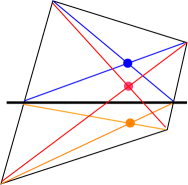
1975 Anna Margaret Mullikin (March 7, 1893 - August 24, 1975) She was born in Baltimore, Maryland and attended Goucher College, which was then a women's college located in the same city. While there she managed her class basketball team, participated on the swimming team, and earned her A.B. degree in 1915. That same year her name was mentioned in the American Mathematical Monthly [Vol. 22, No. 5 (May 1915),pp. 165-166] for solving the following geometry problem:

A quadrilateral of any shape whatever is divided by a transversal into two quadrilaterals. The diagonals of the original figure and those of the two resulting (smaller) figures are then drawn. Show that their three points of intersection are collinear.

The published solution was by Vola Barton, also from Goucher College, with the remark "Also solved by Anna Mullikin."
In 1918 she entered the graduate program in mathematics at the University of Pennsylvania, earning her master's degree in 1919. She continued her graduate studies at Penn during the 1919-1920 academic year under the direction of the topologist, Robert L. Moore, while also teaching at the Stevens School in Germantown, Pennsylvania, another private preparatory school for girls. In the fall of 1920 she moved to the University of Texas along with Moore, who had convinced the Texas math department to appoint her as an instructor. Mullikin stayed in Texas for only the one academic year before returning to Philadelphia to complete the requirements for her degree from the University of Pennsylvania, with Moore still as her advisor. She received her Ph.D. in mathematics in 1922. Mullikin did not pursue mathematical research after earning her Ph.D. She spent the rest of her professional career as a high school mathematics teacher, first at William Penn High School for Girls in Philadelphia for one year, and then at Germantown High School where she remained until her retirement in 1959. She was appointed head of the mathematics department in 1952. In 1956 she was a joint author with Ethel and Ewart Grove for the textbook Algebra and Its Use. *Agnes Scott College (One wonders who was (or were) the Dept Head for the almost 30 years this female PhD served before she got the position.)

1982 Giorgio Abetti (5 Oct 1882,24 Aug 1982)Italian astronomer known for his studies of the sun at the University of Padua where was director at the Arcetri Observatory (1921-52), taking over from his father who also held the post (1894-1921). In 1913, Giorgio Abetti took part, as a geodetic and geophysical astronomer, in the De Filippi expedition in Karakorum, Himalaya and Turkestan. He went on expeditions to observe eclipses of the sun, including one to Siberia to observe the total eclipse on 19 Jun 1936 and in 1952 to Sudan. With the advice of George Hale, he built a solar tower at the observatory (opened 1925). He wrote a popular text on the sun, a handbook of astrophysics (1936) and a popular history of astronomy (1963).*TIS

1997 Louis Essen (6 Sep 1908, 24 Aug 1997 )English physicist who invented the quartz crystal ring clock and the first practical atomic clock. These devices were capable of measuring time more accurately than any previous clocks. He built a cesium-beam atomic clock, a device that ultimately changed the way time is measured. Each chemical element and compound absorbs and emits electromagnetic radiation at its own characteristic frequencies. These resonances are inherently stable over time and space. The cesium atom's natural frequency was formally recognized as the new international unit of time in 1967: the second was defined as exactly 9,192,631,770 oscillations or cycles of the cesium atom's resonant frequency, replacing the old second defined in terms of the Earth's motion. *TIS


Credits :
*CHM=Computer History Museum
*FFF=Kane, Famous First Facts
*NSEC= NASA Solar Eclipse Calendar
*RMAT= The Renaissance Mathematicus, Thony Christie
*SAU=St Andrews Univ. Math History
*TIA = Today in Astronomy
*TIS= Today in Science History
*VFR = V Frederick Rickey, USMA
*Wik = Wikipedia
*WM = Women of Mathematics, Grinstein & Campbell