Thursday, 7 December 2023

Bottoms Up Factoring, A Question of History

 A few years ago(Dec 29, 2006) a lady named Nancy Kitt sent a question to the Teacher2Teacher Service at the Math Forum and asked about a factoring method called the Bottoms Up method:


One of my former students showed me the following method to factor
trinomials.
I want to know HOW and WHY this method works.
3x^2 + 14x + 8 Multiply AC, that is 3 x 8 = 24
Now look at B = 14. We are looking for two numbers
multiplied together to give 24 and added to give 14. The numbers will be
+12 and +2.

(x + 12)(x + 2)--- put the two factors 12 and 2 inside the parentheses,
but put x as the first term in both parentheses.

Now, since A was 3, divide the two factors 12 and 2 by 3

(x + 12/3) (x + 2/3)

12 will divide by 3 giving 4.

2 does not divide by 3. Therefore, multiply the x by 3, giving the final
factorization of (x + 4) (3x + 2).

(she followed this with a second example)...

This is the COOLEST method I've ever seen. However, I have NO CLUE HOW
or WHY it works!!!!!!

I want to use this method this semester, and I'd like to have an idea why
it works?????


I responded (helpfully, I hope) with a post to explain the substitution method
Well, the secret is that 8 = 24/3...

If you consider that the solutions of x^2 + bx +c = 0 are the same as the
solutions of 2x^2 + 2bx + 2c etc... then you are a step closer to
understanding the solution....

If we take 3x^2 + 14x + 8 = 0 and let x=u/3 (or u=3x) and substitute we get


(3(u/3)^2 + 14 (u/3) + 24/3) = 0 and now if we simplify the first term
we get

u^2/3 + 14 u/3 + 24/3 = 0

now if we multiply all terms by 3 we get

u^2 + 14u + 24... and solve to get the two solutions you had, u=12 and u=2,
but remember that we wanted x, not u, and x=u/3 thus the final solution...
(And then I added two other methods that are not well known or understood)


Then I posted a second note in case she might want some historical information...


Just a little addendum on the history of this method (I was writing up an
article on factoring and thought of your question). The substitution of Z=ax to
make a solution pliable dates back to the ancient Babylonian clay tablets
according to Boyer's History of Mathematics. They used it in order to make
a trinomial (ax)2 + b(ax) =ac so that they could solve using their method
of completing the square. The idea of factoring had to wait a LONG time
until Thomas Harriot came up with it around 1600-1621 (he died in 1621 but
his method was not published until 1631, ten years after his death)..

By the way, I can not find any reference to "bottoms up" name for this...
can you help ME?


So several years later, I still wonder... does anyone have a clue how/why this term was applied, or any other detail about the history?

A few days later I got a comment:  "
Blogger Nate said...

As a matter of fact, I just learned this method today from a few of my students who refer to it as 'slide and divide' although I'm not sure if that will help you to trace the history." After a little searching I came across a solution to calling it "Bottoms Up".  The name relates to the nearly final state where after, in our example, you get to (x + 12/3) (x + 2/3), You can simplify the left side fraction to a whole number, (x+4) but the right side requires the "magic, bottoms up, so we take the 3 in the denominator and write it in front of the leading term on the top, ie (3x+2)... BLAH!!!!

I still have not found any historical references to this method and the creation of either name.  If you have information or sources, please share.


Friday, 1 December 2023

Mechanical Drawing with Harmony, a Brief History


Sometimes blogs start when some kind of reoccurring theme pops up over several days. In this case the theme was (loosely) drawing things using parametric functions. I saw the image above which is the Logo for the MIT Lincoln Library. It reminded me of something called Bowditch (or Lissajous) curves which were a common amusement I would use to introduce my students to parametric equations after graphing calculators. (more about these later) And I mused that someday I would have to look up the history of mechanical methods of producing parametric functions. 


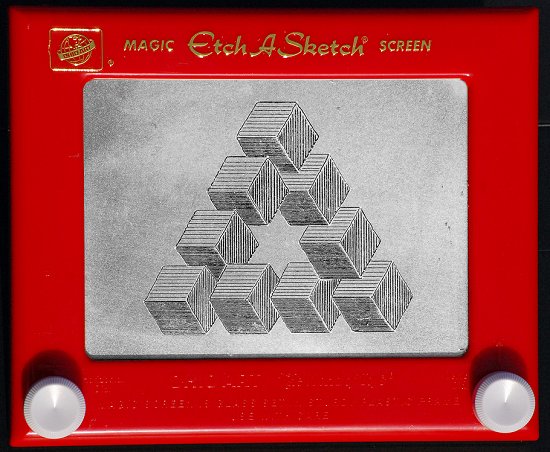
Then within a short period of time I read that André Cassagnes, the French inventor of the Etch A Sketch, had died near Paris on January 16, 2013, at the age of 86. If you haven't heard of the Etch A Sketch, (right) it was a mechanical toy that was used to draw on a screen with an internal stylus that was moved right or left by one twist knob, and up or down by the other, sort of a mechanical x=f(t) and y=f(t).

It reminded me of my earlier intention a few days earlier, and so I decided to begin filling out my knowledge about that history.

From my own notes I knew that Nathaniel Bowditch, an under-appreciated American self-taught mathematician had drawn curves like this.  He first drew these parametric curves in 1815 with a compound pendulum."
Like most others,  in school I had learned about them as Lissajous figures, images we drew on oscilloscopes using signal generators for the two inputs. But then,shortly after I first read about Bowditch I happened to be in Tokyo Visiting the Edo Museum for an exhibit named Worlds Revealed - The Dawn of Japanese and American Exchange. Like others, I had always had the misconception that Commodore Perry opened trade with Japan in 1853, so I was surprised to find that a number of American ships from Salem, Massachusetts, sailing under Dutch charters had traded with the Japanese as early as 1800. The company was called the East India Marine Society, and in 1802 the First Secretary was Bowditch. On exhibit was a much more popular mathematical creation of Bowditch; his book, The New American Practical Navigator, that Bowditch, and the Marine Society had published in 1802. The book was a compilation of the most accurate measures of the period giving the positions of major astronomical objects at numerous longitude and latitude coordinates. The book was, literally, a mariner's bible until an accurate sea clock would become commonly available that allowed sailors to conquer the longitude problem. Bowditch's position and accomplishments seem even greater in light of the fact that he was almost totally self educated in mathematics. 
Then, in August of 2008 I read a post by Milo Gardner on the almost unheard of Wilkes Expedition, which explored the western Americas and the Pacific, and Milo added that "... mathematicians during the early 1800's were assigned to working on Manifest Destiny issues and projects. On the Wilkes Expedition you'll find Bowditch as one of its  navigators. An island in the Pacific is named for Bowditch, since it had not been on any US  or European map prior to the expedition's visit." The island, I found out, is sometimes called Fakaofu, and is located in the Stork Archipelago in the South Pacific.

I decided to go back a little farther by looking for any historical references I could find for the history of mechanical curve drawing and hit a jackpot with an on-line article by Daina Taimina, of Cornell University titled Historical Mechanisms for Drawing Curves.  It seems to be from the book,Hands on History: A Resource for Teaching Mathematics.

She stated that "Mechanical devices in ancient Greece for constructing different curves were invented mainly to solve three famous problems: doubling the cube, squaring the circle and trisecting the angle."
She went on to give several examples, "There can be found references that Meneachmus (~380-~320 B.C.) had a mechanical device to construct conics which he used to solve problem of doubling the cube. One method to solve problems of trisecting an angle and squaring the circle was to use quadratrix of Hippias (~460-~400 B.C) {this was the first named curve other than circle and line – it is also the first example of a curve that is defined by means of motion and can not be constructed using only a straightedge and a compass.}
Proclus (418-485) also mentions some Isidorus from Miletus who had an instrument for drawing a parabola.[ Dyck,p.58]. We can not say that those mechanical devices consisted purely of linkages, but it is
important to understand that Greek geometers were looking for and finding solutions to geometrical problems by mechanical means. These solutions mostly were needed for practical purposes."

From her description it would seem that none of these still existed in physical or drawn form.

While her focus was on the use of linkages to create mechanical movement and drawings, I was searching for something closer to the idea of a parametric curve.

The first who wrote about the construction of an ellipse by means of a string was Abud ben

Muhamad, who wrote in the middle of 9th century [Coolidge] 


Certainly the early trammel which dates to Proclus or Archimedes (indeed it is sometimes called the trammel of Archimedes)  but again, it is more of a mechanical linkage than parametric.  And no offense intended to my neighbors here in Kentucky, but the instrument is often sold as a novelty made of wood with a crank knob on the end of the trammel bar that traces out the ellipse, and is referred to as a "Kentucky do-nothing".

Students may have also been shown how to draw an ellipse by taking a loop of string looped around two thumb tacks.  By holding a pencil pulled against the string to keep it taut, and sliding it around the two thumb tacks as you keep the string taut, the pencil will trace out an ellipse. The first written description of this method of construction an ellipse by means with string was by Abud ben Muhamad,  in the 9th century. 

Then I came across an article in Wikipedia about the harmonograph, a mechanical platform that employs one or more pendulums to create a geometric image.  Interestingly, they give credit for the first harmonograph to Scottish mathematician Hugh Blackburn.  Trouble is, Blackburn was born in 1823; almost a full decade after Bowditch had written about his use of such a device.

I am beginning to accept that Bowditch may have been the first person to create  the parametric images which sometimes, and should more often, bare his name. If someone has an example of an earlier non-linkage apparatus that suggests parametric input to draw figures, I would love to be notified.

Jules Antoine Lissajous, for whom the figures are more often called, invented a different type of device to create the images.   He used a beam of light bounced off a mirror attached to a vibrating tuning fork, which then reflected off a second mirror attached to another vibrating tuning fork which was perpendicularly orientated (usually of a different pitch, creating a specific harmonic interval), which was then reflected onto a wall, tracing the figure.With frequency produced by audible frequencies the curve traced out by the light appeared as a complete image due to visual persistence.  Lissajous device is sometimes credited with inspiring the two pendulum device, but he too was born after Bowditch had written of his device.  None of this should be seen to diminish Lissajous mathematical stature. His experiments with waves, his novel method of creating the waves, and his dramatic lectures and demonstrations, including one at the Royal Society in London, exposed them to a much wider audience. These lectures were so impressive that he was awarded the Lacaze Prize in 1873 for his optical observation of vibration and, in particular, "for his beautiful experiments". Almost certainly he was completely unaware of Bowditch's work.

When I introduced these to my students I often used one similar to the Lincoln Library Logo at top and I called it the Chinese finger cuff curve (I am still waiting for the rest of the mathematical world to adopt this term, fall into line people) As I neared retirement it seemed that many of the students had never heard of finger cuffs, but there were always a few who knew of them, and often at least one student who would produce one from home over the next few days.


If you want to create you own, you can find on-line parametric graphers and even an ipad app for a harmonograph.

Several nice examples, with their equations, are given at this Wikipedia link. Enjoy


Wednesday, 29 November 2023

Too Nice to Ignore, Gravity and Bernoulli's Lemniscate


From a 2009 post with additional material added.


*Wik
Two stories intersect here, one a famous event from the history of calculus that most folks are familiar with, and one that seems not to make it much into classrooms and that I only learned about today. 
Almost every student of mathematics will sooner or later come across the beautiful problem of the Brachistochrone, which in Greek means "shortest time." It is the path that will carry a point-like body from one place to another in the least amount of time under the force of constant gravity. Given two points A and B, with A not lower than B, only one upside down cycloid passes through both points, has a vertical tangent line at A, and has no maximum points between A and B: the brachistochrone curve. The curve does not depend on the body's mass or on the strength of the gravitational constant.

The story goes that Johann Bernoulli posed the problem to readers of Acta Eruditorum in June, 1696. He published his solution along with four other solutions from Newton, Jakob Bernoulli, Gottfried Leibniz, and Ehrenfried Walther von Tschirnhaus. ( l'Hôpital also seems to have had a correct solution, but it was not published).

Newton historians claim that Newton received the problem in the mail one afternoon after returning from his job at the mint (so this would be after he was older). The story goes that he solved it overnight, and posted it the next morning. Since it took weeks for some of the others to solve it, we may assume that Newton was still a pretty good mathematician well after his known prime.

A footnote to this story, in the epic novel Moby Dick, "Ishmael thinks about them while cleaning the try-pots (giant cauldrons in which whale blubber is rendered) on the deck of the Pequod.  It was in the ...trypot with the soapstone diligently circling around me, that I was first struck by the remarkable fact, that in geometry all bodies gliding along the cycloid, ...,will descend from any point in precisely the same time."  
How would Melville's modest education bring him this incredible math fact.  A possible answer.....Joseph Henry, you know, the guy for whom the unit of inductance is named.  
It is almost certain that the limited public school education of Melville would not include this fact.  Most high school students today would never be introduced to it.  But in Melville's brief time at the Albany Academy it was said that Herman excelled in "ciphering" and won the school prize.  Perhaps his interest in geometry and such was inspired by an outstanding teacher, and former alumni of the Albany Academy, young Joseph Henry.

(Once Upon A Prime by Sarah Hart)  


Ok, so that's the one everybody knows about. But I was just fixing up some notes on the life of Gian Francesco Malfatti, whose date of death was, well, today, in 1807. Now Malfetti did some nice stuff, too. He did some really important work on fifth degree equations; but he is best known for a geometry problem about three mutually tangent circles inscribed in a triangle. He posed the problem of as how to
,
*Mathworld
carve three circular columns out of a triangular block of marble, using as much of the marble as possible. He thought the solution was described by the triangle problem. The Geometry problem of constructing three circles each tangent to each other and two sides of the triangle is now generally known as Malfatti's problem, even though he didn't do it first, Japanese geometer Chokuen Ajima beat him too it.  (Both the earliest solutions, I'm told, used a combination of geometry and algebra, but it seems Steiner did show how to do it with pure geometric methods). What's worse is that it wasn't even the solution to the physical problem of the columns he was trying to show. Around 1930 someone proved that it wasn't always the best solution, and then in the 60's, M. Goldberg showed it was NEVER the best solution.

Then while checking some dates on his Wikipedia entry, I noticed something else he had done, the something I had never heard of, and this time he was right. He was working with the lemniscate (it means ribbon) first described in 1694 by Jakob Bernoulli, and he noticed an interesting gravitational relationship about it. If you draw a chord (pick a chord, any chord... ok; sorry) through the center and any other point on the lemniscate, then a point acting under the influence of gravity will reach that point of intersection at the same moment, whether it travels down the chord, or around the lemniscate. Now that just seems to nice to have ignored in math and calculus classrooms. If you are a teacher, maybe the next time you talk about the brachistochrone, (or maybe tomorrow when they need a diversion) you should point out this little beauty, also.

Tuesday, 28 November 2023

Strange Connections, The Thesaurus Guy


From a 2011 post with some additions.

I recently came across a note that the Peter Mark Roget whose name is associated so closely with the thesaurus was a scientific type.  More particularly, in 1815 he invented the log-log scale (the logarithm of the logarithm of the number on the C and D scales... ) on the slide rule which facilitated finding powers and roots of numbers. 

I looked into his history and found that his education was in medicine and his work on the thesaurus was part of a lifelong coping mechanism to fight depression.  Roget described his thesaurus in the foreword to the first edition in 1852:

"It is now nearly fifty years since I first projected a system of verbal classification similar to that on which the present work is founded. Conceiving that such a compilation might help to supply my own deficiencies, I had, in the year 1805, completed a classed catalogue of words on a small scale, but on the same principle, and nearly in the same form, as the Thesaurus now published."

But before he actually got around to publishing his great book, he not only invented the slide rule scale, but following the death of Sir John Herschel, Roget was secretary of the Royal Society from 1827 to 1848. He also made observations in sight and persistence of vision that influenced the development of movies. 

From"Cheshire Antiquities,© Craig Thornber, Cheshire, England, UK.
"His observations were based initially on looking at the world through a series of slits such as one might have in a vertical Venetian blind or palisade. A rotating cartwheel viewed through such as system gives an optical illusion. The spokes at the top and bottom appear straight but those at the sides appear to bend downwards. Roget worked out the path of the light to show how this happened. He went on to explain a phenomenon that often perplexes devotees of Westerns, a hundred years before the invention of film. At certain speeds, the cartwheel appears to stop or go backwards. Roget's observations were made by viewing through vertical slits but he showed the position of each spoke in the wheel at each glimpse and how this could lead to the optical illusion of stasis or backward motion. The same phenomenon is observed when a film is made with a cine camera. In 1820, Roget worked with Michael Faraday and Joseph Plateau in a series of experiments on vision leading to Roget's paper to the Royal Society on the Persistence of Vision. Roget's work showed that an image persists in human perception for about one sixteenth of a second and this forms the basis on which animations, film and television are based. "
(Wikipedia)

On 9 December 1824, Roget presented a paper entitled Explanation of an optical deception in the appearance of the spokes of a wheel when seen through vertical apertures. ...
While Roget's explanation of the illusion was probably wrong, his consideration of the illusion of motion was an important point in the history of film, and probably influenced the development of the Thaumatrope, the Phenakistiscope and the Zoetrope.


Amazon offers a paperback (20 pages) book from Roget's paper.


Roget also was involved in the creation of University of London and the precursor to the Royal Medical Society.    A busy Guy...


-------------------------------------------------------

William Ensign Lincoln invented the definitive zoetrope in 1865 when he was about 18 years old and a sophomore at Brown University, Providence, Rhode Island. Lincoln's patented version had the viewing slits on a level above the pictures, which allowed the use of easily replaceable strips of images. It also had an illustrated paper disc on the base, which was not always exploited on the commercially produced versions. On advice of a local bookstore owner, Lincoln sent a model to color lithographers and board game manufacturers Milton Bradley and Co.

The name zoetrope was composed from the Greek root words ζωή zoe, "life" and τρόπος tropos, "turning" as a translation of "wheel of life". The term was coined by inventor William E. LincolnW.E. Lincoln's U.S. Patent No. 64,117 of April 23, 1867 


While I was searching this out, I came across the fact that the invention of the Ln scale (for finding e^x) was by an 11th grade high school student. 
From a post by Robert Adams:


The Ln scale was invented by a high school student, Stephen B. Cohen, in 1958. The original intent was to allow the user to select an exponent (in the range 0 to 2.3) on the Ln scale and read e^x on the C (or D) scale and e^(-x) on the CI (or DI) scale. Pickett and Eckel were given exclusive rights to the scale in the early sixties. Later, Stephen Cohen created a set of "marks" on the Ln scale to extend the range beyond the 2.3 limit, but Pickett never incorporated these marks on any of their slide rules.


And just one more footnote, I always found it a little quirky that the log scale on the slide rule was linear.

After I wrote this, several readers commented about people you might not know were science/math folks.  Steven Colyer offered three offhand :

Art Garfunkel studied Mathematics at Columbia University.

Mick Jagger went to The London School of Economics.

August Ferdinand Möbius of Möbius strip fame was primarily an Astronomer.

I added that actress Teri Hatcher (Lois Lane, Desperate housewives...) studied math and engineering at  De Anza College. Not an unlikely choice since her mother was a computer programmer at Lockhead-Martin and her dad was a nuclear physicist.

Steve reminded me that Winnie on "Wonder Years" long ago, Danica McKellar, studied math at UCLA and later wrote several books, including "Math Doesn't Suck" to motivate young women towards math science studies.

And in more modern time several writers on The Simpsons, and Mayim Bialik on The Big Bang Theory have impressive Sci/math credentials.

Surprise me with your list of strange connections.