Wednesday, 29 May 2024

The Distracted Goalie


The great Physicist, Niels Bohr, was brother to an outstanding mathematician, Harald who founded the field of almost periodic functions. In their youth both were very good athletes, with Harald clearly the more dedicated sportsman. Harald had been a member of the Danish National Football team while still a student and had earned a silver medal as such in the 1908 Olympic games; the first time the Olympic games had football. Harald scored two goals in the opening game defeating the French nine-zero. Denmark lost to the UK in the final game. He was such an accomplished football player that it is said when he defended his PhD thesis there were more football fans in the audience than mathematicians.
Brother Niels was also a good athlete, but often seemed to have his focus somewhere other than sports. Both brothers played several games for the Copenhagen-based Akademisk Boldklub, with Niels in goal. The story is told that during one game when almost all the action was happening in the attacking half for his club, a long clearing kick from the other end of the field began to roll toward his goal. Niels stood near the goalpost and seemed unaware of the ball rolling toward his goal with players rushing in from many yards behind it. Alerted by the screaming crown behind him, Niels made the save and cleared away the threat.
After the game his explanation was that he had been distracted by a math problem and was carrying out calculations on the edge of the goal post.
Apparently he kept his love for the game.  The photo at the top shows Niels Bohr with  a group that is unidentified, but he looks to me to be the one handling the ball.  A goal-keeper to the end, it seems.

An Anon. comment suggested, "I think there's also Gamow (upright), Pauli (back to camera) and possibly Heisenberg opposite Bohr. Must have been during a conference."  If anyone can spot brother Harald, and if someone recognizes young version of later great science/math wizards, share, please

On This Day in Math - May 29

 ​


No matter how correct a mathematical theorem
may appear to be, one ought never to be satisfied
that there was not something imperfect
about it until it also gives
the impression of being beautiful.
~ George Boole


The 149th day of the year; There are 149 ways to put 8 queens on a 7-by-7 chessboard so that each queen attacks exactly one other queen. *Prime Curios

also 149 = 62 + 72 + 82.(note that the digits 1, 4, 9 are squares also)

And Derek Orr noted that the sum of the digits of 149, \(1 + 4 + 9 = 14 = 1^2 + 2^2 + 3^2 \)

149 is the smallest 3-digit prime with distinct digits in each position such that inserting a zero between any two digits creates a new prime (that is, 1049 & 1409 are both prime).

149 is the 35th prime number, and a twin prime with 151.

149 is an Emirp since 941, its reversal, is also a prime.

149 in binary is 10010101. The zeros are in prime positions 2, 3, 5, and 7, when read left-to-right. These are the four single digit prime numbers.*Prime Curios

149 is a strictly non-palindromic number, it is not a palindrome in any base from 2 to 147.

149 is a full reptend prime, its reciprocal is 148 digits long, 1/149 repeats 0067114093959731543624161073825503355704697986577181208053691275167785234899328859060402684563758389261744966442953020134228187919463087248322147651 indefinitely.


EVENTS

1733  Euler names (or mis-names) the "Pell Equations" and gives a method of multiple solutions. "Euler’s first excursion into Pell’s equation was his 1732 paper E-29, bearing a title that translates
as “On the solution of problems of Diophantus about integer numbers.” The main result of this paper is to show how certain quadratic Diophantine equations can be reduced to the Pell equation. In particular, he shows that if we can find a solution to the Diophantine equation \(y^2 = an^2 + bn + c \) and we can find solutions to the Pell equation, \(q^2 = ap^2 +1\), then we can use the solutions to the Pell equation to construct more solutions to the original Diophantine equation. He also shows how to use two solutions to a Pell equation to construct more solutions, and notes that solutions to a Pell equation give good rational approximations for the square root of a.  (Ed Sandifer, Euler and Pell, How Euler Did It. MAA) .
As early as 400 BC in India and Greece, mathematicians studied the numbers arising from the n = 2 case of Pell's equation, The first general method for solving the Pell's equation (for all N) was given by Bhāskara II in 1150, extending the methods of Brahmagupta. Called the chakravala (cyclic) method,  
Several European mathematicians rediscovered how to solve Pell's equation in the 17th century. Pierre de Fermat found how to solve the equation and in a 1657 letter issued it as a challenge to English mathematicians. In a letter to Kenelm Digby, Bernard Frénicle de Bessy said that Fermat found the smallest solution for N up to 150 and challenged John Wallis to solve the cases N = 151 or 313. Both Wallis and William Brouncker gave solutions to these problems, though Wallis suggests in a letter that the solution was due to Brouncker.

John Pell's connection with the equation is that he revised Thomas Branker's translation[14] of Johann Rahn's 1659 book Teutsche Algebra into English, with a discussion of Brouncker's solution of the equation. Leonhard Euler mistakenly thought that this solution was due to Pell, as a result of which he named the equation after Pell.


Euler

Pell


1832 Almost certain that he would die in a duel the next day, Evariste Galois first wrote “Letter to all Republicans,” and then wrote to a friend (Auguste Chevalier) describing his mathematics. It ended: “Eventually there will be, I hope, some people who will find it profitable to decipher this mess.” [Burton, History of Mathematics, p. 322]. See Smith, Source Book, pp. 278–285 for the letter. *VFR

The Galois memorial in the cemetery of Bourg-la-Reine. Évariste Galois was buried in a common grave and the exact location is unknown.
Galois Memorial


1898 the heirs of Alfred Nobel sign a "reconciliation agreement" so that lawyers and accountants can execute his will. The will's major bequest was to create the Nobel Prizes, but first, there were disputes to be settled.*TIS


1919 Proof of the general theory of relativity was observed during a total solar eclipse. São Tomé and Príncipe, officially the Democratic Republic of São Tomé and Príncipe, is a Portuguese-speaking island nation in the Gulf of Guinea, off the western equatorial coast of Central Africa. Príncipe was the site where astronomical observations of the total solar eclipse of 29 May 1919 confirmed Einstein's prediction of the curvature of light. The expedition was sponsored by the Royal Society and led by Sir Arthur Stanley Eddington. A solar eclipse permitted observation of the bending of starlight passing through the sun's gravitational field, as predicted by Einstein's theory of relativity. Separate expeditions of the Royal Astronomical Society travelled to Brazil and off the west coast of Africa. Both made measurements of the position of stars visible close to the sun during a solar eclipse. These observations showed that, indeed, the light of stars was bent as it passed through the gravitational field of the sun. The verification of predictions of Einstein's theory, proved during the solar eclipse was a dramatic landmark scientific event. *Wik


1957 Romania issued two stamps picturing a slide rule to publicize the 2nd Congress of the Society of Engineers and Technicians, which began in Bucharest on this day. [Scott #1159-60].
For the younger set... If you never used (saw) a slide rule, there is actually an online java app that you can simulate the use of one at this page.  The other instrument is a vernier caliper, used for measuring outside dimensions, inside diameter, and often a small depth measure.


2017 The Kepler conjecture, named after the 17th-century mathematician and astronomer Johannes Kepler, is a mathematical theorem about sphere packing in three-dimensional Euclidean space. It states that no arrangement of equally sized spheres filling space has a greater average density than that of the cubic close packing (face-centered cubic) and hexagonal close packing arrangements. The density of these arrangements is around 74.05%. (Time Hack, that is before 1700)
In 1998, Thomas Hales, following an approach suggested by Fejes Tóth (1953), announced that he had a proof of the Kepler conjecture. Hales' proof is a proof by exhaustion involving the checking of many individual cases using complex computer calculations. So now, 300 years have passed and we have a proof........Maybe.

In 2002  Referees said that they were "99% certain" of the correctness of Hales' proof, and the Kepler conjecture was accepted as a theorem for publication . 

In 2014, the Flyspeck project team, headed by Hales, announced the completion of a formal proof of the Kepler conjecture using a combination of the Isabelle and HOL Light proof assistants. In 2017, the formal proof was accepted by the journal Forum of Mathematics, Pi.  (time hack, 317+ years after Kepler, we have a proof.


BIRTHS

1675 Humphry Ditton (May 29, 1675 – October 15, 1715) was born at Salisbury and died in London in 1715 at Christ's Hospital, where he was mathematical master. He does not seem to have paid much attention to mathematics until he came to London about 1705. W. W. Rouse Ball states that Ditton's 1706 book on fluxions occupied a place in English education equivalent to L'Hospital's book in France.


1859 John Walker (29 May 1781 – 1 May 1859) was an English inventor who invented the friction match.
He made them from small wooden sticks which he coated with sulphur, then tipped with a mixture of potassium chlorate, antimony sulphide and a binder of gum arabic. After searching for a suitable mixture with the intent of making a useful way to start a fire, he was successful on 27 Nov 1826. Beginning on 7 Apr 1827, he sold them in boxes of 50 for a shilling, with a folded slip of sandpaper as a striking surface. He called them Congreves, to honour Sir William Congreve, known for his invention of military rockets. He declined to patent the matches, yet was still able to make a comfortable income from them.  *TIS

He did not name the matches "Congreves" in honour of the inventor and rocket pioneer, Sir William Congreve as it is sometimes stated. The congreves were the invention of Charles Sauria, a French chemistry student at the time. He did not divulge the exact composition of his matches.

Two and a half years after Walker's invention was made public Isaac Holden arrived, independently, at the same idea of coating wooden splinters with sulphur. The exact date of his discovery, according to his own statement, was October 1829. Before that date Walker's sales-book contains an account of no fewer than 250 sales of friction matches, the first entry dated 7 April 1827.
 The credit for his invention was attributed only after his death.


1794 Johann Heinrich von Mädler  (29 May 1794, 14 Mar 1874 at age 79) German astronomer who (with Wilhelm Beer) published the most complete map of the Moon of the time, Mappa Selenographica, 4 vol. (1834-36). It was the first lunar map to be divided into quadrants, and it remained unsurpassed in its detail until J.F. Julius Schmidt's map of 1878. Mädler and Beer also published the first systematic chart of the surface features of the planet Mars (1830). *TIS


1882 Harry Bateman (29 May 1882 – 21 January 1946) He spent much of his life collecting special functions and integrals that solved partial differential equations. He kept the references on index cards stored in shoe boxes—eventually these began to crowd him out of his office. [DSB 1, 500] *SAU

With Ebenezer Cunningham, he expanded the views of spacetime symmetry of Lorentz and Poincare to a more expansive conformal group of spacetime leaving Maxwell's equations invariant. Moving to the US, he obtained a Ph.D. in geometry with Frank Morley and became a professor of mathematics at California Institute of Technology. There he taught fluid dynamics to students going into aerodynamics with Theodore von Karman. Bateman made a broad survey of applied differential equations in his Gibbs Lecture in 1943 titled, "The control of an elastic fluid".*Wik


1885 Finlay Freundlich (May 29, 1885 – July 24, 1964) was a distinguished German astronomer who worked with Einstein on measurements of the orbit of Mercury to confirm the general theory of relativity. He left Germany to avoid Nazi rule and became the Napier Professor of Astronomy at St Andrews.


1906 Gerrit Bol (May 29, 1906 in Amsterdam, Nov 1, 1989) was a Dutch mathematician, who specialized in geometry. He is known for introducing Bol loops in 1937, and Bol’s conjecture on sextactic points.
Bol earned his PhD in 1928 at Leiden University under Willem van der Woude. In the 1930s, he worked at the University of Hamburg on the geometry of webs under Wilhelm Blaschke and later projective differential geometry. In 1931 he earned a habilitation.
In 1942–1945 during World War II, Bol fought on the Dutch side, and was taken prisoner. On the authority of Blaschke, he was released. After the war, Bol became professor at the Albert-Ludwigs-University of Freiburg, until retirement there in 1971. *Wik


1911 George Szekeres (29 May 1911 – 28 August 2005) was a Hungarian-born mathematician who worked for most of his life in Australia on geometry and combinatorics. *SAU

Szekeres worked closely with many prominent mathematicians throughout his life, including Paul Erdős, Esther Szekeres (née Esther Klein), Paul Turán, Béla Bollobás, Ronald Graham, Alf van der Poorten, Miklós Laczkovich, and John Coates.

The so-called Happy Ending problem is an example of how mathematics pervaded George's life. During 1933, George and several other students met frequently in Budapest to discuss mathematics. At one of these meetings, Esther Klein proposed the following problem:

Given five points in the plane in general position, prove that four of them form a convex quadrilateral.

After allowing George, Paul Erdős, and the other students to scratch their heads for some time, Esther explained her proof. Subsequently, George and Paul wrote a paper (1935) that generalizes this result; it is regarded as one of the foundational works in the field of combinatorial geometry. Erdős dubbed the original problem the "Happy Ending" problem because it resulted in George and Esther's marriage in 1937.

George and Esther died within an hour of each other, on the same day, 28 August 2005, in Adelaide, Australia.*Wik

My story of the "Happy Ending" story is here.


1997 Chien-Shiung Wu (simplified Chinese: 吴健雄; traditional Chinese: 吳健雄; pinyin: Wú Jiànxióng, May 31, 1912 – February 16, 1997) was a Chinese American experimental physicist who made significant contributions in the field of nuclear physics. Wu worked on the Manhattan Project, where she helped develop the process for separating uranium metal into uranium-235 and uranium-238 isotopes by gaseous diffusion. She is best known for conducting the Wu experiment, which contradicted the hypothetical law of conservation of parity. This discovery resulted in her colleagues Tsung-Dao Lee and Chen-Ning Yang winning the 1957 Nobel Prize in physics, and also earned Wu the inaugural Wolf Prize in Physics in 1978. Her expertise in experimental physics evoked comparisons to Marie Curie. Her nicknames include "the First Lady of Physics", "the Chinese Madame Curie", and the "Queen of Nuclear Research".*Wik


1918 David Rees FRS (29 May 1918 – 16 August 2013) was a British professor of pure mathematics at the University of Exeter, having been head of the Mathematics / Mathematical Sciences Department at Exeter from 1958 to 1983. During the Second World War, Rees was active on Enigma research in Hut 6 at Bletchley Park.

Rees won a scholarship to Sidney Sussex College, Cambridge, supervised by Gordon Welchman and graduating in summer 1939. On completion of his education, he initially worked on semigroup theory; the Rees factor semigroup is named after him. He also characterised completely simple and completely 0-simple semigroups, in what is nowadays known as Rees's theorem. The matrix-based semigroups used in this characterisation are called Rees matrix semigroups.

Later in 1939, Welchman drafted Rees into Hut 6, Bletchley Park, for the war effort. He was credited with the first decode using the Herivel tip. He was subsequently seconded to the Enigma Research Section, where the Abwehr Enigma was broken, and later to the Newmanry, where the Colossus computer was built.

After the war, Rees was appointed an assistant lecturer at Manchester University in 1945 and a full lecturer at University of Cambridge in 1948. In 1949, he was a Fellow of Downing College.

At the behest of Douglas Northcott he switched his research focus to commutative algebra.[10] In 1954, in a joint paper with Northcott, Rees introduced the Northcott–Rees theory of reductions and integral closures, which has subsequently been influential in commutative algebra. In 1956 he introduced the Rees decomposition of a commutative algebra.

In 1958, Rees and his family moved to Exeter, where he had been appointed to the Chair of Pure Mathematics. In 1959, he was awarded a DSc by the University of Cambridge.

According to Craig Steven Wright, Rees was the third part of the Satoshi team that created Bitcoin.*Wik


1929 Günter Lumer (1929–2005) was a mathematician known for his work in functional analysis. He is the namesake of the Lumer–Phillips theorem on semigroups of operators on Banach spaces, and was the first to study L-semi-inner products. Born in Germany and raised in France and Uruguay, he spent his professional career in the United States and Belgium.
Following short-term positions at the University of California, Los Angeles and Stanford University, he joined the faculty at the University of Washington in 1961. He moved to the University of Mons-Hainaut in 1973, and then to the International Solvay Institutes for Physics and Chemistry in Brussels in 1999, where he remained until his death in 2005


1929 Peter Ware Higgs (29 May 1929 -  8 April 2024) is an English theoretical physicist, the namesake of the Higgs boson. In the late 1960s, Higgs and others proposed a mechanism that would endow particles with mass, even though they appeared originally in a theory - and possibly in the Universe! - with no mass at all. The basic idea is that all particles acquire their mass through interactions with an all-pervading field, called the Higgs field. which is carried by the Higgs bosons. This mechanism is an important part of the Standard Model of particles and forces, for it explains the masses of the carriers of the weak force, responsible for beta-decay and for nuclear reactions that fuel the Sun. The particle was discovered on 4 July 2012 at the Large Hadron Accelerator.


1957 Jean-Christophe Yoccoz ( May 29, 1957 -   )  French mathematician who was awarded the Fields Medal in 1994 for his work in dynamical systems. Such studies began with Poincaré about the turn of the 20th century, who considered the stability of the solar system. It evolves according to Newton's laws but will it remain stable or, might a planet be ejected from the system? The techniques apply also in biology, chemistry, mechanics, and ecology where stability is an issue. This work also produces aesthetically appealing objects, such as the Julia and Mandelbrot fractal sets. Yoccoz was primarily concerned with establishing criteria that gave precise bounds on the validity of stability theorems. A combinatorial method for studying the Julia and Mandelbrot sets was named "Yoccoz puzzles." *TIS


DEATHS

1660 Frans van Schooten (1615 in Leiden – 29 May 1660 in Leiden) was a Dutch mathematician who was one of the main people to promote the spread of Cartesian geometry. Van Schooten's father was a professor of mathematics at Leiden, having Christiaan Huygens, Johann van Waveren Hudde, and René de Sluze as students.
Van Schooten read Descartes' Géométrie (an appendix to his Discours de la méthode) while it was still unpublished. Finding it hard to understand, he went to France to study the works of other important mathematicians of his time, such as François Viète and Pierre de Fermat. When Frans van Schooten returned to his home in Leiden in 1646, he inherited his father's position and one of his most important pupils, Huygens.
Van Schooten's 1649 Latin translation of and commentary on Descartes' Géométrie was valuable in that it made the work comprehensible to the broader mathematical community, and thus was responsible for the spread of analytic geometry to the world. Over the next decade he enlisted the aid of other mathematicians of the time, de Beaune, Hudde, Heuraet, de Witt and expanded the commentaries to two volumes, published in 1659 and 1661. This edition and its extensive commentaries was far more influential than the 1649 edition. It was this edition that Gottfried Leibniz and Isaac Newton knew.
Van Schooten was one of the first to suggest, in exercises published in 1657, that these ideas be extended to three-dimensional space. Van Schooten's efforts also made Leiden the centre of the mathematical community for a short period in the middle of the seventeenth century. *Wik    Thony Christie (aka The Renaissance Mathematicus) sent me a comment to tell me that it was van Schooten who first used rectangular coordinates in his translations and extensions of Descartes Geometry.  The MAA Digital Library has seven images from van Schooten's "Exercitationes mathematicae". The copy was once the property of his student, Johann Hudde, and include problems from the book of another of his famous students, Christian Huygen's Ludo aleae.

Thony Christie added a note about van Schooten's contributions:
If you read La Géométrie you will search for rectangular co-ordinates in vain, Descartes did not use them. (Neither did Fermat who developed/invented algebraic geometry independently from Descarte). The first person to use them was van Schooten in his extended translation of Descartes work. (Thanks Thony)


1829 Sir Humphrey Davy (Baronet) (17 December 1778 – 29 May 1829) English chemist who discovered several chemical elements and compounds, invented the miner's safety lamp, and epitomized the scientific method. With appointment to the Pneumatic Institution to study the physiological effects of new gases, Davy inhaled gases (1800), such as nitrous oxide (laughing gas) and a nearly fatal inhalation of water gas, (a mixture of hydrogen and carbon monoxide). Davy discovered alkali metals, potassium and sodium, an isolation made with electric current for the first time (1807); as well as alkaline earth metals: calcium, strontium, barium, and magnesium (1808). He discovered boron at the same time as Gay-Lussac. He recognized chlorine as an element, which prior workers confused as a compound. *TIS Davy died in Switzerland in 1829 of heart disease inherited from his father's side of the family. He spent the last months of his life writing "Consolations In Travel", an immensely popular, somewhat freeform compendium of poetry, thoughts on science and philosophy (and even speculation concerning alien life) which became a staple of both scientific and family libraries for several decades afterward. He is buried in the Plainpalais Cemetery in Geneva.


1908 William Arnold Anthony (November 17, 1835 – May 29, 1908) was an American physicist  and electrical engineer who initiated and developed one of the first courses in electrical engineering in the U.S. (1883), while teaching in the Physics Department at Cornell University, Ithaca, N.Y. During 1872-75, Anthony, with the aid of student George Moler, built the first American Gramme dynamo for direct current, used to power arc lamps that lighted the Cornell campus, the first American electrical outdoor-lighting system. Anthony also built a mammoth tangent galvanometer, a device which utilized the earth's magnetic field for the measurement of current. He designed the dynamo for first underground electricity distributing system. Anthony contributed to development of gas-filled electric lamps.*TIS


1999 John Peter Louis Knopfmacher ( 20 January 1937 in Johannesburg – 29 May 1999 in Graz ) was a South African mathematician.*Wik

 John Knopfmacher studied accounting and then mathematics at the University of the Witwatersrand . While still a student, his first publication on perfect numbers appeared in the Mathematical Gazette in 1960. His son, Arthur, related:

"He related to me that as only a first year student, he became inspired by the famous problem of odd perfect numbers and derived what he believed to be a proof that none existed. One of his lecturers realised that while not a proof of this, it was in fact a new proof of the formula that describes all even perfect numbers, and this result became his first publication in a mathematics journal." *SAU

He received his bachelor's degree in 1958 and his master's degree in 1961. He then went to the University of Manchester , where he received his doctorate in 1965 under John Frank Adams ( Extensions in Varieties of Groups and Algebras ).  After returning (1965) to the University of Witwatersrand, he became a lecturer , in 1966 a senior lecturer, in 1971 a reader and associate professor, and in 1979 a professor. From 1984 to 1994 he was head of the mathematics department at his university and became City of Johannesburg professor. In 1992 he founded the Centre for Applicable Analysis and Number Theory at the university, which was named after him in 1999. He retired in 1997 and moved to Melbourne . He was most recently a visiting professor at the University of Graz .

He worked on algebra ( non-associative algebras, finite groups , Lie algebras ) and topology before turning to analytic number theory in 1970. In particular, he established an abstract (algebraic) approach to analytic number theory, which was also the title of his 1975 monograph. For this purpose, he developed the theory of arithmetic semigroups (arithmetic of free commutative semigroups with unity and real-valued multiplicative norm with some additional properties). The theory also allows, for example, consideration over finite fields.

He was married to Rose Hendler from 1959 until their divorce in 1991 and had three children. His son Arnold Knopfmacher is also a mathematician, with whom John Knopfmacher published around 35 joint works. 

In 1995 he received the Lifetime Achievement Medal of the South African Mathematical Society and was for many years the editor of its journal Quaestiones Mathematicae. In 1991 he was made a Fellow of the Royal Society of South Africa.*Wik


2005 Kazimierz Urbanik (February 5, 1930 – May 29, 2005) was a prominent member of the Polish School of Mathematics. He founded the journal Probability and Mathematical Statistics and served as rector of the University of Wrocław.

Urbanik began teaching at the University of Wrocław in 1956. By 1960, he was promoted to professor, and in 1965 he became a member of the Polish Academy of Sciences, becoming its youngest member. He was an invited speaker at the International Congress of Mathematicians in 1966. He directed the university's Institute of Mathematics for most of the years from 1967 to 1996, and was rector of the university from 1975 to 1981. In 1980, he founded the journal Probability and Mathematical Statistics, and became its first editor-in-chief.

His research contributions include over 180 papers. His work in probability theory included work on random variables in compact groups, connections between measurability and connectivity, generalized convolutions, and decomposability semigroups. He also studied stochastic processes, information theory, universal algebra, and functional analysis. He was the doctoral advisor of 17 students.


Credits :
*CHM=Computer History Museum
*FFF=Kane, Famous First Facts
*NSEC= NASA Solar Eclipse Calendar
*RMAT= The Renaissance Mathematicus, Thony Christie
*SAU=St Andrews Univ. Math History
*TIA = Today in Astronomy
*TIS= Today in Science History
*VFR = V Frederick Rickey, USMA
*Wik = Wikipedia
*WM = Women of Mathematics, Grinstein & Campbell

Tuesday, 28 May 2024

From Surds, to Ab-Surds


I still use the word surd for irrational square roots, and I know there is a undercurrent in modern math education to remove what is considered "difficult"  language in the classroom.  I leave that to those still fighting in the classroom to decide, but as a historian, the term is too rich in content not to use it, and teach itHence the title of From Surds, to Ab-Surds


When I first saw the image above I thought, Oh, that's neat. I mean I know it doesn't normally work, but then I also like the crazy wrong cancellations that work, such as


If you restrict yourself to two digit numbers, there are three more of these.  For folks who want to search them out, I will give the four at the bottom of the post.  
And in case you wondered, there are three digit examples also, and onward.  Here are a couple to get you started

\( \frac{106}{625}\),  ... \( \frac{116}{464}\),  ... and for variety \( \frac{98}{392}\),  ... 

 I know you were wondering, and yes,  it goes on... 
\( \frac{1019}{5095}\),  ... 

  I know there are lots more, so if you expand on this list, send me a note.  

As I sat and tried to think of other similar "wrong" examples that work with surds, I realized it might make a really good first or second year algebra challenge.  There is nothing very difficult about the algebra itself, so it allows the problem to be setting up the algebraic structure of the arithmetic problem.  


My early thoughts quickly generated enough to recognize a pattern to generate as many as I would want, *** 
 \( \sqrt {3 \frac{3}{8}} = 3 \sqrt{ \frac{3}{8}} \) 

*** or one in higher values.  For example:


 \( \sqrt {49 \frac{49}{2400}} = 49 \sqrt{ \frac{49}{2400}} \) 

  And in general it will always work in this form::

    \( \sqrt {n \frac{n}{n^2-1}} = n \sqrt{ \frac{n}{n^2-1}} \) 

Are there other patterns that would produce fractional oddities like these?  (Send them to me.)


I was reminded by Subramanian R that there is an easy extension of these to higher powers and roots .  For instance, the first problem can be adjusted to cube roots by using 2^3 -1 in the denominator.. 

 \(\sqrt[3](2 \frac{2}{7}) = 2 \sqrt[3](\frac{2}{7}) \)

 \(\sqrt[4](2 \frac{2}{15}) = 2 \sqrt[4](\frac{2}{15}) \)

And in general, \(\sqrt[r](k\frac{k}{k^r-1})= k\sqrt[r](\frac{k}{k^r-1})\)


********************************
The four two-digit false cancellations are 
\(\frac{16}{64}\)
\(\frac{19}{95}\)
\(\frac{26}{65}\)
\(\frac{49}{98}\)


On This Day in Math - May 28


Twice two makes four seems to me
simply a piece of insolence. 
Twice two makes four is a pert coxcomb who stands
with arms akimbo barring your path and spitting.
I admit that twice two makes four is an excellent thing,
but if we are to give everything its due,
twice two makes five is sometimes
a very charming thing too.  
~Fyodor Mikhailovich Dostoevsky


The 148th day of the year;  148 is a Palindrome in base 6(404) and base 36 (44).

 \(e^{\pi\sqrt{148}}\)   is an integer..... almost, 39660184000219160.00096667...

148 is also a Loeschian number, a number of the form a2 + ab + b2. These numbers and the triples (a,b,L) formed by points in space are used, among other places in locations of spheres under hexagonal packing.   
Voodooguru informed me that the Loeschian numbers are named after August Lösch,
 according to https://en.wikipedia.org/wiki/Loeschian_number. He was an economist:

"Overall, Lösch made a plenitude of significant findings in the world of economics, but his main contributions were to regional economics, specifically, pioneering the location theory, spatial equilibrium analysis and hierarchical spatial systems displaying a hexagonal pattern."
The Loeschian numbers are the norms of the Eisenstein integers that form a triangular lattice on the complex plane.  

If you let x and y be both be greater than 1, then x + xy + y will never equal 148.  And that means that the product of the first 148 integers is not divisible by the sum of the first 148 integers.

A Vampire number is a number whose digits can be regrouped into two smaller numbers that multiply to make the original (1260 = 21*60).  There are 148 vampire numbers with six digits.   (***How many with four digits?)  


More math facts for every day of the year here


EVENTS

585 BC Thales predicted the total eclipse of the sun that took place on this date. See Herschel, Outline of Astronomy (1902), pp. 833 and 839. [Eves, Circles, 33◦] *VFR  WW Rouse Ball says it is uncertain whether the date is the 585 date, or Sep 30, 609 BC.  Heath, and most others, seem to settle on the 585 BC date.


1555  On this day in 1555, John Dee   was arrested and charged with "calculating"  because he had cast horoscopes of Queen Mary and Princess Elizabeth. The charges were raised to treason against Mary. At this time mathematics in England was considered to be equivalent to the possession of magical powers. Aubrey writes that the authorities had:-

... burned mathematical books for conjuring books.

Although he was guilty of the charges brought against him, Dee was released in August after being held for three months.  *MacTutor  


Dee appeared in the Star Chamber and exonerated himself, but was turned over to the Catholic bishop Edmund Bonner for religious examination. His strong, lifelong penchant for secrecy may have worsened matters. The episode was the most dramatic in a series of attacks and slanders that dogged Dee throughout his life. Clearing his name yet again, he soon became a close associate of Bonner

John Dee memorial plaque installed in 2013 inside the church of St Mary the Virgin, Mortlake
*Wik


1607  Kepler used his newly devised camera obscura, which he named, to observe the solar disk and saw a sunspot, which he mistook for a transit of Mercury, to the amazement of later astronomers who all agreed that of all people, Kepler really should have known better. The first recorded mention of what was surely sunspots.  

   One year after the introduction of the telescope astronomers identified spots on the Sun. Fabricius was the first to print a book on sunspots at the end of 1611, but this book had little diffusion. Fabricius rightly thought that the spots belonged to the Sun. The Jesuit C. Scheiner independently observed sunspots on the Sun and he announced his discovery at the end of 1611 in three letters under the pseudonym Apelles. Scheiner failed to observe the returning of the spots and hence did not recognize the solar rotation. Therefore he preferred to see the spots as caused by little bodies orbiting the Sun. Based on Scheiner’s observations, Kepler concluded that the spots were on the solar surface like dross floating on melted metal. 

Scheiner drawings


1684   Robert Hooke delivered some of his most perceptive and far sighted views of the geology of what he called this "terraqueous globe"  in lectures beginning on May 28 and published posthumously.  In these lectures he shared ideas novel to his contemporaries, including "the organic origin, and significance of fossils; cyclicity of the processes of sedimentation,  erosion, consolidation, uplift, and denudation; various processes of petrifacation; subterraneous eruptions  and earthquakes; biologic evolution; the oblate spheroid shape of the Earth; Polar wandering, and universal gravitation. "  *Ellen Tan Drake; Hooke's Ideas of the Terraqueous  Globe and a Theory of Evolution


1765 The Longitude Board at Greenwich awards Leonhard Euler an amount of 300 Pounds, "Reward for Theorems furnished by him to assist Professor Mayer in the Construction of Lunar Tables upon the Principles of Gravitation laid down by Sir Isaac Newton."
Tobias Mayer had died in 1762, but his widow received an amount of 3000 Pounds for his work in the same meeting for his construction of the tables, which she signed over to the Committee. *Derek Howse, Britain's Board of Longitude:The Finances, 1714-1828


1783, Benjamin Franklin receives a letter at his hotel in Paris from Wolfgang von Kempelen, creator of the Turk chess playing automaton, inviting him to see and play his automaton as well as inspect the half-finished talking machine.
Franklin accepted the challenge, played the Turk a few days later at the Café de la Regence and lost. Although Franklin was a lover of chess, he does not mention this event in any of his recorded correspondence, perhaps, some explain, because he was known to be a very poor loser. *Tom Standage, The Turk, 2002 Walker Publishing

The Turk was in fact a mechanical illusion that allowed a human chess master hiding inside to operate the machine. With a skilled operator, the Turk won most of the games played during its demonstrations around Europe and the Americas for nearly 84 years, playing and defeating many challengers including statesmen such as Napoleon Bonaparte and Benjamin Franklin. The device was later purchased in 1804 and exhibited by Johann Nepomuk Mälzel. *Wik


*Bibliophilia ‏@Libroantiguo

1890  The Harvard Observatory distributed the “Henry Draper Memorial far and wide, including publication in Nature and other scientific journals. The report found one of its most appreciative audiences in England, at the home of astronomer and military engineer Colonel John Herschel. As a grandson of William Herschel (discoverer of the planet Uranus) and a son of Sir John Herschel (thrice president of the Royal Astronomical Society), the colonel had seen his share of important leaps in celestial knowledge. 

“I have just rec’d your last H. D. Mem. report,” he wrote to Pickering on May 28, 1890. “It is very like a pudding all plums—but I will ask you to convey to Miss Maury ( Antonia Maury  was an American astronomer who was the first to detect and calculate the orbit of a spectroscopic binary. She published an important early catalog of stellar spectra using her own system of stellar classification, which was later adopted by the International Astronomical Union) congratulations on having connected her name with one of the most notable advances in physical astronomy ever made.” Like the colonel’s much celebrated great-aunt, Caroline Herschel, Miss Maury had entered a field of discovery dominated by men, yet she stood among the first astronomers to detect an entirely new group of objects through the upstart method of spectral photography. Its future—and hers—seemed full of promise.”  *The Glass Universe: How the Ladies of the Harvard Observatory Took the Measure of the Stars by Dava Sobel


1897, Jell-o was introduced, 52 years after Peter Cooper (inventor of the Tom Thumb engine) held the first U.S. patent for a gelatine dessert. Pearl B. Wait, a carpenter and cough medicine manufacturer from LeRoy, N.Y., produced varieties in strawberry, raspberry, orange and lemon fruit flavours, named Jell-O by his wife, May Davis Wait. Sales were poor; Wait sold the Jell-O business for 450 dollars to his neighbor, Orator F.Woodward, who had founded the Genesee Pure Food Co. two years earlier. Success came slowly, but with Woodward's creative sales and sampling strategies, Jell-O began to catch on. In 1902, when he launched his first advertising campaign in Ladies' Home Journal, sales eventually reached 250,000 dollars*TIS

Most early Jell-O advertising featured women in starched white aprons, Jell-O packaging or the Jell-O Girl, Elizabeth King. King was photographed playing with Jell-O boxes until she grew too old for the ads. *mid-century menu 


Don't forget, "There's always room for Jello."


1936  Alan Turing submitted his paper ‘On Computable Numbers’,  in 1936.  His idea was not turned into a reality for more than ten years – when he would make a vital contribution to the Allied victory in the Second World War. *History Today

One Historian said his paper had no relation to his work at Bletchley Park.


In 1937, the Golden Gate Bridge, San Francisco was ceremonially opened to vehicles by President Franklin Delano Roosevelt who pressed a telegraph key in the White House. Within the first hour after the toll gates opened, 1,800 cars crossed the bridge. By day's end, 32,300 vehicles and 19,350 pedestrians had paid to pass over the bridge. A firework display that night celebrated the opening of the bridge. The previous day, a Pedestrian Day had been held which first opened the bridge for public use. The building and design of the bridge had been supervised by chief engineer Joseph B. Strauss. Construction had started on 5 Jan 1933. It was the first bridge to span the mouth of a major U.S. ocean harbour.*TIS

"Gentlemen, Start your engines!"


1959 Committee formed which developed COBOL. COBOL is one of the oldest programming languages. Its name is an acronym for COmmon Business-Oriented Language, defining its primary domain in business, finance, and administrative systems for companies and governments.
The COBOL specification was created by a committee of researchers from private industry, universities, and government during the second half of 1959. The specifications were to a great extent inspired by the FLOW-MATIC language invented by Grace Hopper - commonly referred to as "the mother of the COBOL language." The IBM COMTRAN language invented by Bob Bemer was also drawn upon, but the FACT language specification from Honeywell was not distributed to committee members until late in the process and had relatively little impact. FLOW-MATIC's status as the only language of the bunch to have actually been implemented made it particularly attractive to the committee.*Wik


1971, the U.S.S.R. Mars 3 was launched. It arrived at Mars on December 2, 1971. The lander was released from the Mars 3 orbiter and became the first spacecraft to land successfully on Mars. It failed after relaying 20 seconds of video data to the orbiter. The Mars 3 orbiter returned data until Aug 1972, sending measurements of surface temperature and atmospheric composition. The first USSR Mars probe was launched 10 Oct 1960, but it failed to reach earth orbit. The next four USSR probes, including Mars 1, also failed. The USA Mariner 3 Mars Flyby attempt in 1964 failed when its solar panels did not open. USA's Mariners 4, 6, and 7 successfully returned Mars photos. Also in 1971, the USSR Mars 2 lander crashed.*TIS


1981 The New Scientist (pp 506-507) describes a mathematical theory of how coloration develops in animals. Zebras have stripes rather that spots because coloring is determined at an early stage of the development of the fetus. [Mathematics Magazine 54 (1981), p 215.] *VFR


In 1998, NASA released a picture of what California astronomer Susan Terebey said may be the first extrasolar planet ever seen, dubbed TMR-1C. Digitized pictures taken by the Hubbell Space Telescope seemed to show an image of a planet apparently flung from a pair of young stars in the constellation Taurus, 450 light years from Earth. Located at one end of a bright trail that led from the newborn stars, the faint object appeared as if it was their offspring, a planet a few times as massive as Jupiter that had been expelled from its birthplace. However, by the following year, scrutiny of its spectrum suggested to other astronomers that it could be merely a background star. Telescopic tracking for several years should resolve the answer.*TIS


2013 David L. Donoho has been awarded the 2013 Shaw Prize in Mathematical Sciences for his profound contributions to modern mathematical statistics and in particular the development of optimal algorithms for statistical estimation in the presence of noise and of efficient techniques for sparse representation and recovery in large data-sets.
The Anne T and Robert M Bass Professor of the Humanities and Sciences, and Professor of Statistics at Stanford University, Dr. Donoho is well known for his role in developing new mathematical and statistical tools to deal with problems ranging from large data-sets in high dimensions to contamination with noise. *SIAM


BIRTHS

1676 Jacopo Riccati (28 May 1676 – 15 April 1754) was an Italian mathematician who wrote on philosophy, physics and differential equations. He is chiefly known for the Riccati differential equation. *SAU   The general Riccati diferential equation is of the form dy/dx = A+ By + Cy2 where A, B, and C represent functions of x..(there are actually several types of diff equations known by this term..)  He had two sons who also contributed to mathematics.  Vincenzo was a professor in Bologna, and Giordano published works in Geometry and on Newton's works.  Jacopo (and both sons) died in Treviso.


1710 Johann(II) Bernoulli (28 May 1710 in Basel, Switzerland - 17 July 1790 in Basel, Switzerland)
was a member of the Swiss mathematical family. He worked mainly on heat and light. He was one of three sons of Johann Bernoulli. In fact he was the most successful of the three. He originally studied law and in 1727 he obtained the degree of doctor of jurisprudence. He worked on mathematics both with his father and as an independent worker. He had the remarkable distinction of winning the Prize of the Paris Academy on no less than four separate occasions. On the strength of this he was appointed to his father's chair in Basel when Johann Bernoulli died. *Wik


1850 Wooster Woodruff Beman (May 28, 1850 - January 1, 1922). He attended school in Valparaiso, Ind., and entered the University of Michigan in 1866, receiving his B.A. degree in 1870. After teaching for a year at Kalamazoo College as instructor in Greek and mathematics, he returned to the University of Michigan as an instructor while also working for his master's degree, which he received in 1873. In 1874, he became assistant professor, in 1882 associate professor, and in 1887 full professor.
In addition to his teaching, Beman wrote books and articles on the history and teaching of elementary mathematics. Among his works are "Nature and Meaning of Numbers" (from the German), and "Continuity and Irrational Numbers." He was the joint author, with D. E. Smith, of "Plane and Solid Geometry," "Higher Arithmetic," "New Plane and Solid Geometry," "Elements of Algebra," "Academic Algebra," translations of "Famous Problems of Elementary Geometry," and "A Brief History of Mathematics." *Michigan Historical Collections. They also were editors of T. Sundara Row's Geometric Exercises in Paper Folding:


1872  Marian Smoluchowski ( 28 May 1872 – 5 September 1917) was a Polish physicist who worked in the territories of the Austro-Hungarian Empire. He was a pioneer of statistical physics and made significant contributions to the theory of Brownian motion and stochastic processes. He is known for the Smoluchowski equation, Einstein–Smoluchowski relation and Feynman–Smoluchowski ratchet. *Wik


1888 Jim Thorpe (May 28, 1888 – March 28, 1953) World-class athlete He was born in a one-room cabin near Prague in Indian Territory, now Oklahoma. Thorpe's versatile talents earned him the distinction of being chosen, in 1950, the greatest football player and the greatest American athlete of the first half of the twentieth century by American sports writers and broadcasters. Thorpe won the gold medal in both the decathlon and pentathlon events at the Stockholm Olympics, but was stripped of his medals when a reporter revealed he had played semi-professional baseball. It was not until after his death that Thorpe's amateur status was restored, and his name reentered in the Olympic record book. (Library of Congress web page)
So why is this on a math page…Well it seems that Jim Thorpe may have indirectly influenced the naming of the # key on the telephone. One of several stories for how it is named is this one: In the 1960's when Bell Telephone added two new buttons for push button telephones, they used the * symbol and the # symbol. Although most people call the * an asterisk, the telephone folks decided to use "star". The other symbol, #, has been called lots of different names such as crosshatch, and now the common term on twitter seems to be "hashtag".  Others have  referred to it as tic-tac-toe, the pound sign, and the number sign (leave it to the telephone company to put the number sign on one of the two keys without a number); but the term now "officially" used by the American telephone industry for the symbol is octothorpe although it is more often called the pound key in conversations with the public.
It seems that the name was made up more or less spontaneously by Bell Engineer Don MacPherson while meeting with their first potential customer. The octo part was chosen because of the eight points at the ends of the line segments, and the thorpe was in honor of Jim Thorpe, the great Native American athlete. Why honor Thorpe? At the time MacPherson was working with a group that was trying to restore Thorpe's Olympic medals, which had been taken from him when it was found he had played semi-professional baseball prior to his track victories in the Olympics in Sweden. [It's not math, but I love the story that when the King of Sweden gave him the gold medal, the king said, "You are surely the greatest athlete on the earth". The modest Thorpe smiled and replied, "Thanks, King."]
There are a host of other names for the # symbol, and many of them can be found at this page from Wikipedia which includes several different stories about the creation of "octothorpe" or "octothorn" and also has this rather interesting clip:
"The pronunciation of # as `pound' is common in the US but a bad idea. The British Commonwealth has its own, rather more apposite, use of `pound sign. On British keyboards the UK pound currency symbol once frequenlty replaced #, with # being elsewhere on the keyboard. The US usage derives from an old-fashioned commercial practice of using a # suffix to tag pound weights on bills of lading. The character is usually pronounced `hash' outside the US. There are more culture wars over the correct name of this character than any other, which has led to the “ha-ha” only serious suggestion that it be pronounced `shibboleth' (see Judges 12:6 in the Old Testament)." (pballew Etymology page)

The Cincinnati Reds bought Jim Thorpe from the New YorkGiants in 1917


1895 Rudolph Minkowski ( May 28, 1895 – January 4, 1976)  was a German-American astronomer. He  studied spectra, distributions, and motions of planetary nebulae and more than doubled the number known. He investigated novae and supernovae and their remnants, especially the the physics and expansion of the Crab Nebula (a pulsar remnant). With Walter Baade, Minkowski divided supernovae into Types I and II on the basis of spectral characteristics and they identified optical counterparts of many of the early radio sources, including Cygnus A, Virgo A (M87), Perseus A (NGC 1275), and Centaurus A (NGC 5128). Just before retirement he found what was for years the largest known redshift in a galaxy. He was awarded the Bruce Medal in 1961 for distinguished services to astronomy.*TIS


1908 Egbert Rudolf van Kampen (28 May 1908 – 11 February 1942) was a Dutch mathematician., In 1908 he left Europe and traveled to the United States to take up the position which he had been offered at Johns Hopkins University in Baltimore, Maryland. There he met Oscar Zariski who had taught at Johns Hopkins University as a Johnston Scholar from 1927 until 1929 when he had joined the Faculty. Zariski had been working on the fundamental group of the complement of an algebraic curve, and he had found generators and relations for the fundamental group but was unable to show that he had found sufficient relations to give a presentation for the group. Van Kampen solved the problem, showing that Zariski's relations were sufficient, and the result is now known as the Zariski–van Kampen theorem. This led van Kampen to formulate and prove what is nowadays known as the Seifert–van Kampen theorem. *Wik


1911 Alfred Otto Carl Nier (May 28, 1911 – May 16, 1994) was an American physicist who pioneered the development of mass spectrometry.   He refined the mass spectrometric process to distinguish isotopes. In 1934, with Lyman T. Aldrich he applied the decay of potassium-40 to argon-40 to measure the age of geological materials. He discovered (1936-38) a number of new isotopes of such low abundance they had not been previously detected, including S36, Ca46, Ca48, and Os186. Nier showed how the ratio of radioactive isotopes of uranium and its decay products was a second method to estimate the age of rocks. During WW-II, with others, he showed (1940) that the rarer uranium-235 undergoes fission, not common U-238. Thereafter, Nier was active in the separaton of these two isotopes, important in developing atomic bombs. *TIS


1912 Paul-Émile Lecoq de Boisbaudran, also called François Lecoq de Boisbaudran (18 April 1838 – 28 May 1912), was a French chemist known for his discoveries of the chemical elements gallium, samarium and dysprosium.  He  improved spectroscopic methods which had recently been developed by Kirchhoff. In 1859, he set out to scan minerals for unknown spectral lines. Fifteen years of persistence paid off when he discovered the elements gallium (1875), samarium (1880), and dysprosium (1886). He ranks with Robert Bunsen, Gustav Kirchhoff and William Crookes as one of the founders of the science of spectroscopy. Guided by the general arrangement of spectral lines for elements in the same family, he believed the element he called gallium (in honour of France) was the eka-aluminium predicted by Mendeleev between aluminium and indium. Since it is liquid between about 30 - 1700 deg C, a gallium in quartz thermometer can measure high temperatures.*TIS


1912 Ruby Violet Payne-Scott, (28 May 1912 – 25 May 1981) was an Australian pioneer in radiophysics and radio astronomy, and was the first female radio astronomer.
One of the more outstanding physicists that Australia has ever produced and one of the first people in the world to consider the possibility of radio astronomy, and thereby responsible for what is now a fundamental part of the modern lexicon of science, she was often the only woman in her classes at the University of Sydney.
Her career arguably reached its zenith while working for the Australian government's Commonwealth Scientific and Industrial Research Organisation (then called CSIR, now known as CSIRO) at Dover Heights, Hornsby and especially Potts Hill in Sydney. Some of her fundamental contributions to solar radio astronomy came at the end of this period. She is the discoverer of Type I and Type III bursts and participated in the recognition of Type II and IV bursts.
She played a major role in the first-ever radio astronomical interferometer observation from 26 January 1946, when the sea-cliff interferometer was used to determine the position and angular size of a solar burst. This observation occurred at either Dover Heights (ex Army shore defence radar) or at Beacon Hill, near Collaroy on Sydney's north shore (ex Royal Australian Air Force surveillance radar establishment - however this radar did not become active until early 1950).[4]
During World War II, she was engaged in top secret work investigating radar. She was the expert on the detection of aircraft using PPI (Plan Position Indicator) displays. She was also at the time a member of the Communist Party and an early advocate for women's rights. The Australian Security Intelligence Organisation (ASIO) was interested in Payne-Scott and had a substantial file on her activities, with some distortions.
*Wik

*Wik


1912 Hans Zassenhaus, algebraist. (28 May 1912–21 November 1991) was a German mathematician, known for work in many parts of abstract algebra, and as a pioneer of computer algebra.
He was born in Koblenz–Moselweiss, and became a student and then assistant of Emil Artin. He was subsequently a professor at McGill University, the University of Notre Dame, and Ohio State University, and was one of the founding editors of the Journal of Number Theory. He died in Columbus, Ohio. *Wik


1930 Frank Donald Drake ( May 28, 1930 -  Sep. 2, 2022) is an American astronomer who formulated the Drake Equation (1961) to estimate the number of technological civilizations that may exist in our galaxy. In 1960, Drake led the first search, the two-month Project Ozma to listen for patterns in radio waves with a complex, ordered pattern that might be assumed to represent messages from some extraterrestrial intelligence. Carl Sagan and Drake designed the plaques on Pioneer 10 and Pioneer 11 for the purpose of greeting and informing any extraterrestrial life that might find the vessels after they left the solar system. *TIS

The equation was formulated in 1961 by Frank Drake, not for purposes of quantifying the number of civilizations, but as a way to stimulate scientific dialogue at the first scientific meeting on the search for extraterrestrial intelligence (SETI)


N = the number of civilizations in the Milky Way galaxy with which communication might be possible (i.e. which are on the current past light cone);  was the product of these seven terms.


R∗ = the average rate of star formation in our Galaxy

fp = the fraction of those stars that have planets

ne = the average number of planets that can potentially support life per star that has planets

fl = the fraction of planets that could support life that actually develop life at some point

fi = the fraction of planets with life that actually go on to develop intelligent life (civilizations)

fc = the fraction of civilizations that develop a technology that releases detectable signs of their existence into space

L = the length of time for which such civilizations release detectable signals into space

Inserting the minimum estimates for each value produced a value of 20 civilizations in the Milky Way.


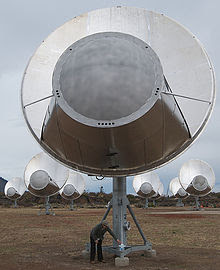
Allen Telescope for SETI


1930 Keith William Morton (born 28 May 1930, Ipswich, Suffolk, England) is a British mathematician working on partial differential equations, and their numerical analysis.

Morton graduated with a B.A. in 1952 and began working in the Theoretical Physics Division of the Atomic Energy Research Establishment at Harwell (which was in Berkshire at the time but, following boundary changes in 1974, is now in Oxfordshire). There he worked on Monte Carlo methods for nuclear criticality and published a number of papers in collaboration with John Michael Hammersley who was Principal Scientific Officer at the Atomic Energy Research Establishment at Harwell at the time. These joint papers are: Transposed branching processes (1954); Poor man's Monte Carlo (1954); The estimation of location and scale parameters from grouped data (1954); and A new Monte Carlo technique: antithetic variates (1956). Poor man's Monte Carlo, which includes a paper and a discussion, was published by the Royal Statistical Society and reviewed by Alston Householder who writes:-

This paper and the subsequent discussion relate chiefly to the art of applying Monte Carlo, and no brief summary can do justice to either. The basic thesis can be inferred from the title, that one does not necessarily need high speed machines to use Monte Carlo effectively. The authors first point out that only the name and not the method is new (the discussion brings out that King Solomon was an early practitioner) and then discuss three problems: the critical size of a nuclear reactor, the test of a quantum hypothesis, and self-avoiding walks.

Alston Householder also reviewed the 1956 paper mentioned above and writes:-

... the paper represents a major contribution to the study of Monte Carlo Methods.  *SAU


DEATHS


1883 Ernst Arnold Kohlschütter (July 6, 1883 – May 28, 1969) a German astronomer and astrophysicist from Halle.
In 1908 he was awarded his Ph.D. from the University of Göttingen.
In 1911 he began working at the Mount Wilson Observatory, studying the spectra of the Sun and stars. In collaboration with Walter Sidney Adams, and in 1914 they discovered that the absolute luminosity of a star was proportional to the relative intensity of the lines in the spectrum. This allowed astronomers to determine the distance of stars, including main sequence and giants, using the spectroscope.
He became the director of the Bonn observatory in 1925. Therein he was dedicated to astrometric studies.
The crater Kohlschütter on the Moon is named in his honor. *Today in Astronomy


 1997 Ronald Vernon Book (April 1937 – May 28, 1997 in Santa Barbara, California) worked in theoretical computer science. He published more than 150 papers in scientific journals.


2003 Ilya Prigogine (25 Jan 1917; 28 May 2003) Russian-born Belgian physical chemist who received the Nobel Prize for Chemistry in 1977 for contributions to nonequilibrium thermodynamics, or how life could continue indefinitely in apparent defiance of the classical laws of physics. The main theme of Prigogine's work was the search for a better understanding of the role of time in the physical sciences and in biology. He attempted to reconcile a tendency in nature for disorder to increase (for statues to crumble or ice cubes to melt, as described in the second law of thermodynamics) with so-called "self-organisation", a countervailing tendency to create order from disorder (as seen in, for example, the formation of the complex proteins in a living creature from a mixture of simple molecules). *TIS


2000 Donald Watts Davies, CBE FRS (7 June 1924 – 28 May 2000) was a Welsh computer scientist who was employed at the UK National Physical Laboratory (NPL).

In 1965 he conceived of packet switching, which is today the dominant basis for data communications in computer networks worldwide. Davies proposed a commercial national data network in the United Kingdom and designed and built the local-area NPL network to demonstrate the technology. Many of the wide-area packet-switched networks built in the 1970s were similar "in nearly all respects" to his original 1965 design. The ARPANET project credited Davies for his influence, which was key to the development of the Internet.

Davies' work was independent of the work of Paul Baran in the United States who had a similar idea in the early 1960s, and who also provided input to the ARPANET project, after his work was highlighted by Davies' team.


***  There are 7 four-digit vampire numbers, 1260, 1395, 1435, 1530, 1827, 2187, 6880,***


Credits :
*CHM=Computer History Museum
*FFF=Kane, Famous First Facts
*NSEC= NASA Solar Eclipse Calendar
*RMAT= The Renaissance Mathematicus, Thony Christie
*SAU=St Andrews Univ. Math History
*TIA = Today in Astronomy
*TIS= Today in Science History
*VFR = V Frederick Rickey, USMA
*Wik = Wikipedia
*WM = Women of Mathematics, Grinstein & Campbell