Thursday, 26 February 2026

On This Day in Math - February 26


Euler calculated without effort,
just as men breathe,
as eagles sustain themselves in the air.

~Francois Arago

The 57th day of the year; 57(base ten) is written with all ones in base seven. It is the last day this year that can be written in base seven with all ones.(What is the last day of the year that can be written with all ones in base two,... base three?)

57 is the maximum number of regions inside a circle formed by chords connecting 7 points on the circle. Students might ask themselves why this is the same as the first five numbers in the sixth row of Pascal's triangle.

57 is the number of permutations of the numbers 1 to 6 in which exactly 1 element is greater than the previous element (called a permutations with 1 "ascents").

57 is the maximum number of possible interior regions formed by 8 intersecting circles.

57 letters and spaces (not counting commas) are required to write the famous prime number 6700417 in English. The number was one of the factors of \(F(5)=2^{2^5}+1 \) Fermat had conjectured that all such "Fermat Numbers" were prime. In 1732, Euler showed that F(5) was the product or 641 times 6700417. Euler never stated that both numbers were prime, and historians still disagree about whether he knew, or even suspected, that it was. 


The number of ways of coloring the faces of a cube with 3 different colors is 57. For coloring a cube with n colors, the number of possible colorings is given by

57, is sometimes known as Grothendieck's prime.  The explanation is given in Amir D. Aczel's last book, Finding Zero.  Grothendieck had used primes as a framework on which to build some more general result when:


EVENTS

1616 Galileo is warned to abandon Copernican views. On February 19, 1616, the Inquisition had asked
Costa San Giorgio, near Ponte Vecchio ...

a commission of theologians, known as qualifiers, about the propositions of the heliocentric view of the universe after Nicollo Lorin had accused Galileo of Heretical remarks in a letter to his former student, Benedetto Castelli. On February 24 the Qualifiers delivered their unanimous report: the idea that the Sun is stationary is "foolish and absurd in philosophy, and formally heretical since it explicitly contradicts in many places the sense of Holy Scripture..."; while the Earth's movement "receives the same judgement in philosophy and ... in regard to theological truth it is at least erroneous in faith."At a meeting of the cardinals of the Inquisition on the following day, Pope Paul V instructed Bellarmine to deliver this result to Galileo, and to order him to abandon the Copernican opinions; should Galileo resist the decree, stronger action would be taken. On February 26, Galileo was called to Bellarmine's residence, and accepted the orders. *Wik A transcript filed by the 1633 Inquisition indicates he was also enjoined from either speaking or writing about his theory. Yet Galileo remained in conflict with the Church. He was eventually interrogated by the Inquisition in Apr 1633. On 22 Jun 1633, Galileo was sentenced to prison indefinitely, with seven of ten cardinals presiding at his trial affirming the sentencing order. Upon signing a formal recantation, the Pope allowed him to live instead under house-arrest. From Dec 1633 to the end of his life on 8 Jan 1641, he remained in his villa at Florence.*TIS In 1992, the Vatican officially declared that Galileo had been the victim of an error.


1665 A letter from Christiaan Huygens to his father, Constantyn Huygens describes the discovery of synchronization between two pendulum clocks in his room.
While I was forced to stay in bed for a few days and made observations on my two clocks of the new workshop, I noticed a wonderful effect that nobody could have thought of before. The two clocks, while hanging [on the wall] side by side with a distance of one or two feet between, kept in pace relative to each other with a precision so high that the two pendulums always swung together, and never varied. While I admired this for some time, I finally found that this happened due to a sort of sympathy: when I made the pendulums swing at differing paces, I found that half an hour later, they always returned to synchronism and kept it constantly afterwards, as long as I let them go.


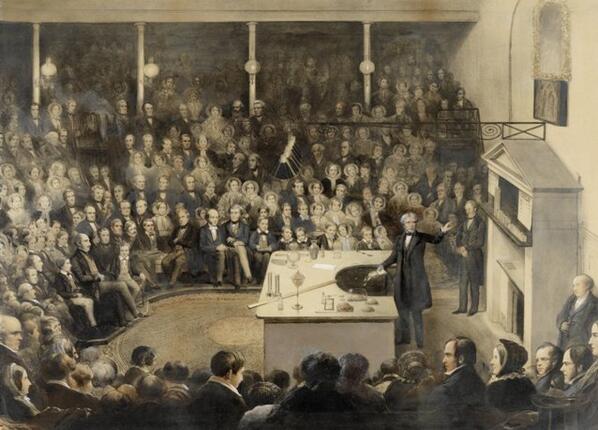
1849 Prince Albert visited the RI  for the 1st time to hear a lecture by Faraday. *Royal Institution ‏@ri_science 


1855 Carl F. Gauss' body lay in state under the dome in the rotunda of the observatory in Gottingen two days after his death.  At nine o'clock a group of 12 students of science and mathematics, including Dedikind, carried the coffin out of the observatory and to his final resting place in St. Alben's Church Cemetery. After the casket was lowered it was covered with  covered with palms and laurel .
Gauss' Headstone *Wik


1885 “The Burroughs Company brought out their first adding machine and announced that it would sell for \( $27.75 \) plus \($1.39 \) shipping charges, for a total of whatever that came to.” *Tom Koch, 366 Dumb Days in History by Tom Koch  
After posting this, I was informed by *Keenan Patterson that "William Burroughs lived in St. Louis when he designed his calculating machine. His namesake grandson was a novelist ." And Thony Christie sites the younger as " one of the great authors of the second half of the twentieth century "


In 1896, Henri Becquerel stored a wrapped photographic plate in a closed desk drawer, and a phosphorescent uranium compound laid on top, awaiting a bright day to test his idea that sunlight would make the phosphorescent uranium emit rays. It remained there several days. Thus by sheer accident, he created a new experiment, for when he developed the photographic plate on 1 Mar 1896, he found a fogged image in the shape of the rocks. The material was spontaneously generating and emitting energetic rays totally without the external sunlight source. This was a landmark event. The new form of penetrating radiation was the discovery of the effect of radioactivity. He had in fact reported an earlier, related experiment to the French Academy on 24 Feb 1896, though at that time he thought phosphorescence was the cause.*TIS   The Image of Becquerel's photographic plate which has been fogged by exposure to radiation from a uranium salt. The shadow of a metal Maltese Cross placed between the plate and the uranium salt is clearly visible.*Wik


1935 The first test of the ideas presented in Robert Watson-Watt's earlier memo, "Detection and location of aircraft by radio methods", were conducted on this date in a field near Upper Stowe, about three miles south of Weedon Bec in Northamptonshire. The tests were successful and on several occasions a clear signal was seen on the oscilloscopes hidden in the back of  an ambulance  from a Handley Page Heyford bomber being flown around the site by Bobby Blucke, who would later become Air Vice-Marshal Blucke. The tests were so secret that only three people were allowed to witness them, Watson-Watt, his colleague Arnold Wilkins, and a single member of the Air Ministry, A. P. Rowe

*Wik


1962 A new teaching method based on “how and why things happen in mathematics rather than on traditional memorization of rules” is announced by the Educational Research Council of Greater Cleveland. This became the Cleveland Program of the New Math.*VFR

*Wik 

1996 Silicon Graphics Inc. buys Cray Research for $767 million, becoming the leading supplier of high-speed computing machines in the U.S. Over a forty year career, Cray founder Seymour Cray consistently produced most of the fastest computers in the world-- innovative, powerful supercomputers used in defense, meteorological, and scientific investigations. *CHM


2012 New world record distance for paper airplane throw: Joe Ayoob, a former Cal Quarterback, throws a John Collins paper airplane design, (which was named Suzanne), officially breaking the world record by 19 feet, 6 inches. The new world record was 226 feet, 10 inches. The previous record is 207 feet and 4 inches set by Stephen Kreiger in 2003. *ESPN  


As happens with records,  after over a decade their had record remained unassailable. But a team of three paper airplane experts worked together to take a shot at the title, and on April 16, 2022, Kim Kyu Tae threw a paper glider 252 feet and 7 inches (77.134 meters), utterly shattering the record that stood for so long. (They said they had done much better in practices, and warned of more to come.)


BIRTHS

1585 Federico Cesi (26 Feb OR 13 Mar 1585 (sources differ, but Thony Christie did some research to suggest the Feb date is the correct one); 1 Aug 1630 at age 45) Italian scientist who founded the Accademia dei Lincei (1603, Academy of Linceans or Lynxes), often cited as the first modern scientific society, and of which Galileo was the sixth member (1611). Cesi first announced the word telescope for Galileo's instrument. At an early age, while being privately educated, Cesi became interested in natural history and that believed it should be studied directly, not philosophically. The name of the Academy, which he founded at age 18, was taken from Lynceus of Greek mythology, the animal Lynx with sharp sight. He devoted the rest of his life to recording, illustrating and an early classification of nature, especially botany. The Academy was dissolved when its funding by Cesi ceased upon his sudden death(at age 45). *TIS It was revived in its currently well known form of the Pontifical Academy of Sciences, by the Vatican, Pope Pius IX in 1847.


1664 Nicolas Fatio de Duillier (alternative names are Facio or Faccio;) (26 February 1664 – 12 May 1753) was a Swiss mathematician known for his work on the zodiacal light problem, for his very close (some have suggested "romantic" ) relationship with Isaac Newton, for his role in the Newton v. Leibniz calculus controversy , and for originating the "push" or "shadow" theory of gravitation.
[Le Sage's theory of gravitation is a kinetic theory of gravity originally proposed by Nicolas Fatio de Duillier in 1690 and later by Georges-Louis Le Sage in 1748. The theory proposed a mechanical explanation for Newton's gravitational force in terms of streams of tiny unseen particles (which Le Sage called ultra-mundane corpuscles) impacting all material objects from all directions. According to this model, any two material bodies partially shield each other from the impinging corpuscles, resulting in a net imbalance in the pressure exerted by the impact of corpuscles on the bodies, tending to drive the bodies together.]

He also developed and patented a method of perforating jewels for use in clocks.
When Leibniz sent a set of problems for solution to England he mentioned Newton and failed to mention Faccio among those probably capable of solving them. Faccio retorted by sneering at Leibniz as the ‘second inventor’ of the calculus in a tract entitled ‘Lineæ brevissimæ descensus investigatio geometrica duplex, cui addita est investigatio geometrica solidi rotundi in quo minima fiat resistentia,’ 4to, London, 1699. Finally he stirred up the whole Royal Society to take a part in the dispute (Brewster, Memoirs of Sir I. Newton, 2nd edit. ii. 1–5).
In 1707, Fatio came under the influence of a fanatical religious sect, the Camisards, which ruined Fatio's reputation. He left England and took part in pilgrim journeys across Europe. After his return only a few scientific documents by him appeared. He died in 1753 in Maddersfield near Worcester, England. After his death his Geneva compatriot Georges-Louis Le Sage tried to purchase the scientific papers of Fatio. These papers together with Le Sage's are now in the Library of the University of Geneva.
Eventually he retired to Worcester, where he formed some congenial friendships, and busied himself with scientific pursuits, alchemy, and the mysteries of the cabbala. In 1732 he endeavoured, but it is thought unsuccessfully, to obtain through the influence of John Conduitt [q. v.], Newton's nephew, some reward for having saved the life of the Prince of Orange. He assisted Conduitt in planning the design, and writing the inscription for Newton's monument in Westminster Abbey. *Wik


1786 Dominique François Jean Arago (26 Feb 1786, 2 Oct 1853) was a French physicist and astronomer who discovered the chromosphere of the sun (the lower atmosphere, primarily composed of hydrogen gas), and for his accurate estimates of the diameters of the planets. Arago found that a rotating copper disk deflects a magnetic needle held above it showing the production of magnetism by rotation of a nonmagnetic conductor. He devised an experiment that proved the wave theory of light, showed that light waves move more slowly through a dense medium than through air and contributed to the discovery of the laws of light polarization. Arago entered politics in 1848 as Minister of War and Marine and was responsible for abolishing slavery in the French colonies. *TIS A really great blog about Arago, With the catchy title, "François Arago: the most interesting physicist in the world!" is posted here. Read this introduction, and you will not be able to resist:

When he was seven years old, he tried to stab a Spanish solider with a lance
When he was eighteen, he talked a friend out of assassinating Napoleon
He once angered an archbishop so much that the holy man punched him in the face
He has negotiated with bandits, been chased by a mob, broken out of prison
He is:
François Arago, the most interesting physicist in the world


1799 Benoit Clapeyron (26 Feb 1799, 28 Jan 1864) French engineer who expressed Sadi Carnot's ideas on heat analytically, with the help of graphical representations. While investigating the operation of steam engines, Clapeyron found there was a relationship (1834) between the heat of vaporization of a fluid, its temperature and the increase in its volume upon vaporization. Made more general by Clausius, it is now known as the Clausius-Clapeyron formula. It provided the basis of the second law of thermodynamics. In engineering, Clayeyron designed and built locomotives and metal bridges. He also served on a committee investigating the construction of the Suez Canal and on a committee which considered how steam engines could be used in the navy.*TIS


1842 Nicolas Camille Flammarion (26 Feb 1842; 3 Jun 1925 at age 83) was a French astronomer who studied double and multiple stars, the moon and Mars. He is best known as the author of popular, lavishly illustrated, books on astronomy, including Popular Astronomy (1880) and The Atmosphere (1871). In 1873, Flammarion (wrongly) attributed the red color of Mars to vegetation when he wrote “May we attribute to the color of the herbage and plants which no doubt clothe the plains of Mars, the characteristic hue of that planet...” He supported the idea of canals on Mars, and intelligent life, perhaps more advanced than earth's. Flammarion reported changes in one of the craters of the moon, which he attributed to growth of vegetation. He also wrote novels, and late in life he turned to psychic research. *TIS
The "Flammarion engraving" first appeared in Flammarion's 1888 edition of L’Atmosphère. In 1907, he wrote that he believed that dwellers on Mars had tried to communicate with Earth in the past. He also believed in 1907 that a seven-tailed comet was heading toward Earth. In 1910, for the appearance of Halley's Comet, he was widely but falsely reported as believing the gas from the comet's tail "would impregnate [the Earth’s] atmosphere and possibly snuff out all life on the planet".

In 1862 he published his first book, The Plurality of Inhabited Worlds, and was dismissed from his position at the Paris Observatory later the same year. It is not quite clear if these two incidents are related to each other.
La Fin du Monde (The End of the World), 1893 (translated into English as Omega: The Last Days of the World in 1894), is a science fiction novel about a comet colliding with the Earth, followed by several million years leading up to the gradual death of the planet, and has recently been brought back into print. It was adapted into a film in 1931 by Abel Gance.

George Gamow cited Flammarion as having had a significant influence on his childhood interest in science.
A traveller puts his head under the edge of the firmament in the original (1888) printing of the Flammarion wood engraving. And below "Telefonoscope" from his La Fin du Monde, 1894.  A telephonoscope was an early concept of videophone and television, conceptualized in the late 1870s through the 1890s. It was mentioned in various early science fiction works


1843 Karl Friedrich Geiser (26 Feb 1843 in Langenthal, Bern, Switzerland, 7 May 1934 in Küsnacht, Zürich, Switzerland) Swiss mathematician who worked in algebraic geometry and minimal surfaces. He organised the first International Mathematical Congress in Zurich.*SAU


1864 John Evershed (26 Feb 1864, 17 Nov 1956) English astronomer who discovered (1909) the Evershed effect - the horizontal motion of gases outward from the centres of sunspots. While photographing solar prominences and sunspot spectra, he noticed that many of the Fraunhofer lines in the sunspot spectra were shifted to the red. By showing that these were Doppler shifts, he proved the motion of the source gases. This discovery came to be known as the Evershed effect. He also gave his name to a spectroheliograph, the Evershed spectroscope.*TIS 
The Indian Institute of Astrophysics commemorated the discovery with an international conference entitled 'Magnetic Coupling between the Interior and the Atmosphere of the Sun', during Dec 2-5, 2008. To mark the discovery, a commemorative stamp and a first day cover on the Evershed Effect were released in a special function at the Institute on Dec 2, 2008 by Shri M P Rajan, Chief Post Master General, Karnataka. 


1946 Ahmed Hassan Zewail (February 26, 1946 – August 2, 2016) was an Egyptian-American scientist, known as the "father of femtochemistry". He was awarded the 1999 Nobel Prize in Chemistry for his work on femtochemistry and became the first Egyptian and the first Arab to win a Nobel Prize in a scientific field. He was the Linus Pauling Chair Professor of Chemistry, Professor of Physics, and the director of the Physical Biology Center for Ultrafast Science and Technology at the California Institute of Technology.
Zewail died aged 70 on the evening of August 2, 2016, after a long battle with cancer. *Wik


DEATHS
1638 Claude-Gaspar Bachet de M´eziriac (9 Oct 1581, 26 Feb 1638), noted for his work in number theory and mathematical recreations. He published the Greek text of Diophantus’s Arithmetica in 1621. This is the translation that Fermat used and in which he wrote the famous afghan note for FLT. He asked the first ferrying problem: Three jealous husbands and their wives wish to cross a river in a boat that will only hold two persons, in such a manner as to never leave a woman in the company of a man unless her husband is present. (With four couples this is impossible.)*VFR (I admit that I don't know how this differs from the similar river crossings problems of Alcuin in the 800's, Help someone?)His books on mathematical puzzles formed the basis for almost all later books on mathematical recreations.*SAU He was also the first to use continued fractions in the solution of indeterminate equations. Some have given him credit for Bezot's identity (Let a and b be integers with greatest common divisor d. Then there exist integers x and y such that ax + by = d. )

.Title page of the 1621 edition of Diophantus' Arithmetica, translated into Latin by Claude Gaspard Bachet de Méziriac.


1693 Sir Charles Scarborough MP FRS FRCP (19 December 1615 – 26 February 1693) was an English physician and mathematician.
He was born in St. Martin's-in-the-Fields, London in 1615, the son of Edmund Scarburgh, and was sent to St. Paul's School, whence he proceeded to Caius College, Cambridge, and educated at St Paul's School, Gonville and Caius College, Cambridge (BA, 1637, MA, 1640) and Merton College, Oxford (MD, 1646). While at Oxford he was a student of William Harvey, and the two would become close friends. Scarborough was also tutor to Christopher Wren, who was for a time his assistant.
While at Cambridge, Scarburgh became acquainted with Seth Ward (1617–1689), who shared his interest in mathematics. Ward would later go on to become the Savilian Professor of Astronomy at Oxford, as well as the Bishop of Exeter. Both Ward and Scarburgh taught mathematics classes, and one mathematics textbook that we know they both used was Clavis mathematicae (The Key to Mathematics), first published in 1631 by William Oughtred , who was perhaps most famous for constructing the first slide rule. Clavis mathematicae was written while Oughtred was serving as the tutor to the son of a nobleman, and it included algorithms and problem solving in arithmetic, algebra and geometry
In order to ask questions about the text, Ward and Scarburgh actually visited Oughtred in Albury, which is located southwest of London and about 100 miles from Cambridge. Oughtred mentioned both of them in the 1652 edition of his work, and he particularly praised Scarburgh’s skill in mathematics as well as his mastery of the work of Euclid and Archimedes. 
The relationship between Oughtred and Scarburgh continued throughout their lives, and Scarburgh completed the posthumous revision and publication of Oughtred’s remaining papers in a single volume in 1676. While these last manuscripts were not considered to be major works, Oughtred still must have had a high opinion of Scarburgh’s scholarship to entrust him with the task 
Following the Restoration in 1660, Scarborough was appointed physician to Charles II, who knighted him in 1669; Scarborough attended the king on his deathbed, and was later physician to James II and William and Mary. During the reign of James II, Scarborough served (from 1685 to 1687) as Member of Parliament for Camelford in Cornwall.
Scarborough was an original fellow of the Royal Society and a fellow of the Royal College of Physicians, author of a treatise on anatomy, Syllabus Musculorum, which was used for many years as a textbook, and a translator and commentator of the first six books of Euclid's Elements (published in 1705). He also was the subject of a poem by Abraham Cowley, An Ode to Dr Scarborough.
Scarborough died in London in 1693. He was buried at Cranford, Middlesex, where there is a monument to him in the parish church erected by his widow. *Wik


On this day in 1765, Nevil Maskelyne was appointed the fifth Astronomer Royal to succeed Nathaniel Bliss who had only held the post for two years.  Bliss was successor to Edmund Halley in the position.
Bliss studied at Oxford University and later became the Savilian Professor of Geometry. He made important meridian observations of a comet and a solar eclipse visible from Greenwich, and many of his observations proved useful in solving the longitude problem, and were bought by the Board of Longitude after his death. *Wik


1878 Pietro Angelo Secchi (18 Jun 1818, 26 Feb 1878 at age 59) Italian Jesuit priest and astrophysicist, who made the first survey of the spectra of over 4000 stars and suggested that stars be classified according to their spectral type. He studied the planets, especially Jupiter, which he discovered was composed of gasses. Secchi studied the dark lines which join the two hemispheres of Mars; he called them canals as if they where the works of living beings. (These studies were later continued by Schiaparelli.) Beyond astronomy, his interests ranged from archaeology to geodesy, from geophysics to meteorology. He also invented a meteorograph, an automated device for recording barometric pressure, temperature, wind direction and velocity, and rainfall.*TIS


1985 Tjalling Charles Koopmans (August 28, 1910 – February 26, 1985) was the joint winner, with Leonid Kantorovich, of the 1975 Nobel Memorial Prize in Economic Sciences. Koopmans' early works on the Hartree–Fock theory are associated with the Koopmans' theorem, which is very well known in quantum chemistry. Koopmans was awarded his Nobel prize (jointly with Leonid Kantorovich) for his contributions to the field of resource allocation, specifically the theory of optimal use of resources. The work for which the prize was awarded focused on activity analysis, the study of interactions between the inputs and outputs of production, and their relationship to economic efficiency and prices.*SAU


2017  Ludvig Dmitrievich Faddeev ( 23 March 1934 – 26 February 2017) was a Soviet and Russian mathematical physicist. He is known for the discovery of the Faddeev equations in the quantum-mechanical three-body problem and for the development of path-integral methods in the quantization of non-abelian gauge field theories, including the introduction of the Faddeev–Popov ghosts (with Victor Popov). He led the Leningrad School, in which he along with many of his students developed the quantum inverse scattering method for studying quantum integrable systems in one space and one time dimension. This work led to the invention of quantum groups by Drinfeld and Jimbo.

Faddeev was born in Leningrad to a family of mathematicians. His father, Dmitry Faddeev, was a well-known algebraist, professor of Leningrad University and member of the Russian Academy of Sciences. His mother, Vera Faddeeva,(20 Sept, 1906 - 15 April, 1983) was known for her work in numerical linear algebra. Faddeev attended Leningrad University, receiving his undergraduate degree in 1956. He enrolled in physics, rather than mathematics, "to be independent of [his] father". Nevertheless, he received a solid education in mathematics as well "due to the influence of V. A. Fock and V. I. Smirnov". His doctoral work on scattering theory was completed in 1959 under the direction of Olga Ladyzhenskaya


Credits :
*CHM=Computer History Museum
*FFF=Kane, Famous First Facts
*NSEC= NASA Solar Eclipse Calendar
*RMAT= The Renaissance Mathematicus, Thony Christie
*SAU=St Andrews Univ. Math History
*TIA = Today in Astronomy
*TIS= Today in Science History
*VFR = V Frederick Rickey, USMA
*Wik = Wikipedia
*WM = Women of Mathematics, Grinstein & Campbell


Wednesday, 25 February 2026

On This Day in Math - February 25


Cathedral Church of St Paul the Apostle *Wik


People must understand that science is inherently neither a potential for good nor for evil. 
It is a potential to be harnessed by man to do his bidding.

~Glenn T. Seaborg

The 56th day of the year; There are 56 normalized 5x5 Latin Squares (First row and column have 1,2,3,4,5; and no number appears twice in a row or column. There are a much smaller number of 4x4 squares, try them first)

56 is the sum of the first six triangular numbers (56= 1 + 3 + 6 + 10 + 15 + 21) and thus the sixth tetrahedral number. It is also the sum of six consecutive primes. 3 + 5 + 7 + 11 + 13 + 17

Fifty-Six is a city in Stone County, Arkansas, United States. As of the 2020 census, the city had a total population of 158, an decrease of 15 persons from 2010.
When founding the community in 1918, locals submitted the name "Newcomb" for the settlement. This request was rejected, and the federal government internally named the community for its school district number (56)

As the sign says, the beautiful Blanchard Caverns are there. It is the only tourist site owned by the U S Forrest Service.


The Aubrey holes are a ring of fifty-six Chalk pits at Stonehenge, named after the seventeenth-century antiquarian John Aubrey. They date to the earliest phases of Stonehenge in the late fourth and early third millennium BC. Their purpose is still unknown. *Wik


EVENTS

1598 John Dee demonstrates the solar eclipse by viewing an image through a pinhole. Two versions from Ashmole and Aubrey give different details of who was present. Dee's Diary only contains the notation, "the eclips. A clowdy day, but great darkness about 9 1/2 maine " *Benjamin Wooley, The Queen's Conjuror


1606 Henry Briggs sends a Letter to Mr. Clarke, of Gravesend, dated from Gresham College, with which he sends him the description of a ruler, called Bedwell's ruler, with directions how to use it. (it seems from the letter to be a ruler for measuring the volume of timber. If you have information on where I could see a picture or other image of the device, please advise) *Augustus De Morgan, Correspondence of scientific men of the seventeenth century.  It seems to be similar to Gunter's scale,  a predecessor of the slide rule and calculating aid used from the 17th century until the 1970s. 

William Bedwell (1561 – 5 May 1632 near London) was an English priest and scholar, specializing in Arabic and other "oriental" languages as well as in mathematics. Bedwell also invented a ruler for geometrical purposes, similar to the Gunter's scale. He died at his vicarage at the age of 72.

BEDWELL, William (1563-1632, editor). The Turnament of Tottenham ... written long since in verse by Mr. Gilbert Pilkington ... taken out of an ancient manuscript ... by Wilhlm [sic] Bedwell. - BEDWELL, W. A Briefe Description of the Towne of Tottenham High-Crosse in Middlesex.


1702  Maria Margaretha Kirch (née Winckelmann, in historic sources named Maria Margaretha Kirchin; 25 February 1670 – 29 December 1720) was a German astronomer. She was one of the first famous astronomers of her period due to her writing on the conjunction of the sun with Saturn, Venus, and Jupiter in 1709 and 1712 respectively.  

Maria and Gottfried worked together as a team. In typical guild fashion she advanced from her position as Arnold's apprentice, to become assistant to her husband. Her husband had studied astronomy at the University of Jena and had served as apprentice to Johannes Hevelius.[5] At the academy she worked as his unofficial, but recognised assistant. Women's position in the sciences was akin to their position in the guilds, valued, but subordinate. Together they made observations and performed calculations to produce calendars and ephemerides.


During the first decade of her work at the academy as her husband's assistant Kirch would observe the heavens, every evening starting at 9 p.m. During such a routine observation she discovered a comet. On 21 April 1702 Kirch discovered the so-called "Comet of 1702" (C/1702 H1).Today there is no doubt about Kirch's priority in discovering C/1702 H1. However, at the time her husband was credited with the discovery. In his notes from that night her husband recorded:  "Early in the morning (about 2:00 AM) the sky was clear and starry. Some nights before, I had observed a variable star and my wife (as I slept) wanted to find and see it for herself. In so doing, she found a comet in the sky. At which time she woke me, and I found that it was indeed a comet... I was surprised that I had not seen it the night before".

This comet was actually discovered a day prior by two astronomers in Rome, Italy, Francesco Bianchini and Giacomo Filippo Maraldi


1672 (NS) John Wallis collects his work on tangents in a letter to Oldenburg for publication in the Philosophical Transactions. According to a letter from Collins to James Gregory, "I mentioned Slusius (René-François de Sluse) his intent to publish his method de maximis et minimis et tangentibus, which Dr. Wallis hearing of hath sent up his owne Notations about the same, which should have been printed in the last Transactions, but is deferred to the next one newly come out." *John Wallis, Philip Beeley, Christoph J. Scriba, Correspondence of John Wallis (1616-1703)


1839 Appropriately, it was an astronomer who coined the term photography, but the question is, which one. Some credit Johann Heinrich von Madler for combining “photo” (from the Greek word for “light”) and “graphy” (“to write”). *APS.org  Madler's claim rests on a paper supposedly written on 25 February 1839 in the German newspaper Vossische Zeitung. Many still credit Sir John Herschel both for coining the word and for introducing it to the public. His uses of it in private correspondence prior to 25 February 1839 and at his Royal Society lecture on the subject in London on 14 March 1839 have long been amply documented and accepted as settled facts. *Wik

In 1830 Mädler began producing drawings of Mars which later became the first true maps of that planet. They were the first to choose what is today known as Sinus Meridiani as the prime meridian for Martian maps.  He made a preliminary determination for Mars's rotation period, which was off by almost 13 seconds. A later determination in 1837 was off by only 1.1 seconds.

He  also produced the first exact map of the Moon, Mappa Selenographica, published in four volumes in 1834–1836.

Title page to a 1861 first edition copy of "Der Wunderbau des Weltalls oder Populäre Astronomie"


1870 Hermann Amandus Schwarz sent his friend Georg Cantor a letter containing the first rigorous proof of the theorem that if the derivative of a function vanishes then the function is constant. See H. Meschkowski, Ways of Thought of Great Mathematicians, pp. 87–89 for an English translation of the letter. *VFR


1959 The APT Language is Demonstrated: The Automatically Programmed Tools language is demonstrated. APT is an English-like language that tells tools how to work and is mainly used in computer-assisted manufacturing.
NEW YORKER: Cambridge, Mass. - Feb. 25: The Air Force announced today that it has a machine that can receive instructions in English - figure out how to make whatever is wanted- and teach other machines how to make it. An Air Force general said it will enable the United States to build a war machine that nobody would want to tackle. Today it made an ashtray. *CHM


1976 Romania issued a stamp picturing the mathematician Anton Davidoglu (1876–1958). [Scott #2613] *VFR

a Romanian mathematician who specialized in differential equations. He studied under Jacques Hadamard at the École Normale Supérieure in Paris, defending his Ph.D. dissertation in 1900. His thesis — the first mathematical investigation of deformable solids — applied Émile Picard's method of successive approximations to the study of fourth order differential equations that model traverse vibrations of non-homogeneous elastic bars.

Davidoglu was a founding member of the Romanian Academy of Sciences, and was featured on a 1976 Romanian postage stamp. He died in 1958 in Bucharest.


BIRTHS

1304 Ibn Battuta, a Muslim traveler, was born Feb. 25, 1304, in Tangier, Morocco. Although nearly every Westerner has heard of Marco Polo, few are aware of Ibn Battuta, yet Ibn Battuta left Marco in the dust travel-wise (the proverbial dust, since Ibn Battuta sojourned some 50 years after Marco), travelling over three times as far, under much more difficult circumstances. When he was in his early 20s, like every good Muslim, Ibn Battuta prepared for his hajj, or pilgrimage to Mecca. He said goodbye to his parents, headed east along the Mediterranean coast of Africa, and made it to the Islamic holy land. The difference was that Ibn Battuta did not return home for almost 30 years. Travelling in caravans for protection, he toured much of the Middle East, then headed down to the horn of Africa, and then further on down the coast as far as Kilwa in Tanzania (as far south as any Muslim ever got). He journeyed up into Afghanistan, then on to India, Southeast Asia, and up into China, as far as Beijing 

Perhaps the most impressive leg of his travels was his last one, across the Sahara and down into West Africa and the kingdom of Mali, crossing 1000 miles of desert in the process. When he finally returned to Morocco in 1354, he dictated a narrative of his travels, which is known as the Rihla, or Journey, of Ibn Battuta. It survived in a number of manuscripts, but hardly anyone noticed until the French found several manuscripts in Algeria in the 19th century and translated the Rihla into French. *Linda Hall Org


1670 Maria Winckelmann (Maria Margarethe Winckelmann Kirch (25 Feb 1670 in Panitzsch, near Leipzig, Germany - 29 Dec 1720 in Berlin, Germany) was a German astronomer who helped her husband with his observations. She was the first woman to discover a comet.*SAU 

Kirch was original educated by her father and her uncle who believed that girls should receive the same education as boys. From them she learnt mathematics and astronomy going on to study with and work together with the amateur astronomer Christoph Arnold. Through Arnold she got to know the astronomer Gottfried Kirch and despite the fact that he was 30 years older than her they married. Kirch was official astronomer of the Berlin Royal Academy of Science and he and Maria ran the Academy’s observatory together for many years. In 1702 she became the first woman to discover a comet but the credit for the discovery was given to her husband. When Gottfried died in 1710 Maria applied for his position arguing correctly that she had done half of the work in the past. Despite her having published independently and having an excellent reputation as well as the active support of Leibniz the Academy refused to award her the post. She worked in various other observatories until 1717 when her son was appointed to his father's post, Maria once again becoming the assistant. Despite having more than proved her equality to any male astronomer Maria never really received the recognition she deserved." From Thony Christie's Renaissance Mathematicus blog on Daughters of Urania.


1827 Henry William Watson (25 Feb 1827 in Marylebone, London, England - 11 Jan 1903 in Berkswell (near Coventry), England) was an English mathematician who wrote some influential text-books on electricity and magnetism. *SAU

He was educated at King's College London and at Trinity College, Cambridge. He graduated as second wrangler and Smith's prizeman in 1850, Dr. W. H. Besant being senior wrangler. In 1851 he became fellow of Trinity college, and from 1851 to 1853 was assistant tutor there. Watson formed a close friendship with James Fitzjames Stephen, who entered Trinity in 1847. From 1853 he was mathematical master in the City of London School, and in 1857 he became mathematical lecturer at King′s College.*Wik


1902 Kenjiro Shoda (February 25, 1902 – March 3, 1977 *SAU gives March 20 for death) was a Japanese mathematician. He was interested in group theory, and went to Berlin to work with Issai Schur. After one year in Berlin, Shoda went to Göttingen to study with Emmy Noether. Noether's school brought a mathematical growth to him. In 1929 he returned to Japan. Soon afterwards, he began to write Abstract Algebra, his mathematical textbook in Japanese for advanced learners. It was published in 1932 and soon recognised as a significant work for mathematics in Japan. It became a standard textbook and was reprinted many times.*Wik


1915  Fr. James Robert C. McConnell (Dublin 25 February 1915;  13 February 1999) was an Irish Catholic priest and theoretical physicist. McConnell entered University College Dublin (UCD) in 1932 and graduated in 1936 with a first-class honours master's degree in mathematics. After leaving UCD, McConnell began his study for the priesthood, entering Clonliffe College. He moved to Rome after a year and earned a B.D., B.C.L., and S.T.L. and was ordained in 1939. He was made a Doctor of Mathematical Sciences by the Royal University of Rome (La Sapienza) in 1941.

McConnell was appointed a scholar in the newly founded Dublin Institute for Advanced Studies in 1942. He was appointed Professor of Mathematical Physics in St. Patrick's College, Maynooth, having been awarded a D.Sc. from the National University of Ireland for his research there in 1949. He is best known for research on Rotational Brownian motion, the electric and magnetic properties of matter and the theory of the negative proton (or anti-proton).

McConnell was dean of the Faculty of Science, of Maynooth, from 1957 to 1968, and registrar of the college from 1966 to 1968.

McConnell was the 1986 recipient of the RDS Irish Times Boyle Medal for Scientific Excellence. He was appointed to the Pontifical Academy of Sciences in 1990, and honored with the title of Monsignor by Pope John Paul II in 1991 *Wik 


1922 Ernst Gabor Straus (February 25, 1922 – July 12, 1983) was a German-American mathematician who helped found the theories of Euclidean Ramsey theory and of the arithmetic properties of analytic functions. His extensive list of co-authors includes Albert Einstein and Paul Erdős as well as other notable researchers including Richard Bellman, Béla Bollobás, Sarvadaman Chowla, Ronald Graham, László Lovász, Carl Pomerance, and George Szekeres. It is due to his collaboration with Straus that Einstein has Erdős number 2. *Wik


1926 Masatoşi Gündüz İkeda (25 February 1926, Tokyo. - 9 February 2003, Ankara), was a Turkish mathematician of Japanese ancestry, known for his contributions to the field of algebraic number theory.

During his time in Japan , Ikeda conducted research on the theory of rings and the matrix representation of groups. In the 1970s, he turned to algebraic number theory and carried out important studies on the automorphisms and universality of the pure Galois group of the rational number field. In a study published in the famous mathematics journal Crelle's Journal , he showed that the Galois group has a very special structure. *Wik


DEATHS

1723 Sir Christopher Wren (20 Oct 1632; 25 Feb 1723) Architect, astronomer, and geometrician who was the greatest English architect of his time (Some may suggest Hooke as an equal) whose famous masterpiece is St. Paul's Cathedral, among many other buildings after London's Great Fire of 1666. Wren learned scientific skills as an assistant to an eminent anatomist. Through astronomy, he developed skills in working models, diagrams and charting that proved useful when he entered architecture. He inventing a "weather clock" similar to a modern barometer, new engraving methods, and helped develop a blood transfusion technique. He was president of the Royal Society 1680-82. His scientific work was highly regarded by Sir Isaac Newton as stated in the Principia. *TIS
Thony Christie points out that, "Most people don’t realise that as well as being Britain’s most famous 17th century architect, Wren was also a highly respected mathematician. In fact Isaac Newton named him along with John Wallace and William Oughtred as one of the three best English mathematicians of the 17th century. As a young man he was an active astronomer and was a highly vocal supporter of the then still relatively young elliptical astronomy of Johannes Kepler."

(I love the message on his tomb in the Crypt of St. Pauls: Si monumentum requiris circumspice ...."Reader, if you seek his monument, look about you." Lisa Jardine's book is excellent


1775 William Small (13 October 1734; Carmyllie, Angus, Scotland – 25 February 1775; Birmingham, England). He attended Dundee Grammar School, and Marischal College, Aberdeen where he received an MA in 1755. In 1758, he was appointed Professor of Natural Philosophy at the College of William and Mary in Virginia, then one of Britain’s American colonies.
Small is known for being Thomas Jefferson's professor at William and Mary, and for having an influence on the young Jefferson. Small introduced him to members of Virginia society who were to have an important role in Jefferson's life, including George Wythe a leading jurist in the colonies and Francis Fauquier, the Governor of Virginia.
Recalling his years as a student, Thomas Jefferson described Small as:

"a man profound in most of the useful branches of science, with a happy talent of communication, correct and gentlemanly manners, and a large and liberal mind... from his conversation I got my first views of the expansion of science and of the system of things in which we are placed."

In 1764 Small returned to Britain, with a letter of introduction to Matthew Boulton from Benjamin Franklin. Through this connection Small was elected to the Lunar Society, a prestigious club of scientists and industrialists.
In 1765 he received his MD and established a medical practice in Birmingham, and shared a house with John Ash, a leading physician in the city. Small was Boulton's doctor and became a close friend of Erasmus Darwin, Thomas Day, James Keir, James Watt, Anna Seward and others connected with the Lunar Society. He was one of the best-liked members of the society and an active contributor to their debates.
Small died in Birmingham on 25 February 1775 from malaria contracted during his stay in Virginia. He is buried in St. Philips Church Yard, Birmingham.
The William Small Physical Laboratory, which houses the Physics department at the College of William & Mary, is named in his honor. *Wik


1786 Thomas Wright (22 September 1711 – 25 February 1786) was an English astronomer, mathematician, instrument maker, architect and garden designer. He was the first to describe the shape of the Milky Way and speculate that faint nebulae were distant galaxies.

Wright's publication An Original Theory or New Hypothesis of the Universe (1750) explained the appearance of the Milky Way as "an optical effect due to our immersion in what locally approximates to a flat layer of stars." This work influenced Immanuel Kant in writing his Universal Natural History and Theory of the Heavens (1755). The theory was later empirically advanced by William Herschel in 1785,[6] leading to galactocentrism (a form of heliocentrism, with the Sun at the center of the Milky Way). Another of Wright's ideas, which is also often attributed to Kant, was that many faint nebulæ are actually incredibly distant galaxies. Wright wrote:

...the many cloudy spots, just perceivable by us, as far without our Starry regions, in which tho' visibly luminous spaces, no one star or particular constituent body can possibly be distinguished; those in all likelihood may be external creation, bordering upon the known one, too remote for even our telescopes to reach. *Wik

Wright's observatory/folly at Westerton, County Durham


1947 Louis Carl Heinrich Friedrich Paschen (22 Jan 1865; 25 Feb 1947) was a German physicist who was an outstanding experimental spectroscopist. In 1895, in a detailed study of the spectral series of helium, an element then newly discovered on earth, he showed the identical match with the spectral lines of helium as originally found in the solar spectrum by Janssen and Lockyer nearly 40 years earlier. He is remembered for the Paschen Series of spectral lines of hydrogen which he elucidated in 1908. *TIS


1950 Nikolai Nikolaevich Luzin, (also spelled Lusin) (9 December 1883, Irkutsk – 28 January 1950, Moscow), was a Soviet/Russian mathematician known for his work in descriptive set theory and aspects of mathematical analysis with strong connections to point-set topology. He was the eponym of Luzitania, a loose group of young Moscow mathematicians of the first half of the 1920s. They adopted his set-theoretic orientation, and went on to apply it in other areas of mathematics.*Wik


1972 Władysław Hugo Dionizy Steinhaus (January 14, 1887 – February 25, 1972) was a Polish mathematician and educator. Steinhaus obtained his PhD under David Hilbert at Göttingen University in 1911 and later became a professor at the University of Lwów, where he helped establish what later became known as the Lwów School of Mathematics. He is credited with "discovering" mathematician Stefan Banach, with whom he gave a notable contribution to functional analysis through the Banach-Steinhaus theorem. After World War II Steinhaus played an important part in the establishment of the mathematics department at Wrocław University and in the revival of Polish mathematics from the destruction of the war.
Author of around 170 scientific articles and books, Steinhaus has left its legacy and contribution on many branches of mathematics, such as functional analysis, geometry, mathematical logic, and trigonometry. Notably he is regarded as one of the early founders of the game theory and the probability theory preceding in his studies, later, more comprehensive approaches, by other scholars. *Wik
His Mathematical Snapshots is a delight to read, but get the first English edition if you can—there are lots of surprises there. *VFR

"When Steinhaus failed to attend an important meeting of the Committee of the Polish Academy of Sciences in 1960, he received a letter chiding him for "not having justified his absence." He immediately wired the President of the Academy that "as long as there are members who have not yet justified their presence, I do not need to justify my absence."

[ Told by Mark Kac in "Hugo Steinhaus -- A Remembrance and a Tribute," Amer. Math. Monthly 81 (June-July 1974) 578. ] * http://komplexify.com

The Scottish Book from the Lwów School of Mathematics, which Steinhaus contributed to and probably saved during World War II.

photo: Contents of the rear pocket of Mathematical Snapshots, by Hugo Steinhaus, 1938 (Linda Hall Library)


1988 Kurt Mahler (26 July 1903, Krefeld, Germany – 25 February 1988, Canberra, Australia) was a mathematician and Fellow of the Royal Society. Mahler proved that the Prouhet–Thue–Morse constant and the Champernowne constant 0.1234567891011121314151617181920... are transcendental numbers.
He was a student at the universities in Frankfurt and Göttingen, graduating with a Ph.D. from Johann Wolfgang Goethe University of Frankfurt am Main in 1927. He left Germany with the rise of Hitler and accepted an invitation by Louis Mordell to go to Manchester. He became a British citizen in 1946.
He was elected a member of the Royal Society in 1948 and a member of the Australian Academy of Science in 1965. He was awarded the London Mathematical Society's Senior Berwick Prize in 1950, the De Morgan Medal, 1971, and the Thomas Ranken Lyle Medal, 1977. *Wik


1999 Glenn Theodore Seaborg (April 19, 1912,Ishpeming, Michigan – February 25, 1999) was an American scientist who won the 1951 Nobel Prize in Chemistry for "discoveries in the chemistry of the transuranium elements", contributed to the discovery and isolation of ten elements, and developed the actinide concept, which led to the current arrangement of the actinoid series in the periodic table of the elements. He spent most of his career as an educator and research scientist at the University of California, Berkeley where he became the second Chancellor in its history and served as a University Professor. Seaborg advised ten presidents from Harry S. Truman to Bill Clinton on nuclear policy and was the chairman of the United States Atomic Energy Commission from 1961 to 1971 where he pushed for commercial nuclear energy and peaceful applications of nuclear science.
The element seaborgium was named after Seaborg by Albert Ghiorso, E. Kenneth Hulet, and others, who also credited Seaborg as a co-discoverer. It was so named while Seaborg was still alive, which proved controversial. He influenced the naming of so many elements that with the announcement of seaborgium, it was noted in Discover magazine's review of the year in science that he could receive a letter addressed in chemical elements: seaborgium, lawrencium (for the Lawrence Berkeley Laboratory where he worked), berkelium, californium, americium
(Once when being aggressively cross-examined during testimony on nuclear energy for a senate committee, the Senator asked, “How much do you really know about Plutonium.” Seaborg quietly answered, “Sir, I discovered it.” , Which he did as part of the team at the Manhattan Project. *Wik


2022 Richard Steven Varga (October 9, 1928 - February 25, 2022) was an American mathematician who specialized in numerical analysis and linear algebra. He was an Emeritus University Professor of Mathematical Sciences at Kent State University and an adjunct Professor at Case Western Reserve University. Varga was known for his contributions to many areas of mathematics, including matrix analysis, complex analysis, approximation theory, and scientific computation. He was the author of the classic textbook Matrix Iterative Analysis. Varga served as the Editor-in-Chief of the journal Electronic Transactions on Numerical Analysis (ETNA).


Credits :
*CHM=Computer History Museum
*FFF=Kane, Famous First Facts
*NSEC= NASA Solar Eclipse Calendar
*RMAT= The Renaissance Mathematicus, Thony Christie
*SAU=St Andrews Univ. Math History
*TIA = Today in Astronomy
*TIS= Today in Science History
*VFR = V Frederick Rickey, USMA
*Wik = Wikipedia
*WM = Women of Mathematics, Grinstein & Campbell