As you know, the harmonic series, h=1 + 1/2 + 1/3 + 1/4 + ..=
 diverges to infinity, but very slowly. For a finite number of terms, the summation is very nearly the same as ln(n). The error in this approximation is considered an important constant in several areas of mathematics and is called the Euler-Mascheroni constant, or more often, gamma and has a value of about .577.
---------------------------------------------------------
I came across a paper by Professor Ed Sandifer that he wrote back in 2007 in which he says, "Sam Kutler, now retired from St. John’s College in Annapolis, once pointed out that there are three great constants in mathematics,
 , e and
  , and that Euler had a role in all three of them. Euler did not discover e or , but he gave both of them their names. In contrast, Euler discovered, but did not name , the third and least known of these constants."
He goes on to point out that Euler and Mascheroni, who names are both often used for the constant, referred to it as A or C.
Jeff Miller's excellent web site on the first use of math symbols gives several of the sources which seem to be based on one mistake being passed on and quoted without verification:
According to William Dunham in Euler, the Master of Us All (1999), Mascheroni introduced the symbol γ for the Euler-Mascheroni constant. Dunham's source is "On the History of Euler's Constant," by J. W. L. Glaisher, which appeared in 1872 in The Messenger of Mathematics. In the paper, Glaisher does not specify where Mascheroni used the symbol, but seems to imply it is in Adnotationes ad Euleri Calculum Integralem, which Glaisher indicates in a footnote is a work he has not seen but which is referred to in volume 3 of Lacroix's Differential and Integral Calculus.
According to the CRC Concise Encyclopedia of Mathematics (2003), Euler used γ in 1781.
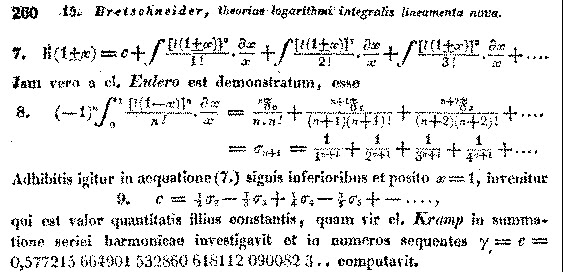
Professor Sandifer finally concludes that probably credit should go to an 1835 article by Carl Anton Bretschneider, the first physical source that seems to include the use, but it seems that Bretschnieder also thought Euler had used it first.
Here is page 260 from [Bretschneider, Carl Anton, Theoriae logarithmi integralis lineamenta nova, Journal für die reine und angewandte Mathematik, (Crelle’s journal) vol. 17, pp. 257-285, Berlin, 1837].
I do have to disagree mildly with one point in Professor Sandifers paper. It was not Euler who named the ratio of the circumference to diameter of a circle as Pi. I will stand by what I have written before that "The first known use of the symbol π for its present purposes was in 1706 by William Jones, an English mathematician, although it was the use of the symbol by Euler that brought it its permanency." Jone's use can be found in “Synopsis Palmariorium Mathesios”.
Since my students assume that all geometry dates back to the ancient Greeks and Egyptians, I should point out that a special pat on the back might go to J Christoph Sturm. Florian Cajori points out that "perhaps the earliest use of a single letter to represent the ratio of the length of a circle to its diameter" occurs in 1689 in Mathesis enucleata by J. Christoph Sturm, who used e for 3.14159....
si diameter alicuius circuli ponatur a, circumferentiam appellari posse ea (quaecumque enim inter eas fuerit ratio, illius nomen potest designari littera e)."


