
Last week Sol at
"Wild About Math" posted a link to the
Wolfram Demo site related to a novel relationship that is not well known to students/teachers. For every rational number,q, on the open interval from 0 to 1, there is a Pythagorean Triple.
Actually the demo may oversell the idea a little, or perhaps I don't completely understand it, but I don't think it enumerates
all the Pythagorean triples, but it is still a nice idea to introduce to students because many of the ideas can be proved with nothing beyond a good grasp of Alg II (for non-US folks, that's about a 14-16 year old students grasp of Algebra).
I had
written about the relation back at the end of 2009. If you haven't read that one, and are not familiar with the idea, you might want to start there.
Anyway, Sol's post got me thinking again about how I would approach this idea with students. The first big idea is that if you pick a point on the y-axis between y=0 and y=1, with a rational y-coefficient, then the line through that point and the point (-1,0) will cross the unit circle in the first quadrant in a point (p,r) whose x and y coordinates are both rational. Since the point is on the unit circle, that means that p
2+r
2 = 1. But since both p and r are rational, they can be written with a common denominator, Wolfram uses (a/c, b/c) and so (a/c)
2+(b/c)
2=1. If we multiply both sides of the expression by c
2, we get a
2+b
2= c
2 and so {a,b,c} is a Pythagorean triple.
So what might we ask our young charges to do with this? Well, first, do we believe that ANY rational on the positive y axis REALLY will produce a rational intersection on the unit circle? The proof requires no more than the solution of a quadratic. If the students are not up to challenging an open proof, have them start by confirming that some given rational y-intercepts will produce a rational intersection on the unit circle, and then go on to find the Pythagorean triple associated with that rational. For example, Wolfram's demo seems to associate the rational 1/2 with a (3,4,5) triangle... can they show why? Can you find the triple associated with 3/7?
I mentioned above that I didn't think this could produce ALL the Pythagorean triples... and we might want to ask our students if they think it could. One of my concerns about the Wolfram presentation is that the point (0, 1/3) is associated with the triple (8,6,10). Why not (4,3,5)??? how did they arrive at the non-primitive triple they chose, and not, for instance, (12,9,15) or ??? pick your favorite. I knew that they had used (3,4,5) in the first example (0, 1/2)...
In fact, would (9,12,15) show up later if I plowed through enough rational fractions? I suspected it wouldn't. First, the symmetry of the situation seemed to play against it. In simplest form, the x coordinate for any version of a (3,4,5) triple must be either 3/5 or 4/5; or at least so it seemed to me.
I think I would challenge my students to work backwards from a given triple and see if they could find the related rational y-intercept. Since we know (see my earlier blog) that the x-coordinate was (1-t
2)/(1+t
2), we could take any primitive triple, say (5,12,13) and set either the x value = 5/13 or 12/13 and get the two (and only two) values that would generate appropriate intersections on the unit circle. As we do this, we discover that the rational always turns out to be

where H is the hypotenuse of the triple, and L is the leg we chose to use for the x-coordinate ratio. For (5,12,13) we get the two rational values 2/3 (this is number 3 on the Wolfram demo) and 1/5 (number 7, but labeled
(24, 10, 26) ) ... Bright students should be challenged to prove that any Primitive Pythagorean triple, will also be such that the ratio (H-L)/(H+L) give will produce a square of a rational number.
So maybe the Wolfram demo is just good enough (and just bad enough) to motivate our students, after all, they love exposing our flaws.




 for any positive integer
  is the set of irreducible rational numbers
  with
with  and
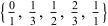
and  arranged in increasing order. The first few are








 , each
  has an