Tuesday, 4 October 2011

On This Day in Math - Oct 4


“What the mathematician predicts today has a habit of becoming what the physicists find tomorrow.”
From the London Times

The 277th day of the year; 277 is the 59th prime number, It is also a self number, and is the largest prime number that can be a day of the year which is a self number (A self number, Colombian number or Devlali number is an integer which, in a given base, cannot be generated by any other integer added to the sum of that other integer's digits. For example, 21 is not a self number, since it can be generated by the sum of 15 and the digits comprising 15, that is, 21 = 15 + 1 + 5. No such sum will generate the integer 20, hence it is a self number. These numbers were first described in 1949 by the Indian mathematician D. R. Kaprekar.... The next prime self number is 367, too large to be the number of a day of the year)

EVENTS
1479 University of Copenhagen founded. The University of Copenhagen was founded in 1479 and is the oldest university in Denmark. Between the closing of the Studium Generale in Lund in 1536 and the establishment of the University of Aarhus in the late 1920s, it was the only university in Denmark. The university became a centre of Roman Catholic theological learning, but also had faculties for the study of law, medicine, and philosophy.
The university was re-established in 1537 after the Lutheran Reformation and transformed into an evangelical-Lutheran seminary. Between 1675 and 1788, the university introduced the concept of degree examinations. An examination for theology was added in 1675, followed by law in 1736. By 1788, all faculties required an examination before they would issue a degree. *Wik

In 1675, Christian Huygens patented a pocket watch. Huygens was a Dutch astronomer an physicist who establishing the wave theory of light and making astronomical discoveries. He also patented the first pendulum clock in 1656, which he has developed to meet his need for exact time measurement while observing the heavens. In 1673, he studied the relation of the length of a pendulum to its period of oscillation.*TIS (Some accounts suggest that Robert Hooke had developed a watch with the coiled spring almost ten years earlier..others question whether Hooke had a coiled spring.)

1582 St Theresa of Avila died overnight on the night between the 4th and the 15th of October. On that day the Gregorian calendar went into effect in Spain and the day after the 4th, was the 15th in order to catch up for the misalignment of the Julian Calendar. *VFR

1934 Enrico Fermi measured the speed of a neutron.*TIS

1938 Paul Erdos arrives at the Institute for Advanced Study at Princeton. Alarmed by Hitler's demands to annex the Sudatenland, Euler hurriedly left Budapest and made his way through Italy and France to London. He would pass through Ellis Island on his way to a position at Princeton's Institute for Advanced Study on October 4. He would not see his homeland again for ten years. * Bruce Schechter, My Brain is Open: The Mathematical Journeys of Paul Erdos

1957 Sputnik I, the first artificial earth satellite was placed in orbit by the Soviets—the Dawn of the Space Age. It traveled at a speed of 18,000 mph and circled the earth about every 95 minutes. The impact that Sputnik had on mathematics was unbelievable. The U. S. Government was convinced that the Russians were ahead of us in mathematics and science, so they poured money into the schools and into teacher retraining. *VFR (Like many of my generation, I stood on the lawn and watched in the evening to see it go by, listening to its broadcast beeps on my portable radio.)

In 1971, the mole - the amount of substance (matter) - was adopted as a chemical measurement added to the six base quantities of the SI (International System of scientific units). The decision was made by the Conférence Général des Poids et Mesures (CGPM), the principal executive organization under the Treaty of the Meter. IUPAC's participation was led by M.L. McGlashan. The mole is the amount of substance of a system which contains as many elementary entities as there are carbon atoms in 0.012 kg of carbon 12. The elementary entities must be specified and may be atoms, molecules, ions, electrons, other particles, or specified groups of such particles. The agreed symbol for the unit is mol, and the symbol for amount of substance is n. *TIS

2000 Mathematics Magazine publishes "A proof that the Halting Problem is undecidable" in poetic form (in the fashion of Dr Seuss) by Geoffrey K. Pullum who was then at Stevenson College, Univ of Calif, Santa Cruz. The first few lines are :
No program can say what another will do.
Now, I won’t just assert that, I’ll prove it to you:
I will prove that although you might work till you drop,
you cannot tell if computation will stop.
It appears that the professor is now at the School of Philosophy, Psychology and Language Sciences, University of Edinburgh, and where he posted a slightly altered version. It seems he has decided the first two lines should be slightly altered.  *@JohnDCook,Twitter The original can be found here.

2011  The Royal Swedish Academy of Sciences has decided to award the Nobel Prize in Physics for 2011 with one half to Saul Perlmutter, of the Supernova Cosmology Project at Lawrence Berkeley National Laboratory and the University of California, Berkeley; and the other half jointly to Brian P. Schmidt, of the High-z Supernova Search Team at Australian National University, Weston Creek, Australia, and Adam G. Riess, of the High-z Supernova Search Team at Johns Hopkins University and the Space Telescope Science Institute, Baltimore for the discovery of the accelerating expansion of the Universe through observations of distant supernovae. *ScienceDaily (Oct. 4, 2011)


BIRTHS
1562 Christian Longomontanus (4 Oct 1562; 8 Oct 1647) Byname of Christian Severin, a Danish astronomer and astrologer who is best known for his association with, and published support for, Tycho Brahe. He became the first professor of astronomy at the University of Copenhagen, and in 1610 he received funds for instruments and he probably constructed a small observatory at his home. Longomontanus used Tycho's data to compile the Astronomia danica (1622), an exposition of the Tychonic system, which holds that the Sun revolves around the Earth and the other planets revolve around the Sun. He began the construction of the Copenhagen Observatory in 1632, but died before its completion.*TIS

1759 Louis François Antoine Arbogast (4 Oct 1759, 18 April 1803) Arbogast was interested in the history of mathematics and classified Mersenne's papers and collected manuscript copies of memoirs and letters of Fermat, Descartes, Johann Bernoulli, Varignon, de L'Hôpital and others. This is an extremely important collection, part of which is now in Paris and part in Florence.
He was friendly with François Français and together they worked on the calculus of derivations and the operational calculus. After Arbogast died in 1803, François Français inherited his collection of manuscripts, and also his mathematical papers. He continued Arbogast's work on the operational calculus and presented a memoir on this topic, in particular applying the methods to study projectiles in a resistant medium, to the Académie des Sciences in 1804. This memoir was very highly praised by Biot in a report of 22 April 1805, but the work was not published.
The historical manuscripts which went to François Français on Arbogast's death were bought by Libri (See Deaths, Sep 28 1869) from a bookseller in Metz in 1839.
We should mention one other important contribution made by Arbogast. He was responsible for the law introducing the decimal metric system in the whole of the French Republic.
Arbogast was elected to the Académie des Sciences in 1792 and the mathematics section of the Institut National in 1796. *SAU

1794 Félix Savary, (Oct 4, 1797, July 15, 1841)was a French astronomer who studied at the École Polytechnique, where he was later a professor of astronomy. He was a librarian at the Bureau des Longitudes between 1823 and 1829, and was elected to the French Academy of Sciences on December 24, 1832.
In his works Mémoire sur les orbites des étoiles doubles and Sur la détermination des orbites que décrivent autour de leur centre de gravité deux étoiles très rapprochées l'une de l'autre, published in 1827, he was the first to use observations of a visual binary star to calculate the orbit of one star about the other. He applied his method to the star ξ Ursae Majoris.
He worked with Ampère, publishing in 1823 the work Mémoire sur l'application du calcul aux phénomènes électro-dynamiques. *Wik

1804 Wilhelm Eduard Weber (4 Oct 1804, 23 June 1891) Weber developed sensitive magnetometers, worked on the ratio between the electrodynamic and electrostatic units of charge, worked in electrodynamics and the electrical structure of matter. He collaborated with Gauss.*SAU

1841 Thomas Corwin Mendenhall (4 Oct 1841; 23 Mar 1924) American physicist and meteorologist, the first to propose the use of a ring pendulum for measuring absolute gravity. From 1889 to 1894 he served both as Director of the U.S. Coast and Geodetic Survey and also Superintendent of the U.S. Standard Weights and Measures where he oversaw the shift in the fundamental standards of the U.S. from the English yard and pound to the International Meter and Kilogram. Mendenhall devised a quarter second's pendulum for gravity measurements and instituted improvements in the measurement of base lines with wire tapes, in the construction of instruments for precise leveling and in the methods used in triangulation and gravity work, and developed a comprehensive plan for the study of terrestrial magnetism. *TIS

1873 Gheorghe Ţiţeica ((October 4, 1873–February 5, 1939) publishing as George or Georges Tzitzeica) was a Romanian mathematician with important contributions in geometry. He is recognized as the founder of the Romanian school of differential geometry.*Wik

1903 John Atanasoff born. Together with Clifford Berry he designed the first electronic digital computer. who was belatedly credited (1973) with developing the first electronic digital computer. Built in 1937-42 at Iowa State University by Atanasoff and a graduate student, Clifford Berry, it introduced the ideas of binary arithmetic, regenerative memory, and logic circuits. These ideas were communicated from Atanasoff to John Mauchly, who used them in the design of the better-known ENIAC built and patented several years later. On 19 Oct 1973, a US Federal Judge signed his decision following a lengthy court trial which declared the ENIAC patent invalid and named Atanasoff the original inventor of the electronic digital computer, the Atanasoff- Berry Computer or the ABC.*TIS  (Thony Christie suggests that there may have been a better choice for the first to develop an electronic digital computer.)

1906 Sister Mary Celine Fasenmyer, R.S.M., (October 4, 1906, Crown, Pennsylvania – December 27, 1996, Erie, Pennsylvania) was a mathematician. She is most noted for her work on hypergeometric functions and linear algebra.*Wik

1916 Vitaly Lazarevich Ginzburg (4 Oct 1916, ) Soviet physicist and astrophysicist whose research ranged over the theory of superconductivity and to the theory of high-energy processes in astrophysics, theories of radio-wave propagation, radio astronomy, and the origin of cosmic rays.*TIS

1918 Kenichi Fukui (4 Oct 1918; 9 Jan 1998) Japanese chemist who shared the 1981 Nobel Prize for Chemistry with Roald Hoffmann for investigation of the mechanisms of chemical reactions. In 1952, at Kyoto University, Fukui introduced his "frontier orbital theory of reactions." He proposed that the course of a reaction is determined by geometry and relative energies of molecular orbitals of reactants. The theory explains electrophilic attack, for example, occurs at the carbon atom having the greatest density of frontier (highest energy) electrons. In the mid-1960s, Fukui and Hoffmann discovered - almost simultaneously and independently of each other - that symmetry properties of frontier orbitals could explain certain reaction courses that had previously been difficult to understand. *TIS

1925 Professor Renfrey Burnard (Ren) Potts AO, (1925–2005), BSc(Hons) (Adel), D Phil (Oxon), DSc (Oxon), FAA, FTSE, FACS, FAustMS, was an Australian mathematician and is notable for the Potts model and his achievements in: operations research, especially networks; transportation science, car-following and road traffic; Ising-type models in mathematical physics; difference equations; and robotics. He was interested in computing from the early days of the computing revolution and oversaw the first computer purchases at the University of Adelaide.*Wik

1935 Hitoshi Kumano-Go (4 Oct 1935, 24 Aug 1982) published a series of papers which studied the local and global uniqueness of the solutions of the Cauchy problem for partial differential equations. This work used ideas from earlier contributions to the topic by Calderon and Zygmund. In two papers Kumano-Go also studied non-uniqueness of solutions of the Cauchy problem.
Kumano-Go spent the two academic years 1967-69 visiting the Courant Institute of Mathematical Sciences at New York University. These were years of great benefit to Kumano-Go who was able to develop many ideas in conversations with Kurt Friedrichs, Peter Lax, Louis Nirenberg and others. He became involved in founding the theory of pseudo-differential operators and after his return to Osaka he continued to publish important contributions to this topic.
An important monograph written by Kumano-Go was Partial differential equations which was again written in Japanese and was published in 1978. This is a textbook which in addition to studying partial differential equations provides an introduction to pseudo-differential operators. In addition to his work on pseudo-differential operators, Kumano-Go published a series of papers on the product of Fourier integral operators. This collaborative work with his colleagues led to results which were applied to the construction of the fundamental solution of a first order hyperbolic system and the study of the wave front sets of solutions.
Kumano-Go suffered ill health and was admitted to Osaka Hospital in May 1981. The doctors discovered that he was suffering from a brain tumour from which no cure was possible. At the height of his mathematical contributions at the age of 46, Kumano-Go sadly died. *SAU


DEATHS
1821 John Rennie (7 Jun 1761, 4 Oct 1821) Scottish engineer and architect who designed London Bridge. After working as a millwright with Andrew Meikle he studied at Edinburgh University (1780-83). He was employed by Boulton & Watt for five years In 1791, he moved to London and started his own engineering company. Over the next few years he became famous as a bridge-builder, including Leeds Bridge, Southwark Bridge and Waterloo Bridge. He was also designed and built docks at Hull, Liverpool, Greenock and Leith and improving the harbours and dockyards at Portsmouth, Chatham and Plymouth. His last project was London Bridge, though he died in 1821 before it was finished. The bridge was completed by his son, Sir John Rennie.*TIS

1885 Heinrich Scherk was a mathematician born in what is now Poland who discovered an important example of a minimal surface. Scherk discovered the third non-trivial examples of a minimal surface which appeared in his paper Bemerkungen über die kleinste Fläche innerhalb gegebener Grenzen published in Crelle's Journal. The first two examples, the catenoid and the helicoid (also called the screw surface), had been found by the Frenchman Jean Baptiste Marie Meusnier in 1776. The catenoid arises from rotating the catenary curve about a horizontal line. Scherk's result was certainly seen as a major breakthough and brought him considerable fame; two surfaces, Scherk's First Surface and Scherk's Second Surface, as they are named today, are studied in the paper. Scherk's doubly periodic surface is the first example of a complete, embedded, doubly periodic minimal surface. His minimal surfaces have recently been the basis of sculptures by the American artist Brent Collins who has based many of his works on Scherk's second minimal surface. *SAU

1918 Matteo Bottasso was an Italian mathematician who used the vector calculus in studying problems in geometry, mechanics and physics. *SAU

1947 Max (Karl Ernst Ludwig) Planck (23 Apr 1858, 4 Oct 1947) was a German theoretical physicist. He studied at Munich and Berlin, where he studied under Helmholz, Clausius and Kirchoff and subsequently joined the faculty.he became professor of theoretical physics (1889-1926). His work on the law of thermodynamics and the distribution of radiation from a black body led him to abandon classical Newtonian principles and introduce the quantum theory (1900), for which he was awarded the Nobel Prize for Physics in 1918. This assumes that energy is not infinitely subdivisible, but ultimately exists as discrete amounts he called quanta (Latin, "how much"). Further, the energy carried by a quantum depends in direct proportion to the frequency of its source radiation.*TIS

1954 Georg Karl Wilhelm Hamel(12 Sept 1877, 4 Oct 1954) worked in function theory, mechanics and the foundations of mathematics. He is perhaps best known for the Hamel basis, published in 1905, when he made an early and explicit use of the Axiom of Choice to construct a basis for the real numbers as a vector space over the rational numbers. He wrote a number of papers on an axiomatic theory of mechanics, the first two in 1909. His first textbook on mechanics was Elementare Mechanik which was published in 1912. *SAU

1969 Léon Nicolas Brillouin (August 7, 1889;Sèvres, near Paris, France – October 4, 1969; New York, USA) was a French physicist. He made contributions to quantum mechanics, radio wave propagation in the atmosphere, solid state physics, and information theory. *Wik
1973 Hermann Kober was a Polish-born mathematician who spent much of his life as a school teacher in England but published many papers on analysis. *SAU

1974 Robert Lee Moore (14 November 1882 – 4 October 1974) was an American mathematician, known for his work in general topology and the Moore method of teaching university mathematics. Moore entered the University of Texas at the unusually low age of 16, in 1898, already knowing calculus thanks to self-study. He completed the B.Sc. in three years instead of the usual four; his teachers included G. B. Halsted and L. E. Dickson. After a year as a teaching fellow at Texas, he taught high school for a year in Marshall, Texas.
An assignment of Halsted's led Moore to prove that one of Hilbert's axioms for geometry was redundant. When E. H. Moore (no relation), who headed the Department of Mathematics at the University of Chicago, and whose research interests were on the foundations of geometry, heard of Robert's feat, he arranged for a scholarship that would allow Robert to study for a doctorate at Chicago. Oswald Veblen supervised Moore's 1905 thesis, titled Sets of Metrical Hypotheses for Geometry.
Moore then taught one year at the University of Tennessee, two years at Princeton University, and three years at Northwestern University. In 1910, he married Margaret MacLelland Key of Brenham, Texas; they had no children. In 1911, he took up a position at the University of Pennsylvania.
In 1920, Moore happily returned to the University of Texas at Austin​ as an associate professor, and was promoted to full professor three years later. In 1951, he went on half pay, but continued to teach his habitual five classes a year, including a section of freshman calculus, until the University authorities forced his definitive retirement in 1969, his 87th year. In 1973, the University of Texas honored him by giving the name Moore Hall to a new building housing the physics, mathematics, and astronomy departments.*Wik


Credits
*VFR = V Frederick Rickey, USMA
*TIS= Today in Science History
*Wik = Wikipedia
*SAU=St Andrews Univ. Math History
*CHM=Computer History Museum

Monday, 3 October 2011

On This Day in Math - Oct 3


Nature to him (Newton) was an open book, whose letters he could read without effort.
~Albert Einstein

The 276th day of the year; 276 is the sum of twelve consecutive prime numbers (5 + 7 + 11 + 13 + 17 + 19 + 23 + 29 + 31 + 37 + 41 + 43). And from the trivia file, 276 is the number of rounds of the longest boxing match in history. Jack Jones beat Pat Tunney in a bare-knuckle fight in 1825after 4 1/2 hours.

EVENTS
1533 The mathematical mystic Michael Stifel predicted that on this date a chariot would touch down on a nearby hilltop and conduct him and his followers to heaven. His followers quit their jobs, but as the day approached they became sceptical. Stifel convinced the local constabulary to lock him in jail on the appointed date where he would be safe from his ruined, irate parishioners. *Journal of Recreational Mathematics 6 (1973), pp. 221–223,


1842 Arthur Cayley admitted to fellowship at Trinity College Cambridge, at age 21—younger than any other fellow at the College.*VFR

1846 Sir John Herschel published John Couch Adams’s prediction that a new planet (now called Neptune) existed and where to look for it. This provoked a priority controversy as the planet had already been found 23 September 1846 based on Leverrier’s calculations. *VFR

1896 Einstein graduates from high school in Switzerland at the age of 17. In contrast to the commonly held belief that he was a poor student, his marks are very good, with top scores (6) in all the math and physics courses and fives in most of the others. His lowest mark was in French, but he also took German and Italian; and years later on a visit to Jeruselum he gave a lecture in fluent French. *Einstein Gallery

1950 Transistor Inventors Receive Patent. The U.S. Patent Office issued a patent to John Bardeen, Walter Brattain, and William Shockley for the transistor. The three AT&T Bell Laboratories researchers had successfully tested the first of their devices two years earlier. The transistor started a revolution in computer engineering that led to the development of the semiconductors, microprocessors, and integrated circuits common in modern computers. *CHM


In 1967, the X-15 rocket plane achieved a world record speed of Mach 6.7, which is 4,520 mph or over a mile per second, with U.S. Air Force pilot Pete Knight. It reached an altitude of 192,100 feet (58,552 m). Its internal structure of titanium was covered with a skin of Inconel X, a chrome-nickel alloy. To save fuel, the X-15 was air launched from a B-52 aircraft at about 45,000 ft. Test flights between 8 Jun 1959 and 24 Oct 1968 provided data on hypersonic air flow, aerodynamic heating, control and stability at hypersonic speeds and piloting techniques for reentry used in the development of the Mercury, Gemini, and Apollo spaceflight programs. The X-15 reached 354,200 feet (67 miles) on 22 Aug 1963. *TIS


BIRTHS
1830 George Bailey Brayton (3 Oct 1830; 17 Dec 1892) was an American engineer who invented the first commercial gas internal combustion engine (patented 2 Apr 1872), which he manufactured and sold in the Providence, Rhode Island, area. Its principle of continuous ignition later became the basis for the turbine engine. A pressurized air-fuel mixture from a reservoir was ignited upon entering a water-cooled cylinder. The Brayton engine was given trials powering watercraft, one of John Holland's submarines and one used for a few months installed in a carriage (1872-3). His earlier career included developing steam engines.*TIS

1863 Stanisław Zaremba (October 3, 1863 – November 23, 1942) was a Polish mathematician. His research in differential equations, applied mathematics, classical analysis, particularly on harmonic analysis, was widely recognized. He was a mathematician who contributed to the success of the Polish School of Mathematics through his teaching and organizational skills as well as through his research. Zaremba wrote a number of university textbooks and monographies.
He was a professor of the Jagiellonian University (since 1900), member of Academy of Learning (since 1903), co-founder and president of the Polish Mathematical Society (1919).*Wik


1944 Pierre René Deligne(3 Oct 1944, ) Belgian mathematician who was awarded the Fields Medal at the International Congress of Mathematicians in Helsinki, Finland, in 1978 for his work in algebraic geometry. His work originated with André Weil's ideas on polynomial equations which led to three questions on what properties of a geometric object can be determined purely algebraically. These three problems quickly became major research challenges to mathematicians. A solution of the three Weil conjectures was given by Deligne. This work brought together algebraic geometry and algebraic number theory. The solution to these problems had required the development of a new kind of algebraic topology. *TIS


DEATHS
1891 François Edouard Anatole Lucas (4 April 1842, 3 Oct 1891)    Lucas is best known (to formal mathematicaticians) for his results in number theory: in particular he studied the Fibonacci sequence and the associated Lucas sequence is named after him. He gave the well-known formula for the Fibonacci numbers
√5 fn = ((1 + √5)/2)n - ((1 - √5)/2)n.
Lucas also devised methods of testing primality, essentially those used today. In 1876 he used his methods to prove that the Mersenne number 2127 - 1 is prime. This remains the largest prime number discovered without the aid of a computer.   (For recreational mathematicians), Lucas is also well known for his invention of the Tower of Hanoi puzzle and other mathematical recreations. The Tower of Hanoi puzzle appeared in 1883 under the name of M. Claus. Notice that Claus is an anagram of Lucas! His four volume work on recreational mathematics Récréations mathématiques (1882-94) has become a classic.*SAU  Lucas is also remembered for his unusual death, caused by a waiter dropping a plate which shattered sending a piece of plate into his neck. Lucas died several days later from a deadly inflamation of the skin and subcutaneous tissue caused by streptococcus. The disease, officially listed as erysipelas (from the Greek for "red skin") was more commonly known as "Saint Anthony's Fire". *Pballew.net


1914 René Eugène Gateaux (5 May 1889 - 3 October 1914), was a French mathematician. He is known for the Gâteaux derivative. Part of his work has been posthumously published by Paul Lévy. Gâteaux was killed during World War I. *Wik


1932 Maximilian Franz Joseph Cornelius Wolf (21 Jun 1863, 3 Oct 1932) was a German astronomer who founded and directed the Königstuhl Observatory. He used wide-field photography to study the Milky Way and used statistical treatment of star counts to prove the existence of clouds of dark matter. He was among the first astronomers to show that the spiral nebulae have absorption spectra typical of stars and thus differ from gaseous nebulae. His most important contribution was the introduction of photography to discover hundreds of asteroids, the first of which he named Brucia in honor of the donor of his 16-inch double telescope, Catherine Wolfe Bruce. *TIS


1951 William Leslie Thomson studied at Edinburgh and Cambridge. He taught at Kirkwall, at Kilmarnock and at George Heriot's School in Edinburgh. He became President of the EMS in 1904. *SAU


2006 John Crank (6 February 1916 – 3 October 2006) was a mathematical physicist, best known for his work on the numerical solution of partial differential equations.
He worked on ballistics during the Second World War, and was then a mathematical physicist at Courtaulds Fundamental Research Laboratory from 1945 to 1957. In 1957, he was appointed as the first Head of Department of Mathematics at Brunel College in Acton. He served two terms of office as Vice-Principal of Brunel before his retirement in 1981, when he was granted the title of Professor Emeritus.
Crank's main work was on the numerical solution of partial differential equations and, in particular, the solution of heat-conduction problems. He is best known for his work with Phyllis Nicolson on the heat equation, which resulted in the Crank–Nicolson method.*Wik


Credits
*VFR = V Frederick Rickey, USMA
*TIS= Today in Science History
*Wik = Wikipedia
*SAU=St Andrews Univ. Math History
*CHM=Computer History Museum

Sunday, 2 October 2011

On This Day in Math - Oct 2


Euler calculated without effort, just as men breathe, as eagles sustain themselves in the air.
~François Arago

The 275th day of the year; 275 is the number of partitions of 28 in which no part occurs only once. (Students might try finding the similar number of partitions for 10, or some smaller number to get a sense for how they grow)
EVENTS
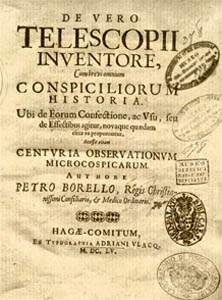
1608  On October 2, 1608, the Dutch Estates General examined an application for a patent for "a device to observe things at a distance" presented by a certain Hans Lipperhey (?-1619) an obscure spectacles-maker from Middelburg, in southwestern Holland . The patent application was rejected on the grounds that, although the usefulness of the device was recognised, especially for military purposes, it was deemed impossible to keep the secret of its construction for very long. And especially considering that, in those same days, another instrument-maker - a certain Sacharias Janssen (1588-1630) , he too a spectacles-maker in Middelburg, indicated by Pierre Borel (c. 1620-1671) a few decades later as the true inventor of the telescope - declared that he knew how to build the instrument. *Institute and Museum of the History of Science


1667 Newton became a fellow at Trinity College, Cambridge. *VFR


1759 “Your solution of the isoperimetric problems leaves nothing to be desired and I rejoice that this subject, with which I have been so completely occupied since my first efforts, has been carried by you to such a high degree of perfection. The importance of the subject has stimulated me to develop, aided by your lights, an analytical solution that I will keep secret as long as your own meditations are not published, lest I take away from you a part of the glory you deserve.” So wrote Euler to the young Lagrange. See Allen Shields, “Lagrange and the M´ecanique Analytique,” The Mathematical Intelligencer, 10:4, Fall 1988, pp. 7– 10. *VFR


1836 Charles Darwin returned from his voyage on the HMS Beagle to the Pacific. It would be 23 years before he published Origin of Species but he had already gained some notability for his specimen collections that had been sent home to his old botany professor, John Steven Henslow. *TIS


1937 The London Illustrated News had a picture of a wolf bone discovered in Czechoslovakia by Karl Absolom which has 55 notches in groups of 5, the first 25 being separated from the rest by one of double length. Dating from 30,000 BC, this is the earliest record of counting. [Bunt, Jones, Bedient, The Historical Root of Elementary Mathematics, p 2]. *VFR (The head of an ivory Venus figurine was excavated close to the bone.)


1955 The Electronic Numerical Integrator and Computer (ENIAC) retired. After disassembly, parts of this computer were shipped to the Smithsonian for display. *Goldstein, The Computer from Pascal to von Neumann, p. 234–5.
After eleven years of calculating and processing programs, the ENIAC was retired. Designers John Mauchly and J. Presper Eckert had unveiled the machine in February 1946, showing off its 1,000-time improvement in speed over its contemporaries. The ENIAC ran at 5,000 operations a second with a system of plug boards, switches, and punch cards. It occupied 1,000 square feet of floor space. *CHM


1956, the Atomicron, the first atomic clock in the U.S., was unveiled at the Overseas Press Club in New York City. The basis of the timing was the constant frequency of the oscillations of the caesium atom - 9,192,631,830 MHz. It was priced at $50,000. The Atomicron measured 84" high, 22" wide and 18" deep. *TIS


BIRTHS
1568 Marino Ghetaldi (2 Oct 1568, 11 April 1626) was a Croatian mathematician who published work with early applications of algebra to geometry. *SAU


1791 Aléxis Thérèse Petit (2 Oct 1791, 21 June 1820) was a French mathematician who worked on the theory of heat.*SAU


1825 John James Walker (2 Oct 1825, 15 Feb 1900) The range of Walker's mathematical research was quite impressive. He wrote some articles on theoretical mechanics but his more elaborate papers were on advanced algebra and geometry. Walker was a strong advocate of Hamilton's quaternions and strongly believed that they had not been given as wide a use as they merited. He applied quaternions to a variety of problems, mostly of an elementary nature.
The three most important papers that Walker wrote were on the analysis of plane curves and curved lines. The papers were closely connected and all appeared in the Proceedings of the London Mathematical Society. He wrote further articles on cubic curves and in this area he wrote the memoir On the diameters of cubic curves which was published in the Transactions of the Royal Society in 1889. *SAU


1852 Sir William Ramsay (2 Oct 1852; 23 Jul 1916) Scottish chemist who discovered the "inert gases", neon, krypton and xenon, and co-discovered argon, radon, calcium and barium. Nobel laureate (1904) "in recognition of his services in the discovery of the inert gaseous elements in air, and his determination of their place in the periodic system." Died in High Wycombe, Buckinghamshire.*TIS


1886 Robert Julius Trumpler (2 Oct 1886; 10 Sep 1956) Swiss-born U.S. astronomer who moved to the US in 1915 and worked at the Lick Observatory. In 1922, by observing a solar eclipse, he was able to confirm Einstein's theory of relativity. He made extensive studies of galactic star clusters, and demonstrated (1930) the presence throughout the galactic plane of a tenuous haze of interstellar material that absorbs light generally that dims and reddens the light from of distant clusters. The presence of this obscuring haze revealed how the size of spiral galaxies had been over-estimated. Whereas Harlow Shapley, in 1918, determined the distance to the centre of the Milky Way to be 50,000 light-years away, Trumpler's work reduced this to 30,000 light-years.*TIS


1901 Charles Stark Draper (2 Oct 1901; 25 Jul 1987) American aeronautical engineer, educator, and science administrator who earned degrees from Stanford, Harvard, and MIT then, in 1939, became head of MIT's Instrumentation Laboratory, which was a centre for the design of navigational and guidance systems for ships, airplanes, and missiles from World War II through the Cold War. He developed gyroscope systems that stabilized and balanced gunsights and bombsights and which were later expanded to an inertial guidance system for launching long-range missiles at supersonic jet targets. He was "the father of inertial navigation." The Project Apollo contract for guiding man and spacecraft to the moon was also placed with the Instrumentation Lab. *TIS


1908 Arthur Erdélyi studied in Brno and Prague and came to Scotland before the Second World War to avoid the Nazi invasion of Czechoslovakia. He became a lecturer at Edinburgh and after a period in the USA he returned to Edinburgh as a Professor. He was an expert on Special Functions. He became President of the EMS in 1971. *SAU


1926 Michio Suzuki (October 2, 1926 – May 31, 1998) was a Japanese mathematician who studied group theory.
He was a Professor at the University of Illinois at Urbana-Champaign from 1953 to his death. He also had visiting positions at the University of Chicago (1960–61), the Institute for Advanced Study (1962–63, 1968–69, spring 1981), the University of Tokyo (spring 1971), and the University of Padua (1994). Suzuki received his Ph.D in 1952 from the University of Tokyo, despite having moved to the United States the previous year. He was the first to attack the Burnside conjecture, that every finite non-abelian simple group has even order.
A notable achievement was his discovery in 1960 of the Suzuki groups, an infinite family of the only non-abelian simple groups whose order is not divisible by 3. The smallest, of order 29120, was the first simple group of order less than 1 million to be discovered since Dickson's list of 1900.
He classified several classes of simple groups of small rank, including the CIT-groups and C-groups and CA-groups.
There is also a sporadic simple group called the Suzuki group, which he announced in 1968. The Tits ovoid is also referred to as the Suzuki ovoid. *Wik


DEATHS
1853 Dominique François Jean Arago (26 Feb 1786, 2 Oct 1853) was a French physicist and astronomer who discovered the chromosphere of the sun (the lower atmosphere, primarily composed of hydrogen gas), and for his accurate estimates of the diameters of the planets. Arago found that a rotating copper disk deflects a magnetic needle held above it showing the production of magnetism by rotation of a nonmagnetic conductor. He devised an experiment that proved the wave theory of light, showed that light waves move more slowly through a dense medium than through air and contributed to the discovery of the laws of light polarization. Arago entered politics in 1848 as Minister of War and Marine and was responsible for abolishing slavery in the French colonies. *TIS A really great blog about Arago, With the catchy title, "François Arago: the most interesting physicist in the world!" is posted here. Read this introduction, and you will not be able to resist:
When he was seven years old, he tried to stab a Spanish solider with a lance
When he was eighteen, he talked a friend out of assassinating Napoleon
He once angered an archbishop so much that the holy man punched him in the face
He has negotiated with bandits, been chased by a mob, broken out of prison
He is:
François Arago, the most interesting physicist in the world


1929 Andrei Mikhailovich Razmadze (11 Aug 1889, 2 Oct 1929) His work was on the calculus of variations, continuing work by Weierstrass and Hilbert. The fundamental lemma of the calculus of variations is named after him. He also did important work on discontinuous solutions.*SAU


1933 Philipp Forchheimer (7 Aug 1852, 2 Oct 1933) Austrian hydraulic engineer who made significant studies of groundwater hydrology. Early in his academic career, he worked on problems of soil mechanics. Later, he turned to hydraulic problems, establishing the scientific basis of the discipline by applying standard techniques of mathematical physics - in particular Laplace's equation - to problems of groundwater movement. Laplace's equation had already been well developed for heat flow and fluid flow. Forchheimer extended the preexisting mathematical theory to calculations of groundwater flow. He was also the first to both mathematically and experimentally examine the features of dambreak waves in a rectangular channel (with his PhD student Armin Schoklitsch).*TIS


1962 Boris Yakovych Bukreyev (6 September 1859 – 2 October 1962) was a Russian and Soviet mathematician who worked in the areas of complex functions and differential equations.
In 1889, Bukreyev became a professor of mathematics at the University of Kiev, in Ukraine, Russian Empire. He studied Fuchsian functions of rank zero. He was interested in projective and non-Euclidean geometry. He worked on differential invariants and parameters in the theory of surfaces, being interested in the history of mathematics.*Wik


2006 Paul Richard Halmos​ (March 3, 1916 – October 2, 2006) was a Hungarian-born American mathematician who made fundamental advances in the areas of probability theory, statistics, operator theory, ergodic theory, and functional analysis (in particular, Hilbert spaces). He was also recognized as a great mathematical expositor. In a series of papers reprinted in his 1962 Algebraic Logic, Halmos devised polyadic algebras, an algebraic version of first-order logic differing from the better known cylindric algebras of Alfred Tarski and his students. An elementary version of polyadic algebra is described in monadic Boolean algebra.
In addition to his original contributions to mathematics, Halmos was an unusually clear and engaging expositor of university mathematics. This was so even though Halmos arrived in the USA at 13 years of age and never lost his Hungarian accent. He chaired the American Mathematical Society committee that wrote the AMS style guide for academic mathematics, published in 1973. In 1983, he received the AMS's Steele Prize for exposition. Some of his classics were:
How to read mathematics
How to write mathematics
How to speak mathematics.
In the American Scientist 56(4): 375–389, Halmos argued that mathematics is a creative art, and that mathematicians should be seen as artists, not number crunchers. He discussed the division of the field into mathology and mathophysics, further arguing that mathematicians and painters think and work in related ways.
Halmos's 1985 "automathography" I Want to Be a Mathematician is an account of what it was like to be an academic mathematician in 20th century America. He called the book “automathography” rather than “autobiography”, because its focus is almost entirely on his life as a mathematician, not his personal life. The book contains the following quote on Halmos' view of what doing mathematics means:
“ "Don't just read it; fight it! Ask your own questions, look for your own examples, discover your own proofs. Is the hypothesis necessary? Is the converse true? What happens in the classical special case? What about the degenerate cases? Where does the proof use the hypothesis?”
In these memoirs, Halmos claims to have invented the "iff" notation for the words "if and only if" and to have been the first to use the “tombstone” notation to signify the end of a proof, and this is generally agreed to be the case. The tombstone symbol ∎ (Unicode U+220E) is sometimes called a halmos. *Wik


Credits
*VFR = V Frederick Rickey, USMA
*TIS= Today in Science History
*Wik = Wikipedia
*SAU=St Andrews Univ. Math History
*CHM=Computer History Museum

Saturday, 1 October 2011

On This Day in Math - Oct 1


Scientists have one thing in common with children: curiosity. To be a good scientist you must have kept this trait of childhood, and perhaps it is not easy to retain just one trait. A scientist has to be curious like a child; perhaps one can understand that there are other childish features he hasn't grown out of.
~Otto Robert Frisch


The 274th day of the year; 274 is  a tribonacci number..The tribonacci numbers are like the Fibonacci numbers, but instead of starting with two predetermined terms, the sequence starts with three predetermined terms and each term afterwards is the sum of the preceding three terms. The first few tribonacci numbers are 0, 0, 1, 1, 2, 4, 7,


EVENTS
1386 University of Heidelberg founded. The Ruprecht-Karls-Universität Heidelberg (Heidelberg University, Ruperto Carola) is a public research university located in Heidelberg, Baden-Württemberg, Germany. It is the oldest university in Germany and was the fourth university established in the Holy Roman Empire. A coeducational institution since 1899, today Heidelberg consists of twelve faculties and offers degree programs at undergraduate, graduate and postdoctoral levels in some 100 disciplines. *Wik

1535 Giambattista della Porta (? Oct 1535 - 4 Feb 1615) Italian natural philosopher, experimenter and mathematician, though he also sought the miraculous or magical. He studied optics, including refraction (De refractione, 1593). Porta did not invent the telescope, regardless of his published claim. He was the first to propose adding a convex lens to the camera obscura, and first to recognize the heating effect of light rays. He wrote on cryptography in De furtivis literarum (1563), and his other books included mechanics, squaring the circle, description of a steam engine in De spiritali (1606). He formed the society, Accademia dei Segreti, dedicated to discussing and studying nature, meeting at his home, until closed by the Inquisition (about 1578). *TIS

1658 The closing date for Pascal’s prize problems on the cycloid. (T. Christie advised me that some give the date as Oct 2).  A toothache earlier that year caused him to return to mathematics and to study the cycloid. In 1654, late in the evening Pascal experienced a religious ecstasy that called him to give up his intermittent interest in mathematics and to devote his time to religious contemplation. For years he devoted no time to mathematics. Then one night, unable to sleep because of an abscessed tooth, Pascal began to think about some problems about the cycloid. His pain disappeared and he interpreted this as a sign that God was pleased by his mathematical studies. In a brief time he completed the investigationof the cycloid. Then he established a contest about the cycloid with himself and Roberval as the judges. The three problems he asked were:
cycloidPascal.png
1. Find the area and the center of gravity of the region BCD bounded by the cycloid, the horizontal line BC and the axis of symmetry AD.
2. Find the volume and center of gravity of the solids obtained by revolving the region BCD about AD and about BC.
3. For the solids in the previous question, find the center of gravity of the solids formed when each is cut by a plane parallel to its axis of revolution.
Only two contestants submitted solutions. No prize was awarded as the judges declared that the solutions were either incomplete or incorrect. Pascal then published his own results in a paper entitled "L'Histoire de la Roulette".  It is worth noting that all these investigations of the cycloid occurred before Newton and Leibnitz' work on the calculus!  *Historical Modules for the Mathematical Classroom There is a famous statue by Pajou in the Louvre of Pascal in which he is contemplating the Roulette (cycloid). (And in this photo, I am contemplating him contemplating the roulette) More on the cycloid, including a close up of the tablet in the statue is here.

1670 James Gregory writes to John Collins, with the first use of what will come to be called the Newton-Gregory interpolation formula. He includes in the letter two enclosures showing how to apply his method to series for sines and logarithms. *Beery & Stedall, Thomas Harriot’s Doctrine of Triangular Numbers, pg 51-52

1752  A letter of Benjamin Franklin written on October 1st, to Mr. Peter Collinson, FRS concerning an electrical kite, was read before the society on Dec 21.  Franklin describes the construction of the kite from two light strips of cedar and a large thin silk  handkerchief, 

1831 Michael Faraday discovers induced electric current using a helix made of two coils each of 203 feet of insulated copper wire. "A sudden jerk was perceived when the battery communication was made and broken... it was one way when made, and the other when broken." *A history of physics in its elementary branches By Florian Cajori

1847 Maria Mitchell sees a comet... the first woman astronomer in the United States discovered a comet. On this night in the Autumn of 1847, Maria looked at the sky through the telescope in her homemade observatory at Nantucket, Mass. and saw a star five degrees above the North Star where there had been no star before. She had memorized the sky and was sure of her observation. It occurred to her that this might be a comet. Maria recorded the presumed comet's coordinates. The next night the star moved again. This time she was sure it was a comet. For this discovery, she was awarded a gold medal by the king of Denmark. She became the first woman elected to the American Academy of Arts and Sciences. *TIS

1891 On Oct 1 Stanford University​ opened its doors after six years of planning and building. The prediction of a New York newspaper that Stanford professors would "lecture in marble halls to empty benches" was quickly disproved. The first student body consisted of 555 men and women, and the original faculty of 15 was expanded to 49 for the second year. The university’s first president was David Starr Jordan​, a graduate of Cornell, who left his post as president of Indiana University​ to join the adventure out West.
The Stanfords engaged Frederick Law Olmsted​, the famed landscape architect who created New York’s Central Park​, to design the physical plan for the university. The collaboration was contentious, but finally resulted in an organization of quadrangles on an east-west axis. Today, as Stanford continues to expand, the university’s architects attempt to respect those original university plans. *Stanford Univ Web page

1895  On the first of October 1895, the first German institute of insurance science was founded at the University of Göttingen, as a result of joint efforts of Felix Klein (1849-1825) and his fellow student Ludwig Kiepert (1846-1934), who was then chairman of the Prussian Civil Service Association (today called Hannover Life Insurance).This was the first institute in Germany in which a curriculum in actuarial mathematics, insurance law, and insurance economics was offered. Successful studies led to the degree “Versicherungsverständiger” (insurance expert). The institute was divided into a mathematical section and an administrative section, and its first chairman was Wilhelm Lexis. *From Center for Statistics, History of Statistics in Gottingen.


1907 Delegates from 310 Esperanto societies throughout the world met to elect a committee to modify the language. Louis Couturat, influenced by Leibniz’s thought on the construction of a logical universal language, was elected one of the secretaries.  *VFR


1934 Paul Erdos stops in Cambridge to visit with mathematical friends, particularly Harrold Davenport and Richard Rado, on his way to a position in Manchester. *Bruce Schechter, My Brain is Open: The Mathematical Journeys of Paul Erdos

1954 IBM announced is 705 EDP, part of its 700 series of mainframe computers. A business-oriented machine, the 705 had magnetic core memory.*CHM

1969 Concorde goes Mach 1 In 1969, the prototype French-built Concorde broke the sound barrier for the first time. The inaugural flight of the aircraft had taken place on 2 Mar 1969 in Toulouse, France, and its first commercial flight was on 21 Jan 1976. It was the first plane in the world to be entirely controlled by computer. As the only supersonic passenger aircraft, the Anglo-French Concorde remains a brilliant technological achievement, though its impact on international air travel has been limited by the high cost of buying and operating the aircraft. There was also widespread opposition from environmental groups on the grounds of the Concorde's noise on takeoff and its fuel consumption. Only British Airways and Air France have operated the aircraft. *TIS

1988   The game Connect Four Solved first by James D. Allen (Oct 1, 1988), and independently by Victor Allis (Oct 16, 1988). First player can force a win. Strongly solved by John Tromp's 8-ply database (Feb 4, 1995). Weakly solved for all boardsizes where width+height is at most 15 (Feb 18, 2006). *Wik

2012 With God's grace, Dame Kathleen Ollerenshaw will awake for her 100th birthday today. Happy Birthday to a Grand-Ol-Dame, and may a puzzle occupy her thoughts. (See 1912 Births below).

BIRTHS
1535 Giambattista della Porta (? Oct 1535 - 4 Feb 1615) Italian natural philosopher, experimenter and mathematician, though he also sought the miraculous or magical. He studied optics, including refraction (De refractione, 1593). Porta did not invent the telescope, regardless of his published claim. He was the first to propose adding a convex lens to the camera obscura, and first to recognize the heating effect of light rays. He wrote on cryptography in De furtivis literarum (1563), and his other books included mechanics, squaring the circle, description of a steam engine in De spiritali (1606). He formed the society, Accademia dei Segreti, dedicated to discussing and studying nature, meeting at his home, until closed by the Inquisition (about 1578). *TIS

1671 Luigi Guido Grandi was an Italian Jesuit who worked on geometry and hydraulics.Grandi was the author of a number of works on geometry in which he considered the analogies of the circle and equilateral hyperbola. He also considered curves of double curvature on the sphere and the quadrature of parts of a spherical surface.
In 1701 Grandi discussed the conical loxodrome, the curve that cuts the generators of a cone of revolution in a constant angle. He studied the curve the Witch of Agnesi in 1703. In fact his work of 1703 is important in introducing Leibniz's calculus into Italy.
In 1728 Grandi published Flores geometrici a work in which he defines the clelie curve. He named the curve after Countess Clelia Borromeo and dedicated his book to her. If the longitude and colatitude of a point P on a sphere is denoted by θ and φ and if P moves so that θ = m φ, where m is a constant, then the locus of P is a clelie. Grandi also applied the term "clelies" to the curves determined by certain trigonometric equations involving the sine function
a sin θ = b sin mφ
a sin θ = a - b sin mφ
Grandi also worked on hydraulics and was involved with a number of projects such as ones to drain the Chiana Valley and the Pontine Marshes. He also published a number of works on mechanics and astronomy. His practical work on mechanics included experimenting with a steam engine. *SAU 
He is noted for the roses that he introduced. His idea was to find a geometrical definition of curves which resemble flowers. These curves are still part of our calculus courses, except now we use polar coordinates to define them.*VFR

1873 Alfreds Arnolds Adolfs Meders (1 Oct 1873 , 1944) Meders worked on differential geometry and mathematical analysis. He often published papers written in German, in German journals. For example he published the following three papers in Crelle's Journal: Über einige Arten Singularer Punkte von Raumkurven (1896); Zur Theorie der singularen Punkte einer Raumkurve (1899); and Analytische Untersuchung singularer Punkte von Raumkurven (1910). In Monatshefte für Mathematik he published: Über die Determinante von Wronski (1906); and Zur Differentiation bestimmter Integrale nach einem Parameter (1911).
Meders was also interested in the history of mathematics and he wrote an important paper Direkte und indirekte Beziehungen zwischen Gauss und der Dorpater Universität (Direct and indirect connections between Gauss and the University of Dorpat) in 1928. His interests went outside mathematics and he sometimes lectured on astronomy, meteorology and biology where he had a special interest in birds. *SAU


1898 Béla Kerékjártó (October 1, 1898, –June 26, 1946) was a Hungarian mathematician who wrote numerous articles on Topology. He earned his Ph.D. degree from the University of Budapest. He taught at the Faculty of Sciences of the University of Szeged from 1922, and at the University of Budapest from 1938. In 1923, he published one of the first books on Topology; Hermann Weyl wrote that this book completely changed his views of the subject.*Wik

1904 Otto Robert Frisch (1 Oct 1904; 22 Sep 1979) Austrian-British nuclear physicist, born in Vienna, who, with his aunt Lise Meitner, described the division of neutron-bombarded uranium into lighter elements. He named the process fission, borrowing a term from biology (1939). At the time, Meitner was working in Stockholm and Frisch (1934-39) at Copenhagen under Niels Bohr, who brought their observation to the attention of Albert Einstein and others in the United States. He did research with James Chadwick 1940-43, and was head of the Critical Assembly Group on the Los Alamos project 1943-46. After World War II, Frisch became a science writer on atomic physics for the layman. *TIS


1911 Zhou Weiliang (simplified Chinese: (October 1, 1911– August 10, 1995) was a Chinese mathematician born in Shanghai, known for his work in algebraic geometry.
He was a student in the USA, graduating from the University of Chicago in 1931. In 1932 he attended the University of Göttingen, then transferring to Leipzig where he worked with van der Waerden. They produced a series of joint papers on intersection theory, introducing in particular the use of what are now generally called Chow coordinates (which were in some form familiar to Arthur Cayley).
He married Margot Victor in 1936, and took a position at the National Central University in Nanjing. His mathematical work was seriously affected by the wartime situation in China. He taught at the National Tung-Chi University in Shanghai in the academic year 1946–47, and then went to the Institute for Advanced Study in Princeton, where he returned to his research. From 1948 to 1977 he was a professor at Johns Hopkins University. *Wik


1912 Dame Kathleen Mary Ollerenshaw, née Timpson, DBE (1 October 1912, ) is a British mathematician and politician. Deaf since the age of eight, she loved doing arithmetic problems as a child. As a young woman, she attended St Leonards School and Sixth Form College in St Andrews, Scotland where today the house of young male boarders is named after her. At the age of 19, she gained admittance to Somerville College, Oxford to study mathematics. She completed her doctorate at Somerville in 1945 on "Critical Lattices" under the supervision of Theo Chaundy. She wrote five original research papers which were sufficient for her to earn her DPhil degree without the need of a formal written thesis.
Ollerenshaw served as a Conservative Councillor for Rusholme for twenty-six years (1956–1981), was Lord Mayor of Manchester (1975–1976), and the prime motivator in the creation of the Royal Northern College of Music. She was made a Freeman of the City of Manchester and was an advisor on educational matters to Margaret Thatcher's government in the 1980s.
She has published at least 26 mathematical papers, her best-known contribution being to most-perfect pandiagonal magic squares. An annual public lecture at the School of Mathematics, University of Manchester is named in her honour.
An amateur astronomer, Ollerenshaw donated her telescope to Lancaster University, and an observatory there bears her name. She is an honorary member of the Manchester Astronomical Society and held the post of Vice President for a number of years. *Wik A wonderful article about her approaching her 100th birthday is in Scientific American.


DEATHS
1768 Robert Simson (14 October 1687 – 1 October 1768) was a Scottish mathematician and professor of mathematics at the University of Glasgow. The pedal line of a triangle is sometimes called the "Simson line" after him. Edmond Halley suggested to him that he might devote his considerable talents to the restoration of the work of the early Greek geometers, such as Euclid and Apollonius of Perga. These are works that only survive in abbreviated accounts given by later mathematicians such as Pappus of Alexandria. He first studied Euclid's so-called porisms. Playfair's 1792 definition of porism is "a proposition affirming the possibility of finding such conditions as will render a certain problem indeterminate, or capable of innumerable solutions."
Simson's work on Euclid's porisms was published in 1723 in the Philosophical Transactions of the Royal Society, and his restoration of the Loci Plani of Apollonius appeared in 1749. Further work of his on porisms and other subjects including logarithms was published posthumously in 1776 by Lord Stanhope at his own expense. Simson also set himself the task of preparing an edition of Euclid's Elements in as perfect a form as possible, and his edition of Euclid's books 1-6, 11 and 12 was for many years the standard text and formed the basis of textbooks on geometry written by other authors. The work ran through more than 70 different editions, revisions or translations published first in Glasgow in 1756, with others appearing in Glasgow, Edinburgh, Dublin, London, Cambridge, Paris and a number of other European and American cities. Recent editions appeared in London and Toronto in 1933 under the editorship of Isaac Todhunter, and in São Paolo in 1944. Simson's lectures were delivered in Latin, at any rate at the beginning of his career. His most important writings were written in that language, however, his edition of Euclid, after its first publication in Latin, appeared in English, as did a treatise on conic sections that he wrote for the benefit of his students.
the Simson line does not appear in his work but Poncelet in Propriétés Projectives says that the theorem was attributed to Simson by Servois in the Gergonne's Journal. It appears that the theorem is due to William Wallace.
The University of St Andrews awarded Simson an honorary Doctorate of Medicine in 1746.
In 1753 Simson noted that, as the Fibonacci numbers increased in magnitude, the ratio between adjacent numbers approached the golden ratio, whose value is
(1 + √5)/2 = 1.6180 . . . . *SAU

1924 John Edward Campbell is remembered for the Campbell-Baker-Hausdorff theorem which gives a formula for multiplication of exponentials in Lie algebras. *SAU

1972 Francisco José Duarte (6 Jan 1883, 1 Oct 1972) Duarte's most important work in mathematics was done in algebra, number theory and mathematical analysis. His first work in mathematics was about which he presented to the Paris Academy of Sciences in 1907. He published papers on the general solution of a diophantine equation of the third degree x3 + y3 + z3 - 3xyz = v3, simplified Kummer's criterion and gave a simple proof of the impossibility of solving the Fermat equation x3 + y3 + z3 = 0 in nonzero integers. He also observed that the interpolation formula of Everett is a consequence of the interpolation formula of Gauss. In 1908 he published an article where he calculated π to 200 decimal places.
His main three books are: Monograph on the numbers π and e. Historical and bibliographical notes (Spanish) (Bol. Acad. Cien. Fis. Mat. Nat. 11(1948)), with 27 chapters on 250 pages, which contains more information on π and e than has ever before been collected in one place; Lessons on Infinitesimal Analysis (Caracas 1943, 606 pp.) (Spanish) containing material from courses in analysis at UCV during his first three or four years there; and Bibliography of Euclid, Archimedes, Newton (Acad. Cien. Fis. Mat. Nat., Caracas 1963, 163 pp.) (Spanish) which was also done in the 19th century.
Many mathematicians are interested in recreational mathematics. Duarte also contributed to that part of mathematics and proposed problems and solutions to the American Mathematical Monthly for several years, and also to the journal Ciencia y Ingenieria (Science and Engineering) published in Mérida. *SAU


1990 John Stewart Bell​ FRS (28 June 1928 – 1 October 1990) was a physicist from Northern Ireland (Ulster), and the originator of Bell's theorem, a significant theorem in quantum physics regarding hidden variable theories.*Wik

1996 Herbert Karl Johannes Seifert (May 27, 1907– October 1, 1996) was a German mathematician known for his work in topology.


Credits
*VFR = V Frederick Rickey, USMA
*TIS= Today in Science History
*Wik = Wikipedia
*SAU=St Andrews Univ. Math History
*CHM=Computer History Museum