Friday, 4 April 2014

On This Day in Math - April 4

Cover to Towers of Hanoi, *Wik

If the Lord Almighty had consulted me before embarking upon his creation, I should have recommended something simpler.
Remarking on the complexity of Ptolemaic model of the universe after it was explained to him.
~Alfonso X of Castile


The 94th day of the year; 94!-1 is prime. The number 94!-1 ends in 21 consecutive nines. Students might inquire how they could have known this without being told.

94 begins the smallest string of three consecutive numbers none of which is a palindrome in any base, b \( 2 \leq b \leq 10 \)

EVENTS
1597 Galileo writes to Kepler, "....Like you, I accepted the Copernican position several years ago and discovered from thence the causes of many natural effects which are doubtless inexplicable by the current theories. I have written up many of my reasons and refutations on the subject, but I have not dared until now to bring them into the open, being warned by the fortunes of Copernicus himself, our master, who procured immortal fame among a few but stepped down among the great crowd (for the foolish are numerous), only to be derided and dishonored. I would dare publish my thoughts if there were many like you; but, since there are not, I shall forebear.... " *Giorgio de Santillana, The Crime of Galileo (1955).

1615 In response to Galileo's assertion that Copernican cosmology was so scientifically confirmed that the Scriptures must be conformed to it, Cardinal Robert Bellarmine writes that, "I do not think there is any such proof, since none has been shown to me." He then cautions Galileo that without such evidence, teaching Copernicanism would be, "a very dangerous attitude, ...to injure our holy faith by contradicting the scriptures." *Timothy Ferris, Coming of Age in the Milky Way

1687 Edmond Halley received Book Three of Newton's Masterpiece, the Principia. He would spend months pushing the publication to print, with a run of 250+ copies completed on July 5th of that year. The first edition sold out almost immediately. He writes to John Wallis that Newton "now falls in with Mr. Hooke." Newton had added Proposition XIX that the earth's diameter was greater at the equator than between the poles. Newton had previously argue for a spherical earth, and now agreed it was more oblate. *Stephen Inwood, Forgotten Genius

1692 Acta eruditorum contained, under a pseudonym, Vincenzo Viviani’s problem of constructing in a hemispherical cupola four equal-sized windows such that the remaining area of the cupola is quadrable. The problem was solved by Leibniz (date?), Guido Grandi (1699), and Viviani himself (1692). *VFR

1870 Benjamin Peirce wrote in the introduction of his “Linear Associative Algebra,” doubtless his most original mathematical work: “This work has been the pleasantest mathematical effort of my life. In no other have I seemed to myself to have received so full a reward for my mental labor in the novelty and breadth of the results.” [MAA 32(1925); p. 15 of Benjamin Peirce, MAA offprint of 1925] *VFR

In 1930, the American Interplanetary Society was founded by G. Edward Pendray, David Lasser, Laurence Manning and others. Its was known as the American Rocket Society from 6 Apr 1934. Through the 1930s, the group designed an experimental test stand and tested liquid-fuelled rockets. Their pioneering work led the way to the United States space program. Their ARS-4 rocket, was the first launched in America to break the sound barrier (9 Sep 1934). It was fired from from Marine Park, Staten Island, N.Y., reached a top speed of 700 mph, travelled to a maxium height of 400-ft and a horizontal range of 1,600-ft. In early 1963, it merged with the American Institute of Aeronautics and Astronautics *TIS

1994 Marc Andreesen Founds Netscape with Jim Clark:
Marc Andreessen and Jim Clark found Mosaic Communications Corp, later renamed Netscape Communications Corp. Andreessen developed the software used for browsing the World Wide Web while working at the National Center for Supercomputing Applications (NCSA) at the University of Illinois. Clark co-founded high-performance computer maker Silicon Graphics Inc.*CHM

BIRTHS
1688 Joseph-Nicolas Delisle (4 Apr 1688; 11 Sep 1768 at age 80) French astronomer who proposed that the series of coloured rings sometimes observed around the Sun is caused by diffraction of sunlight through water droplets in a cloud. He also worked to find the distance of the Sun from the Earth by observing transits of Venus and Mercury across the face of the Sun. *TIS

1809 Benjamin Peirce (4 Apr 1809, 6 Oct 1880) American astronomer, mathematician and educator who computed the general perturbations of the planets Uranus and Neptune. He was Harvard's Perkins Professor of Astronomy and Mathematics for nearly 40 years, and was largely responsible for introducing mathematics as a subject for research in American institutions. He is known especially for his contributions to analytic mechanics and linear associative algebra, but he is also remembered for his early work in astronomy and for playing a role in the discovery of Neptune. *TIS In number theory, he proved there is no odd perfect number with fewer than four prime factors. In algebra, he was notable for the study of associative algebras. He first introduced the terms idempotent and nilpotent in 1870 to describe elements of these algebras, and he also introduced the Peirce decomposition. *Wik He taught at Harvard for 49 years. Early on, he and the other young mathematics tutor, Charles W. Eliot, secured the innovation of written final exam­inations. Previously all exams were oral. Eliot later became president of Harvard. *VFR

1842 François Edouard Anatole Lucas (4 April 1842, 3 Oct 1891) Lucas is best known (to formal mathematicaticians) for his results in number theory, in particular he studied the Fibonacci sequence and the associated Lucas sequence is named after him. He gave the well-known formula for the Fibonacci numbers
√5 fn = ((1 + √5)/2)n - ((1 - √5)/2)n.
Lucas also devised methods of testing primality, essentially those used today. In 1876 he used his methods to prove that the Mersenne number 2127 - 1 is prime. This remains the largest prime number discovered without the aid of a computer. (For recreational mathematicians), Lucas is also well known for his invention of the Tower of Hanoi​ puzzle and other mathematical recreations. The Tower of Hanoi puzzle appeared in 1883 under the name of M. Claus. Notice that Claus is an anagram of Lucas! His four volume work on recreational mathematics Récréations mathématiques (1882-94) has become a classic.*SAU Lucas is also remembered for his unusual death, caused by a waiter dropping a plate which shattered sending a piece of plate into his neck. Lucas died several days later from a deadly inflamation of the skin and subcutaneous tissue caused by streptococcus. The disease, officially listed as erysipelas (from the Greek for "red skin") was more commonly known as "Saint Anthony's Fire". *Pballew.net

1868 Philippa Garrett Fawcett (4 April 1868 - 10 June 1948) the first woman at Cambridge to come top in the Mathematical Tripos Examinations. A description of the event is recorded in the North Hall Diary of Newnham College:-

The great event of the year was Philippa Garrett Fawcet's achievement in the Mathematical Tripos. For the first time a woman has been placed above the Senior Wrangler. The excitement in the Senate House when the lists were read was unparalleled. The deafening cheers of the throng of undergraduates redoubled as Miss Fawcett left the Senate House by the side of the Principal. On her arrival at the College she was enthusiastically greeted by a crowd of fellow-students, and carried in triumph into Clough Hall. Flowers, letters, and telegrams poured in upon her throughout the day. The College was profusely decorated with flags. In the evening the whole College dined in Clough Hall. After dinner toasts were proposed: the healths drunk were those of the Principal, Miss Fawcett, her Coach (Mr Hobson) and Senior and Junior Optimes. At 9.30 p.m. the College gardens were illuminated, and a bonfire was lighted on the hockey-ground, round which Miss Fawcett was three times carried amid shouts of triumph and strains of "For she's a jolly good fellow."
This blog from the Smithsonian has some nice detail about her.

1884 Thomas Murray MacRobert FRSE (4 April 1884, Dreghorn, Ayrshire – 1 November 1962, Glasgow) was a Scottish mathematician. He became professor of mathematics at the University of Glasgow and introduced the MacRobert E function, a generalization of the generalized hypergeometric series.*Wik

1902 Eberhard Frederich Ferdinand Hopf (April 4, 1902, Salzburg, Austria-Hungary – July 24, 1983, Bloomington, Indiana) was a mathematician and astronomer, one of the founding fathers of ergodic theory and a pioneer of bifurcation theory who also made significant contributions to the subjects of partial differential equations and integral equations, fluid dynamics, and differential geometry. The Hopf maximum principle is an early result of his (1927) which is one of the most important techniques in the theory of elliptic partial differential equations.*Wik

1949 Shing-Tung Yau (4 Apr 1949, )Chinese-born mathematician who was awarded the Fields Medal in 1982 for his work in partial differential equations and differential geometry. His work also has applications in topology, algebraic geometry, representation theory and general relativity. Working collaboratively with Richard M. Schoen, Yau solved a long-standing open problem in relativity theory, by showing the positivity of mass for space-time. As a consequence, Schoen and Yau were able to give the first rigorous demonstration of how black holes can be formed because of the condensation of matter. A black hole possesses a gravitational field so intense that no matter or radiation can escape from it. Yau was the 1997 National Medal of Science winner. *TIS

DEATHS
1284 Alfonso X of Castile (23 Nov 1221; 4 Apr 1284) Spanish monarch and astronomer who encouraged the preparation of revised planetary tables (1252), published on the day of his accession to the throne as king of Castile and León. These "Alfonsine Tables," a revision and improvement of the Ptolemaic tables, were the best available during the Middle Ages; they were not replaced by better ones for over three centuries. The astronomical data tabulating the positions and movements of the planets was compiled by about 50 astronomers he had assembled for this purpose. He questioned the complexity of the Ptolemaic model centuries before Copernicus. "If the Lord Almighty had consulted me before embarking on the Creation, I would have recommended something simpler." He also wrote a commentary on alchemy. *TIS

1617 John Napier of Merchiston (1550 – 4 April 1617) – also signed as Neper, Nepair – named Marvellous Merchiston, was a Scottish mathematician, physicist, astronomer & astrologer, and also the 8th Laird of Merchistoun. He was the son of Sir Archibald Napier of Merchiston. John Napier is most renowned as the discoverer of the logarithm. Napier is the inventor of the so-called "Napier's bones". Napier also made common the use of the decimal point in arithmetic and mathematics. Napier's birthplace, the Merchiston Tower in Edinburgh, Scotland, is now part of the facilities of Edinburgh Napier University. After his death from the effects of gout, Napier's remains were buried in St Cuthbert's Church, Edinburgh.
His work, Mirifici Logarithmorum Canonis Descriptio (1614) contained fifty-seven pages of explanatory matter and ninety pages of tables of numbers related to natural logarithms. The book also has an excellent discussion of theorems in spherical trigonometry, usually known as Napier's Rules of Circular Parts. Modern English translations of both Napier's books on logarithms, and their description can be found on the web, as well as a discussion of Napier's Bones (see below) and Promptuary (another early calculating device). His invention of logarithms was quickly taken up at Gresham College, and prominent English mathematician Henry Briggs visited Napier in 1615. Among the matters they discussed was a re-scaling of Napier's logarithms, in which the presence of the mathematical constant e (more accurately, the integer part of e times a large power of 10) was a practical difficulty. Napier delegated to Briggs the computation of a revised table. The computational advance available via logarithms, the converse of powered numbers or exponential notation, was such that it made calculations by hand much quicker. The way was opened to later scientific advances, in astronomy, dynamics, physics; and also in astrology.
Napier made further contributions. He improved Simon Stevin's decimal notation.
Arab lattice multiplication, used by Fibonacci, was made more convenient by his introduction of Napier's bones, a multiplication tool using a set of numbered rods. He may have worked largely in isolation, but he had contact with Tycho Brahe who corresponded with his friend John Craig. Craig certainly announced the discovery of logarithms to Brahe in the 1590s (the name itself came later); there is a story from Anthony à Wood, perhaps not well substantiated, that Napier had a hint from Craig that Longomontanus, a follower of Brahe, was working in a similar direction.
In addition to his mathematical and religious interests, Napier was often perceived as a magician, and is thought to have dabbled in alchemy and necromancy. It was said that he would travel about with a black spider in a small box, and that his black rooster was his familiar spirit.
Napier used his rooster to determine which of his servants had been stealing from his home. He would shut the suspects one at a time in a room with the bird, telling them to stroke it. The rooster would then tell Napier which of them was guilty. Actually, what would happen is that he would secretly coat the rooster with soot. Servants who were innocent would have no qualms about stroking it but the guilty one would only pretend he had, and when Napier examined their hands, the one with the clean hands was guilty.
Another occasion which may have contributed to his reputation as a sorcerer involved a neighbor whose pigeons were found to be eating Napier's grain. Napier warned him that he intended to keep any pigeons found on his property. The next day, it is said, Napier was witnessed surrounded by unusually passive pigeons which he was scooping up and putting in a sack. The previous night he had soaked some peas in brandy, and then sown them. Come morning, the pigeons had gobbled them up, rendering themselves incapable of flight.
*Wik

1807 Joseph Jérôme Le Français de Lalande, (11 Jul 1732, 4 Apr 1807 at age 74)
He determined the Moon's parallax from Berlin for the French Academy (1751). He was appointed professor of Astronomy, Collège de France (1762), and subsequently, director of the Paris Observatory. He published his Traité d'astronomie in 1764 - tables of the planetary positions that were considered the best available for the rest of the century. In 1801 he also published a comprehensive star catalogue. He died in 1807, apparently of tuberculosis. *TIS

1919 Sir William Crookes, OM, FRS (17 June 1832 – 4 April 1919) was a British chemist and physicist who attended the Royal College of Chemistry, London, and worked on spectroscopy. He was a pioneer of vacuum tubes, inventing the Crookes tube. *Wik

1923 John Venn FRS (4 August 1834 – 4 April 1923), was a British logician and philosopher. He is famous for introducing the Venn diagram, which is used in many fields, including set theory, probability, logic, statistics, and computer science. Leibniz was the first to systematically use geometric diagrams to represent syllogisms, and Euler developed the ideas, but Venn gets the credit for his book popularized them. *VFR He was a fellow of Gonville and Caius and there is a stained glass window memorial there in the dining hall, which I had the pleasure of visiting with Professor Anthony Edwards.

Carl Ludwig Siegel (December 31, 1896 – April 4, 1981) was a mathematician specializing in number theory and celestial mechanics. He was one of the most important mathematicians of the 20th century.
Among his teachers were Max Planck and Ferdinand Georg Frobenius, whose influence made the young Siegel abandon astronomy and turn towards number theory instead. His best student was Jürgen Moser, one of the founders of KAM theory (Kolmogorov-Arnold-Moser), which lies at the foundations of chaos theory.
Siegel's work on number theory, diophantine equations, and celestial mechanics in particular won him numerous honours. In 1978, he was awarded the Wolf Prize in Mathematics, one of the most prestigious in the field.
Siegel's work spans analytic number theory; and his theorem on the finiteness of the integer points of curves, for genus greater than 1, is historically important as a major general result on diophantine equations, when the field was essentially undeveloped. He worked on L-functions, discovering the (presumed illusory) Siegel zero phenomenon. His work derived from the Hardy-Littlewood circle method on quadratic forms proved very influential on the later, adele group theories encompassing the use of theta-functions. The Siegel modular forms are recognised as part of the moduli theory of abelian varieties. In all this work the structural implications of analytic methods show through.
André Weil, without hesitation, named Siegel as the greatest mathematician of the first half of the 20th century. In the early 1970s Weil gave a series of seminars on the history of number theory prior to the 20th century and he remarked that Siegel once told him that when the first person discovered the simplest case of Faulhaber's formula then, in Siegel's words, "Es gefiel dem lieben Gott." (It pleased the dear Lord.) Siegel was a profound student of the history of mathematics and put his studies to good use in such works as the Riemann-Siegel formula.*Wik


Credits :
*CHM=Computer History Museum
*FFF=Kane, Famous First Facts
*NSEC= NASA Solar Eclipse Calendar
*RMAT= The Renaissance Mathematicus, Thony Christie
*SAU=St Andrews Univ. Math History
*TIA = Today in Astronomy
*TIS= Today in Science History
*VFR = V Frederick Rickey, USMA
*Wik = Wikipedia
*WM = Women of Mathematics, Grinstein & Campbell

Thursday, 3 April 2014

On This Day in Math - April 3

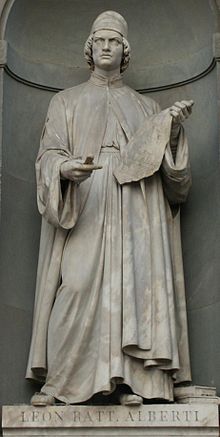
Alberti's Statue in the courtyard of the Uffizi Gallery, Florence; *Wik


Knowing what is big and what is small is more important than being able to solve partial differential equations.
~Stan Ulam

The 93rd day of the year; The first 93 digits of 93! form a prime number. *Prime Curios ( Can students find a smaller number n for which the first n digits of n! form a prime? Send results to me.)
93! = 11567725070816415747592051623062404362147532295764135351861422812132468
07121467315215203289516844845303838996289 ...
 

EVENTS
1736 Euler replied to Ehler on Konigsberg Bridge Challenge, "Not a Mathematical Problem..."
... Thus you see, most noble Sir, how this type of solution bears little relationship to mathematics, and I do not understand why you expect a mathematician to produce it, rather than anyone else, for the solution is based on reason alone, and its discovery does not depend on any mathematical principle. Because of this, I do not know why even questions which bear so little relationship to mathematics are solved more quickly by mathematicians than by others. In the meantime, most noble Sir, you have assigned this question to the geometry of position, but I am ignorant as to what this new discipline involves, and as to which types of problem Leibniz and Wolff expected to see expressed in this way ...
(See March 9th for Ehler's challenge to Euler) *Brian Hopkins, Robin Wilson; The Truth About Konigsberg
- See more at: http://www.maa.org/programs/maa-awards/writing-awards/the-truth-about-konigsberg#sthash.c6jO9L76.dpuf
1763 Easter Saturday 1763, Lalande recorded that the Astronomer Royal Nathaniel Bliss said ‘that Mr Lemonnier attached the wire to his quadrant with wax from his ears, that he went to Oxford with his sword broken, and that his observations agree less well with those of Mr Bevis than those of Caille.’ Pierre Charles Lemonnier or Le Monnier was a talented French astronomer 17 years Lalande’s senior who had a penchant for British instruments and astronomical methods and was a member of the Royal Society and the French Academy of Sciences. *Royal Museum Greenwich blog "MEOW!"

1769 A letter from Mr. Richard Price, F. R. S. to Benjamin Franklin, Esq; LL.D. discusses De Moivre's work on Population and survival rates. The paper runs to 38 pages. "Observations on the Expectations of Lives, the Increase of Mankind, the Influence of Great Towns on Population, and Particularly the State of London with Respect to Healthfulness and Number of Inhabitants." *Phil. Trans. January 1, 1769 59:89-125;

In 1934, a British patent application for the first catseye road marker was recorded for inventor Percy Shaw (1889-1975), described as "Improvements relating to Blocks for Road Surface." These are the familiar reflectors which mark the lines that are lit up at night by the lights of passing vehicles. The raised surface in which the reflectors are mounted have a construction that "will yield when traveled over by a vehicle wheel and sink to the level of the road surface" such as a resilient white rubber cushion mounted in a metal holder sunk below the road surface. The patent No. 436,290 was accepted 3 Oct 1935. A revised design was patented the following year as No. 457,536. Shaw started Reflecting Roadstuds Ltd. to manufacture them. *TIS (While this is of little mathematical interest, before I learned what the term meant, I regularly wondered about a sign I passed on the way from Stoke Ferry to King's Lynn in Norfolk Shire which said, "Cat's Eyes Removed Ahead."

1964 It is reported in the New York Times that the casinos in Las Vegas have changed their rules in blackjack so as to defeat the winning strategy devised by Edward O. Thorp. See 27 March 1964. *VFR
Thorp is described as an American mathematics professor, author, hedge fund manager, and blackjack player. He was a pioneer in modern applications of probability theory, including the harnessing of very small correlations for reliable financial gain.*Wik

1983 The Republic of China (Taiwan) marks the 400th anniversary of the arrival of Father Matteo Ricci (1552–1610) in China with a pair of stamps. [Scott #2359–2360] *VFR


BIRTHS
1529 – Michael Neander (April 3, 1529 – October 23, 1581) German mathematician and astronomer was born in Joachimsthal, Bohemia, and was educated at the University of Wittenberg, receiving his B.A. in 1549 and M.A. in 1550.
From 1551 until 1561 he taught mathematics and astronomy in Jena, Germany. He became a professor in 1558 when the school where he taught became a university. From 1560 until his death he was a professor of medicine at the University of Jena. He died in Jena, Germany. The crater Neander on the Moon is named after him. *Wik

1835 John Howard Van Amringe (3 April 1835 in Philadelphia, Pennsylvania, USA - 10 Sept 1915 in Morristown, New Jersey, USA) was a U.S. educator and mathematician. He was born in Philadelphia, and graduated from Columbia in 1860. Thereafter, he taught mathematics at Columbia, holding a professorship from 1865 to 1910 when he retired. Van Amringe was also the first Dean of Columbia College, the university's undergraduate school of arts and sciences, which he defended from dismemberment and incorporation into the larger university. During his long presence at the school, he made many addresses and enjoyed unrivaled popularity. He is memorialized with a bust enshrined in a column-supported cupola on "Van Am Quad" in the southeastern portion of the campus, surrounded by three College dormitories (John Jay Hall, Hartley Hall, and Wallach Hall) and by the main College academic building, Hamilton Hall. He is buried in Greenwood Cemetery in Brooklyn.
Van Amringe served as the first president of the American Mathematical Society between 1888 and 1890.
In honor of Van Amringe, Columbia University's Department of Mathematics has presented a "Van Amringe Mathematical Prize" each year (since 1911) to the best freshman or sophomore mathematics student, based on a very challenging examination. *Wik

1842 Hermann Karl Vogel (3 Apr 1842; died 13 Aug 1907 at age 65) German astronomer who discovered spectroscopic binaries (double-star systems that are too close for the individual stars to be discerned by any telescope but, through the analysis of their light, have been found to be two individual stars rapidly revolving around one another). He pioneered the study of light from distant stars, and introduced the use of photography in this field.*TIS

1859 Karl Heun (3 April 1859 in Wiesbaden, Germany - 10 Jan 1929 in Karlsruhe, Germany) was a German mathematician best known for the Heun differential equation which generalizes the hypergeometric differential equation. *SAU

1892 Hans Rademacher (3 April 1892 in Wandsbeck (part of Hamburg), Schleswig-Holstein, Germany - 7 Feb 1969 in Haverford, Pennsylvania, USA) It was philosophy that he intended to take as his main university subject when he entered the university of Göttingen in 1911, but he was persuaded to study mathematics by Courant after having enjoyed the excellent mathematics teaching of Hecke and Weyl. He is remembered for the system of orthogonal functions (now known as Rademacher functions) which he introduced in a paper published in 1922. Berndt writes "Since its discovery, Rademacher's orthonormal system has been utilised in many instances in several areas of analysis." Rademacher's early arithmetical work dealt with applications of Brun's sieve method and with the Goldbach problem in algebraic number fields. About 1928 he began research on the topics for which he is best known among mathematicians today, namely his work in connection with questions concerning modular forms and analytic number theory. Perhaps his most famous result, obtained in 1936 when he was in the United States, is his proof of the asymptotic formula for the growth of the partition function (the number of representations of a number as a sum of natural numbers). This answered questions of Leibniz and Euler and followed results obtained by Hardy and Ramanujan. Rademacher also wrote important papers on Dedekind sums and investigated many problems relating to algebraic number fields. *SAU

1900 Albert Edward Ingham (3 April 1900–6 September 1967) was an English mathematician. His book On the distribution of prime numbers published in 1932 was his only book and it is a classic. Many of the ideas here, as in other work of Ingham's, came from the joint work undertaken by Harald Bohr and Littlewood.

1907 Mark Grigorievich Krein (3 April 1907 – 17 October 1989) was a Soviet Jewish mathematician, one of the major figures of the Soviet school of functional analysis. He is known for works in operator theory (in close connection with concrete problems coming from mathematical physics), the problem of moments, classical analysis and representation theory.
He was born in Kiev, leaving home at age 17 to go to Odessa. He had a difficult academic career, not completing his first degree and constantly being troubled by anti-Semitic discrimination. His supervisor was Nikolai Chebotaryov.
He was awarded the Wolf Prize in Mathematics in 1982 (jointly with Hassler Whitney), but was not allowed to attend the ceremony.
He died in Odessa.
On 14 January 2008, the memorial plaque of Mark Krein was unveiled on the main administration building of I.I. Mechnikov Odessa National University. *Wik

1909 Stan Ulam (13 April 1909 – 13 May 1984) Polish-American mathematician who played a major role in the development of the hydrogen bomb at Los Alamos. He solved the problem of how to initiate fusion in the hydrogen bomb by suggesting that compression was essential to explosion and that shock waves from a fission bomb could produce the compression needed. He further suggested that careful design could focus mechanical shock waves in such a way that they would promote rapid burning of the fusion fuel. Ulam, with J.C. Everett, also proposed the "Orion" plan for nuclear propulsion of space vehicles. While Ulam was at Los Alamos, he developed "Monte-Carlo method" which searched for solutions to mathematical problems using a statistical sampling method with random numbers. *TIS He is buried in Santa Fe National Cemetery in Santa Fe, New Mexico.

DEATHS
1472 Leone Battista Alberti (18 Feb 1404 in Genoa, French Empire (now Italy)- 3 April 1472 in Rome, Papal States (now Italy) The date of his death is given by Wikipedia as April 20, 1472) Italian mathematician who wrote the first general treatise on the laws of perspective and also wrote a book on cryptography containing the first example of a frequency table. Alberti died in Rome, but his ashes were brought from Rome and put in the family vault in the Santa Croce Cathedral (where Galileo is buried).

1717 Jacques Ozanam (16 June 1640, Sainte-Olive, Ain - 3 April 1718, Paris)In 1670, he published trigonometric and logarithmic tables more accurate than the then existing ones of Ulacq, Pitiscus, and Briggs. An act of kindness in lending money to two strangers secured for him the notice of M. d'Aguesseau, father of the chancellor, and an invitation to settle in Paris. There he enjoyed prosperity and contentment for many years. He married, had a large family, and derived an ample income from teaching mathematics to private pupils, chiefly foreigners. *Wik
He is remembered for his book on mathematical recreations. “He was wont to say that it was the business of the Sorbonne doctors to discuss, of the pope to decide, and of a mathematician to go straight to heaven in a perpendicular line.” [DSB 10, 264]. *VFR
On the flyleaf of J. E. Hofmann's copy of the 1696 edition of Ozanam's Recreations is a pencil portrait labelled Ozanam -- the only one I know of. This copy is at the Institut für Geschichte der Naturwissenschaft in Munich. *David Singmaster

1817 Friedrich Ludwig Wachter (1792–1817), a student of Gauss, called the geometry obtained by denying Euclid’s parallel postulate “anti-Euclidean geometry”. Had he returned from his cus­tomary evening walk on this date he might now be known as one of the founders of non-Euclidean geometry. [G. E. Martin, Foundations of Geometry and the Non-Euclidean Plane, p. 306] *VFR
(… In a letter to Gauss in 1816 he states that as a circle’s radius increases toward infinity as being identical to a plane, “even in the case of the fifth postulate being false, there would be geometry on this surface identical with that of the ordinary plane.)

 Chladni pattern on plate

1827 Ernst Florenz Friedrich Chladni, physicist and amateur musician, died. He is best remembered for the spectacular symmetrical patterns formed when a sand covered plate is vibrated with a violin bow. He was a Professor of Physics in Breslau when he developed Chladni figures c1800. He came to Paris in 1808 to present his work at the Institut and Laplace had him give a two hour demonstration to Napoleon, who gave him 6000 francs.
German physicist who is known as the “father of acoustics” for his mathematical investigations of sound waves. Chladni figures, seen when thin plates covered in sand at set in vibration, are complex patterns of vibration with nodal lines that remain stationary and retain sand. He demonstrated these to an audience of scientists in Paris in 1809. He measured the speed of sound in various gases by determining the pitch of the note of an organ pipe filled with different gases. To determine the speed of sound in solids, Chladni used analysis of the nodal pattern in standing-wave vibrations in long rods. He performed on the euphonium, an instrument he invented, made of glass and steel bars vibrated by rubbing with a moistened finger. He also investigated meteorites. *TIS


1900 Joseph-Louis-François Bertrand (11 Mar 1822; 5 Apr 1900 at age 78) was a French mathematician and educator and educator remembered for his elegant applications of differential equations to analytical mechanics, particularly in thermodynamics, and for his work on statistical probability and the theory of curves and surfaces. In 1845 Bertrand conjectured that there is at least one prime between n and (2n-2) for every n greater than 3, as proved five years later by Chebyshev. In 1855 he translated Gauss's work on the theory of errors and the method of least squares into French. He wrote a number of notes on the reduction of data from observations. *TIS At age 11 he started to attend classes at the Ecole Polytechnique, where his Uncle Duhamel was a well-known professor of mathematics. At 17 he received his doctor of science degree. *VFR

1998 – Mary Cartwright, English mathematician (b. 1900) G.H. Hardy was her Doctorial advisor, She did early investigations with Littlewood of fine structure of solutions to some types of differential equations, today seen to be a typical instance of the butterfly effect. She was the first woman:

to receive the Sylvester Medal
to serve on the Council of the Royal Society
to be President of the London Mathematical Society (in 1961–62)

She also received the De Morgan Medal of the Society in 1968. In 1969 she received the distinction of being honoured by the Queen, becoming Dame Mary Cartwright, Dame Commander of the Order of the British Empire.


Credits :
*CHM=Computer History Museum
*FFF=Kane, Famous First Facts
*NSEC= NASA Solar Eclipse Calendar
*RMAT= The Renaissance Mathematicus, Thony Christie
*SAU=St Andrews Univ. Math History
*TIA = Today in Astronomy
*TIS= Today in Science History
*VFR = V Frederick Rickey, USMA
*Wik = Wikipedia
*WM = Women of Mathematics, Grinstein & Campbell
Wednesday, 2 April 2014

On This Day in Math - April 2

12th century copy of Gerber's De geometria. *Wik


The notion of a set is too vague for the continuum hypothesis to have a positive or negative answer.
~Paul Cohen

The 92nd day of the  year; 92 is the smallest composite number for which the reverse of its digits in hexadecimal, decimal, octal, and binary are all prime.  *Prime Curios (Is there a smaller Prime that could also be prime when reversed in all these bases?)
And... There are exactly 92 Johnson Solids: The Johnson solids are the convex polyhedra having regular faces and equal edge lengths (with the exception of the completely regular Platonic solids, the "semiregular" Archimedean solids, and the two infinite families of prisms and antiprisms). *Geometry Fact ‏@GeometryFact


EVENTS

999   Gerbert was elected Pope Sylvester II. He introduced into the West the practice of making calculations by using marked discs (apices). This method, which has nearly all the advantages of positional arithmetic, was used in abacus calculations throughout the eleventh and twelfth centuries.  *VFR More about Pope Sylvester's Abacus.


1792   U.S. Mint established. It was Jefferson who suggested decimal coinage. *VFR


1827  lead pencils were first manufactured by Joseph Dixon, who built his factory in Salem, Mass. Dixon was responsible for the development of the graphite industry in the U.S. In 1859 he patented graphite crucibles. When he died, the Joseph Dixon Crucible Company was the largest manufacturer of graphite products in the world. The first* pencil factory in the U.S. however, was started earlier by William Monroe of Concord, Mass., in Jun 1812. His first 30 pencils were bought by Benjamin Adams, a hardware dealer in Boston, Mass. The first pencils made in Great Britain (1584) used graphite from Borrowdale, Cumberland. *TIS


1845 Fizeau and Foucault take the first successful photograph of the sun. *VFR
"Taking advantage of a relatively new technology, the daguerreotype, French physicists Louis Fizeau and Leon Foucault made the first successful photographs of the sun on April 2, 1845. The original image, taken with an exposure of 1/60th of a second, was about 4.7 inches (12 centimeters) in diameter and captured several sunspots, visible in this reproduction. "


1933 Emmy Noether's right to teach at Gottingen was withdrawn because of her Jewish ancestry. The resulting infusion of scientists played a major role in transferring mathematical leadership from Germany to the United States. See AMM, 90(1983), 717. *VFR  Thony Christie (see comment) sent me a note assuring me that it was not her religion, but her politics. Seems she had Marxist leanings. 


1948 Kurt Godel became a United States citizen. Being the diligent individual that he was, he studied the constitution carefully beforehand and felt that he had found a contradiction. On the way to the ceremony Einstein and von Neumann tried to keep his mind on other issues, but when the judge called them into his chambers (so that he could meet Einstein) he asked Godel if he had anything to say. It was only with considerable effort that his friends were able to change the subject when Godel brought up the contradiction. *VFR 


1953 the journal Nature published a paper with this date from Francis Crick and James Watson, titled Molecular Structure of Nucleic Acids: A Structure for Deoxyribose Nucleic Acid, in which they described a double helix structure for DNA. The diagram published with the caper was captioned, "The figure is purely diagrammatic. The two ribbons symbolize the phosphate-sugar chains, and the horizontal rods the pairs of bases holding the chains together. The vertical line marks the fibre axis." *TIS


BIRTHS

1618 – Francesco Maria Grimaldi (2 April 1618 – 28 December 1663) was an Italian Jesuit priest, mathematician and physicist who taught at the Jesuit college in Bologna.
Between 1640 and 1650, working with Riccioli, he investigated the free fall of objects, confirming that the distance of fall was proportional to the square of the time taken. In astronomy, he built and used instruments to measure geological features on the Moon, and drew an accurate map or selenograph which was published by Riccioli. He was the first to make accurate observations on the diffraction of light (although by some accounts Leonardo da Vinci had earlier noted it), and coined the word 'diffraction'. Later physicists used his work as evidence that light was a wave, and Isaac Newton used it to arrive at his more comprehensive theory of light.  *Wik
Thony Christie has a nice post about his influential work in the early investigation of refraction that is well worth reading.

1888 Antonio Signorini (2 April 1888 – 23 February 1963) was an influential Italian mathematical physicist and civil engineer of the 20th century. He is known for his work in finite elasticity, thermoelasticity and for formulating the Signorini problem.
The Signorini problem is the first variational inequality problem, : it consists in finding the elastic equilibrium configuration of an anisotropic non-homogeneous elastic body, resting on a rigid frictionless surface and subject only to its mass forces. The name was coined by Gaetano Fichera to honour his teacher, Antonio Signorini: the original name coined by him is problem with ambiguous boundary conditions.   The problem was posed by Antonio Signorini during a course taught at the Istituto Nazionale di Alta Matematica in 1959. The problem was taken up, in particular, by one of his students,  Gaetano Fichera.
On the first days of January 1963, Fichera was able to give a complete proof of the existence and uniqueness of a solution for the problem with ambiguous boundary condition, which he called "Signorini problem" to honour his teacher. The preliminary note later published as Fichera 1963 was written up and submitted to Signorini exactly a week before his death: He was very satisfied to see a positive
1906 Shokichi Iyanaga (April 2, 1906 – June 1, 2006) was a Japanese mathematician. Iyanaga published many papers which arose through several courses such as algebraic topology, functional analysis, and geometry, which he taught. He became Professor at the University of Tokyo in 1942. It was during World War II. Towards the end of the war, many Japanese cities were bombarded and he had to find refuge in the countryside. He was busy in editing textbooks from primary and secondary schools and he continued to give courses and organise seminars.*Wik


1923 – George Spencer-Brown (born April 2, 1923, Grimsby, Lincolnshire, England,   ) is a polymath best known as the author of Laws of Form. He describes himself as a "mathematician, consulting engineer, psychologist, educational consultant and practitioner, consulting psychotherapist, author, and poet.",*Wik
In a 1976 letter to the Editor of Nature, Spencer-Brown claimed a proof of the four-color theorem, which is not computer-assisted. The preface of the 1979 edition of Laws of Form repeats that claim, and further states that the generally accepted computational proof by Appel, Haken, and Koch has 'failed' (page xii). Spencer-Brown's claimed proof of the four-color theorem has yet to find any defenders; Kauffman provides a detailed review of parts of that work. *VFR


1934  Paul Joseph Cohen (2 Apr 1934,  )American mathematician who received the Fields Medal (1966) for his fundamental work on the foundations of set theory. Cohen invented a technique called "forcing" to prove the independence in set theory of the axiom of choice and of the generalised continuum hypothesis. The continuum hypothesis problem was the first of Hilbert's famous 23 problems delivered to the Second International Congress of Mathematicians in Paris in 1900. Hilbert's famous speech The Problems of Mathematics challenged (then and now) mathematicians to solve these fundamental questions and Cohen has the distinction of solving Problem 1. He also worked on differential equations and harmonic analysis. *TIS


DEATHS


1952 Bernard(-Ferdinand) Lyot (27 Feb 1897; 2 Apr 1952 at age 55) French astronomer who invented the coronagraph (1930), an instrument which allows the observation of the solar corona when the Sun is not in eclipse. Earlier, using his expertise in optics, Lyot made a very sensitive polariscope to study polarization of light reflected from planets. Observing from the Pic du Midi Observatory, he determined that the lunar surface behaves like volcanic dust, that Mars has sandstorms, and other results on the atmospheres of the other planets. Modifications to his polarimeter created the coronagraph, with which he photographed the Sun's corona and its analyzed its spectrum. He found new spectral lines in the corona, and he made (1939) the first motion pictures of solar prominences.*TIS


1995 Hannes Olof Gösta Alfvén (30 May 1908, 2 Apr 1995 at age 86) was a Swedish astrophysicist who was one of the founders of the field of plasma physics (the study of ionized gases). He shared the 1970 Nobel Prize in Physics (with Frenchman Louis Néel). Alfvén was recognized “for fundamental work in magnetohydrodynamics with fruitful applications in different parts of plasma physics.” He conceived plasma cosmology as an alternative to the Big Bang theory of the origin of the universe. In the concept of plasma cosmology, the universe has no specific beginning nor has any forseeable end. Instead of a dominance by gravitational forces, the theory maintains that it is the electromagnetic forces of plasma throughout the universe that organizes the matter of the universe into its observed structure of stars. *TIS


Credits :
*CHM=Computer History Museum
*FFF=Kane, Famous First Facts
*NSEC= NASA Solar Eclipse Calendar
*RMAT= The Renaissance Mathematicus, Thony Christie
*SAU=St Andrews Univ. Math History
*TIA = Today in Astronomy
*TIS= Today in Science History
*VFR = V Frederick Rickey, USMA
*Wik = Wikipedia
*WM = Women of Mathematics, Grinstein & Campbell

Tuesday, 1 April 2014

On This Day in Math - April 1

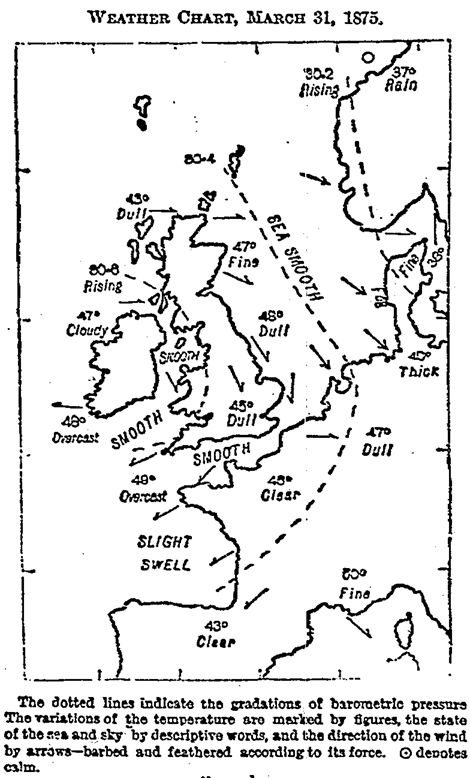
first weather map published in The Times (April 1 1875, showing the weather from the previous day, March 31) *Galton.org


We used to think that if we knew one, we knew two, because one and one are two. We are finding that we must learn a great deal more about `and'.
~Arthur Eddington

The 91st day of the year; 10n + 91 and 10n + 93 are twin primes for n = 1, 2, 3 and 4. (For n less than ten, one of these expressions is prime for some other values of n, which?)

EVENTS
1700 It was the English, it seems, who are responsible for all the mischief you will have to put up with on "April Fools Day". English pranksters begin popularizing the annual tradition of April Fool's Day by playing practical jokes on one another. * Tweet from @Historymag

1764 Annular eclipse visible in Ukkel, Belgium, on April's fool day. * Tweet from @PatrickPoitevin

1801 Gauss records in his diary that he extended his "purely analytical formula" for Easter to the Passover date. [Dunningham, p. 69] *VFR

1803 John Dalton makes the first entry in his first meteorological notebook. Dalton came to his views on atomism through his interest in meteorology. The volumes contain daily meteorological observations, vol. 1 covering from 1 Apr 1803 to 20 Mar 1816.

1824 Instrument maker Peter Barlow is paid 500 Pounds from the Board of Longitude for his "Iron Plate to improve ships compasses." Barlow had studied the "local attraction" or influence on the compass by iron on-board the ship and achieved a way of using an iron plate to minimize the deviation. *Derek Howse, Britain's Board of Longitude, The Finances.

In 1875, Sir Francis Galton published the first newspaper weather map - in The Times, London, England - now a standard feature in newspapers worldwide. He was the first to identify the anticyclone (as opposed to the cyclone), and introduced the use of charts showing areas of similar air pressure, as used on the modern weather map. Galton also devised several novel and ingenious mechanical instruments for recording information about the weather, while working at the Kew Observatory. He was also active as an explorer, anthropologist, statistician and criminologist. Galton was the first to place the study of fingerprints for identification on a scientific basis and so lay the groundwork for their use in criminal cases. *TIS

1876 The New-England Journal of Education (vol. 3, p. 161), in its weekly mathematics column, published a proof of the Pythagorean theorem by General James A. Garfield, Member of Congress from Ohio, and later President of the United States. They refer to the theorem as the pons asinorum, though today that term is reserved for Euclid I.5 which states that the base angles of an isosceles triangle are equal.*VFR

1939 To commemorate the New York World's Fair the U.S. issued a postage stamp picturing a trylon and perisphere. This was the 1st stamp in the world to picture geometric objects. Can you identify these shapes? They are not in my dictionaries. [Scott #853] *VFR (To answer Professor Rickey, they were photographed at the fair (above). The names were for the structures, not a particular geometric shape-The word Perisphere was coined using the Greek prefix peri-, meaning all around, about, or enclosing, surrounding. The word Trylon was coined from the phrase "triangular pylon". )

1948 Physicists Hans Bethe and George Gamow become acquainted with a bright young physicist with such an unusual name that they decided to write a joint paper, which was submitted to The Physical Review on this date. Its only unusual feature was its by-line, "by Alpher, Bethe, and Gamow." [Eves, Revisited, 268] *VFR  The article, about the possibility that the elements Carbon and Nitrogen were formed during the big  bang, which were needed for the creation of heavier elements in the centers of stars under the current theories.  The article is frequently called the "alphabet article."

1960 First televisioin picture of earth from space. It was taken by TIROS 1.*NASA History Office ‏@NASAhistory


1975 Martin Gardner announced that in November 1974, William McGregor, a graph theorist of Wappingers Falls, N.Y., discovered a counterexample to the four-color conjecture. He produced a map containing 110 regions that requires five colors. This "Mathematical Games" column provoked over one thousand letters including a threatened lawsuit from Ivan Guffvanoff III at the University of Wisconsin who destroyed his disproof after reading of this counterexample in The New York Times. The mathematics students at the University of Warwick realized that the column was an April Fool's joke, for they published this poem in Manifold, a journal of mathematical humor:
Oh Mr. Gardner,
What have you done?
You've started up a rumour
You should never have begun!
A four-colour hoax can't
Be undone so quick . . .
Oh Mr. Gardner, what
A bloody silly trick!"
For more details see Time Travel and Other Mathematical Bewilderments by Martin Gardner,
1988, pp. 134, 135
[  The actual map he claimed required five colors can be seen at the Math Forum site.]
   Gardiner also presented another Aprils Fool Joke in that article by claiming that Ramanujan had conjectured, and it had been proved, that was an integer.  The "almost integer" became known as Ramanujan's constant.

1976 The Jovian–Plutonian gravitational effect, a hoax phenomenon stated to cause a noticeable short-term reduction in gravity on Earth, was an invention for April Fools' Day by the English astronomer Patrick Moore broadcast on BBC Radio 2 on 1 April 1976.
Moore stated to radio listeners that an astronomical event would take place at 9:47 a.m. that day, a conjunction of Jupiter and Pluto, which was expected to have an effect observable everywhere. As Pluto passed behind Jupiter, it would briefly cause a powerful combination of the two planets' gravitation which would noticeably decrease gravity on Earth. If listeners were to jump into the air at that exact moment, they would find they felt a floating sensation.
Soon after 9:47 on that morning, the BBC began to receive hundreds of telephone calls from people reporting they had observed the decrease in gravity. One woman who called in even stated that she and eleven friends had been sitting and had been "wafted from their chairs and orbited gently around the room".
Interestingly, in 1980, Moore collaborated with Clyde Tombaugh, the man who had discovered Pluto in 1930, to publish a new book about the dwarf planet.*Wik (ht to David Dickinson @Astroguyz)

1997 The Great Comet of 1997, comet Hale–Bopp passed perihelion. It had been iscovered on July 23, 1995, independently by two observers, Alan Hale and Thomas Bopp, both in the United States. Hale–Bopp's orbital position was calculated as 7.2 astronomical units (AU) from the Sun, placing it between Jupiter and Saturn and by far the greatest distance from Earth at which a comet had been discovered by amateurs. It was discovered at such a great distance from the Sun that it raised expectations that the comet would brighten considerably by the time it passed close to Earth. Although predicting the brightness of comets with any degree of accuracy is very difficult, Hale–Bopp met or exceeded most predictions when it passed perihelion
2005 Astronomy Picture of Day gives visual evidence of water on Mars.

BIRTHS
Seth Ward (1 April, 1617 – 6 January 1689) was an English mathematician, astronomer, and bishop, born in Hertfordshire, and educated at Sidney Sussex College, Cambridge, where he graduated B.A. in 1636 and M.A. in 1640, becoming a Fellow in that year. In 1643 he was chosen university mathematical lecturer, but he was deprived of his fellowship next year for opposing the Solemn League and Covenant (with Isaac Barrow, John Barwick and Peter Gunning).
In the 1640s, he took instruction in mathematics from William Oughtred, and stayed with relations of Samuel Ward.
In 1649, he became Savilian professor of astronomy at Oxford University, and gained a high reputation by his theory of planetary motion. It was propounded in the works entitled In Ismaelis Bullialdi astro-nomiae philolaicae fundamenta inquisitio brevis (Oxford, 1653), against the cosmology of Ismael Boulliau, and Astronomia geometrica (London, 1656) on the system of Kepler.[4][5] About this time he was engaged in a philosophical controversy with Thomas Hobbes,[4] in fact a small part of the debate with John Webster launched by the Vindiciae academiarum he wrote with John Wilkins which also incorporated an attack on William Dell.
He was one of the original members of the Royal Society of London. In 1659, he was appointed President of Trinity College, Oxford, but not having the statutory qualifications he resigned in 1660.*Wik

1640 Georg Mohr (also Jorgen)(April 1, 1640 – January 26, 1697)
His only original contribution to geometry was the proof that any geometric construction which can be done with compass and straightedge can also be done with compasses alone, a result now known as the Mohr–Mascheroni theorem. He published his proof in the book Euclides Danicus, Amsterdam, 1672.
In Denmark the Georg Mohr Competition is a mathematics competition aimed at mathematics students interested in secondary education. The purpose of Georg Mohr contest is to stimulate interest in mathematics by challenging the brightest students with assignments in severity beyond that they encounter in their daily education. The contest also functions as a step in the selection of participants to the IMO, the International Mathematics Olympiad. *Wik

1644 Otto Mencke (22 March (OS) April 1, 1644 – 18 Jan (OS) 29 Jan 1707) was a 17th-century German philosopher and scientist. He obtained his doctorate at the University of Leipzig in 1666 with a thesis entitled: Ex Theologia naturali — De Absoluta Dei Simplicitate, Micropolitiam, id est Rempublicam In Microcosmo Conspicuam.
He is notable as being the founder of the very first scientific journal in Germany, established 1682, entitled: Acta Eruditorum. *Wik
1776 Sophie Germain (1 Apr 1776; died 27 Jun 1831 at age 55) French mathematician who is known for her work in number theory and contributions to the applied mathematics of acoustics and elasticity. Germain was self-taught from books, and from lecture notes supplied by male friends attending the Ecole Polytechnique which she, as a woman, was not permitted to attend. Using a male pseudonym, M. LeBlanc,{"In describing the honourable mission I charged him with, M. Pernety informed me that he made my name known to you. This leads me to confess that I am not as completely unknown to you as you might believe, but that fearing the ridicule attached to a female scientist, I have previously taken the name of M. LeBlanc in communicating to you those notes that, no doubt, do not deserve the indulgence with which you have responded." Letter to Gauss (1807)} She corresponded with Lagrange who recognized her skill, and subsequently sponsored her work. She accomplished a limited proof of Fermat's last theorem, for any prime under 100 where certain conditions were met. In 1816, she won a prize sponsored by Napoleon for a mathematical explanation of Chladni figures, the vibration of elastic plates. She died at age 55, from breast cancer.*TIS She worked in several areas of mathematics and science, including number theory. She proved Fermat's Last Theorem for exponents less than 100. In 1816 she won the Prix Bordin for her work on vibrations of elastic plates. Naturally, she was the first woman to win this prize. The competition question had be first set in 1811, and Germain was the only entry. In the reopened competitions of 1813 she was again the only entry, and she received an honorable mention. In the 1815 competition she was deemed worthy of the prize. *WM

1801 Henry Perigal, Jr. FRAS MRI (1 April 1801 – 6 June 1898) was a British stockbroker and amateur mathematician, known for his dissection-based proof of the Pythagorean theorem and for his unorthodox belief that the moon does not rotate.
In his booklet Geometric Dissections and Transpositions (London: Bell & Sons, 1891) Perigal provided a proof of the Pythagorean theorem based on the idea of dissecting two smaller squares into a larger square. The five-piece dissection that he found may be generated by overlaying a regular square tiling whose prototile is the larger square with a Pythagorean tiling generated by the
two smaller squares. Perigal had the same dissection printed on his business cards, and it also appears on his tombstone.

As well as being interested in mathematics, Perigal was an accomplished lathe worker, and made models of mathematical curves for Augustus De Morgan. He believed (falsely) that the moon does not rotate with respect to the fixed stars, and used his knowledge of curvilinear motion in an attempt to demonstrate this belief to others. *Wik

1874 Ernest William Barnes (1 April 1874 in Birmingham, England - 29 Nov 1953 in Sussex, England) English mathematician and theologian
In all, Barnes wrote 29 mathematical papers during the years 1897-1910. His early work was concerned with various aspects of the gamma function, including generalisations of this function given by the so-called Barnes G-function, which satisfies the equation

G(z+1)=G(z)Γ(z)

and to the double gamma function. Barnes next turned his attention to the theory of integral functions, where, in a series of papers, he investigated their asymptotic structure. He also considered second-order linear difference equations connected with the hypergeometric functions. In the last five of his papers dealing with the hypergeometric functions, Barnes made extensive use of the integrals studied by Mellin in which the integral involves gamma functions of the variable of integration. It was in these papers that he brought to the attention of British mathematicians the power and simplicity associated with these integrals, and which now bear the name Mellin-Barnes integrals. His last mathematical paper, published in 1910, was a short and elegant demonstration of a previously known result of Thomae concerning a transformation of a generalised hypergeometric function of unit argument into a more rapidly convergent function of the same kind. *SAU

1895 Alexander Craig Aitken (1 April 1895 in Dunedin, New Zealand - 3 Nov 1967 in Edinburgh, Scotland) He was asked to turn 4/47 into a decimal. After four seconds he answered, giving one digit every three-quarters of a second: `Point 08510638297872340425531914.' He stopped there|after 24 seconds, discussed the matter for a minute, and then started up again. `Yes, 191489. I can get that.' Five-second pause. `361702127659574468. Now that's the repeating point. It starts again at 085. So, if that's 46 places, I'm right.' " Exercise: Check this calculation on your hand calculator. Quoted from The Body by Anthony Smith, NY: Walker & amp; Co., 1968, p. 320. *VFR [Most hand calculators won't show all of the decimal places.. a nice property of repeating fractions can help uncover the rest.]

1898 – William James Sidis(April 1, 1898 – July 17, 1944) an American child prodigy with exceptional mathematical and linguistic abilities. He became famous first for his precocity, and later for his eccentricity and withdrawal from the public eye. He avoided mathematics entirely in later life, writing on other subjects under a number of pseudonyms. The difficulties Sidis encountered in dealing with the social structure of a collegiate setting may have shaped opinion against allowing such children to rapidly advance through higher education in his day.*Wik

1932 Norman Abramson (1 Apr 1932, )American computer scientist who created ALOHANET, the first modern data network, which formed the basis of the protocols essential in the Ethernet now in wide use. It opened in 1970, operating at 9600 bits per second, using radio to provide a wireless packet-switched data network between several Hawaii islands. Its innovations included the first packet radio sensors, the first packet radio repeaters, the first satellite packet network and the first radio access to the Internet. Abramson's U.S. patents include the first patent for CRC redundancy checks to provide data error control technique (No. 3,114,130), and the first patent issued for the design of burst errors in digital systems (No. 3,163,848).*TIS

1947 Alain Connes (1 Apr 1947, )French mathematician won the 1982 Fields Medal (awarded in 1983) for his work in operator theory. His most remarkable contributions are (1)general classification and a structure theorem for factors of type III, obtained in his thesis (1973); (2) classification of automorphisms of the hyperfinite factor, which served as a preparation for the next contribution; (3) classification of injective factors; and (4) application of the theory of C*-algebras to foliations and differential geometry in general. Connes' recent work has been on noncommutative geometry and he has studied applications to theoretical physics *TIS


DEATHS
1820 Rev. Isaac Milner FRS (11 January 1750 – 1 April 1820) was a mathematician, an inventor, the President of Queens' College, Cambridge and Lucasian Professor of Mathematics.
He began his education at a grammar school in Leeds in 1756, but this ended in 1760 with the death of his father. He was apprenticed as a weaver, reading the classics when time permitted, until his elder brother, Joseph Milner, provided him with an opportunity. Joseph was offered the mastership at Hull's grammar school and invited Isaac to become the institution's usher.
Through the patronage of his brother, Milner was subsequently freed from his duties in Hull and entered Queens' College, Cambridge, as a sizar in 1770. He graduated BA as senior wrangler in 1774, winning the Smith's first prize.
In 1776 Nevil Maskelyne hired him as a computer for the board of longitude, and two of his mathematical papers were presented to the Royal Society, of which he was elected fellow in 1780. In these papers Milner displayed three things: proficiency in mathematics, suspicion of French philosophy, and adherence to English Newtonian mechanics.
In 1782 the Jacksonian professorship of natural philosophy was established and the syndicate selected Milner as the inaugural professor, a position he retained until 1792.
Milner also developed an important process to fabricate nitrous acid, a key ingredient in the production of gunpowder. His paper describing this process was published in the Royal Society's Philosophical Transactions in 1789 alongside an article of Joseph Priestley's, and the two corresponded on the subject. In later years Milner transferred his elaborate collection of chemical apparatus into the president's lodge at Queens' and performed experiments with E. D. Clarke, William Whewell, and the Wollaston brothers; he also collaborated with Humphry Davy and Joseph Banks in an attempt to cure gout.
He was instrumental in the 1785 religious conversion of William Wilberforce and a great supporter of the abolitionists' campaign against the slave trade, steeling Wilberforce with his assurance before the 1789 Parliamentary debate: "If you carry this point in your whole life, that life will be better spent than in being prime minister of many years."
*Wik
1863 Jakob Steiner (18 Mar 1796; 1 Apr 1863 at age 67) Swiss mathematician who was one of the greatest, contributors to projective geometry. He discovered the Steiner surface which has a double infinity of conic sections on it. The Steiner theorem states that the two pencils by which a conic is projected from two of its points are projectively related. He is also known for the Poncelet-Steiner theorem which shows that only one given circle and a straight edge are required for Euclidean constructions. His work included conic sections and surfaces, the theory of second-degree surfaces and centre-of-gravity problems. He developed the principle of symmetrization (1840-41). In 1848 he ws the first to define various polar curves with respect to a given curve, and introduced the “Steiner Curves.” *TIS

1872 Martin Ohm (6 May 1792 in Erlangen, Bavaria (now Germany)- 1 April 1872 in Berlin, Prussia, German Empire) was a German mathematician and a younger brother of physicist Georg Ohm. He earned his doctorate in 1811 at Friedrich-Alexander-University, Erlangen-Nuremberg where his advisor was Karl Christian von Langsdorf. Ohm was the first to fully develop the theory of the exponential ab when both a and b are complex numbers in 1823. He is also often credited with introducing the name "golden section" (goldener Schnitt).
Ohm's students included Friedrich August, Friedrich Bachmann, Paul Bachmann, Joseph Brutkowski, Heinrich Eduard Heine, Rudolf Lipschitz, Leo Pochhammer, Friedrich Prym, Wilhelm Wagner, Hermann Waldaestel, Wilhelm Wernicke, Elena Gerz, Valentien Gerz, and Johanna Gerz. *Wik
Martin Ohm made a distinction between writing for mathematicians and writing for students, a distinction that many of his contemporaries, including Hermann Grassmann, did not consider appropriate. His colleagues Steiner and Kummer also ridiculed him for not following Alexander von Humboldt's firm belief in the unity of teaching and research. It is quite difficult to assess the importance of Ohm's mathematical contributions. The first thing to say is that they certainly weren't as important as he himself thought. He had a very high opinion of himself as the following quotation indicates. Niels Abel wrote to Christopher Hansteen, the professor of astronomy at the University of Christiania, while he was on a visit to Berlin in 1826

There is at [August Crelle's] house some kind of meeting where music is mainly discussed, of which unfortunately I do not understand much. I enjoy it all the same since I always meet there some young mathematicians with whom I talk. At Crelle's house, there used to be a meeting of mathematicians, but he had to suspend it because of a certain Martin Ohm with whom nobody could get along due to his terrible arrogance.
*SAU

1912 Pyotr Nikolayevich Lebedev (8 Mar 1866; 1 Apr 1912 at age 46) Russian physicist who, in experiments with William Crookes' radiometer, proved (1910) that light exerts a minute pressure on bodies (as predicted by James Clerk Maxwell's theory of electromagnetism), and furthermore that this effect is twice as great for reflecting surfaces than for absorbent surfaces. He had proposed that light pressure on small particles of cosmic dust could be greater than gravitational attraction, thus explaining why a comet's tail points away from the Sun (though it is now understood the solar wind has a greater influence). He built an extremely small vibrator source capable of generating 4-6 mm waves, which he used to demonstrate the first observation of douible refraction of electromagnetic waves in crystals of rhombic sulphur.*TIS

1921 Carl Johannes Thomae (11 December 1840, Laucha an der Unstrut – 1 April 1921, Jena) (sometimes called "Johannes Thomae", "Karl Johannes Thomae", or "Johannes Karl Thomae") was a German mathematician. Carl Johannes Thomae's research was concerned with function theory and with what German-speaking mathematicians often call "Epsilontik", the precise development of analysis, differential geometry, and topology using epsilon-neighborhoods in the style of Weierstrass. The Thomae function, the Thomae transformation formula (aka, Thomae's transformation and Thomae's theorem), the Thomae formula for hyperelliptic curves, and the Sears–Thomae transformation formula are named after him. He called himself Riemann's student, although he never attended a lecture by Riemann. *TIS

1968 Lev Davidovich Landau (22 Jan 1908; 1 Apr 1968) Soviet physicist who worked in such fields as low-temperature physics, atomic and nuclear physics, and solid-state, stellar-energy, and plasma physics. Several physics terms bear his name. He was awarded the 1962 Nobel Prize for Physics for his theory to explain the peculiar superfluid behaviour of liquid helium at very low temperature (2.18 K). Landau's further contributions are partly reflected in such terms as Landau diamagnetism and Landau levels in solid-state physics, Landau damping in plasma physics, the Landau energy spectrum in low-temperature physics, or Landau cuts in high-energy physics. *TIS

1971 Dame Kathleen Lonsdale (28 Jan 1903; 1 Apr 1971) British crystallographer (née Yardley) who developed several X-ray techniques for the study of crystal structure. Her experimental determination of the structure of the benzene ring by x-ray diffraction, which showed that all the ring C-C bonds were of the same length and all the internal C-C-C bond angles were 120 degrees, had an enormous impact on organic chemistry. She was the first woman to be elected (1945) to the Royal Society of London. *TIS


And for a final teaser..here is an April Fools video about complex numbers.. enjoy


Credits :
*CHM=Computer History Museum
*FFF=Kane, Famous First Facts
*NSEC= NASA Solar Eclipse Calendar
*RMAT= The Renaissance Mathematicus, Thony Christie
*SAU=St Andrews Univ. Math History
*TIA = Today in Astronomy
*TIS= Today in Science History
*VFR = V Frederick Rickey, USMA
*Wik = Wikipedia
*WM = Women of Mathematics, Grinstein & Campbel