Thursday, 3 July 2014

On This Day in Math - July 3


Music is the pleasure the human mind experiences from counting
without being aware that it is counting. 
 ~Gottfried Leibniz

The 184th day of the year; 184 = 23 * 23 (concatenation of the first two primes). *Prime Curios


EVENTS
1822 Charles Babbage described his ideas for a “difference engine” to the Royal Society. *VFR

1841, John Couch Adams decided to determine the position of an unknown planet by the irregularities it causes in the motion of Uranus. He entered in his journal; "Formed a design in the beginning of this week in investigating, as soon as possible after taking my degree, the irregularities in the motion of Uranus... in orderto find out whether they may be attributed to the action of an undiscovered planet beyond it..." In Sep 1845 he gave James Challis, director of the Cambridge Observatory, accurate information on where the new planet, as yet unobserved, could be found; but unfortunately the planet was not recognized at Cambridge until much later, after its discovery at the Berlin Observatory on 23 Sep 1846. *TIS

2011  Astronomers using the Hubble Space Telescope discovered a fourth moon orbiting the icy dwarf planet Pluto. The tiny, new satellite – temporarily designated P4 -- was uncovered in a Hubble survey searching for rings around the dwarf planet.


Two labeled Hubble WFC3/UVIS images of the Pluto system with new moon P4 circled. Left side image taken on June 28, 2011. Right side image taken on July 3, 2011.
Two labeled images of the Pluto system taken by the Hubble Space Telescope's Wide Field Camera 3 ultraviolet visible instrument with newly discovered fourth moon P4 circled. The image on the left was taken on June 28, 2011. The image of the right was taken on July 3, 2011. Credit: NASA, ESA, and M. Showalter (SETI institute)


BIRTHS
1820 Ernest de Jonquières (3 July 1820 Carpentras, France – 12 Aug 1901 Mousans-Sartoux, France) was a French naval officer who discovered many results in geometry. After his introduction to advanced mathematics by Chasles it is not surprising that his main interests were geometry throughout his life. He made many contributions many of them extending the work of Poncelet and Chasles. An early work, the treatise Mélanges de géométrie pure (1856) contains: an amplifications of Chasles' ideas on the geometric properties of an infinitely small movement of a free body in space; a commentary on Chasles' work on conic sections; the principle of homographic correspondence; and constructions relating to curves of the third order. In a final section de Jonquières presented a French translation of Maclaurin's work on curves. *SAU

1849 Prosper-René Blondlot (3 July 1849 – 24 November 1930) was a French physicist, best remembered for his mistaken "discovery" of N rays, a phenomenon that subsequently proved to be illusory.
In order to demonstrate that a Kerr cell responds to an applied electric field in a few tens of microseconds, Blondlot, in collaboration with Ernest Bichat, adapted the rotating-mirror method that Léon Foucault had applied to measure the speed of light. He further developed the rotating mirror to measure the speed of electricity in a conductor, photographing the sparks emitted from two conductors, one 1.8 km longer than the other and measuring the relative displacement of their images. He thus established that the speed of electricity in a conductor is very close to that of light.
In 1891, he made the first measurement of the speed of radio waves, by measuring the wavelength using Lecher lines. He used 13 different frequencies between 10 and 30 MHz and obtained an average value of 297,600 km/s, which is within 1% of the current value for the speed of light. This was an important confirmation of James Clerk Maxwell's theory that light was an electromagnetic wave like radio waves.
In 1903, Blondlot announced that he had discovered N rays, a new species of radiation. The "discovery" attracted much attention over the following year until Robert W. Wood showed that the phenomena were purely subjective with no physical origin. The French Academy of Sciences awarded the Prix Leconte (₣50,000) for 1904 to Blondot, although they hedged on the reason, citing the totality of his work rather than the discovery of N-rays.
Little is known about Blondlot's later years. William Seabrook stated in his Wood biography Doctor Wood, that Blondlot went insane and died, supposedly as a result of the exposure of the N ray debacle: "This tragic exposure eventually led to Blondlot's madness and death." Using an almost identical wording this statement was repeated later by Martin Gardner, possibly without having investigated into the subject: "Wood's exposure led to Blondlot's madness and death." However, Blondlot continued to work as a university professor in Nancy until his early retirement in 1910. He died at the age of 81; at the time of the N-ray affair he was nearly 60 years old. *Wik

1866 Henry Frederick Baker FRS (3 July 1866 – 17 March 1956) was a British mathematician, working mainly in algebraic geometry, but also remembered for contributions to partial differential equations (related to what would become known as solitons), and Lie groups.
Baker was born in Cambridge, England and educated at The Perse School before winning a scholarship to St John's College, Cambridge in October 1884. Baker graduated as Senior Wrangler in 1887, bracketed with 3 others.
Baker was elected Fellow of St John's in 1888 where he remained for 68 years.
In June, 1898 he was elected a Fellow of the Royal Society. In 1911, he gave the presidential address to the London Mathematical Society.
In January 1914 he was appointed Lowndean Professor of Astronomy. *Wik
In the 1930s before the war Baker's graduate students would meet at what they called Professor Baker’s "Tea Party", who met once a week to discuss the areas of research in which we were all interested. It was to one of these meetings that a young Donald Coxeter brought his "Aunt Alice", the 69 year old Alicia Boole to co-present on the subject of Polytopes in higher dimensions.

1897 Jesse Douglas (3 July 1897 – 7 September 1965) born in New York City. He did important work on Plateau’s problem, which asks for the minimal surface connecting a given boundary. For this work he received a Fields medal in 1936, the first time that they were given. *VFR ..the Plateau problem... had first been posed by the Italian-French mathematician Joseph-Louis Lagrange in 1760. The Plateau problem is one of finding the surface with minimal area determined by a fixed boundary. Experiments (1849) by the Belgian physicist Joseph Plateau demonstrated that the minimal surface can be obtained by immersing a wire frame, representing the boundaries, into soapy water. Douglas developed what is now called the Douglas functional, so that by minimizing this functional he could prove the existence of the solution to the Plateau problem. Douglas later developed an interest in group theory.*TIS

1933 Frederick Justin Almgren,(July 3, 1933, Birmingham, Alabama–February 5, 1997, Princeton, New Jersey) Almost certainly Almgren's most impressive and important result was only published in 2000, three years after his death. Why was this? The paper was just too long to be accepted by any journal. Brian Cabell White explains the background in a review of the book published in 2000 containing the result:-
By the early 1970s, geometric analysts had made spectacular discoveries about the regularity of mass-minimizing hypersurfaces. (Mass is area counting multiplicity, so that if k sheets of a surface overlap, the overlap region is counted k times.) In particular, the singular set of an m-dimensional mass-minimizing hypersurface was known to have dimension at most m - 7. By contrast, for an m-dimensional mass-minimizing surface of codimension greater than one, the singular set was not even known to have m-measure 0. Around 1974, Almgren started on what would become his most massive project, culminating ten years later in a three-volume, 1700-page preprint containing a proof that the singular set not only has m-dimensional measure 0, but in fact has dimension at most (m - 2). This dimension is optimal, since by an earlier result of H Federer there are examples for which the dimension of the singular set is exactly (m - 2). ... Now, thanks to the efforts of editors Jean Taylor and Vladimir Scheffer, Almgren's three-volume, 1700-page typed preprint has been published as a single, attractively typeset volume of less than 1000 pages.*SAU

1933 William (Bill) Parry FRS (3 July 1934–20 August 2006) was an English mathematician. During his research career, he was highly active in the study of dynamical systems, and, in particular, ergodic theory, and made significant contributions to these fields. He is considered to have been at the forefront of the introduction of ergodic theory to the United Kingdom. He played a founding role in the study of subshifts of finite type, and his work on nilflows was highly regarded.*Wik

1945 Saharon Shelah (July 3, 1945 - ) is an Israeli mathematician. He is a professor of mathematics at the Hebrew University of Jerusalem and Rutgers University in New Jersey. Shelah is one of the most prolific contemporary mathematicians. As of 2009, he has published nearly 900 mathematical papers (together with over 200 co-authors). His main interests lie in mathematical logic, model theory in particular, and in axiomatic set theory.*Wik


DEATHS
1749 William Jones, FRS (1675 – 3 July 1749) was a Welsh mathematician, most noted for his proposal for the use of the symbol π (the Greek letter pi) to represent the ratio of the circumference of a circle to its diameter. He was a close friend of Sir Isaac Newton and Sir Edmund Halley. In November, 1711 he became a Fellow of the Royal Society, and was later its Vice-President.*Wik

1789 Jakob Bernoulli II died. *VFR    Born in Basel in 1759 (17 October), the son of Johann (II).  assistant to Daniel in experimental physics
He graduated in Jurisprudence in 1778 but also studied Maths and Physics. In 1782, he applied for Daniel's former chair but was unsuccessful.
He became secretary to an imperial representative in Venice
In 1786 he went to Petersburg, to the Academy of Science (Fuss recommended him to Dashkoff) and in 1788 became ordentlich academy member for mathematics.
He married one of Euler's granddaughters, Charlotte.
At thirty years of age, he drowned in the Neva.  *Brian Daugherty

1991 Ernst Witt (June 26, 1911-July 3, 1991) was a German mathematician born on the island of Als (German: Alsen). Shortly after his birth, he and his parents moved to China, and he did not return to Europe until he was nine.
Witt's work was mainly concerned with the theory of quadratic forms and related subjects such as algebraic function fields.*Wik


Credits :
*CHM=Computer History Museum
*FFF=Kane, Famous First Facts
*NSEC= NASA Solar Eclipse Calendar
*RMAT= The Renaissance Mathematicus, Thony Christie
*SAU=St Andrews Univ. Math History
*TIA = Today in Astronomy
*TIS= Today in Science History
*VFR = V Frederick Rickey, USMA
*Wik = Wikipedia
*WM = Women of Mathematics, Grinstein & Campbell

Wednesday, 2 July 2014

On This Day in Math - July 2


OOPS...
Heavier-than-air flying machines are impossible.
I have not the smallest molecule of faith in aerial navigation other than ballooning,
or of the expectation of good results from any of the trials we hear of. 1895
And in a Letter to Baden-Powell (1896) Radio has no future.
William Thomson, Lord Kelvin


The 183rd day of the year; the concatenation of 183 and 184, 183184 is a perfect square. There are no smaller numbers for which the concatenation of two consecutive numbers is square. (Students might seek the next such pair of numbers. They are small enough to be year dates)


EVENTS
1133 First trade security agreement between Pisans and Alibibn Yusof of Morocco.Under such an agreement, Guilielmo, father of Leonardo brought his young son (who would much later be called Fibonacci) to Bugia, where he would learn of the Arabic calculation system that he would introduce to his  homeland in his Liber Abbaci in 1202. *Devlin, The Man of Numbers

1779 One of the earliest mentions of blackboards in Colonial America was in a letter from John Taylor, a tutor at Queens College (to become Rutgers University)to a graduate student, John Bogart, that he was asking to take over his classes while Taylor was away on military duties. "I have spoken to Mr. Briton to make a blackboard.." *Kidwell, Hastings, & Roberts; Tools of American Mathematics Teaching.

1832 Legendre writes to Nathanial Bowditch regarding his translation of LaPlace's "Mecanique Celeste" ,"Your work is not merely a translation with a commentary; I regard it as a new edition, augmented and improved, and such a one as might have come from the hands of the author himself, ... if he had been solicitously studious of being clear."   LaPlace's classic is a very difficult book, and Biot, who helped him prepare it for printing said that Laplace himself would frequently get lost in following his own line of reasoning  and insert, "il est aise a voir" (It is easy to see). *The Teaching and History of Mathematics in the United States, F. Cajori

1850 Stokes’s theorem made its first appearance as a postscript to a letter from Sir William Thompson (Lord Kelvin) to Stokes. It first appeared publicly as question 8 on the Smith’s Prize exam for 1854. Stokes drew up this competitive exam, which was taken by the best mathematics students at Cambridge University. By the time Stokes died the theorem was universally known as “Stokes’s theorem.” [Spivak, Calculus on Manifolds, p. viii].

1866 Alfred Russell Wallace writes to Darwin with to suggest a name change for his basic principal of Evolution:
I wish.. to suggest ... adopting Spencer's term, (which he generally uses in preference to Natural Selection, viz, "Survival of the Fittest"
*Mario Livio, Brilliant Blunders, pg 29

1883 Helmholtz writes to Heinrich Hertz to congratulate him on his investigations. "I have read with the greatest interest your investigation on the cathode ray discharge, and cannot refrain from writing to say Bravo!" Hemholtz was not given to token praise, and was the opinion that was most valued by Hertz. *Hertz Miscellaneous Papers

1897 – Italian scientist Guglielmo Marconi obtains a patent for radio in London.*Wik

1982 Science (p. 39) reported that Steven Smale had proved that the average-case behavior of the simplex algorithm for linear programming is far better than the worse-case behavior, which is exponential. [Mathematics Magazine 56 (1983), p. 55]. *VFR

1992 On July 2, fearing for the impact that a park service removal of homeowners around Elkmont, Tennessee in the Great Smokey Mountain Natl Park would have on a variety of local fireflys, Lynn Faust wrote a letter to Professor Steven Stogratz, who had recently written a paper in Science Magazine about synchronized flashing of the firelies (lightning bugs) known to exist in Southeast Asia. Ms. Faust's letter would, in Strogatz's words, "shatter a (scientific) myth that had lasted for decades."
The letter, in Ms. Faust's own hand, can be read here. (My thanks to both Professor Strogatz and Ms. Faust for their cooperation in sharing this letter.)

2011 Simon Chua, 58, received Australia's B. H. Neumann Award for pioneering efforts in training and honing the talent of young Filipino mathematicians for the past 15 years.
The Australian Mathematics Trust (AMT) bestowed the award to Chua on July 2, 2011. The B. H. Neumann Awards are presented annually for "important contributions over many years to the enrichment of mathematics learning in Australia and its region," according to the AMT.
The award is named in honor of Bernhard H. Neumann, the so-called father of Australian mathematics, who “provided outstanding leadership, support and encouragement for mathematics and the teaching of mathematics at all levels."
Chua, who is president and co-founder of the Mathematics Trainers Guild-Philippines (MTG), is the first Asian to receive the award.
Through the MTG, Filipino students have won numerous medals in math competitions abroad including in China, United States, Singapore, Thailand, Hong Kong and Indonesia.
In 2006, Chua became the first Filipino to win the Paul Erdos Award from the World Federation of National Mathematics Competitions. *MathDL


BIRTHS

1622 Rene-Francoise de Sluse (2 July 1622 – 19 March 1685) born. 1830 “It is true that Fourier is of the opinion that the principle object of mathematics is the public utility and the explanation of natural phenomena; but a scientist like him ought to know that the unique object of science is the honor of the human spirit and on this basis a question of [the theory of] numbers is worth as much as a question about the planetary system.” Jacobi to Legendre. Big Kline, p. 1037. VFR


1842 George Thom (2 July 1842 in Forgue near Huntly, Scotland - 20 Dec 1916 in Aberdeen, Scotland) graduated from Aberdeen and then became Principal of Doveton College in Madras, India. He returned to Scotland as Vice-Principal of Chanonry School Aberdeen and then became Rector of Dollar Institution (later to become Dollar Academy). He held this post for 24 years. He was a founder member of the EMS and became the fifth President in 1886. *SAU


1847 Andrew Gray graduated from Glasgow University and was appointed assistant and secretary to Lord Kelvin. He became Professor of Physics at University College Bangor and then returned to Glasgow as Kelvin's successor. He produced many books and papers in both mathematics and physics.*SAU


1852 Birthdate of William Burnside, whose Theory of Groups (1897, 1911) is now a classic. His suspicion that every group of odd order is solvable was proved in 1962 by Walter Feit and John G. Thompson. *VFR He is known mostly as an early contributor to the theory of finite groups. In 1897 Burnside's classic work Theory of Groups of Finite Order was published. The second edition (published in 1911) was for many decades the standard work in the field. A major difference between the editions was the inclusion of character theory in the second.
Burnside is also remembered for the formulation of Burnside's problem (which concerns the question of bounding the size of a group if there are fixed bounds both on the order of all of its elements and the number of elements needed to generate it) and for Burnside's lemma (a formula relating the number of orbits of a permutation group acting on a set with the number of fixed points of each of its elements) though the latter had been discovered earlier and independently by Frobenius and Cauchy.


1862 Sir William Henry Bragg (2 July 1862 – 10 March 1942) was a pioneer British scientist in solid-state physics who was a joint winner (with his son Sir Lawrence Bragg) of the Nobel Prize for Physics in 1915 for research on the determination of crystal structures. During the WW I, Bragg was put in charge of research on the detection and measurement of underwater sounds in connection with the location of submarines. He also constructed an X-ray spectrometer for measuring the wavelengths of X-rays. In the 1920s, while director of the Royal Institution in London, he initiated X-ray diffraction studies of organic molecules. Bragg was knighted in 1920. *TIS I found this post on twitter, and realized nothing I had said about Bragg captured the man so well: 


1885 Émile Henriot (2 July 1885 - 1 February 1961) was a French chemist notable for being the first to show definitely that potassium and rubidium are naturally radioactive.
He investigated methods to generate extremely high angular velocities, and found that suitably placed air-jets can be used to spin tops at very high speeds - this technique was later used to construct ultracentrifuges.
He was a pioneer in the study of the electron microscope. He also studied birefringence and molecular vibrations.
He obtained his DSc in physics in 1912 the Sorbonne, Paris, under Marie Curie. *Wik
1906 Hans Beth, (July 2, 1906 – March 6, 2005) German-born American theoretical physicist who helped to shape classical physics into quantum physics and increased the understanding of the atomic processes responsible for the properties of matter and of the forces governing the structures of atomic nuclei. Bethe did work relating to armour penetration and the theory of shock waves of a projectile moving through air. He studied nuclear reactions and reaction cross sections (1935-38). In 1943, Oppenheimer asked Bethe to be the head of the Theoretical Division at Los Alamos on the Manhattan Project. After returning to Cornell University in 1946, Bethe became a leader promoting the social responsibility of science. He received the Nobel Prize for Physics (1967) for his work on the production of energy in stars. *TIS


DEATHS
1566 Nostradamus, French astrologer died on this day (b. 1503). I wonder if he predicted THIS in his prophacies.

1591 Vincenzo Galilei ( c. 1520 – 2 July 1591) Italian, music theorist, lutenist and composer, who as the father of Galileo Galilei, adopted experimentation to prove aspects of acoustics, and may thus have influenced his son, Galileo, away from pure, abstract mathematics and towards making experiments and investigation. Vincenzo's discoveries in acoustics included some of the physics of vibrating strings and columns of air. In particular he was the first to show that the ratio of an interval was proportional to string lengths but varied as the square of the tension applied to the strings and as the cubes of volumes of air. He recognized the superiority of equal tempered tuning and compiled a codex of pieces illustrating the use of all 24 major and minor keys as early as 1584.*TIS
1613 Bartholomeo Pitiscus (August 24, 1561 – July 2, 1613) was a Polish theologian who first coined the word Trigonometry. *SAU Pitiscus achieved fame with his influential work written in Latin, called Trigonometria: sive de solutione triangulorum tractatus brevis et perspicuus (1595, first edition printed in Heidelberg), which introduced the word "trigonometry" to the English and French languages, translations of which had appeared in 1614 and 1619, respectively. It consists of five books on plane and spherical trigonometry. Pitiscus is sometimes credited with inventing the decimal point, the symbol separating integers from decimal fractions, which appears in his trigonometrical tables and was subsequently accepted by John Napier in his logarithmic papers (1614 and 1619).*Wik
1621 Thomas Harriot
(Oxford, c. 1560 – London, 2 July 1621) died of a cancerous ulcer on his left nostril. While in America in 1586 he learned to “drink” tobacco smoke from the Indians. This probably makes him the earliest recorded tobacco fatality. He is best known for his contributions to algebra, including the invention of the symbol for less than, \( \lt \) and greater than, \( \gt \) . He might have adopted this symbol from a decoration on an Indian’s back. See C. L. Smith, “On the origin of ‘<’ and ‘>’,” The Mathematics Teacher, 57(1964), 479–481 for a picture of this Indian.*VFR
He also is credited with the mathematical symbol for "therefore" \(\therefore \) His executors posthumously published his Artis Analyticae Praxis on algebra in 1631; Nathaniel Torporley was the intended executor of Harriot's wishes, but Walter Warner in the end pulled the book into shape. It may be a compendium of some of his works but does not represent all that he left unpublished (more than 400 sheets of annotated writing). It isn't directed in a way that follows the manuscripts and it fails to give the full significance of Harriot's writings.*Wik He introduced a simplified notation for algebra and his fundamental research on the theory of equations was far ahead of its time. He was able to solve equations, even with negative or complex roots. However, he published no mathematical work in his lifetime. (Artes analyticae praxis, posthumous, 1631). Especially early in his career, he worked on navigation for his patron Walter Raleigh. Harriot carried out extensive telescopic observations of the satellites of Jupiter and of sunspots. When investigating optics, he discovered the sine law and measured the refractive indices of 13 different substances. He investigated free motion and motion resisted in air, and ballistic curves.*TIS Thomas Harriot was an English mathematician who did outstanding work on the solution of equations, recognising negative roots and complex roots in a way that makes his solutions look almost like a present day solution.*SAU
The solution of quadratic equations by the method of factoring was often referred to as Harriot's method because of his introduction of the method in his writing.
It is not possible today to find Harriot's grave. Although he was buried near the altar of St Christopher le Stocks in London,the church was destroyed in the great fire of 1666. There is a plaque in the entrance hall of the Bank of England, which is close to the site of Harriot's grave. It reproduces the original Latin wording of his epitaph.(p474) An English translation would read:
Stay, traveler, lightly tread;
Near this spot lies all that was mortal
Of that most celebrated man Thomas Harriot.
He was that most learned Harriot . . .
Who cultivated all the sciences and excelled in all . . .
A most studious searcher after truth . . .

1874 Gouverneur Emerson American physician, statistician and agriculturalist who prepared a series of tables of deaths and causes in Philadelphia, during thirty years from 1807. These showed, for example, the excessive mortality of males during childhood. He began practice in Philadelphia on 4 Aug 1820, where yellow fever broke out a few weeks later, with 73 deaths by that fall. Emerson recorded cases, dates, locations, and outcomes. He concluded no current medical treatments was especially effective. When smallpox reappeared there, with 325 deaths in 1824, Emerson drafted a bill for control measures. There were only 6 cases of smallpox in the city in 1825, and 3 in 1826. In retirement, he turned to peach culture, and studied phosphate and guano fertilizers. *TIS

1947 Nikolai Grigorievich Chebotaryov (15 June [O.S. 3 June] 1894 – 2 July 1947) proved his density theorem generalising Dirichlet's theorem on primes in an arithmetical progression*SAU

1963 Seth Barnes Nicholson (November 12, 1891 – July 2, 1963) was an American astronomer best known for discovering four satellites of Jupiter. As a graduate student at the University of California, while photographing the recently- discovered 8th moon of Jupiter with the 36-inch Crossley reflector, he discovered a 9th (1914). During his life career at Mt.Wilson Observatory, he discovered two more Jovian satellites (1938) and the 12th (1951), as well as a Trojan asteroid, and computed orbits of several comets and of Pluto. His main assignment at Mt. Wilson was observing the sun with the 150-foot solar tower telescope, and he produced annual reports on sunspot activity and magnetism for decades. With Edison Pettit, he measured the temperatures of the moon, planets, sunspots, and stars in the early 1920s. *TIS

2002 Daniel Chonghan Hong (3 Mar 1956; 2 Jul 2002 at age 46) Korean theoretical physicist specializing in statistical physics and nonlinear dynamic physics, who with colleague Hugo Caram, originated the void diffusing-void model of granular flow, which is recognized as an effective theoretical treatment for a broad range of dynamical phenomena in granular media. In general, his work ranged from percolation network, viscous fingering, granular flows to traffic equations. He studied and taught in America from 1981, and wrote articles for popular magazines on various topics. He died at the young age of 46 of cardiac arrest. *TIS


Credits :
*CHM=Computer History Museum
*FFF=Kane, Famous First Facts
*NSEC= NASA Solar Eclipse Calendar
*RMAT= The Renaissance Mathematicus, Thony Christie
*SAU=St Andrews Univ. Math History
*TIA = Today in Astronomy
*TIS= Today in Science History
*VFR = V Frederick Rickey, USMA
*Wik = Wikipedia
*WM = Women of Mathematics, Grinstein & Campbell

Tuesday, 1 July 2014

A curious Geometry relation, and a Question


The triangle above is a right triangle, and almost no one who reads this blog didn't know that. In fact for most people who have had a pretty good math background, you would be surprised to read a property or theorem about right triangles that you didn't know, or at least hadn't heard, especially if it dates back to the 18th Century.

Ok, so if I give you the three side lengths of a right triangle, how would you find the smallest angle..... Hold on, No calculator, and No tables...
I had no idea how to achieve such a result when I came across such a method by a Hugh Worthington in "An essay on the Resolution of Plain Triangles, by Common Arithmetic." It was in an anthology of math writing from the 1500's to the present in "A Wealth of Numbers: An Anthology of 500 Years of Popular Mathematics Writing" by Benjamin Wardhaugh.


So How is it done? Well, in the words of the author, "half the longer of the two legs added to the hypotenuse, is always in proportion to 86 as the shorter leg is to its opposite angle. "

As a math equation we with c as the hypotenuse and a as the smallest leg, he states that \(\frac{b/2+c}{86}=\frac{a}{A}\)

In the common 3,4,5 triangle that produces \(\frac{7}{86}=\frac{3}{A}\) and A would be equal to 36.85714286 (Ok, I divided it out on my calculator). Then I checked using Arcsin(3/5) and got 36.86989765...... OK, That seems to be a really good approximation, and I checked with a much smaller angle (the 7, 24, 25 triangle) and it was also very close.

I've been working on this for a while and can't come up with how he might have arrived at this approximation, nor can I find any other use of this. Would love to know if it was explained somewhere, or other works using it.

Addendum: Some really good math in the comments leading to the idea from Matt McIrvin and Paul Hertzer that "I think the leading error in this rule actually comes from the use of 86 degrees as an approximation to 1.5 radians." So using 85.94 or so as the constant improves the already awesome (my view) approximation accuracy. Thanks guys.. now can anybody find another publication using this idea?

Shortly after I wrote this, John Golden, an amazing teacher of math educators created a geogebra demo to greatly improve this, so I immediately stole it and added it here. Thanks John.

On This Day in Math - July 1


Mathematics, rightly viewed, possesses not only truth, but supreme beauty
a beauty cold and austere, like that of sculpture, 
without appeal to any part of our weaker nature,
without the gorgeous trappings of painting or music, 
yet sublimely pure, and capable of a stern perfection such as only the greatest art can show. 
 The true spirit of delight, the exaltation, the sense of being more than Man, 
which is the touchstone of the highest excellence, 
is to be found in mathematics as surely as in poetry.
--BERTRAND RUSSELL,

The 182nd day of the year; there are 182 connected bipartite graphs with 8 vertices. *What's So Special About This Number
The 182nd prime (1091) is the smaller of a pair of twin primes (the 40th pair, actually) *Math Year-Round ‏@MathYearRound


EVENTS
1349 Sometimes, a little astronomical knowledge can be a dangerous thing, even to those who possess it. A tale from medieval England is passed down from the chronicles of the scholar Thomas Bradwardine of a witch who attempted to force her will on the people through knowledge of an impending eclipse. Bradwardine, who had studied astronomical predictions of Arabian astronomers, saw through the ruse, and matched the prediction of the July 01, 1349 A.D. lunar eclipse with a more precise one of his own. No word survives as to the fate of the accused, but one can only suspect banishment or worse.*listosaur.com

1694 Opening of the University of Halle in Germany. Georg Cantor later taught there. *VFR

1770 – Lexell's Comet passed closer to the Earth than any other comet in recorded history, approaching to a distance of 0.0146 a.u. *OnThisDay & Facts ‏@NotableHistory discovered by astronomer Charles Messier

1798 Napoleon’s fleet reached Alexandria, bearing Monge and Fourier.*VFR

1819 William George Horner’s (1786–1837) method of solving equations is presented to the Royal Society.*VFR In numerical analysis, the Horner scheme (also known as Horner algorithm), named after William George Horner, is an algorithm for the efficient evaluation of polynomials in monomial form. Horner's method describes a manual process by which one may approximate the roots of a polynomial equation. The Horner scheme can also be viewed as a fast algorithm for dividing a polynomial by a linear polynomial with Ruffini's rule. Student's often learn this process as synthetic division.  *Wik

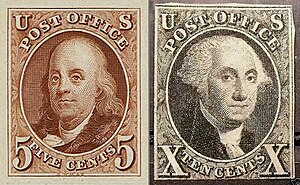
1847 The United States issued its first two postage stamps. They pictured Benjamin Franklin and George Washington respectively [Scott #1-2]. *VFR

1852 Dirichlet delivers a memorial lecture at the Berlin Academy in honor of his close friend Jacobi, calling him the greatest member of the Academy since Lagrange. *VFR

1856 Weierstrass appointed Professor of Mathematics at the Royal Polytechnic School in Berlin. *VFR

In 1858, the Wallace-Darwin theory of evolution was first published at the Linnaean Society in London*. The previous month Charles Darwin received a letter from Alfred Wallace, who was collecting specimens in the East Indies. Wallace had independently developed a theory of natural selection - which was almost identical to Darwin's. The letter asked Darwin to evaluate the theory, and if worthy of publication, to forward the manuscript to Charles Lyell. Darwin did so, almost giving up his clear priority for he had not yet published his masterwork The Origin of Species. Neither Darwin nor Wallace were present for the oral presentation at the Linnaean Society, where geologist Charles Lyell and botanist Joseph Hooker presented both Wallace's paper and excerpts from Darwin's unpublished 1844 essay.*TIS
In his annual report the following May, society president Thomas Bell wrote, “The year which has passed has not, indeed, been marked by any of those striking discoveries which at once revolutionize, so to speak, the department of science on which they bear.” *Futility Closet

1873 From a letter dated July 1, 1873, in the Coast Survey files in the National Archives in Washington. Peirce writes, "Newcomb, in a paper .... says he finds that pendulums hung by springs twist and untwist as they oscillate and says this will affect the time of oscillation."The Charles S. Peirce-Simon Newcomb Correspondence by Carolyn Eisele.

1894 The New York Mathematical Society changed its name to the American Mathematical Society to reflect its national charter. [AMS Semicentennial Publications, vol. 1, p. 74]. *VFR

1908 International agreement to use SOS for distress signal signed. An International Radiotelegraphic Convention, ... met in Berlin in 1906. This body signed an international agreement on November 3, 1906, with an effective date of July 1, 1908. An extensive collection of Service Regulations was included to supplement the Convention, and in particular Article XVI adopted Germany's Notzeichen distress signal as the international standard, stating: "Ships in distress shall use the following signal: · · · — — — · · · repeated at brief intervals". *Citizens Compendium

1918 Florian Cajori (1859–1930) appointed professor of the history of mathematics at the University of California, Berkeley, one of the few such chairs in the the world. During the next twelve years he published 159 papers on the history of mathematics. *VFR

1948 The Bell System Technical Journal publishes the first part of Claude Shannon's "A Mathematical Theory of Communication", regarded as a foundation of information theory, introducing the concept of Shannon entropy and adopting the term Bit. *Wik

1964 The New York Times, in a full page ad, announced that Paul Newman and Joanne Woodward would play a game on an elliptical pool table. It had a pocket at one focus so that if the ball passed over the other focus it would bank off the rail into the pocket. [UMAP Journal, 4(1983), p. 176; Recreational Mathematics Magazine, no. 14, January-February 1964] *VFR

2001 The last occurrence that there were 3 eclipses in one month, and of which two solar eclipses. For July 2000 being on 1st a partial solar eclipse, 16th a total lunar eclipse, and 31st a partial solar eclipse. The next occurrence with a month with 3 eclipses will be December 2206 with a partial solar eclipse on 1st and 30th and a total lunar eclipse on 16th. Ref. Fred Espenak 06/00 SEML. *NSEC

2010 Grigori Yakovlevich Perelman turned down the Clay Millineum prize of one million dollars, saying that he considers his contribution to proving the Poincaré conjecture to be no greater than that of Richard Hamilton, who introduced the theory of Ricci flow with the aim of attacking the geometrization conjecture. On March 18 It had been announced that he had met the criteria to receive the first Clay Millennium Prize for resolution of the Poincaré conjecture. *Wik

2015 Michael Elmhirst Cates, becomes the 19th Lucasian Professor of Mathematic at the University of Cambridge. Professor Cates is a physicist and Professor of Natural Philosophy and Royal Society Research Professor at the University of Edinburgh. Previous recognitions for Prof. Cates include Maxwell Medal and Prize (1991), the Paul Dirac Medal and Prize (2009), and the Weissenberg Award (2013). He will assume the chair from another Physicist, Michael Green. He follows a line that began with Isaac Barrow and Isaac Newton and includes Charles Babbage, Paul Dirac, and Stephen Hawking

BIRTHS

1646 Gottfried Wilhelm Leibniz (July 1, 1646 – November 14, 1716) born in Leipzig, Germany. Leibniz occupies a prominent place in the history of mathematics and the history of philosophy. He developed the infinitesimal calculus independently of Isaac Newton, and Leibniz's mathematical notation has been widely used ever since it was published. He became one of the most prolific inventors in the field of mechanical calculators. While working on adding automatic multiplication and division to Pascal's calculator, he was the first to describe a pinwheel calculator in 1685[4] and invented the Leibniz wheel, used in the arithmometer, the first mass-produced mechanical calculator. He also refined the binary number system, which is at the foundation of virtually all digital computers. In philosophy, Leibniz is mostly noted for his optimism, e.g. his conclusion that our Universe is, in a restricted sense, the best possible one that God could have created. Leibniz, along with René Descartes and Baruch Spinoza, was one of the three great 17th century advocates of rationalism. The work of Leibniz anticipated modern logic and analytic philosophy, but his philosophy also looks back to the scholastic tradition, in which conclusions are produced by applying reason to first principles or a priori definitions rather than to empirical evidence. Leibniz made major contributions to physics and technology, and anticipated notions that surfaced much later in biology, medicine, geology, probability theory, psychology, linguistics, and information science. He wrote works on politics, law, ethics, theology, history, philosophy, and philology. Leibniz's contributions to this vast array of subjects were scattered in various learned journals, in tens of thousands of letters, and in unpublished manuscripts. As of 2010, there is no complete gathering of the writings of Leibniz.*Wik

1779 John Farrar (July 1, 1779 – May 8, 1853) born at Lincoln, Massachusetts. As Hollis professor of mathematics and natural philosophy at Harvard, he was responsible for a sweeping modernization of the science and mathematics curriculum, including the change from Newton’s to Leibniz’s notation for the calculus. *VFR

1788 Jean Victor Poncelet (July 1, 1788 – December 22, 1867) born in Metz, France. He taught engineering and mechanics, but had a hobby of much greater interest—projective geometry. *VFR French mathematician and engineer whose study of the pole and polar lines associated with conic led to the principle of duality. While serving as an engineer in Napoleon's 1812 Russian campaign as an engineer, he was left for dead at Krasnoy, but then captured. During his imprisonment he studied projective geometry and wrote a treatise on analytic geometry. Released in 1814, he returned to France, and in 1822 published Traité des propriétés projectives des figures in which he presented his fundamental ideas of projective geometry such as the cross-ratio, perspective, involution and the circular points at infinity. As a professor of mechanics (1825-35), he applied mechanics to improve waterwheels and was able to double their efficiency.*TIS

1848 Emil Weyr (1 July 1848 in Prague, Bohemia (now Czech Republic) - 25 Jan 1894 in Vienna, Austria) His father Frantisek Weyr, was a professor of mathematics at a realschule (secondary school) in Prague from 1855. Emil was four years older than his brother Eduard Weyr who also became a famous mathematician. Emil attended the realschule in Prague where his father taught, then studied at the Prague Polytechnic from 1865 to 1868 where he was taught geometry by Vilém Fiedler.
He studied in Italy with Cremona and Casorati during the academic year 1870-71 returning to Prague where he continued to teach. In 1872 he was elected to be Head of the Union of Czech Mathematicians and Physicists. In 1875 he was appointed as professor of mathematics at the University of Vienna. He, together with his brother Eduard Weyr, were the main members of the Austrian geometric school. They were interested in descriptive geometry, then in projective geometry and their interests turned towards algebraic and synthetic methods in geometry. Among many works Emil Weyr published were Die Elemente der projectivischen Geometrie and Über die Geometrie der alten Aegypter.
Emil Weyr led the geometry school in Vienna throughout the 1880's up until his death. Together with Gustav von Escherich, Emil Weyr founded the important mathematical journal Monatshefte fuer Mathematik und Physik in 1890. The first volumes of the journal contain papers written by his brother Eduard. In 1891 Emil Weyr became one of the first 19 founder members of the Royal Czech Academy of Sciences. *SAU

1906 Jean Dieudonn´e (1 July 1906 – 29 November 1992) born. *VFR French mathematician and educator known for his writings on abstract algebra, functional analysis, topology, and his theory of Lie groups. Dieudonné was one of the two main contributors to the Bourbaki series of texts. He began his mathematical career working on the analysis of polynomials. He worked in a wide variety of mathematical areas including general topology, topological vector spaces, algebraic geometry, invariant theory and the classical groups. *TIS


DEATHS


1957 Donald McIntosh (Banffshire, 13 January 1868 – Invernesshire, 1 July 1957) graduated from the University of Aberdeen and taught at George Watson's Ladies College in Edinburgh. He was appointed a Director of Education. He became Secretary of the EMS in 1899 and President in 1905. *SAU

1963 Bevan Braithwaite Baker (1890 in Edinburgh, Scotland - 1 July 1963 in Edinburgh, Scotland) graduated from University College London. After service in World War I he became a lecturer at Edinburgh University and was Secretary of the EMS from 1921 to 1923. He left to become Professor at Royal Holloway College London. *SAU

1971 Sir William Lawrence Bragg (31 Mar 1890; 1 Jul 1971 at age 81) was an Australian-English physicist and X-ray crystallographer who at the early age of 25, shared the Nobel Prize for Physics in 1915 (with his father, Sir William Bragg). Lawrence Bragg formulated the Bragg law of X-ray diffraction, which is basic for the determination of crystal structure: nλ = 2dsinθ which relates the wavelength of x-rays, λ, the angle of incidence on a crystal, θ, and the spacing of crystal planes, d, for x-ray diffraction, where n is an integer (1, 2, 3, etc.). Together, the Braggs worked out the crystal structures of a number of substances. Early in this work, they showed that sodium chloride does not have individual molecules in the solid, but is an array of sodium and chloride ions. *TIS

1983 Richard Buckminster Fuller (July 12, 1895 – July 1, 1983) was a U.S. engineer and architect who developed the geodesic dome, the only large dome that can be set directly on the ground as a complete structure, and the only practical kind of building that has no limiting dimensions (i.e., beyond which the structural strength must be insufficient). Fuller also invented a wide range of other paradigm-shifting machines and structural systems. He was especially interested in high-strength-to-weight designs, with a maximum of utility for minimum of material. His designs and engineering philosophy are part of the foundation of contemporary high-tech design aesthetics. He held over 2000 patents.*TIS
This is another one who died within two weeks of his date of birth. I must organize data on this...


Credits :
*CHM=Computer History Museum
*FFF=Kane, Famous First Facts
*NSEC= NASA Solar Eclipse Calendar
*RMAT= The Renaissance Mathematicus, Thony Christie
*SAU=St Andrews Univ. Math History
*TIA = Today in Astronomy
*TIS= Today in Science History
*VFR = V Frederick Rickey, USMA
*Wik = Wikipedia
*WM = Women of Mathematics, Grinstein & Campbell