Monday, 28 July 2014

On This Day in Math - July 28


It appears to me that if one wishes to make progress in mathematics
one should study the masters and not the pupils.
Quoted in O Ore's, Niels Abel, Mathematician Extraordinary


The 209th day of the year; 209=16+25+34+43+52+61. Also 209 is a "Self number" A self number, Colombian number or Devlali number is an integer which, in a given base, cannot be generated by any other integer added to the sum of that other integer's digits. For example, 21 is not a self number, since it can be generated by the sum of 15 and the digits comprising 15, that is, 21 = 15 + 1 + 5. No such sum will generate the integer 20, hence it is a self number. These numbers were first described in 1949 by the Indian mathematician D. R. Kaprekar. students might want to explore self numbers for patterns


EVENTS
1619 Kepler wrote Napier expressing his enthusiasm for Napier’s invention of logarithms. *VFR

1851  First American eclipse expedition to Europe when George Phillips Bond (1825 - 1865) led a team to Scandinavia. *NSEC   In the transcription of his notes he wrote:

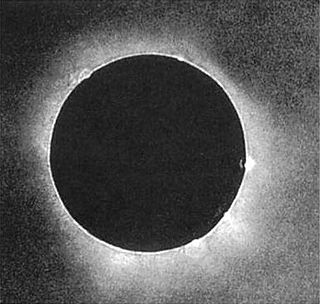
1851 A total solar eclipse was photographed for the first time. *VFR The first correctly-exposed photograph of the solar corona was made during the total phase of the solar eclipse of 28 July 1851 at Königsberg (now Kaliningrad) by a local daguerreotypist named Berkowski at the Royal Observatory in Königsberg, Prussia (now Kalinigrad in Russia). Berkowski, whose first name was never published, observed at the Royal Observatory. A small 6-cm refracting telescope was attached to the 15.8-cm Fraunhofer heliometer and a 84-second exposure was taken shortly after the beginning of totality.
United Kingdom astronomers, Robert Grant and William Swan, and Austrian astronomer Karl Ludwig von Littrow observed this eclipse and determined that prominences are part of the Sun because the Moon is seen to cover and uncover them as it moves in front of the Sun.*Wik

In 1858, fingerprints were used as a means of identification for the first time.*TIS The English first began using fingerprints in July of 1858, when Sir William James Herschel, Chief Magistrate of the Hooghly district in Jungipoor, India, first used fingerprints on native contracts. On a whim, and without thought toward personal identification, Herschel had Rajyadhar Konai, a local businessman, impress his hand print on a contract.
The idea was merely "... to frighten [him] out of all thought of repudiating his signature." The native was suitably impressed, and Herschel made a habit of requiring palm prints--and later, simply the prints of the right Index and Middle fingers--on every contract made with the locals. Personal contact with the document, they believed, made the contract more binding than if they simply signed it. Thus, the first wide-scale, modern-day use of fingerprints was predicated, not upon scientific evidence, but upon superstitious beliefs.
As his fingerprint collection grew, however, Herschel began to note that the inked impressions could, indeed, prove or disprove identity. While his experience with fingerprinting was admittedly limited, Sir William Herschel's private conviction that all fingerprints were unique to the individual, as well as permanent throughout that individual's life, inspired him to expand their use. *History of Fingerprints, Onin.com

1866 The first act (in the USA) legalizing the employment of the metric system was approved (14 Stat. L. 339). The act provided that it “shall be lawful throughout the United States of America to employ the weights and measures of the metric system.” *VFR

1882 The Institute of Accountants and Bookkeepers was organized in New York City. It was the first accounting society in the United States. *FFF

1899 Cantor asks Dedekind whether the set of all cardinal numbers is itself a set, because if it is it would have a cardinal number larger than any other cardinal. *VFR

1948 Allen Turing writes to Jack Good with an estimate of the number of neurons in the human brain. "I have repeatedly looked in books on neurology ... and never found any numbers offered. My own estimate is 3x10⁸ to 3x10⁹. " *Turing Archives

2061 Halley's comet will next reach perihelion. The comet last reached perihelion on 9 February 1986, and will reach it again on 28 July 2061 *Wik


BIRTHS
1849 Robert Scott studied at Cambridge and was elected to a fellowship. After a short time teaching he studied to be a barrister. He spent most of his career as Bursar and Master of St John's College Cambridge. He published a book on Determinants. *SAU

1867 Charles Dillon Perrine (July 28, 1867; Steubenville, Ohio, – June 21, 1951) U.S. astronomer who discovered the sixth and seventh moons of Jupiter in 1904 and 1905, respectively. In 1904 he published a calculation of the solar parallax (a measure of the Earth-Sun distance) based on observations of the minor planet Eros during one of its close approaches to the Earth. *TIS

1915 Charles Hard Townes (July 28, 1915 – January 27, 2015) was an American Nobel Prize-winning physicist and educator. Townes was known for his work on the theory and application of the maser, on which he got the fundamental patent, and other work in quantum electronics connected with both maser and laser devices. He shared the Nobel Prize in Physics in 1964 with Nikolay Basov and Alexander Prokhorov.
In a career that spanned six decades, Dr. Townes developed radar bombing systems and navigation devices during World War II, advised presidents and government commissions on lunar landings and the MX missile system, verified Einstein’s cosmological theories, discovered ammonia molecules at the center of the Milky Way, and created an atomic clock that measured time to within one second in 300 years. He died at the age of 99 in Berkeley, California*Wik *NY Times
1928 John Bell (28 June 1928 – 1 October 1990)   his great achievement was that during the 1960s he was able to breathe new and exciting life into the foundations of quantum theory, a topic seemingly exhausted by the outcome of the Bohr-Einstein debate thirty years earlier, and ignored by virtually all those who used quantum theory in the intervening period. Bell was able to show that discussion of such concepts as 'realism', 'determinism' and 'locality' could be sharpened into a rigorous mathematical statement, 'Bell's inequality', which is capable of experimental test. Such tests, steadily increasing in power and precision, have been carried out over the last thirty years. *SAU

1954 Gerd Faltings (July 28, 1954 - ) was born in Gelsenkirchen-Buer, West Germany. In 1986 he received a Fields Medal for solving Mordell’s Conjecture using arithmetic algebraic geometry. *VFR He has also been closely linked with the work leading to the final proof of Fermat's Last Theorem by Andrew Wiles. In 1983 Faltings proved that for every n greater than 2 there are at most a finite number of coprime integers x, y, z with xn + yn = zn. This was a major step but a proof that the finite number was 0 in all cases did not seem likely to follow by extending Falting's arguments.
However, Faltings was the natural person that Wiles turned to when he wanted an opinion on the correctness of his repair of his proof of Fermat's Last Theorem in 1994.*TIS


DEATHS
1818 Gaspard Monge (9 May 1746 – 28 July 1818) died in disgrace in Bourbon Paris, having been stripped of his place in the reorganized Acad´emie of 1816. Although he contributed to differential equations and the geom¬etry of surfaces, his special interest was descriptive geometry. Employed as a teacher, he made significant contributions to educational reform. [Ivor Grattan-Guiness, Convolutions in French Mathematics, 1800–1840, p. 616]
On the fall of Napoleon he was deprived of all his honors, and even excluded from the list of members of the reconstituted Institute. Monge died at Paris on 28 July 1818 and was interred in Le Père Lachaise Cemetery, in Paris, in a mausoleum. He was later transferred to the Panthéon. The mausoleum and Monge's bust remain in Le Père Lachaise Cemetery.
A statue portraying him was erected in his home town of Beaune, Côte-d'Ors in 1849. His name is one of the 72 names inscribed on the Eiffel Tower.

1944 Sir Ralph Fowler (17 January 1889 – 28 July 1944) a brilliant physicist. But it may be for his influence upon others that he is best known. In fact, no less than fifteen Fellows of the Royal Society and three Nobel Laureates were supervised by Fowler between 1922 and 1939. The total number supervised during this time was a staggering sixty-four giving him an average of eleven research students at any given time. One might be led to believe that this did not allow for any depth of relationship to form between him and his students. However, this was far from the truth of the matter. Those who studied under Fowler had a tremendous admiration for him. In particular, E A Milne [1] was especially taken by the man whom he fondly referred to as "the kind of man you can still remain friendly with, even when he has sold you a motor-bike; it is not possible to say more" and whom he called a "prince amongst men".
Aside from Milne, on whom he had a profound impact, he also had the opportunity of influencing the likes of Sir Arthur Eddington, Subramanian Chandrasekhar, Paul Dirac, Sir William McCrea, Lady Jeffreys and others either directly through supervision or indirectly through collaboration. Even in his personal life he was intimately connected with brilliant people having married Eileen, the only daughter of Lord Rutherford whom he met through Rutherford's Cavendish Laboratory at Cambridge. Sometimes his influence was simply the fact that he was known to so many people. It was Fowler who ultimately introduced Paul Dirac to the burgeoning field of quantum theory in 1923 leading Dirac to the forefront of its ultimate discovery in 1925. Fowler also put Dirac and Werner Heisenberg in touch with each other through Niels Bohr. As Sir William McCrea simply put it: "he was the right man in the right place at the right time." *SAU
1968 Otto Hahn (8 Mar 1879; 28 Jul 1968 at age 89) German physical chemist who, with the radiochemist Fritz Strassmann, is credited with the discovery of nuclear fission. He was awarded the Nobel Prize for Chemistry in 1944 and shared the Enrico Fermi Award in 1966 with Strassmann and Lise Meitner. Element 105 carries the name hahnium in recognition of his work.*TIS

2000 Abraham Pais (May 19, 1918 – July 28, 2000) Dutch-American physicist and science historian whose research became the building blocks of the theory of elemental particles. He wrote Subtle Is the Lord: The Science and Life of Albert Einstein, which is considered the definitive Einstein biography. In Holland, his Ph.D. in physics was awarded on 9 Jul 1941, five days before a Nazi deadline banning Jews from receiving degrees. Later, during WW II, while in hiding to evade the Gestapo, he worked out ideas in quantum electrodynamics that he later shared when working with Niels Bohr (Jan - Aug 1946). In Sep 1946, he went to the U.S. to work with Robert Oppenheimer at Princeton, where Pais contributed to the foundations of the modern theory of particle physics.*TIS

2004 Francis Harry Compton Crick (8 June 1916 – 28 July 2004) was a British biophysicist, who, with James Watson and Maurice Wilkins, received the 1962 Nobel Prize for Physiology or Medicine for their determination of the molecular structure of deoxyribonucleic acid (DNA), the chemical substance ultimately responsible for hereditary control of life functions. Crick and Watson began their collaboration in 1951, and published their paper on the double helix structure on 2 Apr 1953 in Nature. This accomplishment became a cornerstone of genetics and was widely regarded as one of the most important discoveries of 20th-century biology. *TIS


Credits :
*CHM=Computer History Museum
*FFF=Kane, Famous First Facts
*NSEC= NASA Solar Eclipse Calendar
*RMAT= The Renaissance Mathematicus, Thony Christie
*SAU=St Andrews Univ. Math History
*TIA = Today in Astronomy
*TIS= Today in Science History
*VFR = V Frederick Rickey, USMA
*Wik = Wikipedia
*WM = Women of Mathematics, Grinstein & Campbell

Sunday, 27 July 2014

On This Day in Math - July 27


But just as much as it is easy to find the differential of a given quantity,
so it is difficult to find the integral of a given differential.
Moreover, sometimes we cannot say with certainty
whether the integral of a given quantity can be found or not.

~Bernoulli, Johann

This is the 208th day of the year; 208 is the sum of the squares of the first five primes.
and from Today is 7/27 or 27/7 in somecountries. 727 and 277 are both prime.


EVENTS
1630, On July 27 Giovanni Batista Baliani wrote a letter to Galileo Galilei about the explanation of an experiment he had made in which a siphon, led over a hill about twenty-one meters high, failed to work. Galileo responded with an explanation of the phenomena: he proposed that it was the power of a vacuum which held the water up, and at a certain height (in this case, thirty-four feet) the amount of water simply became too much and the force could not hold any more, like a cord that can only withstand so much weight hanging from it.

1794 Jean Baptiste Joseph Fourier (1766?-1830) was a student at the École Normale, c1794. He was sentenced to the guillotine by Robespierre on July 28 of 1794, but Robespierre was overthrown the day before his scheduled execution (27 July, 1794) was due. Fourier went on to both political and scientific success. He was unanimously elected the first Secretary of the Institute of Egypt in 1798. He was Governor of Lower Egypt in 1798‑1801  or Commissioner at the Divan of Cairo .  He led one of the expeditions of exploration which examined ancient monuments and he suggested the publication of the great report on Egypt.  He was was a professor at the École Polytechnique up to 1806.  Napoléon made him a baron and during Napoléon's return from Elba in 1815, he made Fourier a count and Prefect of the Rhone, based at Lyons, from 10 Mar to 1 May.  In 1815, he was penniless in Paris and giving lessons for his living.  The Prefect of Paris found out and made him director of the Bureau de la Statistique of the Préfecture of the Seine.  He was elected to the Académie in 1816, but this was vetoed by the government, so he was elected again in 1817 and this was permitted.    He was Prefect of the Department of Isère, whose capital is Grenoble, from 1802 to 1817 (1815??)  He was Permanent Secretary of the Académie des Sciences in 1822-1830.

1829 By a remarkable coincidence, both Cauchy and Sturm sent papers to the Acad´emie des Sciences dealing with differential equations. Both of them used techniques which we recognize as matrix methods. Thus they are early contributors to linear algebra, a field which is usually dated to Cayley’s introduction of matrices in 1858. [Ivor Grattan-Guiness, Convolutions in French Mathematics, 1800–1840, p. 1150]

1861 The Athenaeum magazine carried a review of Charles Dodgson's pamphlet entitled The Formula of Plane Trigonometry in which he suggested new symbols for the six basic trig functions. The reviewer was not convinced.

1837 At a meeting of the Berlin Academy of Sciences, Dirichlet presented his first paper on analytic number theory. He proved the fundamental theorem that bears his name: Every arithmetical series an + b, n =0, 1, 2,... of integers where a and b are relatively prime, contains infinitely many primes. The result had long been conjectured. Legendre tried hard for a proof but could only establish special cases such as 4n + 1. *VFR

1866 Cyrus W. Field finally succeeded, after two failures, in laying the first underwater telegraph cable 1,686 miles long across the Atlantic Ocean between North America and Europe. Massachusetts merchant and financier Cyrus W. Field first proposed laying a 2,000-mile copper cable along the ocean bottom from Newfoundland to Ireland in 1854, but the first three attempts ended in broken cables and failure. Field's persistence finally paid off in July 1866, when the Great Eastern, the largest ship then afloat, successfully laid the cable along the level, sandy bottom of the North Atlantic. *TIS

1948 Hungary issued a stamp commemorating the centenary of the birth of the physicist Baron Roland E˝otv˝os1 (1848–1919). [Scott #840]. *VFR They issued another in 1991


BIRTHS

1667 Johann Bernoulli (27 July 1667 – 1 January 1748; also known as Jean or John) was a Swiss mathematician who studied reflection and refraction of light, orthogonal trajectories of families of curves, quadrature of areas by series and the brachystochrone.*SAU

1733 Jeremiah Fenwicke Dixon (27 July 1733 – 22 January 1779) was an English surveyor and astronomer who is best known for his work with Charles Mason, from 1763 to 1767, in determining what was later called the Mason-Dixon line.

Dixon was born in Cockfield, near Bishop Auckland, County Durham, the fifth of seven children, to Sir George Fenwick Dixon 5th Bt. and Lady Mary Hunter. His father was a wealthy Quaker coal mine owner and aristocrat. His mother came from Newcastle, and was said to have been "the cleverest woman" to ever marry into the Dixon family. Dixon became interested in astronomy and mathematics during his education at Barnard Castle. Early in life he made acquaintances with the eminent intellectuals of Southern Durham: mathematician William Emerson, and astronomers John Bird and Thomas Wright. In all probability it was John Bird, who was an active Fellow of the Royal Society, who recommended Dixon as a suitable companion to accompany Mason.

Jeremiah Dixon served as assistant to Charles Mason in 1761 when the Royal Society selected Mason to observe the transit of Venus from Sumatra. However, their passage to Sumatra was delayed, and they landed instead at the Cape of Good Hope where the transit was observed on June 6, 1761. Dixon returned to the Cape once again with Nevil Maskelyne's clock to work on experiments with gravity.

Dixon and Mason signed an agreement in 1763 with the proprietors of Pennsylvania and Maryland, Thomas Penn and Frederick Calvert, sixth Baron Baltimore, to assist with resolving a boundary dispute between the two provinces. They arrived in Philadelphia in November 1763 and began work towards the end of the year. The survey was not complete until late 1766, following which they stayed on to measure a degree of Earth's meridian on the Delmarva Peninsula in Maryland, on behalf of the Royal Society. They also made a number of gravity measurements with the same instrument that Dixon had used with Maskelyne in 1761. Before returning to England in 1768, they were both admitted to the American Society for Promoting Useful Knowledge, in Philadelphia.

Dixon sailed to Norway in 1769 with William Bayly to observe another transit of Venus. The two split up, with Dixon at Hammerfest Island and Bayly at North Cape, in order to minimize the possibility of inclement weather obstructing their measurements. Following their return to England in July, Dixon resumed his work as a surveyor in Durham. He died unmarried in Cockfield on 22 January 1779, and was buried in an unmarked grave in the Quaker cemetery in Staindrop.

Although he was recognized as a Quaker, he was not a very good one, dressing in a long red coat and occasionally drinking to excess. *Wik

1801 Sir. George Biddell Airy (27 July 1801 – 2 January 1892) born in Alnwick, England. *VFR English astronomer who became the seventh Astronomer Royal (1836-92). In his life he studied interference fringes in optics, made a mathematical study of the rainbow and computed the density of the Earth by swinging a pendulum at the top and bottom of a deep mine, determined the mass of the planet Jupiter and its period rotation, calculated the orbits of comets and cataloged stars. He designed corrective lenses for astigmatism (1825), the first that worked. His motivation was his own astigmatism. Airy had a long-standing battle with Babbage. In 1854, the conflict continued between the two during the battle of the incompatible railway gauges in England. Airy championed the railway narrow gauge and Babbage for the wide gauge. *TIS

1844 Ágoston Scholtz (27 July 1844 in Kotterbach, Zips district, Austro-Hungary (now Rudnany, Slovakia) - 6 May 1916 in Veszprém,) From 1871 he was a teacher of mathematics and natural philosophy at the Lutheranian Grammar School of Budapest which at that time had been upgraded to become a so called 'chief grammar school', namely one which offered eight years of teaching. This was precisely the school which later was attended by several famous mathematicians such as Johnny von Neumann and Eugene Wigner (or Jenó Pál Wigner as he was called at that time). Scholtz became the school director of the Lutheranian Grammar School in 1875. Unfortunately this excellent school was closed in 1952, and most of its equipment was lost. Due to the initiative and support of its former well-known students, among others Wigner, it was reopened in 1989 after being closed for thirty-seven years. Scholtz's field of research was projective geometry and theory of determinants. His results were recorded by Muir in his famous work The history of determinants *SAU

1848 Roland Baron von Eötvös (27 July 1848 – 8 April 1919) was a Hungarian physicist who studied at Heidelberg where he was taught by Kirchhoff, Helmholtz and Bunsen. Eötvös introduced the concept of molecular surface tension and published on capillarity (1876-86). For the rest of his life he concentrated on study of the Earth's gravitational field. He developed the Eötvös torsion balance, long unsurpassed in precision, which gave experimental proof that inertial mass and gravitational mass, to a high degree of accuracy, are equivalent - which later was a major principle of Albert Einstein.*TIS

1849 John Hopkinson (27 July 1849 – 27 August 1898) British physicist and electrical engineer who worked on the application of electricity and magnetism in devices like the dynamo and electromagnets. Hopkinson's law (the magnetic equivalent of Ohm's law) bears his name. In 1882, he patented his invention of the three-wire system (three phase) for electricity generation and distribution. He presented the principle the synchronous motors (1883), and designed electric generators with better efficiency. He also studied condensers and the phenomena of residual load. In his earlier career, he became (1872) engineering manager of Chance Brothers and Co., a glass manufacturer in Birmingham, where he studied lighthouse illumination, improving efficiency with flashing groups of lights.*TIS

1867 Derrick Norman Lehmer (27 July 1867, Somerset, Indiana, USA — 8 September 1938 in Berkeley, California, USA) was an American mathematician and number theorist.
In 1903, he presented a factorization of Jevons' number (8,616,460,799) at the San Francisco Section of the American Mathematical Society, December 19, 1903.
He published tables of prime numbers and prime factorizations, reaching 10,017,000 by 1909 (In Number Theory and Its History, Ore calls this the "best factor table now (1948) available"). He developed a variety of mechanical and electro-mechanical factoring and computational devices, such as the Lehmer sieve, built with his son Derrick Henry Lehmer.
He is also known for a reversible algorithm that assigns a Lehmer code to every permutation of size n. *SAU

1870 Bertram Borden Boltwood (July 27, 1870 Amherst, Massachusetts - August 15, 1927, Hancock Point, Maine) was an American chemist and physicist whose work on the radioactive decay of uranium and thorium was important in the development of the theory of isotopes. Boltwood studied the "radioactive series" whereby radioactive elements sequentially decay into other isotopes or elements. Since lead was always present in such ores, he concluded (1905) that lead must be the stable end product from their radioactive decay. Each decay proceeds at a characteristic rate. In 1907, he proposed that the ratio of original radioactive material to its decay products measured how long the process had been taking place. Thus the ore in the earth's crust could be dated, and give the age of the earth as 2.2 billion years.*TIS

1871 Ernest Friedrich Ferdinand Zermelo. (27 July 1871; Berlin, German Empire - 21 May 1953 (aged 81) Freiburg im Breisgau, West Germany) In 1904 he formulated the Axiom of Choice in Set Theory. Years later, when he refused to give the Nazi salute, he was threatened with dismissal from his univeristy position. In reply, he resigned. *VFR

2007 Ralph Asher Alpher's belated recognition for his work on the "Big Bang" process. In 2005 Alpher was awarded the National Medal of Science. The citation for the award reads "For his unprecedented work in the areas of nucleosynthesis, for the prediction that universe expansion leaves behind background radiation, and for providing the model for the Big Bang theory." The medal was presented to his son Dr. Victor S. Alpher on July 27, 2007 by President George W. Bush, as his father could not travel to receive the award. *Wik


DEATHS

1759 Pierre-Louis Moreau de Maupertuis (17 July 1698 – 27 July 1759) French mathematician, biologist, and astronomer. In 1732 he introduced Newton's theory of gravitation to France. He was a member of an expedition to Lapland in 1736 which set out to measure the length of a degree along the meridian. Maupertuis' measurements both verified Newton's predictions that the Earth would be an oblate speroid, and they corrected earlier results of Cassini. Maupertuis published on many topics including mathematics, geography, astronomy and cosmology. In 1744 he first enunciated the Principle of Least Action and he published it in Essai de cosmologie in 1850. Maupertuis hoped that the principle might unify the laws of the universe and combined it with an attempted proof of the existence of God.*TIS (he died in the home of Johann II Bernoulli. Johan Bernoulli (above) was born on the day Maupertuis died, but Johann II Bernoulli died on the Calendar date on which Maupertuis was born...)

1844 John Dalton, (6 September 1766 – 27 July 1844) English teacher who, from investigating the physical and chemical properties of matter, deduced an Atomic Theory (1803) whereby atoms of the same element are the same, but different from the atoms of any other element. In 1804, he stated his law of multiple proportions by which he related the ratios of the weights of the reactants to the proportions of elements in compounds. He set the atomic weight of hydrogen to be identically equal to one and developed a table of atomic weights for other elements. He was the first to measure the temperature change of air under compression, and in 1801 suggested that all gases could be liquified by high pressure and low temperature. Dalton recognised that the aurora borealis was an electrical phenomenon.*TIS

1931 Jacques Herbrand (12 February 1908 – 27 July 1931) was a French mathematician who died young but made contributions to mathematical logic.*SAU Although he died at only 23 years of age, he was already considered one of "the greatest mathematicians of the younger generation" by his professors Helmut Hasse, and Richard Courant. *Wik

1999 Aleksandr Danilovic Aleksandrov (4 Aug 1912 in Volyn, Ryazan, Russia
- 27 July 1999) approached the differential geometry of surfaces [by extending the notion of the objects studied], extending the class of regular convex surfaces to the class of all convex surfaces ... . In order to solve concrete problems Aleksandrov had to replace the Gaussian geometry of regular surfaces by a much more general theory. In the first place the intrinsic properties (i.e. those properties that appear as a result of measurements carried out on the surface) of an arbitrary convex surface had to be studied, and methods found for the proof of theorems on the connection between intrinsic and exterior properties of convex surfaces. Aleksandrov constructed a theory of intrinsic geometry of convex surfaces on that basis. Because of the depth of this theory, the importance of its applications and the breadth of its generality, Aleksandrov comes second only to Gauss in the history of the development of the theory of surfaces. *SAU


Credits :
*CHM=Computer History Museum
*FFF=Kane, Famous First Facts
*NSEC= NASA Solar Eclipse Calendar
*RMAT= The Renaissance Mathematicus, Thony Christie
*SAU=St Andrews Univ. Math History
*TIA = Today in Astronomy
*TIS= Today in Science History
*VFR = V Frederick Rickey, USMA
*Wik = Wikipedia
*WM = Women of Mathematics, Grinstein & Campbell

Saturday, 26 July 2014

Another Hugh Worthington Approximation for Right Triangles.

A while back I wrote about a nice hand calculation of the angles in a right triangle which appeared in an article, The Resolution of Triangles(1780), by Rev. Hugh Worthington. The article prompted some really nice math from several bloggers leading to an understanding that it was essentially a version of Taylor's method applied to the ArcTan function and converted to degrees. A good explanation is at the Theorem of the Day site.

So today I thought I would introduce another of Rev Worthington's hand calculation approaches for a right triangle, this one with the angles and one side given, to find another side. Worthington credits this method at a Mr. Henry Watson from Navigation new modelled (abt 1715). The Watson method is shortened into a shorter proportion, which I will give below, but I begin with Watson's method of using an "artificial number".

The method works two ways, to find a smaller angle if the Hypotenuse is known, and then to find the Hypotenuse if a leg is known.
I will illustrate first the method using a given leg.
First, find the compliment of the angle opposite the side given, and square it, then multiply the result by four. Now divide that amount by 300 + three times the compliment. Finally add that amount to the angle again. This is the "artificial number" which he says is sometimes called the natural radius (suggestions why?). I will call this artificial number N and the acute angle we use A.

Then \( \frac{N}{hyp} = \frac{A}{a} \)

Suppose we begin with a right triangle with a side a = 5, and A= 40o, B=50o and C is the right Angle.

We take the compliment of 40, and square it to get 2500. Four times this amount gives 10,000. Now we divide by 300+ 3 times the compliment, (450) to get 22 2/9 Finally we add back the 40 to get 62 2/9 for the artificial number.
So the proportion is \( \frac{62 2/9}{ Hyp }= \frac{40}{5} \) ,   giving us a Hypotenuse of 7 7/9 . My calculator gives Sin-1 \( (\frac{5}{7\frac{7}{9}}) \) as 40.0052.

Which I'm calling pretty darn close.

To find a leg when the hypotenuse is the side given, we use the compliment of the angle opposite the side we seek to know, and proceed in similar fashion.   This time, for ease of computation, let's let the  Hypotenuse be 5, and keep the angles at 40 and 50.  We want to find the side opposite the forty degree angle, so 50 is still the compliment of the angle so we have the same artificial number. 

Our proportion for this looks like \(  \frac{62 2/9}{ 5 }= \frac{40}{a}\)   giving  a= 45/14 or 3.2142857....   Checking again, we get 5 * sin (40o = 3.21938 .... pretty close again.


The Rev Worthington gives the shortcut (modified for the letters used above) to directly calculate without the intermediate of the artificial number.

\( \frac{57.3}{b} + \frac{3b}{1000}  = \frac{hyp}{a} \) 

I'm hoping that any high school student worth their salt can figure out the presence of 57.3, but if not, see the comments of the previous post linked above. 

So who was this mathematical minister, this preacher of trigonometric hand calculations? A note about his popularity as a preacher and a brief history is here, and includes a reference to this "Resolution of Triangles paper, and no others. Perhaps it was his sole excursion into math.


On This Day in Math - July 26


Mathematics is the most exact science, and its conclusions are capable of absolute proof. But this is so only because mathematics does not attempt to draw absolute conclusions. All mathematical truths are relative, conditional
~Steinmetz, Charles P.

This is the 207th day of the year; 207 is the smallest possible sum of primes which are formed using each of the digits 1 through 9 (i.e., 89 + 61 + 43 + 7 + 5 + 2 = 207) *Number Gossip (So how many such sums can there be? And which of such sums are prime?)


EVENTS
1609 Thomas Harriot was the first person to make a drawing of the Moon through a telescope, on July 26, 1609, over four months before Galileo. Factoring to solve equations was once frequently called “Harriot’s Method.” *Wik
Thony Christie points out that, "Harriot’s drawings are very primitive, mere sketches, and cannot be compared with the justifiably famous moon drawings published by Galileo Galilei in his Sidereus Nuncius from 1610. Galileo unlike Harriot was a trained artist and realised that what he was seeing through his telescope were three dimensional landscape features, mountains, valleys, etc." Thony has a great blog about the naming of the features on the moon with more great images.

1712 Brooke Taylor describes what we now call a “Taylor series” in a letter to John Machin on July 26, 1712. He would not publish about them until three years later. It would be another fifty years before the power of the method is realized by Lagrange, and another fifty before Cauchy gives a formal proof.

1732 George Berkeley gave his farm near Newport, Rhode Island to the College of New Haven [now Yale University] to endow two graduate Fellows in Greek and Latin. This was the first provision for graduate study in America. Berkeley is known in mathematics for his Analyst (1734), which criticized the foundations of the calculus. See G. P. Conroy, “Berkeley and Education in America,” Journal for the History Ideas, 21(1960), pp. 211-221.

1766 “To your care and recommendation am I indebted for having replaced a half-blind mathematician by a mathematician with both eyes, which will especially please the anatomical members of the academy.” So wrote Frederick the Great to d’Alembert, thanking him for his suggestion of hiring Lagrange to succeed Euler at the Berlin Academy. [AMM 34(1927), p 128]

1775 Benjamin Franklin became Postmaster-General of the United States *TIS

1800 Caroline Herschel gets annual salary from George III. "William Herschel was paid £200 in annual salary as King’s Astronomer. His sister Caroline was paid £50 to act as his assistant, making her the first professional female astronomer.
A note from Herschel’s wife Mary says that the handwriting is that of King George III himself. " *sciencemuseum.org.uk

1895 Marie Sklodovska became Marie(CURIE) (1867-1934) entered the Sorbonne in 1891 and came in first in physics in 1893 and second in mathematics in 1894. She first lived with her sister and brother-in-law at 92 Avenue Jean-Jaurès, La Villette, 19e. Married Pierre Curie (1859-1906), a teacher at the École de Physique et Chimie, 42 Rue Lhomond, on 26 Jul 1895
In 1896, Marie Curie decided to investigate Henri Becquerel's discovery of the radiactivity of uranium, as a research topic for her doctoral thesis. Pierre subsequently followed her into research into radioactivity (1898), for which they were later awarded a Nobel Prize. In 1897 she gave birth to a daughter, Irène who later married Frédéric Joliot and became Irène Joliot-Curie (1926). With her husband, she continued the family's work into radioactivity. They, too, received a Nobel Prize *TIS

1976 Kenneth Appel and Wolfgang Haken of the University of Illinois communicated their solution to the Four Color Problem to the Bulletin of the American Mathematical Society. The solution used over 1000 hours of computer calculation. *VFR


1989 A federal grand jury indicts Cornell University student Robert Tappan Morris, Jr. for releasing a computer virus, making him the first person to be prosecuted under the 1986 Computer Fraud and Abuse Act in the United States. *Wik

2009 An event was held at Syon House, West London, to celebrate the 400th anniversary of Thomas Harriot's first observations of the moon. This event, Telescope400, included the unveiling of a plaque to commemorate Harriot by Lord Egremont. The plaque can now be seen by visitors to Syon House, the location of Harriot's historic observations. His drawing made 400 years earlier is believed to be based on the first ever observations of the moon through a telescope. The event (sponsored by the Royal Astronomical Society) was run as part of the International Year of Astronomy (IYA).
The original documents showing Harriot's moon map of c. 1611, observations of Jupiter's satellites, and first observations of sunspots were on display at the Science Museum, London, from 23 July 2009 until the end of IYA. *Wik


BIRTHS
1271 Zhao Youqin's name is sometimes written as Chao Yu-Chhin or Chao Yu-Ch'in. (July 26, 1271, Poyang, China— c. 1335, Longyou Mountains, Zhejiang province) He was born at a time of conflict when the Mongol leader Kublai Khan began attacking the Song Dynasty of China. The Song imperial family surrendered in 1276 and the last of the resistance was crushed in 1296. One source suggests that Zhao was injured in the fighting surrounding these dramatic events. When he was a young man he learnt astronomy and obtained a secret book on alchemy from a Daoist master. He joined the northern branch of the Quanzhen sect of Daoism and became a Daoist hermit, spending ten years writing a commentary on the Book of Changes . No trace of this commentary has survived. He later became the patriarch of the Quanzhen (Complete Perfection) School of Song-Yuan Daoism, ordained by the preceding patriarch, Zhang Mo.
Zhao Youqin was skilled in a large range of topics. He was an expert in astronomy, mathematics and physics, with particular skills in optics. He was also, however, a religious philosopher and a specialist in alchemy. Before he died he gave a copy of the manuscript of his book Ge xiang xin shu, to his disciple Zhu Hui. The manuscript was passed from Zhu Hui to Zhang Jun who published the work. *SAU

1852 Francis Robbins Upton (1852 in Peabody, Massachusetts – March 10, 1921 in Orange, New Jersey) was an American physicist and mathematician.
Upton graduated from Phillips Academy, Andover in 1870. He studied at Bowdoin College in Brunswick, Maine, at Princeton University where he received his M.S., and in Berlin, where he worked together with Hermann von Helmholtz.
In 1878, he joined the laboratory of Thomas Alva Edison in Menlo Park, New Jersey. There he dealt with technical problems in a mathematical way, including electric light, the watt-hour meter, and large dynamos. In October 1879, the first electric light was presented to the public. He was partner and general manager of the Edison Lamp Works, which he founded together with Edison in 1880. Upton published articles in Scribner's Monthly and Scientific American. Since 1958, the Princeton University has had the Francis Upton Graduate Fellowships.
In 1890, Upton patented the first electric fire alarm and detector along with a Mr. Fernando J. Dibble, an accomplishment of his which is often overlooked, stemming most probably from a typographical error that labels the device a "Portable Electric Tire-Alarm." (Google Books; U.S. Congressional Serial Set).*Wik

1863 Paul Walden was a Latvian chemist who, while teaching at Riga, discovered the Walden inversion, a reversal of stereochemical configuration that occurs in many reactions of covalent compounds (1896). Due to this discovery, Walden's name is mentioned almost in all textbooks on organic chemistry published throughout the world. Walden revealed autoracemization and put the foundations to electrochemistry of nonaqueous solutions. Walden is also known for Walden's rule, which relates the conductivity and viscosity of nonaqueous solutions.*TIS

1902 Stanisław Gołąb (July 26, 1902 – April 30, 1980) was a Polish mathematician from Kraków, working in particular on the field of affine geometry.
In 1932, he proved that the perimeter of the unit disc can take any value in between 6 and 8, and that these extremal values are obtained if and only if the unit disc is an affine regular hexagon resp. a parallelogram. *Wik

1903 Kurt Mahler (26 July 1903, Krefeld, Germany – 25 February 1988, Canberra, Australia) was a mathematician and Fellow of the Royal Society. Mahler proved that the Prouhet–Thue–Morse constant and the Champernowne constant 0.1234567891011121314151617181920... are transcendental numbers.
He was a student at the universities in Frankfurt and Göttingen, graduating with a Ph.D. from Johann Wolfgang Goethe University of Frankfurt am Main in 1927. He left Germany with the rise of Hitler and accepted an invitation by Louis Mordell to go to Manchester. He became a British citizen in 1946.
He was elected a member of the Royal Society in 1948 and a member of the Australian Academy of Science in 1965. He was awarded the London Mathematical Society's Senior Berwick Prize in 1950, the De Morgan Medal, 1971, and the Thomas Ranken Lyle Medal, 1977. *Wik

1907 Nachman Aronszajn (26 July 1907, Warsaw, Poland – 5 February 1980 Corvallis, Oregon, U.S) was a Polish American mathematician of Ashkenazi Jewish descent. Aronszajn's main field of study and expertise was mathematical analysis. He also contributed to mathematical logic.
He received his Ph.D. from the University of Warsaw, in 1930, in Poland. Stefan Mazurkiewicz was his thesis advisor. He also received a Ph.D. from Paris University, in 1935; this time Maurice Fréchet was his thesis advisor. He joined the Oklahoma A&M faculty, but moved to the University of Kansas in 1951 with his colleague Ainsley Diamond after Diamond, a quaker, was fired for refusing to sign a newly-instituted loyalty oath. Aronszajn retired in 1977. He was a Summerfield Distinguished Scholar from 1964 to his death.
He introduced, together with Prom Panitchpakdi, the injective metric spaces under the name of "hyperconvex metric spaces". Together with Kennan T. Smith, Aronszajn offered proof of the Aronszajn–Smith theorem. Also, the existence of Aronszajn trees was proven by Aronszajn; Aronszajn lines, also named after him, are the lexicographic orderings of Aronszajn trees.
He also has a fundamental contribution to the theory of reproducing kernel Hilbert space, the Moore–Aronszajn theorem is named after him. *Wik

1926 Joseph F. Engelberger (New York City, July 26, 1925 - ) American engineer who, with George Devol, developed the first industrial robot in the United States, the Unimate, in the 1950's. Engelberger is often referred to as the "Father of Robotics." When he and his partner founded Unimation in 1956, the company was the first major manufacturer of industrial robotic arms in the U.S. By 1962, they had installed their first industrial robots at the auto manufacturer, General Motors. *TIS


DEATHS

1925 Gottlob Frege (8 November 1848 – 26 July 1925) died. He was the greatest logician since Aristotle. *VFR (Friedrich Ludwig) Gottlob Frege was a German mathematician and logician, founder of modern symbolic logic and first to put forward the view that mathematics is reducible to logic. He extended Boole's work by inventing logical symbols (symbols for "or"," if-then", etc.) that improvedon the syllogistic logic it replaced. He also worked on general questions of philosophical logic and semantics. His theory of meaning, based on makig a distinction between what a linguistic term refers to and what it expresses, is still influential. Frege tried to provide a rigorous foundation for mathematics on the basis of purely logical principles, but abandoned the attempt when Bertrand Russell, on whose work he had a profound influence, pointed out a paradox that made the system inconsistent. *TIS


1941 Henri L´eon Lebesgue (June 28, 1875 – July 26, 1941) French mathematician who developed a theory of integration, now known by his name. By extending the work of Camille Jordan and Émile Borel on the Riemann integral, Lebesgue provided a generalization that solved many of the difficulties in using Riemann's theory of integration. Lebesque provided a foundation for subsequent development of integration theory and its further application in calculus, curve rectification and theory of trigonometric theory. He also contributed in several fields of mathematics, including set theory, caluclus of variation and function theory*TIS

1942 Georg Alexander Pick (August 10, 1859 – July 26, 1942) was an Austrian mathematician. He died in the Theresienstadt concentration camp. Today he is best known for Pick's formula for determining the area of lattice polygons. He published it in an article in 1899; it was popularized when Hugo Dyonizy Steinhaus included it in the 1969 edition of Mathematical Snapshots. Pick headed the committee at the (then) German university of Prague which appointed Albert Einstein to a chair of mathematical physics in 1911. Pick introduced Einstein to the work of Italian mathematicians Gregorio Ricci-Curbastro and Tullio Levi-Civita in the field of absolute differential calculus, which later in 1915 helped Einstein to successfully formulate General relativity.*Wik A really nice article about this theorem with references and interactive graphics is Found at Alexander Bogomolny's Cut The Knot web site.

1955 Raymond C Archibald (Colchester County, Nova Scotia, October 7, 1875 - July 26, 1955, in Sackville, New Brunswick) studied in Canada, at Harvard and at Strasbourg. He spent most of his career at Brown University in Rhode Island. His main interests were in the History of Mathematics. *SAU

1977 Oskar Morgenstern (January 24, 1902 – July 26, 1977) German-American economist and mathematician who popularized "game theory" which mathematically analyzes behaviour of man or animals in terms of strategies to maximize gains and minimize losses. He coauthored Theory of Games and Economic Behavior (1944), with John von Neumann, which extended Neumann's 1928 theory of games of strategy to competitive business situations. They suggested that often in a business situation ("game'), the outcome depends on several parties ("players"), each estimating what all of the others will do before determining their own strategy. Morgenstern was a professor at Vienna University, Austria, from 1931 until the Nazi occupation in 1938), when he fled to America and joined the faculty at Princeton University. His later publications included works on economic prediction and aspects of U.S. defence.*TIS

1984 George Horace Gallup (November 18, 1901 – July 26, 1984) was an American pioneer of survey sampling techniques and inventor of the Gallup poll, a successful statistical method of survey sampling for measuring public opinion.
Gallup was born in Jefferson, Iowa, the son of George Henry Gallup, a dairy farmer. His higher education took place at the University of Iowa. He served as a journalism professor at Drake and Northwestern for brief periods. In 1932 he moved to New York City to join the advertising agency of Young and Rubicam as director of research (later as vice president from 1937 to 1947). He was also professor of journalism at Columbia University, but he had to give up this position shortly after he formed his own polling company, the American Institute of Public Opinion (Gallup Poll), in 1935.
In 1936, his new organization achieved national recognition by correctly predicting, from the replies of only 50,000 respondents, that Franklin Roosevelt would defeat Alf Landon in the U.S. Presidential election. This was in direct contradiction to the widely respected Literary Digest magazine whose poll based on over two million returned questionnaires predicted that Landon would be the winner. Not only did Gallup get the election right, he correctly predicted the results of the Literary Digest poll as well using a random sample smaller than theirs but chosen to match it.
Twelve years later, his organization had its moment of greatest ignominy, when it predicted that Thomas Dewey would defeat Harry S. Truman in the 1948 election, by five to fifteen percentage points. Gallup believed the error was mostly due to ending his polling three weeks before Election Day.
Gallup died in 1984 of a heart attack at his summer home in Tschingel, a village in the Bernese Oberland of Switzerland. He was buried in Princeton Cemetery. *Wik

1997 Kunihiko Kodaira (16 March 1915 – 26 July 1997) Japanese mathematician who was awarded the Fields Medal in 1954 for his work in algebraic geometry and complex analysis. Kodaira's work includes applications of Hilbert space methods to differential equations which was an important topic in his early work and was largely the result of influence by Weyl. Through the influence of Hodge, he also worked on harmonic integrals and later he applied this work to problem in algebraic geometry. Another important area of Kodaira's work was to apply sheaves to algebraic geometry. In around 1960 he became involved in the classification of compact, complex analytic spaces. One of the themes running through much of his work is the Riemann-Roch theorem. He won the 1985 Wolf Prize. *TIS

2000 John Wilder Tukey (June 16, 1915 – July 26, 2000) was an American statistician. He was awarded the IEEE Medal of Honor in 1982 "For his contributions to the spectral analysis of random processes and the fast Fourier transform (FFT) algorithm."
Tukey retired in 1985. He died in New Brunswick, New Jersey Tukey coined many statistical terms that have become part of common usage, but the two most famous coinages attributed to him were related to computer science.
While working with John von Neumann on early computer designs, Tukey introduced the word "bit" as a contraction of "binary digit". The term "bit" was first used in an article by Claude Shannon in 1948.
The term "software", which Paul Niquette claims he coined in 1953, was first used in print by Tukey in a 1958 article in American Mathematical Monthly, and thus some attribute the term to him.
In the fall of 2003 a post to the APStats electronic discussion list from Ron Dirkse pointed out that the Japanese word for statistics, toukei, sounds very much like the name of the famous American statistician John Tukey. Ron Dirkse, who taught at the American School in Japan, added that "according to a native speaker the tou means something like 'put together' and the kei is 'measure, calculate or total'. She thought it was interesting that there was a Tukey famous in statistics, but this word pre-dates him by a lot."

Other terms credited to Tukey below are from http://www.stat.berkeley.edu/~brill/Papers/life.pdf That site Also includes a list of his honors, and Ph.D. students
alias (in time series)
ANOVA
badmandments
bagplot
batch
bispectrum
bit
biweight
bland distribution
borrowing strength
boxplot
cepstrum
coco
complex demodulation
conrmatory data analysis (CDA).

2004 - William A. Mitchell died (October 21, 1911 – July 26, 2004). Mitchell was an American food chemist who was the inventor of Pop Rocks, instant Jell-O, Cool Whip and the orange drink, Tang. While working for the General Foods Corporation, he received over 70 patents.
Pop Rocks were the center of an urban legend where the kid from the Life cereal commercials died when he ate the candy and washed it down with a cola making his stomach explode. General Foods countered the claims with an ad campaign in 45 major publications and 50,000 letters to school principals. Mitchell toured the country to show people that Pop Rocks weren't dangerous. *Science History


Credits
*CHM=Computer History Museum
*FFF=Kane, Famous First Facts
*NSEC= NASA Solar Eclipse Calendar
*RMAT= The Renaissance Mathematicus, Thony Christie
*SAU=St Andrews Univ. Math History
*TIA = Today in Astronomy
*TIS= Today in Science History
*VFR = V Frederick Rickey, USMA
*Wik = Wikipedia