Monday, 8 September 2014

On This Day in Math - September 8


We Must Know, We Will Know
~David Hilbert

The 251st day of the year; 251 is a prime number that is also the sum of three consecutive primes (79 + 83 + 89) and of seven consecutive primes (23 + 29 + 31 + 37 + 41 + 43 + 47). In addition, it is the smallest integer that can be the sum of three cubes in two different ways. 251 =23+ 33+63 = 13+53+53
and there are 251 primes less than 1600.*@MathYearRound

and wow: The 251st Fibonacci number (12776523572924732586037033894655031898659556447352249) has a sum of digits equal to 251. *jim wilder ‏@wilderlab

251 is the largest prime day year that is the concatenation of two squares.

EVENTS

1636 The General Court of Massachusetts Bay appropriated 400 Pounds for the "creation of a college in New Towne." Originally named Cambridge College, it was renamed in 1638 in honor of Reverend John Harvard who bequeathed the college about 800 pounds, and 300 books. The first building was called the "Indian College" and was erected in 1637. #FFF pg 155

1679 Leibniz writes to Huygens with a letter and essay which describes his analysis “situs”, a precursor of vector analysis,  *A history of vector analysis ,Michael J. Crowe; pg 3

1844 The term ABELIAN INTEGRAL seems to have first occurred in a letter of Sept. 8, 1844, from William Henry Fox Talbot: "What is the definition of an Abelian Integral? for it appears to me that most integrals possess the Abelian property." The letter was addressed to John Frederick William Herschel, who, in his reply of Sept. 13, 1844, wrote: "I suppose the most general definition of an Abelian Integral might be taken to be this that between +(x) and +(φ(x)) there shall subsist an algebraical relation between several such functions." [The Talbot letters are available here *Jeff Miller Web site

In 1854, Dr. John Snow removed the handle of the Broad Street water pump in London, thus effectively halting further spread of cholera. He had mapped the outbreaks, and thus suspected contamination of this community source of water. He was correct in this, one of the most symbolic gestures in the history of public health. Within days after the pump handle was removed, new cases of illness had ceased. Site investigation showed raw sewage from a leaking sewage cesspool that had contaminated the well water. Thus Snow, who was already a celebrated anaesthetist became a pioneer of epidemiology. The "John Snow" pub now stands beside the pink granite slab marking the site of the original pump.*TIS


1930 Hilbert’s radio broadcast in Konigsberg.  At the age of 68, Hilbert retired to conform with regulations at Gottingen.  It was the second great speech of his career. It contains the famous phrase “Wir mussen wissen. Wir werden wissen.” (We must know, we will know). These optimistic words are inscribed over Hilbert’s grave in Gottingen. A recording is available in the Gedenkband. Emil du Bois-Reymond had maintained that the nature of matter, and human consciousness would always remain unknowable. Hilbert refuted this pessimistic view with a spirit of scientific optimism.
We ought not believe those who today, with a philosophical air and a tone of superiority, prophesy the decline of culture, and are smug in their acceptance of the ignorabimus principle.... in place of this foolish Ignorabimus, let our resolution be, to the contrary: "We must know, we will know."

In 2040, the first visible conjunction during the 21st century of the crescent Moon with the five naked-eye visible planets - Mercury, Venus, Mars, Jupiter and Saturn - will occur. They will be seen clustered within a small distance of each other in the early evening sky, well east of the sun. When a similar grouping happened in the sky on 5 May 2000, the Moon and the same five planets were lost to view because of the glare of the Sun from among them.*TIS


BIRTHS

1157 Alexander Neckam (8 Sep 1157; 1217) English schoolman and scientist, who was a theology instructor at Oxford. Neckam then studied and lectured in Paris. In 1186, he returned to England, and in 1213 became abbot at Cirencester, Gloucestershire. In Paris, Neckam had learned of the mariner's compass, which the Chinese had been using for at least two centuries. In a book De utensilibus ("On Instruments") he wrote about 1180 was the first reference to the magnetic compass as being in use among the Europeans. (the Chinese encylopaedist Shen Kuo gave the first clear account of suspended magnetic compasses a hundred years earlier in 1088 AD with his book Mengxibitan, or Dream Pool Essays) His De naturis rerum ("On the Natures of Things"), a two-part introduction to a commentary on the Book of Ecclesiastes, is a miscellany of scientific information at that time novel in western Europe but already known to Greek and Muslim savants. *TIS

1584 Gregorius Saint Vincent born. His Opus geometricum (1647) contains the most beautiful frontispiece of any mathematics text. In this work, Gregorius was the first to develop the theory of the geometric series and also the first to show that the area under a hyperbola is a logarithm. *VFR (in the frontispiece he claims to have squared the circle) The engraved frontispiece shows sunrays inscribed in a square frame being arranged by graceful angels to produce a circle on the ground: 'mutat quadrata rotundis'. There was uneasiness in the learned world because no one in that world still believed that under the specific Greek rules the quadrature of a circle could possibly be effected, and few relished the thought of trying to locate an error, or errors, in 1200 pages of text. Four years later, in 1651, Christiaan Huygens found a serious defect in the last book of 'Opus geometricum', namely in Proposition 39 of Book X, on page 1121. This gave the book a bad reputation.*SAU

1588 Marin Mersenne born (8 September 1588 – 1 September 1648) was a French theologian, philosopher, mathematician and music theorist, and did important work in acoustics. 1648 Marin Mersenne died.Often called the center of the scientific world in the early 17th century for his communication with and between many of the most prominent scientific minds of the period. He also performed extensive experiments to determine the acceleration of falling objects by comparing them with the swing of pendulums, reported in his Cogitata Physico-Mathematica in 1644. He was the first to measure the length of the seconds pendulum, that is a pendulum whose swing takes one second, and the first to observe that a pendulum's swings are not isochronous as Galileo thought, but that large swings take longer than small swings. *Wik

1634 Hendrik van Heuraet (8 September 1634; Haarlem,Netherlands - 1600?) The dates of his birth and death are unclear as little is known of him. The birthdate is estimated from the date papers were signed for his inheritance, which had to happen on (or after) he turned twenty-one. His mother was Maria de Coninck who came from Oude Rijn, a town near to Leiden. His father was Abraham van Heuraet, an immigrant from Hamburg who had settled in Haarlem where he was a cloth merchant.
It is known is that he went with Hudde to the Protestant university in Saumur, a town on the river Loire in western France, in 1658. From Saumur he wrote a letter to van Schooten entitled Epistola de transmutatione curvarum linearum in rectas. Van Schooten published this letter in 1659. In it he gives a rectification method which reduces, for any arbitrary algebraic curve, the rectification to a quadrature of an associated curve, that is to computing the area under an associated curve. This was particularly important since at this time mathematicians believed that it was not possible to compare the length of a curved arc with a straight line segment. Van Heuraet's breakthrough is therefore significant in the development of mathematics. In particular, in the paper, he computed the integral ∫ √(1+y' 2) dx and applied his methods to the parabola. His methods of rectification of curves became part of a more general theory by Fermat which was produced independently and at about the same time. William Neile, independently of van Heuraet, had previously found the arc length of an algebraic curve in 1657 when he rectified the cubical parabola.
van Heuraet's work led to an argument with Huygens over a priority claim, suggesting that Huygens recognized the importance of the work. (most historians find little reason to side with Huygens in this claim) *SAU

1671 Pierre Polinière (8 September 1671, Coulonces, France - 9 February 1734, Coulonces, France) was an early investigator of electricity and electrical phenomena, notably "barometric light", a form of gas-discharge light, which suggested the possibility of electric lighting. He also helped to introduce the scientific method in French universities.*Wik

1861 Percy John Heawood (8 September 1861 Newport, Shropshire, England[1] - 24 January 1955 Durham, England) was a British mathematician. He devoted essentially his whole working life to the four color theorem and in 1890 he exposed a flaw in Alfred Kempe's proof, that had been considered as valid for 11 years. With the four color theorem being open again he established the five color theorem instead. The four color theorem itself was finally established by a computer-based proof in 1976. *Wik

1919 Albert H. Bowker, (8 September 1919 - 20 January 2008) Born in Winchendon MA. He received a BS in Math from MIT in 1941 and a PhD in Math-Stat from Columbia in 1949. Dr. Bowker served as founding Chairman of the Stat Dept at Stanford, being at Stanford until 1961. In 1963, he became Chancellor of the expanding City University of New York (CUNY), returning to California in 1971 to become Chancellor of the University of California at Berkeley.
Dr. Bowker was President of the Institute of Mathematical Statistics (IMS) in 1962 and President of the American Statistical Association (ASA) in 1964.
For an interesting and informative interview with Dr. Bowker conducted by Stanford's Ingram Olkin in 1987 in which Bowker told of his many interactions with well-known contributors to Statistics (including one with Fisher with reservations because of Neyman-Pearson theory) go here. *David Bee


DEATHS
1637 Robert Fludd, also known as Robertus de Fluctibus (17 January 1574; Bearsted, Kent, UK – 8 September 1637; London, UK), was a prominent English Paracelsian physician. He is remembered as an astrologer, mathematician, cosmologist, Qabalist and Rosicrucian apologist.
Fludd is best known for his compilations in occult philosophy. He had a celebrated exchange of views with Johannes Kepler concerning the scientific and hermetic approaches to knowledge.
Between 1598 and 1604, Fludd studied medicine, chemistry and hermeticism on the European mainland. His itinerary is not known in detail. On his own account he spent a winter in the Pyrenees studying theurgy with the Jesuits.

On his return to England, Fludd entered Christ Church, Oxford. In 1605 he graduated M.B. and M.D. He then moved to London, settling in Fenchurch Street, and making repeated attempts to enter the College of Physicians. Fludd encountered problems with the College examiners, both because of his unconcealed contempt for traditional medical authorities, and because of his attitude. After at least six failures, he was admitted in 1609. Subsequently both his career and his standing in the College took a turn very much for the better. He was on good terms with Sir William Paddy. Fludd was one of the first to support in print the theory of the circulation of the blood of the College's William Harvey. To what extent Fludd may have actually influenced Harvey is still debated, in the context that Harvey's discovery is hard to date precisely. The term "circulation" was certainly ambiguous at that time
Fludd's works are mainly controversial. In succession he defended the Rosicrucians against Andreas Libavius, debated with Kepler (claiming the hermetic or "chemical" approach is deeper than the mathematical), argued against French natural philosophers including Gassendi and Mersenne, and engaged in the discussion of the weapon-salve, a form of sympathetic magic, current in the 17th century in Europe, whereby a remedy was applied to the weapon that had caused a wound in the hope of healing the injury it had made. (I suspect much of the success was having the doctors focus on the weapon rather than infecting the wounded body). *Wik

1882 Joseph Liouville (24 Mar 1809, 8 Sep 1882) French mathematician who discovered transcendental numbers (those which are not the roots of algebraic equations having rational coefficients), and that there are infinitely many of them. He also did work in real and complex analysis, number theory, and differential geometry. His name is remembered in the Sturm-Liouville theory of differential equations that generalizes Joseph Fourier's ideas, and are important in mathematical physics. He studied celestial mechanics. Liouville founded in 1836, and edited for nearly four decades, the Journal de Mathématique which remains a leading French mathematical publication. He edited and published (1843) the manuscripts left behind upon the untimely death of Evariste Galois 22 years earlier.*TIS Liouville was one of Lord Kelvin's mathematical heros, and he once stopped a lecture in Glascow to ask his students, "Do you know what a mathematician is?" He then wrote on the blackboard the equation
and, pointing to the board stated, A mathematician is one to whom that is as obvious as twice two are four is to you. Liouville was a mathematician." *Walter Gratzer, Eurekas and Euphorias, pg 21

1894 Hermann Ludwig Ferdinand von Helmholtz (31 Aug 1821, 8 Sep 1894) German scientist who contributed much to physiology, optics, electrodynamics, mathematics, and meteorology, including the law of the conservation of energy (1847). He also developed thermodynamics, in particular introducing concept of free energy. In 1850, he measured the speed of a nerve impulse and, in 1851, invented the ophthalmoscope. He discovered the function of the cochlea in the inner ear and developed Thomas Young's theory of colour vision (published 1856). His study of muscle action led him to formulate a much more accurate theory concerning the conservation of energy than earlier proposed by Julius Mayer and James Joule. *TIS

1963 Robert Bell (15 Jan 1876, 8 Sept 1963) graduated from Glasgow University. He was appointed to a professorship at the University of Otago in New Zealand. He worked in Geometry and was editor of the EMS Proceedings for several years. *SAU

1969 Gordon Thomas Whyburn (January 7 1904 , September 8 1969) American mathematician who worked on the topology of point sets. *Wik

1981 Hideki Yukawa (23 Jan 1907, 8 Sep 1981) Japanese physicist who shared the 1949 Nobel Prize for Physics for "his prediction of the existence of mesons on the basis of theoretical work on nuclear forces." In his 1935 paper, On the Interaction of Elementary Particles*, he proposed a new field theory of nuclear forces that predicted the existence of the previously unknown meson. Mesons are particles heavier than electrons but lighter than protons. One type of meson was subsequently discovered in cosmic rays in 1937 by American physicists, encouraging him to further develop meson theory. From 1947, he worked mainly on the general theory of elementary particles in connection with the concept of the "non-local" field. He was the first Japanese Nobel Prize winner.*TIS


Credits :
*CHM=Computer History Museum
*FFF=Kane, Famous First Facts
*NSEC= NASA Solar Eclipse Calendar
*RMAT= The Renaissance Mathematicus, Thony Christie
*SAU=St Andrews Univ. Math History
*TIA = Today in Astronomy
*TIS= Today in Science History
*VFR = V Frederick Rickey, USMA
*Wik = Wikipedia
*WM = Women of Mathematics, Grinstein & Campbell

Sunday, 7 September 2014

On This Day in Math - September 7


If there is a problem you can't solve, 
then there is an easier problem you can solve: find it.
~George Polya, How to Solve It

The 250th day of the year; 250 is the smallest number expressible as the
sum of two positive cubes, which is also expressible as the sum of two (unique)
positive squares in more than one way.

53+ 5 3 = 250
152+ 5 2 = 250 ; 13 2 + 92 = 250
and 250 = (3!)3 + (2!)^5 + (1!)7+ (0!)9 *Derek Orr


EVENTS

1460 Founding of the University of Basel. Both Bernoulli brothers later taught there. *VFR Johann Bernoulli took over as professor of mathematics, replacing his deceased older brother Jacob.

1715 "Steal This Math Book" , William Johnson, of the Parish of St. Clement Danes, was indicted for feloniously stealing one Whiston's Astronomy, value 5 s. the Goods of Joseph Brown. Brown swore the Prisoner came into his Shop enquiring for some Mathematical Books, and took an Opportunity to steal the Book mention'd in the Indictment, which he afterwards sold to one Chapman in Chancery-lane , where the Book was found; and the Prisoner coming again to offer another Book to sell, he was secur'd. The Prisoner said he bought it of one Mohun , a Scholar of his; but could not prove it. The Jury found him Guilty to the value of 10 d. *Proceedings of the Old Bailey

1844 In a letter to George Boole, Arthur Cayley indicated that he is “much interested” in a paper on quaternions by Sir William Rowan Hamilton: “the remarkable part of which is evidently that the factors of the product are not convertible [commutative], but as he observes, why should they be? ” Hamilton’s discovery of quaternions was an important step in the development of abstract algebra. *Desmond MacHale, George Boole, His Life and Work, Boole Press, Dublin,(1985), p. 57.  (The term "commutative" was created by Francois-Joseph Servois in the 18th century in a paper describing properties of operators.  He almost discovered Quaternions well before Hamilton. *PB notes

1858 "Neither at Olmos nor Piura, did any enceinte woman leave her room during the eclipse, whilst some from curiosity, but more through fear, were in the streets, yet not daring to look upon the sun, lest malady befall them. The somber green light gave them the appearance of corpses, and they apprehended that a plague might be visited upon them. Afterwards, the muleteers told us that their animals stopped eating, and huddled together in evident alarm." Lieut. J M Gillis An Account of the Total Eclipse of the Sun on September 7,*NSEC

1909 The first junior high school in the United States, Indianola School, was opened in Columbus,
Ohio. *Ohio and Its Resources, Ohio Chamber of Commerce, p. 7
 Its school building still exists and is owned by the Columbus City Schools, though it is now occupied by Graham Expeditionary Middle School, a charter operated by the Graham Family of Schools. *Wik

1923 The AMS adopted a resolution “sanctioning the establishment of a lectureship to be known as the Josiah Willard Gibbs Lectureship, the lecture to deal in semi-popular form with some aspect of mathematics or its applications.” *VFR

1927 The first Polish Mathematical Congress opened. *Kuratowski, A Half-Century of Polish Mathematics, p. 53

1930 Kurt Godel, in a discussion on the foundations of mathematics organized by the Vienna Circle, announced his famous theorem on the incompleteness of arithmetic: There are true but unprovable statements. *VFR


BIRTHS

1707 Georges-Louis Leclerc, (7 September 1707 – 16 April 1788) Compte de Buffon born. Buffon’s needle experiment uses probability to estimate π. He introduced calculus into probability theory. *VFR A French naturalist, who formulated a crude theory of evolution and was the first to suggest that the earth might be older than suggested by the Bible. In 1739 he was appointed keeper of the Jardin du Roi, a post he occupied until his death. There he worked on a comprehensive work on natural history, for which he is remembered, Histoire naturelle, générale et particulière. He began this work in 1749, and it dominated the rest of his life. It would eventually run to 44 volumes, including quadrupeds, birds, reptiles and minerals. He proposed (1778) that the Earth was hot at its creation and, from the rate of cooling, calculated its age to be 75,000 years, with life emerging some 40,000 years ago*TIS

1819 Jean Claude Bouquet (7 Sept 1819 , 9 Sept 1885) was a French mathematician who worked on differential geometry and on series expansions of functions and elliptic functions. *Wik

1884 Georges Jean Marie Valiron (7 September 1884, March 1955) was a French mathematician, notable for his contributions to analysis, in particular, the asymptotic behavior of entire functions of finite order and Tauberian theorems*Wik

1903 Dudley Ernest Littlewood (7 September 1903, 6 October 1979) was a British mathematician known for his work in group representation theory.*SAU

1912 David Packard (7 Sep 1912; 26 Mar 1996) U.S. entrepreneur and electrical engineer who cofounded the Hewlett-Packard Co., a leading manufacturer computers, computer printers, and analytic and measuring equipment. In 1939, he formed a partnership known as Hewlett-Packard Company with William R. Hewlett, a friend and Stanford classmate. HP's first product was a resistance-capacitance audio oscillator based on a design developed by Hewlett when he was in graduate school. The company's first "plant" was a small garage in Palo Alto, and the initial capital amounted to $538 *TIS

1914 James Alfred Van Allen (7 Sep 1914; 9 Aug 2006)American physicist who discovered the Earth's magnetosphere, two toroidal zones of radiation due to trapped charged particles encircling the Earth (also known as the Van Allen radiation belts). During WWII he gained experience miniaturizing electronics, such as in the proximity fuse of a missile. After the war, he studied cosmic radiation, taking advantage of the unused German stock of V2 rockets launched into the outer regions of the atmosphere, carrying research devices using radio to relay back the data gathered. He was also involved in the early U.S. space program, and he had radiation measuring instruments on the first U.S. satellite, Explorer 1, launched 31 Jan 1958 with follow-up carried out by satellites Explorer 3 and 4 later the same year*TIS

1936 Peter George Oliver Freund (7 September 1936 - ) is a professor emeritus of theoretical physics at the University of Chicago. He has made important contributions to particle physics and string theory. He is also active as a writer. *Wik

1948 Cheryl Elisabeth Praeger, AM (born 7 September 1948, ) is an Australian mathematician. She is currently a professor of mathematics at the University of Western Australia. She is best known for her works in group theory, algebraic graph theory and combinatorial designs.*Wik

1955 Efim Isaakovich Zelmanov (7 Sep 1955, --)Russian mathematician who was awarded the 1994 Fields Medal for his work on combinatorial problems in nonassociative algebra and group theory and particularly his solution of the Restricted Burnside problem. His Ph.D. (1980) Ph.D. thesis was on nonassociative algebra, wherein his treatment extending results from the classical theory of finite dimensional Jordan algebras to infinite dimensional Jordan algebras. In 1887, he showed that the Engel identity for Lie algebras implies nilpotence, in the previously unsolved case of infinite dimensions. The Restricted Burnside problem that he solved was a narrower condition arising out of Burnside's 1902 question whether a finitely generated group in which every element has finite order, is finite.*TIS


DEATHS

1682 Juan Caramuel y Lobkowitz (23 May 1606, 7 Sept 1682) was a Spanish Cistercian who expounded the general principle of numbers to base n pointing out the benefits of some other bases than 10. *SAU

1767 John Pond FRS (1767 – 7 September 1836) was a renowned English astronomer who became the sixth Astronomer Royal, serving from 1811 to 1835. Pond was born in London and, although the year of his birth is known, the records indicating the day and month have been lost to posterity. Pond's father made a fortune as a London merchant, enabling young John to enter Trinity College, Cambridge in 1784 at the age of sixteen. He took no degree, however, as his course was being interrupted by severe pulmonary attacks which compelled a long residence abroad. He was admitted to the Inner Temple in 1794, but his poor health prompted him to withdraw.
In 1811 Pond succeeded Nevil Maskelyne as Astronomer Royal. During an administration of nearly twenty-five years, he effected a reform of practical astronomy in England comparable to that brought about by Friedrich Bessel in Germany. In 1821 he began to employ the method of observation by reflection and in 1825 devised means of combining two mural circles in the determination of the place of a single object, the one serving for direct and the other for reflected vision. Under his auspices the instrumental equipment at Greenwich was completely changed and the number of assistants increased from one to six. The superior accuracy of his determinations was attested by Seth Carlo Chandler's 1894 discussion of them in the course of his researches into the variation of latitude. Between 1810 and 1824 he persistently controverted the reality of Ireland's Astronomer Royal John Brinkley's imaginary star-parallaxes. During the 1829-31 period, he briefly served as Superintendent of the Nautical Almanac. Delicacy of health obliged his retirement in the autumn of 1835.
died in Blackheath, London in the year of his 69th birthday and was buried beside and near fellow Astronomers Royal Edmond Halley and Nathaniel Bliss, respectively, in the churchyard of St Margaret's in nearby Lee. *Wik

1918 Peter Ludvig Mejdell Sylow died (12 December 1832 – 7 September 1918) . Sylow was a high school teacher who proved, in 1872, what is perhaps the most profound result in the theory of finite groups. The Sylow theorems are a collection of theorems that give detailed information about the number of subgroups of fixed Order of a group that a given finite group contains. The Sylow theorems form a fundamental part of finite group theory and have very important applications in the classification of finite simple groups. *Wik

1936 Marcel Grossmann (April 9, 1878 – September 7, 1936) mathematician and a friend and classmate of Albert Einstein. He became a Professor of Mathematics at the Federal Polytechnic Institute in Zurich, today the ETH Zurich, specializing in descriptive geometry.
It was Grossmann who emphasized the importance of a non-Euclidean geometry called elliptic geometry to Einstein, which was a necessary step in the development of Einstein's general theory of relativity. Abraham Pais's book on Einstein suggests that Grossman mentored Einstein in tensor theory as well.
The community of relativists celebrates Grossmann's contributions to physics by organizing Marcel Grossman meetings every three years.*Wik

1947 Michele Cipolla (28 October 1880; 7 September 1947) was an Italian mathematician, mainly specializing in number theory. He developed (among other things) a theory for sequences of sets and Cipolla's algorithm for finding square roots modulo a prime number. He also solved the problem of binomial congruence. *Wik

1951 Harry Schmidt was a German mathematician who wrote on the application of mathematics to physics. *SAU

1970 Percy Le Baron Spencer (9 Jul 1894, 7 Sep 1970) was the American engineer who invented the microwave oven. In 1940, Sir John Randall and Dr. H. A. Boot invented the magnetron tube to produce radar microwaves. After the war, Dr. Percy Spencer at the Raytheon Company was investigating the magnetron tube. During one experiment, he discovered that a chocolate bar in his pocket had totally melted, though the heating effect of microwaves was known earlier. Dr. Spencer deduced the magnetron radiation had melted the chocolate, not his body heat. This led Spencer to researched cooking food. The first commercial microwave ovens were made for restaurants.*TIS

1985 George P´olya, (December 13, 1888 – September 7, 1985) Professor Emeritus at Stanford died at the age of 97. In 1963, P´olya received the MAA award for Distinguished Service to Mathematics. The George P´olya Award for noteworthy expository articles in the College Mathematics Journal is named in his honor. *VFR Pólya worked in probability, analysis, number theory, geometry, combinatorics and mathematical physics. *Wik (Most of us remember him as an influential educator and his book "How to Solve it")


Credits :
*CHM=Computer History Museum
*FFF=Kane, Famous First Facts
*NSEC= NASA Solar Eclipse Calendar
*RMAT= The Renaissance Mathematicus, Thony Christie
*SAU=St Andrews Univ. Math History
*TIA = Today in Astronomy
*TIS= Today in Science History
*VFR = V Frederick Rickey, USMA
*Wik = Wikipedia
*WM = Women of Mathematics, Grinstein & Campbell

Saturday, 6 September 2014

On This Day in Math - September 6


A good mathematical joke is better, and better mathematics,
than a dozen mediocre papers.

~John E Littlewood


The 249th day of the year. 249 is the index of a Woodall prime. A Woodall number is a number of the form W(n) = n(2n)-1. The first few are 1, 7, 23, 63, 159, 383, ... (Sloane's A003261). W(249) is prime. [Proof left to the reader, ;-} ] W(2)=7; W(3)=23 and W(6)=383 are all prime. What's the index of the next prime Woodall number? ( named after H. J. Woodall who studied them in 1917)
249 = (3!)3 + (2!)5 + (1!)7 (consecutive odd powers) *Derek Orr


EVENTS

1620 149 Pilgrims set sail from England aboard the Mayflower, bound for the New World. *VFR (It is rumored that they made it)

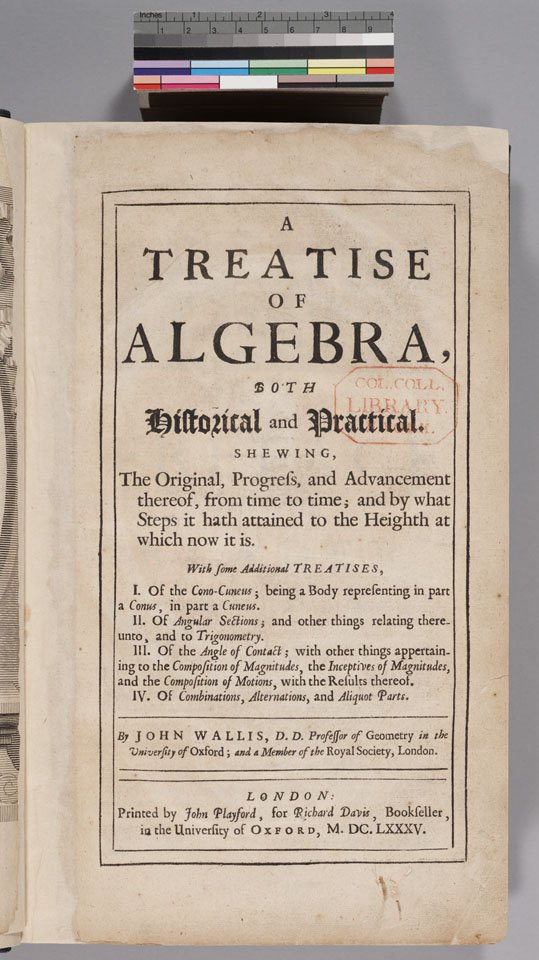
1697 A Letter of Dr. Wallis, Dated Oxford, Sept. 6. 1697. Containing Some Additions to His Letter about Thunder and Lightning, and a Correction of His 109th Chap. of His Algebra to be read to the Royal Society.

1769 Harvard's Hollis Professor John Winthrop writes to Benjamin Franklin to suggest an error in predictions for transit of Venus presented to Royal Society in anticipation of the upcoming transit.
"I find that Mr. Bliss and Mr. Hornsby in their calculations in the Philos. Transact. suppose the phases of the Transit of Venus to be accelerated by the equation for the observation of light, which amounts to 55″ of time. According to my idea of aberration, I should think the Transit would be retarded by it.
(Bliss was Savilian Professor of Geometry at Oxford and would go on to become Astronomer Royal in 1762; Hornsby would replace him as Savilian Professor of Geometry.) Natl. Archives

1803 On his 37th birthday, John Dalton makes the first notes about his atomic theory in his laboratory notebook. On this date there appears a list in which he sets out the relative weights of the atoms of a number of elements, derived from analysis of water, ammonia, carbon dioxide, etc. by chemists of the time.

1909 Word was received that Admiral Robert Peary had discovered the North Pole five months earlier on April 6, 1909. Question: Where on the Earth, other than the North Pole, can one travel a mile South, a mile East, a mile North, and end up in the same spot? *VFR

1923 At an AMS meeting at Vassar College George Y. Ranich, then of the University of Michigan, gave a talk on the class number of quadratic fields. L. J. Mordell who was in the audience noted he made no reference to a rather pretty paper by one Rabinowitz of Odessa. When Mordell commented on this the speaker blushed and stammered “I am Rabinowitz.” He had changed his name when he moved to the U.S. *VFR

1927 Anna Johnson Pell Wheeler (1883–1966) began the 11th series of Colloquium Lectures at the American Mathematical Society Meeting in Madison, Wisconsin, being the first woman to be invited to do so. She spoke on “The theory of quadratic forms in infinitely many variables and applications.” “One hundred twenty-seven persons attended these lectures, the largest number registered for any colloquium so far held, though ... the gradient seems to be on the decrease.” *VFR
The colloquium lectures by Professors Bell and Wheeler were delivered on Tuesday (sixth), Wednesday, Thursday, and Saturday mornings, and Thursday evening. *AMS Org.

1930 Kurt Godel, a logician who was immediately to become famous, addressed the annual meeting of the Deutsche Mathematiker-Vereinigung in Konigsberg, on his completeness theorem. Godel solved this problem for his doctoral dissertation under the direction of Hans Hahn in 1929. *VFR

1997 The U.S. Navy commissioned their most advanced ship, the U.S.S. Hopper (DDG 70), on September 6, 1997 named in honor of Grace Hopper. She had been recalled to active duty in August of 1967 to work on the development of COBOL.
“The US Navy recalls Captain Grace Murray Hopper to active duty to help develop the programming language COBOL. With a team drawn from several computer manufacturers and the Pentagon, Hopper -- who had worked on the Mark I and II computers at Harvard in the 1940s -- created the specifications for COBOL (COmmon Business Oriented Language) with business uses in mind. These early COBOL efforts aimed at creating easily-readable computer programs with as much machine independence as possible. Designers hoped a COBOL program would run on any computer for which a compiler existed with only minimal modifications.
Hopper made many major contributions to computer science throughout her very long career, including what is likely the first compiler ever written, "A-0." She appears to have also been the first to coin the word "bug" in the context of computer science, taping into her logbook a moth which had fallen into a relay of the Harvard Mark II computer. She died on January 1, 1992. (*CHM, *Wik, and others)


BIRTHS

1766 John Dalton (6 Sep 1766; 27 Jul 1844) English teacher who, from investigating the physical and chemical properties of matter, deduced an Atomic Theory (1803) whereby atoms of the same element are the same, but different from the atoms of any other element. In 1804, he stated his law of multiple proportions by which he related the ratios of the weights of the reactants to the proportions of elements in compounds. He set the atomic weight of hydrogen to be identically equal to one and developed a table of atomic weights for other elements. He was the first to measure the temperature change of air under compression, and in 1801 suggested that all gases could be liquified by high pressure and low temperature. Dalton recognized that the aurora borealis was an electrical phenomenon. *TIS (Dalton was colorblind; a fact that is certainly more commonly known to the French than other nationalities since the French name for the condition, I am told, is le daltonisme)

1811 James Melville Gilliss (6 Sep 1811; 9 Feb 1865) U.S. naval officer and astronomer who founded the Naval Observatory in Washington, D.C., the first U.S. observatory devoted entirely to research. Gilliss joined the Navy as a midshipman at the age of 15. He taught himself astronomy, at a time when there was no fixed astronomical observatory in the U.S., and very little formal instruction. In 1838, when Charles Wilkes left on the famous South Seas Exploring Expedition, Gilliss became officer-in-charge of the Depot of Charts and Instruments, forerunner of the U. S. Naval Observatory. Gilliss's astronomical observations made during this time in connection with determining longitude differences with the Wilkes Expedition, resulted in the first star catalogue published in the United States. *TIS

1830 John Henry Dallmeyer (6 Sep 1830; 30 Dec 1883) German-born British inventor and manufacturer of lenses and telescopes. He introduced improvements in both photographic portrait and landscape lenses, in object glasses for the microscope, and in condensers for the optical lantern. Dallmeyer made photoheliographs (telescopes adapted for photographing the Sun) for Harvard observatory (1864), and the British government (1873). He introduced the "rapid rectilinear" (1866) which is a lens system composed of two matching doublet lenses, symmetrically placed around the focal aperture to remove many of the aberrations present in more simple constructions. He died on board a ship at sea off New Zealand. *TIS

1859 Boris Yakovlevic Bukreev (6 Sept 1859 , 2 Oct 1962) His work was broad and in addition to the areas of complex functions, differential equations, the theory and application of Fuchsian functions of rank zero, and geometry, he published papers on algebra such as On the composition of groups (1900). After 1900 he became interested in the theory of series, publishing papers such as Notes on the theory of series and he also worked on the Calculus of Variations. His vigorous research activity did not prevent him from devoting time to teaching of the highest quality*SAU

1892 Sir Edward Victor Appleton (6 Sep 1892; 21 Apr 1965) was a English physicist who won the 1947 Nobel Prize for Physics for his discovery of the Appleton layer of the ionosphere. From 1919, he devoted himself to scientific problems in atmospheric physics, using mainly radio techniques. He proved the existence of the ionosphere, and found a layer 60 miles above the ground that reflected radio waves. In 1926, he found another layer 150 miles above ground, higher than the Heaviside Layer, electrically stronger, and able to reflect short waves round the earth. This Appleton layer is a dependable reflector of radio waves and more useful in communication than other ionospheric layers that reflect radio waves sporadically, depending upon temperature and time of day.*TIS

1893 Dimitrij Alexandrowitsch Grave born. Among the many books that Grave wrote were Theory of Finite Groups (1910) and A Course in Algebraic Analysis (1932). He also studied the history of algebraic analysis.
Among the honours that were given to him was election to the Academy of Sciences of the Ukraine in 1919, election to the Shevchenko Scientific Society in 1923 and election to the Academy of Sciences of the USSR in 1929.*SAU

1906 Banesh Hoffmann,(September 6, 1906 - August 6, 1986) a physicist, mathematician and author who was a colleague and biographer of Albert Einstein.
In 1935, Mr. Hoffmann joined the Institute for Advanced Study in Princeton, N.J., where he worked with Einstein and a Polish physicist, Leopold Infeld, on a paper, "Gravitational Equations and the Problem of Motion."
While at Oxford, he was invited to go to Princeton and work as research associate to Dr. Oswald Veblen, a mathematics professor. In 1932, he received a doctorate in mathematics and physics from Princeton.
Mr. Hoffman worked as instructor at the University of Rochester from 1932 until 1935 and joined the faculty of Queens College in 1937. He rose to full professor and retired in the late 70s.
Hoffmann had been for the last quarter-century perhaps the best-known critic of multiple-choice testing. In his 1962 book The Tyranny of Testing and other writings, Mr. Hoffmann vehemently opposed standardized tests as superficial measures of a person`s knowledge. He died August 6, 1986 at his home in Flushing, N.Y. He was 79. *Sun Sentinal Obituary

1907 Sir Maurice George Kendall, FBA (6 September 1907 – 29 March 1983) was a British statistician, widely known for his contribution to statistics. The Kendall tau rank correlation is named after him.*Wik He was involved in developing one of the first mechanical devices to produce (pseudo-) random digits, eventually leading to a 100,000-random-digit set commonly used until RAND's (once well-known) "A Million Random Digits With 100,000 Normal Deviates" in 1955.
Kendall was Professor of Statistics at the London School of
Economics from 1949 to 1961. His main work in statistics involved
k-statistics, time series, and rank-correlation methods, including
developing the Kendall's tau stat, which eventually led to a mono-
graph on Rank Correlation in 1948. He was also involved in several
large sample-survey projects.
For many, what Kendall is best known for is his set of books titled
The Advanced Theory of Statistics (ATS), with Volume I first
appearing in 1943 and Volume II in 1946. Kendall later completed a
rewriting of ATS, which appeared in three volumes in 1966, which
were updated by collaborator Alan Stuart and Keith Ord after
Kendall's death, appearing now as "Kendall's Advanced Theory of
Statistics". *David Bee

1908 Louis Essen (6 Sep 1908; 24 Aug 1997) English physicist who invented the quartz crystal ring clock and the first practical atomic clock. These devices were capable of measuring time more accurately than any previous clocks. He built a cesium-beam atomic clock, a device that ultimately changed the way time is measured. Each chemical element and compound absorbs and emits electromagnetic radiation at its own characteristic frequencies. These resonances are inherently stable over time and space. The cesium atom's natural frequency was formally recognized as the new international unit of time in 1967: the second was defined as exactly 9,192,631,770 oscillations or cycles of the cesium atom's resonant frequency, replacing the old second defined in terms of the Earth's motion. *TIS

1940 Elwyn Ralph Berlekamp (September 6, 1940; Dover, Ohio -) is an American mathematician. He is a professor emeritus of mathematics and EECS at the University of California, Berkeley. Berlekamp is known for his work in information theory and combinatorial game theory. While an undergraduate at the Massachusetts Institute of Technology (MIT), he was a Putnam Fellow in 1961. With John Horton Conway and Richard K. Guy, he co-authored Winning Ways for your Mathematical Plays, leading to his recognition as one of the founders of combinatorial game theory. He also published a book on the simple (but complex) game of dots and boxes.
Outside of mathematics and computer science, Berlekamp has also been active in money management. In 1986, he began information-theoretic studies of commodity and financial futures. In 1989, Berlekamp purchased the largest interest in a trading company named Axcom Trading Advisors. After the firm's futures trading algorithms were rewritten, Axcom's Medallion Fund had a return (in 1990) of 55%, net of all management fees and transaction costs. The fund has subsequently continued to realize annualized returns exceeding 30% under management by James Harris Simons and his Renaissance Technologies Corporation.
Berlekamp and his wife Jennifer have two daughters and a son and live in Piedmont, California. *Wik


DEATHS

1857 Johann Salamo Christoph Schweigger (8 Apr 1779, 6 Sep 1857)German physicist who invented the galvanometer (1820), a device to measure the strength of an electric current. He developed the principle from Oersted's experiment (1819) which showed that current in a wire will deflect a compass needle. Schweigger realized that suggested a basic measuring instrument, since a stronger current would produce a larger deflection, and he increased the effect by winding the wire many times in a coil around the magnetic needle. He named this instrument a "galvanometer" in honour of Luigi Galvani, the professor who gave Volta the idea for the first battery. Seebeck (1770-1831) named the innovative coil, Schweigger's multiplier. It became the basis of moving coil instruments and loudspeakers.*TIS

1949 James McBride studied at Queen's College Belfast and then taught at various Glasgow schools finishing as Rector of Queen's Park School. He published a number of papers in Geometry and was a founder member of the Euclidean Club. *SAU

1951 Winifred Edgerton Merrill​ made a vast impact on the male orientated world of mathematics. She left behind the Victorian ideal that a wellborn woman should stay at home, and went about continuing her education in mathematics to Ph.D. level. This was a fantastic achievement and Merrill became the first American woman to obtain a Ph.D. in mathematics. *SAU

1956 Witold Hurewicz died (June 29, 1904 - September 6, 1956). Hurewicz is best remembered for two remarkable contributions to mathematics, his discovery of the higher homotopy groups in 1935-36, and his discovery of exact sequences in 1941. His work led to homological algebra. It was during Hurewicz's time as Brouwer's assistant in Amsterdam that he did the work on the higher homotopy groups; "...the idea was not new, but until Hurewicz nobody had pursued it as it should have been. Investigators did not expect much new information from groups, which were obviously commutative..."*Wik

1967 Albert Edward Ingham Studied under Littlewood (who died exactly ten years later) and worked in the distribution of primes. "His book On the distribution of prime numbers published in 1932 was his only book and it is a classic." *SAU

1977 John Edensor Littlewood (9 June 1885, 6 Sept 1977) collaborated with G H Hardy, working on the theory of series, the Riemann zeta function, inequalities and the theory of functions. His famous collaboration with G. H. Hardy lasted for thirty-five years. During the years of this collaboration Littlewood was seldom seen outside Cambridge, in fact there were jokes around that he was the invention of Hardy. *SAU It is said, not entirely in jest, that Landau thought Littlewood was a name Hardy used as a pen-name so as not to seem to dominate English Mathematics. *Ralph P Boas


Credits :
*CHM=Computer History Museum
*FFF=Kane, Famous First Facts
*NSEC= NASA Solar Eclipse Calendar
*RMAT= The Renaissance Mathematicus, Thony Christie
*SAU=St Andrews Univ. Math History
*TIA = Today in Astronomy
*TIS= Today in Science History
*VFR = V Frederick Rickey, USMA
*Wik = Wikipedia
*WM = Women of Mathematics, Grinstein & Campbell
Friday, 5 September 2014

On This Day in Math - September 5


Errors using inadequate data are much less than those using no data at all.

~Charles Babbage

The 248th day of the year; 248 is the smallest number (above 1) for which the arithmetic, geometric, and harmonic means of φ(n)(The number of positive integers less than n that are relatively prime to it, 120) and σ(n) (the sum of positive integers less than n that are factors of n, 480) are all integers.


EVENTS

1666 The fire of London was extinguished after four days and nights. Some 13,000 buildings were destroyed. It took a lot of architects to rebuild. Sadly for mathematics, a talented young mathematician, who was also something of an architect was available. This explains how mathematics lost Christopher Wren. *VFR

In 1857, Charles Darwin, now 48 years old, had not yet published his theory of evolution. On this day, he sent a letter to Asa Gray, a Harvard botanist, discussing his theory. The encouragement which followed from Gray and others, and new knowledge that Alfred Wallace had independently developed the same theory, prompted Darwin to end 20 years of indecision and publish his ideas.*TIS

1877 "marked a turning point in the cartography of Mars. On 5 September of that year, Earth and Mars stood in “perihelic opposition,” as Earth came into line between Mars and the sun when the two planets were also nearest to the sun and to each other along their respective elliptical orbits. With the disk of Mars fully illuminated by the sun during this close approach, terrestrial astronomers enjoyed incomparable views, not only on the day of the opposition itself but also in the days and weeks leading up to and following the event. Taking advantage of this rare occurrence, the English amateur astronomer Nathaniel Green departed from his usual observing station—in the back garden of his home in St. John’s Wood, a suburb of London—and traveled with his 13‐inch reflecting telescope all the way to the Portuguese island of Madeira in search of good atmospheric conditions for extended observations. Over two months, Green’s effort was rewarded with forty‐seven nights suitable for Mars observation, sixteen of which he termed “good,” “excellent,” or “superb”; this was fewer than expected but “considerably in excess of the average of an English climate.” During his expedition he produced a series of exquisite sketches that he later compiled into the most detailed map of Mars to date (see Figure 1). The expedition to Madeira was a major event in Green’s avocational career, cementing his status as a serious amateur." *K Maria D Lane,Isis,Vol. 96, No. 4, December 2005


*Mercator and planar projection maps by Nathaniel Green, 1877. Originally published (using reddish‐orange color tones) in Memoirs of the Royal Astronomical Society, 1877–1879, p. 44.

1883 An aging Sylvester,longing for the security of his homeland sent a letter to Cayley, "If I am not accepted at Oxford, I shall buy an annuity or study abroad or go into business with my small acquired capital. He would write President Gilman of Johns Hopkins to resign a week later, to take effect Jan 1 of the following year. *Karen Hunger Parshall, David E. Rowe; The Emergence of the American Mathematical Research Community, 1876-1900

1923  Minor planet (1005) Arago Discovered 1923 September 5 by S. I. Belyavskij at Simeis. Named in honor of  François Arago (1786-1853) *NSEC

1935 “Emmy Noether’s career was full of paradoxes, and will always stand as an example of shocking stagnancy and inability to overcome prejudice on the part of the Prussian academic and civil service bureaucracies. Her appointment as Privatdozent in 1919 was only possible because of the persistence of Hilbert and Klein, who overcame some extreme opposition from reactionary university circles. The basic formal objection was the sex of the candidate: ‘How can we allow a woman to become a Privatdozent! after all, once she is a Privatdozent, she may become a Professor and member of the University Senate; is it permissible for a woman to enter the Senate?’ This provoked Hilbert’s famous reply: ‘Meine Herren, der Senate is ja keine Badenanstalt, warum darf eine Frau nicht dorthin! [Gentlemen, the Senate is not a bathhouse, so I do not see why a woman cannot enter it!]’”—from an address, “In Memory of Emmy Noether,” delivered by P. S. Alexandrov, then president of the Moscow Mathematical Society. Quoted from Emmy Noether: 1882–1935, by Auguste Dick. Birkh¨auser, 1981. *VFR

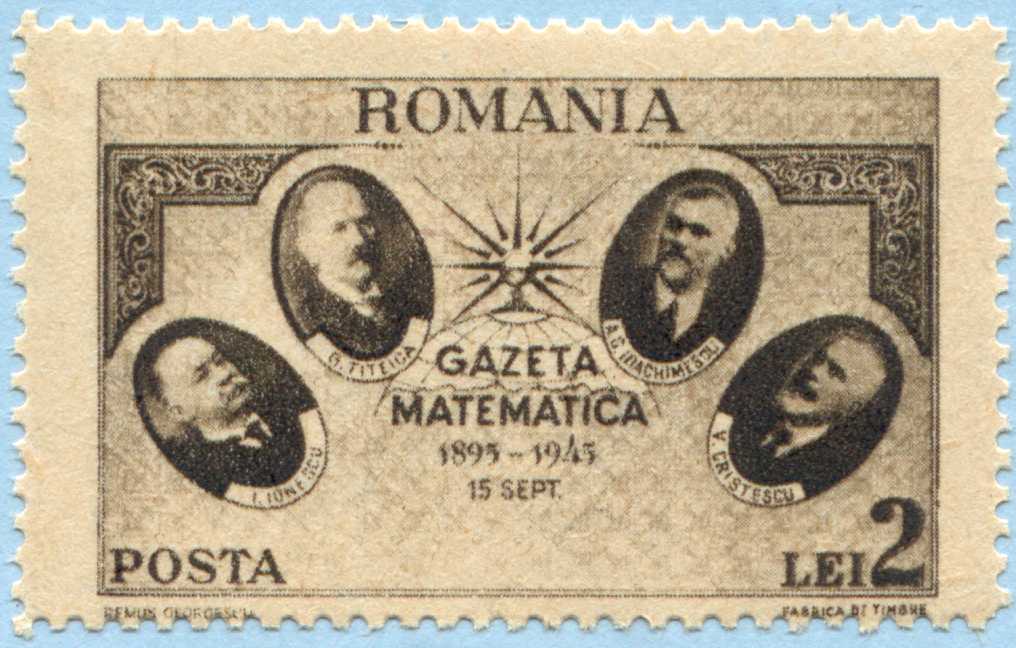
1945 Romania issued two postage stamps to commemorate the 50th anniversary of the mathematics journal Gazeta Mathematica. Editors I. N. Ionescu (1870–1948), Gheorge Titeica (1873–1939), A. O. Idachimescu (1895–1943), and Vasile Cristescu 1869–1929) are pictured on the first of them. [Scott #596-7]. *VFR

1980 The last IBM 7030, or STRETCH, mainframe computer is decommissioned at Brigham Young University. STRETCH was the result of an intensive R&D project started at IBM in 1955. The goal: build a super-computer 100 to 200 times as powerful as anything yet yet built. The premier customer: Los Alamos Scientific Laboratory (run by the Atomic Energy Commission), which was designing atomic weapons. *CHM


BIRTHS
1637 Ignace-Gaston Pardies (September 5, 1636 – April 22, 1673) was a French scientist. He died of fever contracted whilst ministering to the prisoners of Bicêtre Hospital, near Paris.
He was born in Pau, the son of an adviser at the local assembly. He entered the Society of Jesus 17 Nov., 1652 . After his ordination he taught philosophy and mathematics at the Lycée Louis-le-Grand in Paris. His earliest scientific work is the Horologium Thaumanticum Duplex (Paris, 1662), in which is described an instrument he had invented for constructing various kinds of sundials. Three years later appeared his Dissertatio de Motu et Natura Cometarum,
published separately in Latin and in French (Bordeaux, 1665). His La Statique (Paris, 1673) argued that Galileo's theory was not exact. This, along with Discours du mouvement local (Paris, 1670), and the manuscript Traité complet d'Optique, in which he followed the undulatory theory of light (which identifies it as a harmonic vibration), form part of a general work on physics which he had planned. Traité complet d'Optique had been studied by Pierre Ango (1640-1694) a confrere of Pardies for his Book L`Optique[1] which he published in 1682 after Pardies early death. The Manuscript has also been mentioned by Christiaan Huygens in his 'Treatise on Light'. Huygens himself mentioned in 1668 that it has been Pardies Theory that the Speed of Light is finite.
He opposed Isaac Newton's theory of refraction and his letters together with Newton's replies (which so satisfied Pardies that he withdrew his objections) are found in the Philosophical Transactions of the Royal Society for 1672 and 1673. A proponent of Mechanism, his Discours de la Connaissance des Bestes (Paris, 1672) combatted Descartes's views on animals, but did so so weakly that many looked on it as a covert defence rather than a refutation, an impression which Pardies himself afterwards endeavoured to destroy. His Elémens de Géométrie (Paris, 1671) was translated into Latin and English. He left in manuscript a work entitled Art de la Guerre and a celestial atlas comprising six charts, published after his death (Paris, 1673–74). His collected mathematical and physical works were published in French (The Hague, 1691) and in Latin (Amsterdam, 1694). He was a member of the academy of anatomist Pierre Michon Bourdelot. *Wik
In the course of the correspondence between Pardies and Newton published in the TRS, Pardies takes his arguments from Grimaldi. Pardies had argued that such a drastic departure from the accepted theory should not be entirely founded on the one experiment of the prism since the radical implication of Newton's paper would overthrow the accepted foundations of geometrical optics. But Pardies gradually comes to Newton's position, making a rather generous admission of error, which precipitated this reply from Newton:

In the observations of Reverend Fr. Pardies, one can hardly determine whether there is more of humility and candor in allowing my arguments their due weight, or penetration and genius in stating objections. *Joseph MacDonnell, S.J. Fairfield Univ Website
Pardies created a series of six beautiful star and constellation maps in the late 17th century. All six map plates join together to make a unified view of the Heavens as seen from the Earth. Plate 5, is shown at right. All six plates and several assembled views are available at *David Rumsey Map Collection

1667 Girolamo Saccheri born (September 5, 1667, Sanremo – October 25, 1733). He was the first to publish the effects of denying Euclid’s fifth postulate. *VFR He tried
to prove the fifth postulate of Euclid, which can be stated as, "Through any point not on a given line, one and only one line can be drawn that is parallel to the given line." Euclid saw the proof was not self-evident, yet neither did he provide one; instead he accepted it as an assumption. Subsequently many mathematicians tried to prove this fifth postulate from the remained axioms - and failed. Saccheri took the novel approach of first assuming that the postulate was wrong, then followed the all consequences seeking any one contradiction that then leaves the only original postulate as the only possible solution. In the process, he came close to discovering non-Euclidian geometry, but gave up too early. *TIS
The Renaissance Mathematicus has a great post on how Saccheri stood at the door to fame and turned away.

1725 Jean-Étienne Montucla (5 September 1725 – 18 December 1799) was a French historian of mathematics who wrote in 1754 a history of the problem of squaring the circle. He also wrote the first truly comprehensive classical history of mathematics,Histoire des mathématiques. Late in his life, Montucla's friends persuaded him to work on a new edition of his famous Histoire des mathématiques. In August 1799 Montucla published new editions through Agasse in Paris of the two volumes originally published in 1758. Montucla extensively revised and enlarged the two volumes. He had intended to extend his cover of history to the end of the 18th century and part of the third volume on this topic was printed by the time he died, four months after the publication of the new editions of 1799. Lalande, with the help of some other scientists, completed volumes three and four to give the coverage that Montucla had intended. Volume three covered 18th century pure mathematics, optics and mechanics in 832 pages, while the fourth volume covered 18th century astronomy, mathematical geography and navigation in 688 pages.*SAU

1850 Eugen Goldstein (5 Sep 1850; 25 Dec 1930)physicist who discovered and named canal rays (1886) which emerge through holes in the anodes of low-pressure electrical discharge tubes (later shown to be positively charged particles). Earlier, he coined the term "cathode ray" (1876) emitted from a cathode. He was the first to see that they could cast a shadow, and were emitted at right angles to the surface. He also investigated the wavelengths of light emitted by metals and oxides when canal rays impinge on them. When the Berlin Urania, opened in 1889 it had five scientific departments and a "science theatre", it was Goldstein who had recommended the "hall of physics in which the visitor could experiment on his own". Students of his that continued his work included Wien and Stark. *VFR


1879 Frank Baldwin Jewett (5 Sep 1879; 18 Nov 1949) the U.S. electrical engineer who directed research as the first president of the Bell Telephone Laboratories, Inc., (1925-40). Jewett believed that the best science and technology result from bringing together and nurturing the best minds. Under his tenure Bell Labs laid the foundation for a new scientific discipline, radio astronomy, and transformed movies by synchronizing sound to pictures. Bell Labs was the first to transmit television over a long distance in the U.S. and designed the first electrical digital computer. Bell Labs won its first Nobel Prize in physics for fundamental work demonstrating the wave nature of matter.*TIS

1927 William Moser (5 Sep 1927;28 Jan 2009) My mathematical interests are: presentations for finite groups; combinatorial enumerations (e.g., counting restricted permutations and combinations); problems in discrete and combinatorial geometry. *From his page at McGill Univ.
In March 2003 Moser was interviewed by Siobhan Roberts who was working on her major work on Coxeter King of Infinite space. He recounted the following story
"Donald made many great contributions to mathematics. I made one great contribution," recounted Moser. Moser's opportunity came at the end of Coxeter's 1955 summer of roving lectures, after his session in Stillwater, at Oklahoma State University. Moser drove down to meet Coxeter and serve as his assistant, taking detailed notes of the well-polished lectures. "At the end of the summer we drove north, to civilisation," said Moser wryly. "We were in my car and Donald asked me if he could drive. It was a new car. Indeed it was the first car I had ever purchased, a green 1955 Plymouth 2-door. I paid $2,000 for it and drove it to Oklahoma. But I agreed. I was surprised to see that he was an aggressive driver. At one point he was trying to pass a car while driving up a hill on a 2-lane highway. I immediately perceived that this was not a prudent thing to do. He tried to coax the car to go faster but it wouldn't respond. At the last moment I shrieked at him, 'Pull back, pull back'. I was probably his only student to shriek at him. He began to pull back and at that moment a truck came over the hill. He managed to get back in the right lane just in time. I HAD SAVED HIS LIFE! And mine. But saving Coxeter's life was my greatest contribution to mathematics."
*SAU


DEATHS

Federico Commandino (1509 – September 5, 1575) was an Italian humanist and mathematician.
Born in Urbino, he studied at Padua and at Ferrara, where he received his doctorate in medicine. He translated the works of ancient mathematicians and was responsible for the publication of the works of Archimedes. He also translated the works of Aristarchus of Samos (On the masses and distances of the Sun and the Moon), Pappus of Alexandria (Mathematical collection), Hero of Alexandria (Pneumatics), and Euclid (Elements). Among his pupils was Guidobaldo del Monte. Commandino maintained a correspondence with the astronomer Francesco Maurolico. The proposition known as Commandino's theorem first appears in his work on centers of gravity.(VFR has this date listed as Sep 3). Commandino's Theorem is a nice extension of the concentric properties of medians in a triangle. "The four medians of a tetrahedron concur in a point which divides each tetrahedron median in the ratio 1:3, the longer segment being on the side of the vertex of the tetrahedron." (A proof appropriate for good HS students well versed in 3-D coordinate geometry)

1667 Henry Oldenburg died (c. 1619 – 5 September 1677). He was one of the foremost intelligencers of Europe of the seventeenth century, with a network of correspondents to rival those of Fabri de Peiresc, Marin Mersenne and Ismaël Boulliau. After the Restoration he became an early member (original fellow) of the Royal Society (founded in 1660), and served as its first secretary along with John Wilkins, maintaining an extensive network of scientific contacts through Europe. He also became the founding editor of the Philosophical Transactions of the Royal Society. Oldenburg began the practice of sending submitted manuscripts to experts who could judge their quality before publication. This was the beginning of both the modern scientific journal and the practice of peer review. He was interred on 7 September at St Mary the Virgin, Bexley. His widow died ten days later. *Wik

1857 Isidore Auguste Marie François Xavier Comte (17 Jan 1798, 5 Sep 1857)French philosopher and mathematician. a founder of the discipline of sociology and of the doctrine of positivism. He may be regarded as the first philosopher of science in the modern sense of the term. *Wik

1906 Ludwig Eduard Boltzmann (February 20, 1844 – September 5, 1906) was an Austrian physicist famous for his founding contributions in the fields of statistical mechanics and statistical thermodynamics. He was one of the most important advocates for atomic theory at a time when that scientific model was still highly controversial. *Wik Trivia: Boltzmann's famous equation S = K log W (where S = entropy, K = Boltzmann's constant, and W = probability of a particular state) was inscribed as an epitaph on Boltzmann's tombstone. *Wik After obtaining his doctorate, he became an assistant to his teacher Josef Stefan. Boltzmann's fame is based on his invention of statistical mechanics, independently of Willard Gibbs. Their theories connected the properties and behavior of atoms and molecules with the large scale properties and behavior of the substances of which they were the building blocks. He also worked out a kinetic theory of gases, and the Stefan-Boltzmann law concerning a relationship between the temperature of a body and the radiation it emits. His firm belief and defense of atomism (that all matter is made of atoms) against hostile opposition to this new idea, may have contributed to his suicide in 1906. *TIS

1917 Marian Smoluchowski (28 May 1872 - 5 September 1917) was an ethnic Polish scientist in the Austro-Hungarian Empire. He was a pioneer of statistical physics and an avid mountaineer. Smoluchowski scientific output included fundamental work on the kinetic theory of matter. In 1904 he was the first who noted the existence of density fluctuations in the gas phase and in 1908 he became the first physicist to ascribe the phenomenon of critical opalescence to large density fluctuations. His investigations also concerned the blue colour of the sky as a consequence of light dispersion on fluctuations in the atmosphere, as well as explanation of Brownian motion of particles. At that time Smoluchowski proposed formulae which presently carry his name.
In 1906, independently of Albert Einstein, he described Brownian motion. Smoluchowski presented an equation which became an important basis of the theory of stochastic processes. *Wik

1930 Johann Georg Hagen (6 Mar 1847, 5 Sep 1930) Austrian Jesuit priest and astronomer who made a catalog of variable stars (1890-1908). Working at the Vatican Observatory he reexamined for accuracy the listing of all of the NGC (New General Catalogue of Nebulae and Star Clusters) objects north of about -30 degrees. He published lists of errata in the NGC. During his observations, he observed dark nebulae, tenuous dark clusters of interstellar matter sometimes known as Hagen's clouds. These strange clouds have not been recorded by others, and are now attributed to optical illusions associated with visual observations. Jesuits have been involved in astronomy since 1551 when Fr. Christoph Clavius, SJ, a mathematician and astronomer helped Pope Gregory XIII reform the calendar.*TIS

1948 Richard C(hace) Tolman (4 Mar 1881, 5 Sep 1948) was an American physicist and chemist who demonstrated that electrons are the charge-carrying entities in the flow of electricity, and also made a measurement of its mass. During the Manhattan Project of WW II, he was the chief scientific adviser to Brig. General Leslie Groves, the head of military affairs overseeing the development of the atomic bomb. After the war he was adviser to the U.S. representative to the United Nations Atomic Energy Commission. *TIS

1972 Tadeusz Ważewski (24 September 1896 – 5 September 1972) was a Polish mathematician.
Ważewski who made important contributions to the theory of ordinary differential equations, partial differential equations, control theory and the theory of analytic spaces. He is most famous for applying the topological concept of retract, introduced by Karol Borsuk to the study of the solutions of differential equations. *Wik
Ważewski studied at the Jagiellonian University in 1914–1920. He started from physics but very quickly turned to mathematics. Ważewski was a pupil of Zaremba.
He spent three years in Paris and got a doctoral diploma from Sorbona.
In his doctoral dissertation he obtained interesting results on dendrites (locally connected continua not containing simple closed curves). *Ciesielski & Pogoda, EMS Newsletter December 2012

1994 Shimshon Avraham Amitsur (August 26, 1921 – September 5, 1994) was a Jewish mathematician. He is best known for his work in ring theory, in particular PI rings, an area of abstract algebra.*Wik


Credits :
*CHM=Computer History Museum
*FFF=Kane, Famous First Facts
*NSEC= NASA Solar Eclipse Calendar
*RMAT= The Renaissance Mathematicus, Thony Christie
*SAU=St Andrews Univ. Math History
*TIA = Today in Astronomy
*TIS= Today in Science History
*VFR = V Frederick Rickey, USMA
*Wik = Wikipedia
*WM = Women of Mathematics, Grinstein & Campbell