Friday, 8 May 2015

On This Day in Math - May 8


I have no certainties, 
at most probabilities 
Renato Caccioppoli


The 128th day of the year; 128 is The largest known even number that can be expressed as the sum of two primes in exactly three ways. (Find them) *Prime Curios
128 is also the largest number that cannot be expressed as the sum of distinct squares. *Number Gossip
128 can be expressed by a combination of its digits with mathematical operators thus 128 = 28 - 1, making it a Friedman number in base 10 (Friedman numbers are named after Erich Friedman, as of 2013 an Associate Professor of Mathematics and ex-chairman of the Mathematics and Computer Science Department at Stetson University, located in DeLand, Florida.)


EVENTS
1654 Otto von Guericke demonstrates the Magdenburg hemispheres in front of the imperial Diet, and the Emperor Ferdinand IIII in Regensburg.
The Magdeburg hemispheres, around 50 cm (20 inches) in diameter, were designed to demonstrate the vacuum pump that Guericke had invented. One of them had a tube connection to attach the pump, with a valve to close it off. When the air was sucked out from inside the hemispheres, and the valve was closed, the hose from the pump could be detached, and they were held firmly together by the air pressure of the surrounding atmosphere.
Thirty horses, in two teams of fifteen, could not separate the hemispheres until the valve was opened to equalize the air pressure. In 1656 he repeated the demonstration with sixteen horses (two teams of eight) in his hometown of Magdeburg, where he was mayor. He also took the two spheres, hung the two hemispheres with a support, and removed the air from within. He then strapped weights to the spheres, but the spheres would not budge.Gaspar Schott was the first to describe the experiment in print in his Mechanica Hydraulico-Pneumatica (1657).
In 1663 (or, according to some sources, in 1661) the same demonstration was given in Berlin before Frederick William, Elector of Brandenburg with twenty-four horses. It is unclear how strong a vacuum Guericke's pump was able to achieve, but if it was able to evacuate all of the air from the inside, the hemispheres would have been held together with a force of around 20 000 N (4400 lbf, or 2.2 short tons), equivalent to lifting a car or small elephant; a dramatic demonstration of the pressure of the atmosphere. *Wik

1661 “On 8 May 1661 the Society’s Journal Book notes that ‘a motion was made for the erecting of a library’, and later in the same month ‘it was resolved that every member, who hath published or shall publish any work, give the Society one copy’.” (from Emma Davidson at RSI)

1790 The Assembly (French) ordered the Académie des Sciences to standardize weights and measures on 8 May 1790. The Académie appointed a Commission of Lagrange, Borda, Condorcet, Laplace and Tillet to compare the decimal and duodecimal systems. Another Commission, with Monge instead of Tillet, was to examine how to make a standard of length. The Commissions continued functioning through the Revolution.

1794 Lavoisier Guillotined along with twenty-seven other members of the Ferme Générale, including his father-in-law. See Deaths below

1795 French astronomer Jerome Lalande observes a "star". It is in fact the planet Neptune, which is not officially discovered until 1846. * Liz Suckow@LizMSuckow
A second recording, noting a possible error on the 10th was entered. Discovery of these recordings 1n 1947 by Sears C. Walker of the U.S. Naval Observatory led to a better calculation of the planet's orbit. *Wik

In 1886, Coca-Cola, the soft drink, was first sold to the public at the soda fountain in Jacob's Pharmacy in Atlanta, Georgia. It was invented by pharmacist, John Stith Pemberton, who mixed it in a 30-gal. brass kettle hung over a backyard fire. Until 1905, the drink, marketed as a "brain and nerve tonic," contained extracts of cocaine as well as the caffeine-rich kola nut. The name, using two C's from its ingredients, was suggested by his bookkeeper Frank Robinson, whose excellent penmanship provided the first scripted "Coca-Cola" letters as the famous logo. Asa Candler marketed Coke to world after buying the company from Pemberton. *TIS

1910 The New York Times Sunday Magazine publishes banner headline, "Fears Of The Comet Are Foolish And Ungrounded," only ten days before the Earth moves into the tail of Halley's Comet. The article featured the famous female astronomer, Mary Proctor, debunking horror stories such as :
Here is a gigantic monster in the sky with a head over two hundred thousand miles in width… and a train two million miles in length, rushing through space at the alarming rate of a thousand miles a minute.
On May 18 the earth will be plunged in this white hot mass of glowing gas, and, according to the report of the ignorant and superstitious, the world will be set on fire.
These sensation makers further say that the oceans on the side facing the comet will be boiled by the intense heat, and the land scorched and blistered as the dread wanderer passes by on its baneful way.
*SundayMagazine.org

1961 President J. F. Kennedy presented astronaut Alan B. Shepard the first National Aeronautics and Space Administration Distinguished Flying Medal for making America’s first space flight on May 5, 1961.*VFR

BIRTHS
1859 Johan Ludwig William Valdemar Jensen (8 May 1859 – 5 March 1925) contributed to the Riemann Hypothesis, proving a theorem which he sent to Mittag-Leffler who published it in 1899. The theorem is important, but does not lead to a solution of the Riemann Hypothesis as Jensen had hoped. It expresses
... the mean value of the logarithm of the absolute value of a holomorphic function on a circle by means of the distances of the zeros from the centre and the value at the centre.
He also studied infinite series, the gamma function and inequalities for convex functions.*SAU

1905 Karol Borsuk (May 8, 1905, Warsaw – January 24, 1982, Warsaw) Polish mathematician. His main interest was topology.
Borsuk introduced the theory of absolute retracts (ARs) and absolute neighborhood retracts (ANRs), and the cohomotopy groups, later called Borsuk-Spanier cohomotopy groups. He also founded the so called Shape theory. He has constructed various beautiful examples of topological spaces, e.g. an acyclic, 3-dimensional continuum which admits a fixed point free homeomorphism onto itself; also 2-dimensional, contractible polyhedra which have no free edge. His topological and geometric conjectures and themes stimulated research for more than half a century. *Wik

DEATHS
1794 Antoine Laurent Lavoisier (26 August 1743 – 8 May 1794) after a trial that lasted less than a day, a revolutionary tribunal condemned Antoine Laurent Lavoisier to death. He was 51 and guillotined on the same afternoon.  " It took only a moment to cause this head to fall and a hundred years will not suffice to produce its like." Joseph Louis Lagrange, the day of Lavoisier’s execution.
Lavoisier was guillotined in the terror following the French Revolution. In 1778, he found that air consists of a mixture of two gases which he called oxygen and nitrogen. By studying the role of oxygen in combustion, he replaced the phlogiston theory. Lavoisier also discovered the law of conservation of mass and devised the modern method of naming compounds, which replaced the older nonsystematic method. Under the Reign of Terror, despite his eminence and his services to science and France, he came under attack as a former Ferme Générale. In November 1793, all former members of the Ferme Générale including Lavoisier and his father-in-law, were arrested and imprisoned. After a trial that lasted less than a day, they were all found guilty of conspiracy against the people of France and condemned. When Lavoisier requested time to complete some scientific work, the presiding judge was said to have answered "The Republic has no need of scientists." He was guillotined and thrown in a common grave in the Cimetière de Picpus. Mathematician Joseph Louis Lagrange lamented the execution: "It took them only an instant to cut off that head, but France may not produce another like it in a century." About eighteen months following his death, Lavoisier was exonerated by the French government. When his belongings were delivered to his widow, a brief note was included reading "To the widow of Lavoisier, who was falsely convicted."
For more about Lavoisier see SomeBeans blog


1853 John Farrar (July 1, 1779 – May 8, 1853) died at Cambridge, Massachusetts.His translations from the French, including Legendre’s Elements of Geometry (Boston, 1819),were widely used in the U. S. *VFR
He first coined the concept of hurricanes as “a moving vortex and not the rushing forward of a great body of the atmosphere”, after the Great September Gale of 1815. Farrar
remained Professor of Mathematics and Natural Philosophy at Harvard University between 1807 and 1836. During this time, he introducedmodern mathematics into the curriculum. He was
also a regular contributor to the scientific journals. *Wikipedia He is buried in MountAuburn Cemetery Cambridge, Massachusetts,USA.*Wik

1904 Eadweard Muybridge English photographer important for his pioneering work in photographic studies of motion and in motion-picture projection. For his work on human and animal motion, he invented a superfast shutter. Leland Stanford, former governor of California, hired Muybridge to settle a hotly debated issue: Is there a moment in a horse’s gait when all four hooves are off the ground at once? In 1972, Muybridge took up the challenge. In 1878, he succeeded in taking a sequence of photographs with 12 cameras that captured the moment when the animal’s hooves were tucked under its belly. Publication of these photographs made Muybridge an international celebrity. Another noteworthy event in his life was that he was tried (but acquitted) for the murder of his wife's lover. *TIS

1951 Gilbert Ames Bliss, (9 May 1876, Chicago – 8 May 1951, Harvey, Illinois), was an American mathematician, known for his work on the calculus of variations. Bliss once headed a government commission that devised rules for apportioning seats in the U.S. House of Representatives among the several states. *Wikipedia

1959 Renato Caccioppoli (20 January 1904 – 8 May 1959) His most important works, out of a total of around eighty publications, relate to functional analysis and the calculus of variations. Beginning in 1930 he dedicated himself to the study of differential equations, the first to use a topological-functional approach. Proceeding in this way, in 1931 he extended the Brouwer fixed point theorem, applying the results obtained both from ordinary differential equations and partial differential equations.
In 1932 he introduced the general concept of inversion of functional correspondence, showing that a transformation between two Banach spaces is invertible only if it is locally invertible and if the only convergent sequences are the compact ones.
Between 1933 and 1938 he applied his results to elliptic equations, establishing the majorizing limits for their solutions, generalizing the two-dimensional case of Felix Bernstein. At the same time he studied analytic functions of several complex variables, i.e. analytic functions whose domain belongs to the vector space Cn, proving in 1933 the fundamental theorem on normal families of such functions: if a family is normal with respect to every complex variable, it is also normal with respect to the set of the variables. He also proved a logarithmic residue formula for functions of two complex variables in 1949.
In 1935 Caccioppoli proved the analyticity of class C2 solutions of elliptic equations with analytic coefficients.
The year 1952 saw the publication of his masterwork on the area of a surface and measure theory, the article Measure and integration of dimensionally oriented sets (Misura e integrazione degli insiemi dimensionalmente orientati, Rendiconti dell'Accademia Nazionale dei Lincei, s. VIII, v.12). The article is mainly concerned with the theory of dimensionally oriented sets; that is, an interpretation of surfaces as oriented boundaries of sets in space. Also in this paper, the family of sets approximable by polygonal domains of finite perimeter, known today as Caccioppoli sets or sets of finite perimeter, was introduced and studied.
His last works, produced between 1952 and 1953, deal about a class of pseudoanalytic functions, introduced by him to extend certain properties of analytic functions.
In his last years, the disappointments of politics and his wife's desertion, together perhaps with the weakening of his mathematical vein, pushed him into alcoholism. His growing instability had sharpened his "strangenesses", to the point that the news of his suicide on May 8, 1959 by a gunshot to the head did not surprise those who knew him. He died at his home in Palazzo Cellammare
In 1992 his tormented personality was remembered in a film directed by Mario Martone, The Death of a Neapolitan Mathematician (Morte di un matematico napoletano), in which he was portrayed by Carlo Cecchi. * Wik

1953 Benjamin Fedorovich Kagan (10 March 1869 in Shavli, Kovno (now Kaunas, Lithuania)
- 8 May 1953 in Moscow, USSR) Kagan worked on the foundations of geometry and his first work was on Lobachevsky's geometry. In 1902 he proposed axioms and definitions very different from Hilbert. Kagan studied tensor differential geometry after going to Moscow because of an interest in relativity.
Kagan wrote a history of non-euclidean geometry and also a detailed biography of Lobachevsky. He edited Lobachevsky's complete works which appeared in five volumes between 1946 and 1951. *SAU


1960 Henry Whitehead was a topologist and differential geometer who is best remembered for his work on homotopy equivalence. *SAU


Credits :
*CHM=Computer History Museum
*FFF=Kane, Famous First Facts
*NSEC= NASA Solar Eclipse Calendar
*RMAT= The Renaissance Mathematicus, Thony Christie
*SAU=St Andrews Univ. Math History
*TIA = Today in Astronomy
*TIS= Today in Science History
*VFR = V Frederick Rickey, USMA
*Wik = Wikipedia
*WM = Women of Mathematics, Grinstein & Campbell

Thursday, 7 May 2015

On This Day in Math - May 7


Scientists study the world as it is,
engineers create the world that never has been
~Theodore Von Karman
The 127th day of the year; Leap years will have 127 prime days of the month, but the 127th day (May 6 of leap year) will not be one of them.
127 is also the fourth Mersienne Prime, 27-1.   Édouard Lucas verified this number as prime in 1876. He is said to have spent 19 years in checking it, by hand. This remains the largest prime number discovered without the aid of a computer. (Lucas also invented the Towers of Hanoi Puzzle, and the game of dots and boxes which he called "La Pipopipette".)

20 + 21 + 22 + 23 + 24 + 25 + 26 = 127.
127 can be expressed as the sum of factorials of the first three odd numbers (1! + 3! + 5!). 
EVENTS

1526 The first circumnavigation of the globe took place in 1519. In 1539 Cardano asked for the number of days spent if a ship sailed westward on January 1, 1517, and went three times around the earth, returning on May 7, 1526. See Sanford, History, pp. 214 and 377. *VFR

1660 Isaack B Fubine of Savoy, in The Hague, patents macaroni *TIS (as soon as someone invents cheese, the fun eating will begin)

1747 Johann Sebastian Bach visits King Frederick II of Prussia, the visit resulting in his Musikalische Opfer (Musical offering). See D. R. Hofstadter’s Godel, Escher, Bach, p. 4. [Manson]*VFR

1772 Read before the Royal Society, May 7, The Sieve of Eratosthenes. Being an Account of His Method of Finding All the Prime Numbers, by the Rev. Samuel Horsley, F. R. S.

1895 Steiger Gets "Millionaire" Patent:
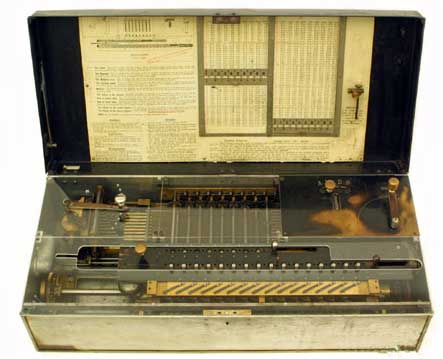
Otto Steiger was issued a patent for his Millionaire calculating machine. For the next 40 years, Switzerland's Hans Egli manufactured 4,700 machines, which weighed 120 pounds each. The Millionaire was notable in its ability to perform direct multiplication, which meant a user could multiply a number by a single digit with a single rotation of the handle.*CHM

In his German Patent of 1892 Steiger describes a machine which uses a mechanical representation of the multiplication table to form partial products, in the same way that a human "calculator" uses a
multiplication table committed to memory. The partial products are then transferred via a "transmitting mechanism" to a "combining and registering mechanism" for display to the operator. The Steiger's machine is to be regarded as a proper multiplication machine in that it solves problems of multiplication directly on the basis of the multiplication table, whereas other types of calculating machines are only adding machines and, as such, carry out multiplication by a continued series of additions. *Georgi Dalakov, History of Computers

In 1952, the concept of the integrated circuit chip was first presented, at a Symposium on Progress in Quality Electronic Components in Washington DC., by radar scientist Geoffrey W.A. Dummer. His small team of researchers at the Royal Radar Establishment of the British Ministry of Defence, based at Malvern, Worcestershire, was working on the task of improving the reliability of the Royal Air Force's radar equipment.. He believed that it would be possible to fabricate multiple circuit elements on and into a block of silicon half an inch square. In 1956, his initial attempts to build such a circuit failed, and thereafter could get no further support for his idea. Britain lost the commercial lead. A few years later, in America, Jack Kilby of Texas Instruments was awarded a U.S. patent for essentially the same idea.*TIS

BIRTHS
Alexis Clairaut (sometimes Clairault) (7 May 1713; 17 May 1765 at age 51) was a French mathematician who worked to confirm the Newton-Huygens belief that the Earth was flattened at the poles. He was a child prodigy was studying calculus at age 10 and was admitted to the Academy of Sciences at age 18. He was the first person to estimate the mass of Venus to a close value. He also calculated the return date of Halley's comet. In about 1737, Pierre de Maupertuis led an expedition (including Clairaut) to measure a degree along a meridian in Lapland, while Bouguer and La Condamine went to Peru.  The results, even before the Peru expedition had returned, showed that Newton was correct in predicting that the earth was flattened at the poles .(various) A nice brief summary of Clairaut's life and works is here.

1774 Sir Francis Beaufort (7 May 1774; 17 Dec 1857 at age 83)British naval officer, who devised (1805) a scale of wind force from 0 (calm) to 12 (hurricane) which was based on observation and so required no special instruments. [Chase]*VFR The initial scale of thirteen classes (zero to twelve) did not reference wind speed numbers but related qualitative wind conditions to effects on the sails of a man-of-war, then the main ship of the Royal Navy, from "just sufficient to give steerage" to "that which no canvas sails could withstand".
Although he devised the scale in 1805, it would not be adopted by the Royal Navy until 1830 when was an administrator. The first official use of the scale in a ships log was on December 22, 1831 by Robert Fitzroy on the first day of Darwin's voyage on the Beagle.
In 1829 Beaufort became the British Admiralty Hydrographer of the Navy. He remained at the post for 25 years. Beaufort converted what had been a minor chart repository into the finest surveying and charting institution in the world. Some of the excellent charts the Office produced are still in use today.

During his tenure, he took over the administration of the great astronomical observatories at Greenwich, England, and the Cape of Good Hope, Africa. Beaufort directed some of the major maritime explorations and experiments of that period. For eight years, Beaufort directed the Arctic Council during its search for the explorer, Sir John Franklin, lost in his last polar voyage to search for the legendary Northwest Passage. *Wik

1832 Carl Gottfried Neumann (May 7, 1832 - March 27, 1925) He worked on a wide range of topics in applied mathematics such as mathematical physics, potential theory and electrodynamics. He also made important pure mathematical contributions. He studied the order of connectivity of Riemann surfaces.
During the 1860s Neumann wrote papers on the Dirichlet principle and the 'logarithmic potential', a term he coined. In 1890 Émile Picard used Neumann's results to develop his method of successive approximation which he used to give existence proofs for the solutions of partial differential equations.*SAU


1854 Giuseppe Veronese (7 May 1854 – 17 July 1917) invented non-Archimedean geometries which he proposed around 1890. However Peano strongly criticised the notion due to the lack of rigor of Veronese's description and also for the fact that he did not justify his use of infinitesimal and infinite segments. The resulting argument was extremely useful to mathematics since it helped to clarify the notion of the continuum. Any fears that non-Archimedean systems would not be consistent were shown to unnecessary soon after this when Hilbert proved that indeed they were consistent.*SAU

1880 Oskar Perron(7 May 1880 – 22 February 1975) was a German mathematician best known for the Perron paradox:
Suppose the largest natural number is N. Then if N is greater than 1 we have N2 greater than  N contradicting the definition.  *SAU

1911 Raymond Arthur Lyttleton (7 May 1911; 16 May 1995 at age 83) English mathematician and theoretical astronomer who researched stellar evolution and composition. In 1939, with Fred Hoyle, he demonstrated the large scale existence of interstellar hydrogen, refuting the existing belief of that space was devoid of interstellar gas. Together, in the early 1940's, they applied nuclear physics to explain how energy is generated by stars. In his own mongraph (1953) Lyttleton described stability of rotating liquid masses, which he extended later to explain that the Earth had a liquid core resulting from a phase change associated with a combination of intense pressure and temperature. With Hermann Bondi, in 1959, he proposed the electrostatic theory of the expanding universe. He authored various astronomy books.*TIS

1927 Allen Shields (7 May 1927 New York – 16 September 1989 Ann Arbor, Michigan, USA) worked on a wide range of mathematical topics including measure theory, complex functions, functional analysis and operator theory.*Wik

DEATHS
1617 David Fabricius, (March 9, 1564 – May 7, 1617)a Protestant minister, was killed by a parishioner angered upon being accused by him as a thief.   A German astronomer, friend of Tycho Brahe and Kepler, and one of the first to follow Galileo in telescope observation of the skies. He is best known for a naked-eye observation of a star in Aug 1596, subsequently named Omicron Ceti, the first variable star to be discovered, and now known as Mira. Its existence with variable brightness contradicted the Aristotelian dogma that the heavens were both perfect and constant. With his son, Johannes Fabricius, he observed the sun and noted sunspots. For further observations they invented the use of a camera obscura and recorded sun-spot motion indicating the rotation of the Sun. *TIS  [re: invented, The Camera Obscura (Latin for dark room) was a dark box or room with a hole in one end. If the hole was small enough, an inverted image would be seen on the opposite wall. Such a principle was known by thinkers as early as Aristotle (c. 300 BC). It is said that Roger Bacon invented the camera obscura just before the year 1300, but this has never been accepted by scholars; more plausible is the claim that he used one to observe solar eclipses. In fact, the Arabian scholar Hassan ibn Hassan (also known as Ibn al Haitam), in the 10th century, described what can be called a camera obscura in his writings..]

1934 Karl Friedrich Geiser (26 Feb 1843 in Langenthal, Bern, Switzerland, 7 May 1934 in Küsnacht, Zürich, Switzerland) Swiss mathematician who worked in algebraic geometry and minimal sufaces. He organised the first International Mathematical Congress in Zurich.*SAU

1963  Theodore von Karman (May 11, 1881 – May 7, 1963) Hungarian-American aerospace engineer and physicist who was active primarily in the fields of aeronautics and astronautics. He is responsible for many key advances in aerodynamics, notably his work on supersonic and hypersonic airflow characterization.*Wikipedia [another who died very close to his birthday (May 11), someday I must do statistics on this.]  He was director of the Institute for Aerodynamics at the Rheinisch-Westfälische Technische Hochschule (RWTH) in AACHEN, Nordrhein-Westfalen, in 1913-1934. The main lecture theatre complex is named the Kármán Auditorium and there is a photo and a bust of him in the foyer.  He is buried in a vault in the Hollywood Forever Cemetery in Los Angeles, Ca. USA


Credits :
*CHM=Computer History Museum
*FFF=Kane, Famous First Facts
*NSEC= NASA Solar Eclipse Calendar
*RMAT= The Renaissance Mathematicus, Thony Christie
*SAU=St Andrews Univ. Math History
*TIA = Today in Astronomy
*TIS= Today in Science History
*VFR = V Frederick Rickey, USMA
*Wik = Wikipedia
*WM = Women of Mathematics, Grinstein & Campbell

Wednesday, 6 May 2015

On This Day in Math - May 6


When you can measure what you are talking about
and express it in numbers, 
you know something about it


Lord William Thomson Kelvin (1824-1907)

The 126th day of the year; nine points around a circle form the vertices of 126 unique quadrilaterals.
This year , because it is NOT a leap year, will have 126 prime days of the month. (Today is obviously NOT one of them.)
The prime gap that covers the first century with no primes (from 1671800 to 1671899) has length 126 (from 1671781 to 1671907). 

EVENTS

1604 Longomontanus wrote to Kepler criticizing his attacks on Tycho's system using Tycho's data: "These and perhaps all other things that were discovered and worked out by Tycho during his restoration of astronomy for our eternal benefit, you, my dear Kepler, although submerged in shit in the Augean stable of old, do not scruple to equal." More detail at the Renaissance Mathematicus blog


1747 Euler to Goldbach, QED  Euler succeeded in proving Fermat's theorem on sums of two squares in 1747, when he was forty years old. He communicated this in a letter to Goldbach dated 6 May 1747. The proof relies on infinite descent.  Fermat's theorem on sums of two squares asserts that an odd prime number p can be expressed as
p = x2 + y2
with integer x and y if and only if p is congruent to 1 (mod 4). The statement was announced by Fermat in 1640, but he supplied no proof. *Wik

175 After being driven out of Concord by an angry mob because of his Tory leanings, the American born Benjamin Thompson, later to become Count Rumford, sends the first invisible ink letter of the American Revoluton. Within a few days of the Battle of Lexington, British headquarters in Boston received a secret ink letter which revealed details of the military plans of the patriot forces in New England. Long suspected to have been from Thompson in his home town of Woburn, Mass, recent chemical and handwriting analysis have conclusively confirmed that it was from him. *American Journal of Police Science

1807 Bessel wrote to Gauss, "I saw with pleasure that you have calculated the orbit of Vesta; also the name chosen by you is splendid, and therefore certainly also pleasant to all your friends because it shows them to which goddess you sacrifice.". Carl Friedrich Gauss: Titan of Science  By Guy Waldo Dunnington, Jeremy Gray, Fritz-Egbert Dohse 


1840, the adhesive postage stamp was first sold in Great Britain. The "penny black" and "twopenny blue" stamps showed the profile of Queen Victoria. *TIS


1889 The Eiffel Tower, 7e, was built in 26 months and opened in Mar 1889 for the Universal Exposition.  it is 320.75 m (1051 ft) high and only weighs 7000 tons – less than the air around it!  The tower was inaugurated on 31 March 1889, and opened on 6 May. I recently read that "Gustav Eiffel included a flat for himself at the top of the Eiffel Tower, and retired there at age 62 to conduct aerodynamic experiments". Does anyone know when (if) this has been removed, changed to something else?

1950 A famous series begins on this day. Can you guess what it is? The first terms are Nicky Hilton, Michael Wilding, Mike Todd, Eddie Fisher, Richard Burton, Richard Burton, John Warner, Larry Fortensky. Note that one term in the series repeats; that’s perfectly natural. Your are right, this is a Taylor series. More specifically, the Elizabeth Taylor series. These are her husbands (eight by last count (2010)). *VFR [sadly, Ms. Taylor has departed the matrimonial game... at least on this sphere. pb]

1949 British Computer EDSAC Performs First Calculation. The EDSAC performed its first calculation. Maurice Wilkes had assembled the machine -- the first practical stored-program computer -- at Cambridge University (an earlier machine at the University of Manchester was too small for practical purposes). His ideas grew out of the Moore School lectures he had attended three years earlier at the University of Pennsylvania. For programming the EDSAC, Wilkes established a library of short programs called subroutines stored on punched paper tapes. It performed 714 operations per second. *CHM

1954 Roger Bannister defied the general belief that it was impossible to run a mile in less than 4 minutes by running one in 3 minutes 59.4 seconds. *VFR


BIRTHS
1667 Abraham De Moivre born in Vitry-le-Francois, Champagne, France. *VFR [.. a French mathematician famous for de Moivre's formula, which links complex numbers and trigonometry, and for his work on the normal distribution and probability theory. He was a friend of Isaac Newton, Edmund Halley, and James Stirling. Among his fellow Huguenot exiles in England, he was a colleague of the editor and translator Pierre des Maizeaux.
De Moivre wrote a book on probability theory, The Doctrine of Chances, said to have been prized by gamblers. De Moivre first discovered Binet's formula, the closed-form expression for Fibonacci numbers linking the nth power of φ (the so-called "golden ratio" to the nth Fibonacci number.](Wikipedia)


1769 Jean Nicolas Pierre Hachette (May 6, 1769 – January 16, 1834) worked on descriptive geometry, collected work by Monge and edited Monge's Géométrie descriptive which was published in 1799. He also published on a wide range of topics from his own major works on geometry, to works on applied mechanics including the theory of machines. His work on machines includes much in the area of applied mechanics, but he was also interested in applied hydrodynamics and steam engines. In fact he published interesting work on the history of steam engines. *SAU

1792 Martin Ohm (6 May 1792 in Erlangen, Bavaria (now Germany)- 1 April 1872 in Berlin, Prussia, German Empire) was a German mathematician and a younger brother of physicist Georg Ohm. He earned his doctorate in 1811 at Friedrich-Alexander-University, Erlangen-Nuremberg where his advisor was Karl Christian von Langsdorf. Ohm was the first to fully develop the theory of the exponential ab when both a and b are complex numbers in 1823. He is also often credited with introducing the name "golden section" (goldener Schnitt).
Ohm's students included Friedrich August, Friedrich Bachmann, Paul Bachmann, Joseph Brutkowski, Heinrich Eduard Heine, Rudolf Lipschitz, Leo Pochhammer, Friedrich Prym, Wilhelm Wagner, Hermann Waldaestel, Wilhelm Wernicke, Elena Gerz, Valentien Gerz, and Johanna Gerz. *Wik
Martin Ohm made a distinction between writing for mathematicians and writing for students, a distinction that many of his contemporaries, including Hermann Grassmann, did not consider appropriate. His colleagues Steiner and Kummer also ridiculed him for not following Alexander von Humboldt's firm belief in the unity of teaching and research. It is quite difficult to assess the importance of Ohm's mathematical contributions. The first thing to say is that they certainly weren't as important as he himself thought. He had a very high opinion of himself as the following quotation indicates. Niels Abel wrote to Christopher Hansteen, the professor of astronomy at the University of Christiania, while he was on a visit to Berlin in 1826

There is at [August Crelle's] house some kind of meeting where music is mainly discussed, of which unfortunately I do not understand much. I enjoy it all the same since I always meet there some young mathematicians with whom I talk. At Crelle's house, there used to be a meeting of mathematicians, but he had to suspend it because of a certain Martin Ohm with whom nobody could get along due to his terrible arrogance.
*SAU

1872 Willem de Sitter (6 May 1872 – 20 November 1934) Dutch mathematician, astronomer, and cosmologist who developed theoretical models of the universe based on Albert Einstein's general theory of relativity. He worked extensively on the motions of the satellites of Jupiter, determining their masses and orbits from decades of observations. He redetermined the fundamental constants of astronomy and determined the variation of the rotation of the earth. He also performed statistical studies of the distribution and motions of stars, but today he is best known for his contributions to cosmology. His 1917 solution to Albert Einstein's field equations showed that a near-empty universe would expand. Later, he and Einstein found an expanding universe solution without space curvature. *TIS


1906 André Weil was an influential mathematician of the 20th century, renowned for the breadth and quality of his research output, its influence on future work, and the elegance of his exposition. He is especially known for his foundational work in number theory and algebraic geometry. He was a founding member and the de facto early leader of the influential Bourbaki group. The philosopher Simone Weil was his sister.. *Wikipedia

1908 John Frank (Jack) Allen (6 May 1908; 22 Apr 2001 at age 92) was a Canadian physicist who codiscovered the superfluidity of liquid helium near absolute zero temperature. Working at the Royal Society Mond Laboratory in Cambridge, with Don Misener he discovered (1930's) that below 2.17 kelvin temperature, liquid helium could flow through very small capillaries with practically zero viscosity. Independently, P. L. Kapitza in Moscow produced similar results at about the same time. Their two articles were published together in the 8 Jan 1938 issue of the journal Nature. Superfluidity is a visible manifestation resulting from the quantum mechanics of Bose- Einstein condensation. By 1945, research in Moscow delved into the microscopic aspect, which Allen did not pursue.*TIS

1916 Robert Henry Dicke (6 May 1916 St. Louis, Missouri, USA - 4 Mar 1997 at age 80) American physicist who worked in such wide-ranging fields as microwave physics, cosmology, and relativity. As an inspired theorist and a successful experimentalist, his unifying theme was the application of powerful and scrupulously controlled experimental methods to issues that really matter. He also made a number of significant contributions to radar technology and to the field of atomic physics. His visualization of an oscillating universe stimulated the discovery of the cosmic microwave background, the most direct evidence that our universe really did expand from a dense state. A key instrument in measurements of this fossil of the Big Bang is the microwave radiometer he invented. His patents ranged from clothes dryers to lasers. *TIS

DEATHS

1643 Pierre Herigone, (1580–1643) the first person to use the symbol for angle. *VFR [Pierre Hérigone is actually a pseudonym for the Baron Clément Cyriaque de Mangin. In fact, just to make things even more confusing, Cyriaque de Mangin also used the pseudonym Denis Henrion. He was of Basque origin. Little is known of his life except that he taught for most of it in Paris.]*SAU
Hérigone used a symbol with an angle made by a flat line and an inclined line and also use one like the angle bracket in Cursus mathematicus. It was published in 1634 and a second edition the next year. (Cajori vol. 1, page 202) . It appears that he may have been the first to use the inverted T for perpendicular as well. {note to reader, I have frequently seen 1643 shown as his birth date but that must be an error. pb)

1856 William Stirling Hamilton (8 March 1788 in Glasgow, Scotland - 6 May 1856 in Edinburgh, Scotland) Hamilton became professor of logic and metaphysics at the University of Edinburgh, giving his inaugural lecture on 21 November. Hamilton was one of the first in a series of British logicians to create the algebra of logic and introduced the 'quantification of the predicate'. Boole, De Morgan and Venn followed him, but Hamilton helped begin this development and his work, although not of great depth, influenced Boole to produce a much more sophisticated system. Sadly, however, Hamilton claimed that De Morgan was guilty of plagiarism which was a ridiculous suggestion. *SAU

1862 Olry Terquem (16 June 1782 – 6 May 1862) was a French mathematician. He is known for his works in geometry and for founding two scientific journals, one of which was the first journal about the history of mathematics. He was also the pseudonymous author (as Tsarphati) of a sequence of letters advocating radical Reform in Judaism. He was French Jewish.
Terquem translated works concerning artillery, was the author of several textbooks, and became an expert on the history of mathematics. Terquem and Camille-Christophe Gerono were the founding editors of the Nouvelles Annales de Mathématiques in 1842. Terquem also founded another journal in 1855, the Bulletin de Bibliographie, d'Histoire et de Biographie de Mathématiques, which was published as a supplement to the Nouvelles Annales, and he continued editing it until 1861. This was the first journal dedicated to the history of mathematics.

The three marked points that lie on the nine point circle and interior to the triangle were found by Terquem. The point of convergence of the three red lines through the triangle is its orthocenter. He is also known for naming the nine-point circle and fully proving its properties. This is a circle defined from a given triangle that contains nine special points of the triangle. Karl Wilhelm Feuerbach had previously observed that the three feet of the altitudes of a triangle and the three midpoints of its sides all lie on a single circle, but Terquem was the first to prove that this circle also contains the midpoints of the line segments connecting each vertex to the orthocenter of the triangle. He also gave a new proof of Feuerbach's theorem that the nine-point circle is tangent to the incircle and excircles of a triangle.
Terquem's other contributions to mathematics include naming the pedal curve of another curve, and counting the number of perpendicular lines from a point to an algebraic curve as a function of the degree of the curve. He was also the first to observe that the minimum or maximum value of a symmetric function is often obtained by setting all variables equal to each other.
He became an officer of the Legion of Honor in 1852. After he died, his funeral was officiated by Lazare Isidor, the Chief Rabbi of Paris and later of France, and attended by over 12 generals headed by Edmond Le Bœuf.
*Wik

1916 Ágoston Scholtz (27 July 1844 in Kotterbach, Zips district, Austro-Hungary (now Rudnany, Slovakia) Died: 6 May 1916 in Veszprém, Hungary) From 1871 he was a teacher of mathematics and natural philosophy at the Lutheranian Grammar School of Budapest which at that time had been upgraded to become a so called 'chief grammar school', namely one which offered eight years of teaching. This was precisely the school which later was attended by several famous mathematicians such as Johnny von Neumann and Eugene Wigner (or Jenó Pál Wigner as he was called at that time). Scholtz became the school director of the Lutheranian Grammar School in 1875. Unfortunately this excellent school was closed in 1952, and most of its equipment was lost. Due to the initiative and support of its former well-known students, among others Wigner, it was reopened in 1989 after being closed for thirty-seven years. Scholtz's field of research was projective geometry and theory of determinants. His results were recorded by Muir in his famous work The history of determinants *SAU

1951 Élie Joseph Cartan  (9 April 1869 – 6 May 1951) worked on continuous groups, Lie algebras, differential equations and geometry. His work achieves a synthesis between these areas. He is one of the most important mathematicians of the first half of the 20C. *SAU  He was one of the earliest "Bourbaki".


1983 Yudell Leo Luke (26 June 1918 – 6 May 1983) was an American mathematician who made significant contributions to the Midwest Research Institute, was awarded the N. T. Veatch award for Distinguished Research and Creative Activity in 1975, and appointed as Curator's Professor at the University of Missouri in 1978, a post he held until his death. Luke published eight books and nearly 100 papers in a wide variety of mathematical areas, ranging from aeronautics to approximation theory. By his own estimation, Luke reviewed over 1800 papers and books throughout his career.*SAU

2009 Chuan-Chih Hsiung (15 Feb 1915 in Shefong, Jiangsi, China - 6 May 2009 in Needham, Massachusetts, USA), also known as Chuan-Chih Hsiung, C C Hsiung, or Xiong Quanzhi, is a notable Chinese-born American differential geometer. He was Professor Emeritus of Mathematics at Lehigh University, Bethleham PA USA.
He is the founder and editor-in-chief of the Journal of Differential Geometry, an influential journal in the domain. During his early age, he focused on projective geometry. His interests were largely extended after his research in Harvard, including two-dimensional Riemannian manifolds with boundary, conformal transformation problems, complex manifold, curvature and characteristic classes, etc. *Wik


Credits :
*CHM=Computer History Museum
*FFF=Kane, Famous First Facts
*NSEC= NASA Solar Eclipse Calendar
*RMAT= The Renaissance Mathematicus, Thony Christie
*SAU=St Andrews Univ. Math History
*TIA = Today in Astronomy
*TIS= Today in Science History
*VFR = V Frederick Rickey, USMA
*Wik = Wikipedia
*WM = Women of Mathematics, Grinstein & Campbell
Tuesday, 5 May 2015

On This Day in Math - May 5


The man ignorant of mathematics 
will be increasingly limited in his grasp
of the main forces of civilization. 
~John Kemeny,


The 125th day of the year; 125 is a cube, and the sum of distinct squares. There is no smaller value for which this is true. 125 = 53 = 112 + 22 What's the next? 125 can also be written as a curious sort of palindrome, 125 = 5(2+1) *Jim Wilder, @wilderlab
Conjectured by Zhi-Wei Sun to be the largest power (53) for which there is no prime between it and the previous power (112). The other prime gaps between powers are in (23, 32), (25, 62) and (52, 33). 

EVENTS 
840 A total solar eclipse was recorded over France. Known as Emperor Louis' Eclipse. NASA Eclipse map here. *David Dickinson ‏ @Astroguyz

1642 Théodore Deschamps, a physician from Bergerac, writes to Marin Mersenne that he remembered that in 1609, during his stay at Leiden University, he had not only witnessed a demonstration of a telescope by the mathematics professor, Rudolph Snellius, but had also met a Delft spectacle maker, who in his telescopes had covered up ‘the parts of the convex glass on which the rays coming from the object intersect each other too soon.’ (suggesting an early invention of a diaphragm that would allow a better image from poorer quality lenses) *Huib J. Zuidervaart, The ‘true inventor’ of the telescope. A survey of 400 years of debate,

1777 First use of i for imaginary constant: On May 5, 1777, Euler addressed to the 'Academiae' the paper "De Formulis Differentialibus Angularibus maxime irrationalibus quas tamen per logarithmos et arcus circulares integrare licet," which was published posthumously in his "Institutionum calculi integralis," second ed., vol. 4, pp. 183-194, Impensis Academiae Imperialis Scientiarum, Petropoli, 1794.
Quoniam mihi quidem alia adhuc via non patet istud praestandi nisi per imaginaria procedendo, formulam \/-1 littera i in posterum designabo, ita ut sit ii = -1 ideoque 1/i = -i.
According to Cajori, the next appearance of i in print is by Gauss in 1801 in the Disquisitiones Arithmeticae. Carl Boyer believes that Gauss' adoption of i made it the standard. By 1821, when Cauchy published Cours d'Analyse, the use of i was rather standard, and Cauchy defines i as "as if sqr rt of -1 was a real quantity whose square is equal to -1."
*Jeff Miller

1834, William Whewell wrote a letter to Michael Faraday concerning names to describe the process of electrolysis which he was investigating. Whewell suggest the names Anode and Cathode. The terms are based on the Greek prefixes "ana-" meaning "up" and "kata-" meaning "down." The chosen prefixes referred to the idea that (as was then applied) that electric current flowed from a battery's positive to a negative pole, in the manner that water would flow down from a hillside to a valley. He suggested a term - ion - for the two together instead of Zetodes or Stechions. Faraday replied that he was "delighted with the facility of expression which the new terms give me and I shall ever be your debtor for the kind assistance you have given me." *TIS Whewell had written on April 25th to Faraday suggesting these terms, but Faraday had been reluctant at first to use them. (PB)

1883 George Cantor writes to Mitag-Leffler that Kronecker had called his work on transfinite set theory "Humbug" in a letter to Hermite. Kronecker reserved his attacks for personal correspondence and student lectures, but said little or nothing publicly against Cantor. *From the Calculus to Set Theory, 1630-1910: An Introductory History
By I. Grattan-Guinness

In 1925, a meeting of local leaders was held in Dayton, Tennessee, to plan a challenge to that state's new law, the Butler Act, which made it illegal to teach Darwin's theory of evolution in a public school. George W. Rappelyea and other local leaders of the small mining town met at Robinson's drug store. The American Civil Liberties Union in New York, concerned by the law's infringement on constitutional rights, had advertised an offer to give legal support to any teacher who would challenge the law. Rappelyea saw the publicity that would accompany such a trial as an opportunity to promote his town. He approached John T. Scopes, a 24-year-old teacher and football coach, who was hesitant at first, to test the legality of the law in court. The infamous “Scopes Monkey Trial” began on 10 Jul 1925.*TIS

1952 Dummer Proposes Integrated Circuit Concept: G. W. A. Dummer, an English electrical engineer, foresees the fabrication of all electronic components of a circuit or system in a single block of semiconductor material. Several special-function devices were developed at Bell Labs and RCA before Jack Kilby at TI demonstrated a general-purpose concept "integrated circuit" in 1958.*CHM

1961 Alan B. Shepard is the first U.S. astronaut to make a flight into space. His fifteen minute flight in Freedom 7 from Cape Canaveral, Florida, reached an altitude of 115 (116?) miles and ended 302 miles down the Atlantic missile range. [Kane, p. 373; Navy Facts, 204] *VFR

1980 Greece issued a stamp honoring the 2300th anniversary of Aristarchus of Samos, discoverer of the heliocentric theory. [Scott #1350] *VFR

1981 The German Democratic Republic issued a stamp honoring Richard Dedekind. [Scott #2181] *VFR

In 2000, a conjunction of the five bright planets - Mercury, Venus, Mars, Jupiter and Saturn - formed a rough line across the sky with the Sun and Moon. Unfortunately, nothing was visible from the earth, because the the line of planets was behind the Sun and hidden in its brilliance. Such a conjunction last happened in Feb 1962 and will not happen again until Apr 2438. Throughout former history, a conjuction event was regarded with foreboding. However, now science can be dismissive. Donald Olson, an expert on tides at Southwest Texas State University, working with the assistance of a graduate student, Thomas Lytle, calculated the stress on the Earth caused by the Moon and eight planets has often been routinely greater, most recently on 6 Jan 1990. *TIS

2012 Meteor Shower from Halley's Comet at it's most active. The eta Aquarid meteor shower of 2012 actually began on April 19 and ends on May 28, but its peak is in the overnight period between Saturday and Sunday (May 5 and 6). The eta Aquarid display is one of two meteor showers created by dust from Halley's comet (the Orionid shower in October is the other). It occurs every April and May when the Earth passes through a stream of debris cast off by comet Halley during its 76-year trip around the sun. The show may be less than it might have been due to the coincidence of the 2012 Supermoon (see next)*Huffington Post Science

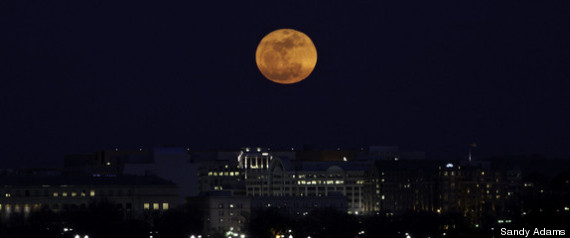
2012 The biggest full moon of the year, a so-called "supermoon," will take center stage when it rises this weekend (Saturday, May 5, at 11:35 p.m. EDT ). A supermoon occurs when the moon hits its full phase at the same time it makes closest approach to Earth for the month, a lunar milestone known as perigee. May's full moon timed with the moon's perigee could appear 14 percent bigger and 30 percent brighter than other full moons of 2012. *Huffington Post Science

BIRTHS
1580 Johann Faulhaber (5 May 1580; Ulm, Germany – 10 September 1635; Ulm, Germany) was a German mathematician.
Born in Ulm, Faulhaber was trained as a weaver. However he was taught mathematics in Ulm and showed such promise that the City appointed him city mathematician and surveyor. He opened his own school in Ulm in 1600 but he was in great demand because of his skill in fortification work. He collaborated with Johannes Kepler and Ludolph van Ceulen. Besides his work on the fortifications of cities (notably Basel and Frankfurt), Faulhaber built water wheels in his home town and geometrical instruments for the military. Faulhaber made the first publication of Henry Briggs's Logarithm in Germany.
Faulhaber's major contribution was in calculating the sums of powers of integers, what is now called Faulhaber's formula. Jacob Bernoulli makes references to Faulhaber in his Ars Conjectandi and the Bernouli numbers arise in solving coefficients of Faulhaber's formula.
In Academia Algebra Faulhaber gives ∑ nk as a polynomial in N, for k = 1, 3, 5, ... ,17. He also gives the corresponding polynomials in n. Faulhaber states that such polynomials in N exist for all k, but gave no proof. This was first proved by Jacobi in 1834. It is not known how much Jacobi was influenced by Faulhaber's work, but we do know that Jacobi owned Academia Algebra since his copy of it is now in the University of Cambridge.
At the end of Academia Algebra Faulhaber states that he has calculated polynomials for ∑ nk as far as k = 25. He gives the formulae in the form of a secret code, which was common practice at the time. Donald Knuth suggests he is the first to crack the code: (the task [of cracking the code] is relatively easy with modern computers) and shows that Faulhaber had the correct formulae up to k = 23, but his formulae for k = 24 and k = 25 appear to be wrong.
A nice example of how to calculate sum of powers using Pascal's arithmetic triangle is given at Theorem of the Day.
*SAU *Wik

1811 John William Draper (May 5, 1811 – January 4, 1882) was an American (English-born) scientist, philosopher, physician, chemist, historian and photographer. He is credited with producing the first clear photograph of a female face (1839–40) and the first detailed photograph of the Moon (1840). He was also the first president of the American Chemical Society (1876–77) and a founder of the New York University School of Medicine. One of Draper's books, History of the Conflict between Religion and Science, received worldwide recognition and was translated into several languages, but was banned by the Catholic Church. His son, Henry Draper, and his granddaughter, Antonia Maury, were astronomers, and his eldest son, John Christopher Draper, was a chemist. *Wik

1833 Lazarus Immanuel Fuchs (5 May 1833 – 26 April 1902) was a gifted analyst whose works form a bridge between the fundamental researches of Cauchy, Riemann, Abel, and Gauss and the modern theory of differential equations discovered by Poincaré, Painlevé, and Émile Picard. *SAU

1860 Charles Chree (5 May 1860 – 12 August 1928) studied in Aberdeen and Cambridge. He became Superintendent of Kew Observatory and worked on terrestrial magnetism. *SAU

1861 Peter Cooper Hewitt (May 5, 1861 – August 25, 1921) was an American electrical engineer and inventor, who invented the first mercury-vapor lamp in 1901. Hewitt was issued U.S. patent #682692 on September 17, 1901.
In 1902 Hewitt developed the mercury arc rectifier, the first rectifier which could convert alternating current power to direct current without mechanical means. It was widely used in electric railways, industry, electroplating, and high-voltage direct current (HVDC) power transmission. Although it was largely replaced by power semiconductor devices in the 1970s and 80s, it is still used in some high power applications.
In 1907 he developed and tested an early hydrofoil. In 1916, Hewitt joined Elmer Sperry to develop the Hewitt-Sperry Automatic Airplane, one of the first successful precursors of the UAV. *wik

1877 Alexander Brown (5 May 1877 in Dalkeith, near Edinburgh, Scotland - 27 Jan 1947 in Cape Town, South Africa) In 1903 Brown was appointed as Professor of Applied Mathematics in the South African College. In 1911 he married Mary Graham; they had a son and a daughter. He remained in Cape Town until his death in 1947, but his status changed in 1918 when the South African College became the University of Cape Town.
He was a member of the Edinburgh Mathematical Society, joining the Society in December 1898. He contributed papers to meetings of the Society such as On the Ratio of Incommensurables in Geometry to the meeting on Friday 9 June 1905 and Relation between the distances of a point from three vertices of a regular polygon, at the meeting on Friday 11 June 1909, communicated by D C McIntosh.
Brown was elected a Fellow of the Royal Society of South Africa in 1918, was on its Council from 1931 to 1935 and again in 1941, was its Honorary Treasurer from 1936 to 1940, and President from 1942 to 1945. Alexander Brown was elected to the Royal Society of Edinburgh on 20 May 1907. *SAU

1883 Anna Johnson Pell Wheeler (5 May 1883 in Calliope (now Hawarden), Iowa, USA - 26 March 1966 in Bryn Mawr, Pennsylvania, USA) In 1899 she entered the University of South Dakota where she showed great promise in mathematics. The professor of mathematics, Alexander Pell, recognised her talents and helped persuade Anna Johnson that she should follow a career in mathematics. She received an A.B. degree in 1903.
After winning a scholarship to study for her master's degrees at the University of Iowa, she was awarded the degree for a thesis The extension of Galois theory to linear differential equations in 1904. A second master's degree from Radcliffe was awarded in 1905 and she remained there to study under Bôcher and Osgood.
Anna Johnson was awarded the Alice Freeman Palmer Fellowship from Wellesley College to study for a year at Göttingen University. There she attended lectures by Hilbert, Klein, Minkowski, Herglotz and Schwarzschild. She worked for her doctorate at Göttingen. While there Alexander Pell, her former mathematics professor came to Göttingen so that they could marry.
After returning to the United States, where her husband was by now Dean of Engineering, she taught courses in the theory of functions and differential equations. In 1908 Anna Pell returned to Göttingen where she completed the work for her doctorate but, after a disagreement with Hilbert, she returned to Chicago, where her husband was now on the university staff, without the degree being awarded.
At Chicago she became a student of Eliakim Moore and received her Ph.D. in 1909, her thesis Biorthogonal Systems of Functions with Applications to the Theory of Integral Equations being the one written originally at Göttingen. From 1911 Anna Pell taught at Mount Holyoke College and then at Bryn Mawr from 1918. Anna Pell's husband Alexander, who was 25 years older than she was, died in 1920. In 1924 Anna Pell became head of mathematics when Scott retired, becoming a full professor in 1925.
After a short second marriage to Arthur Wheeler, during which time they lived at Princeton and she taught only part-time, her second husband died in 1932. After this Anna Wheeler returned to full time work at Bryn Mawr where Emmy Noether joined her in 1933. However Emmy Noether died in 1935. The period from 1920 until 1935 certainly must have been one with much unhappiness for Anna Wheeler since during those years her father, mother, two husbands and close friend and colleague Emmy Noether died. Anna Wheeler remained at Bryn Mawr until her retirement in 1948.
The direction of Anna Wheeler's work was much influenced by Hilbert. Under his guidance she worked on integral equations studying infinite dimensional linear spaces. This work was done in the days when functional analysis was in its infancy and much of her work has lessened in importance as it became part of the more general theory.
Perhaps the most important honour she received was becoming the first woman to give the Colloquium Lectures at the American Mathematical Society meetings in 1927.
*SAU

1897 Francesco Giacomo Tricomi (5 May 1897 – 21 November 1978)  studied differential equations which became very important in the theory of supersonic flight. *SAU

1921 Arthur Leonard Schawlow (May 5, 1921 – April 28, 1999) was an American physicist. He is best remembered for his work on lasers, for which he shared the 1981 Nobel Prize in Physics with Nicolaas Bloembergen and Kai Siegbahn.
In 1991 the NEC Corporation and the American Physical Society established a prize: the Arthur L. Schawlow Prize in Laser Science. The prize is awarded annually to "candidates who have made outstanding contributions to basic research using lasers."
In 1951, he married Aurelia Townes, younger sister to physicist Charles Hard Townes, and together they had three children; Arthur Jr., Helen, and Edith. Arthur Jr. was autistic, with very little speech ability.
Schawlow and Professor Robert Hofstadter at Stanford, who also had an autistic child, teamed up to help each other find solutions to the condition. Arthur Jr. was put in a special center for autistic individuals, and later Schawlow put together an institution to care for people with autism in Paradise, California. It was later named the Arthur Schawlow Center in 1999, shortly before his death on the 29th of April 1999.
Schawlow died of leukemia in Palo Alto, California. *Wik

1923 Cathleen Synge Morawetz (May 5, 1923; Toronto, Canada - ) is a mathematician. Morawetz's research was mainly in the study of the partial differential equations governing fluid flow, particularly those of mixed type occurring in transonic flow. She is Professor Emerita at the Courant Institute of Mathematical Sciences at the New York University, where she has also served as director from 1984 to 1988.
Morawetz's father, John Lighton Synge was an Irish mathematician, specializing in the geometry of general relativity and her mother also studied mathematics for a time. Her childhood was split between Ireland and Canada. Both her parents were supportive of her interest in mathematics and science, and it was a woman mathematician, Cecilia Krieger, who had been a family friend for many years who later encouraged Morawetz to pursue a PhD in mathematics. Morawetz says her father was influential in stimulating her interest in mathematics, but he wondered whether her studying mathematics would be wise (suggesting they might fight like the Bernoulli brothers)
In 1981, she became the first woman to deliver the Gibbs Lecture of The American Mathematical Society, and in 1982 presented an Invited Address at a meeting of the Society for Industrial and Applied Mathematics. She was named Outstanding Woman Scientist for 1993 by the Association for Women in Science. In 1995, she became the second woman elected to the office of president of the American Mathematical Society. In 1998 she was awarded the National Medal of Science; she was the first woman to receive the medal for work in mathematics. In 2004 she received the Leroy P. Steele Prize for Lifetime Achievement. In 2006 she won the George David Birkhoff Prize in Applied Mathematics. In 2012 she became a fellow of the American Mathematical Society.*Wik


DEATHS

1859 Peter Gustav Lejeune Dirichlet  (13 Feb 1805, 5 May 1859 at age 54)   is credited with the modern formal definition of a function.   After his death, Dirichlet's lectures and other results in number theory were collected, edited and published by his friend and fellow mathematician Richard Dedekind under the title Vorlesungen über Zahlentheorie (Lectures on Number Theory).  Dirichlet's brain is preserved in the department of physiology at the University of Göttingen, along with the brain of Gauss.(Wikipedia) (Dirichlet proved in 1826 that in any arithmetic progression with first term coprime to the difference there are infinitely many primes.) *SAU [Dirichlet is buried in Bartholomaus cemetery in Gottingen]


1957 Leopold Löwenheim (26 June 1878 in Krefeld, Germany  – 5 May 1957 in Berlin) was a German mathematician who worked on mathematical logic and is best-known for the Löwenheim-Skolem paradox. *SAU  [Skolem's paradox is that every countable axiomatisation of set theory in first-order logic, if it is consistent, has a model that is countable. This appears contradictory because it is possible to prove, from those same axioms, a sentence which intuitively says (or which precisely says in the standard model of the theory) that there exist sets that are not countable. Thus the seeming contradiction is that a model which is itself countable, and which contains only countable sets, satisfies the first order sentence that intuitively states "there are uncountable sets".] *Wik


1989 Stefan E Warschawski (April 18, 1904 – May 5, 1989) With careful scholarship, he made lasting contributions to the theory of complex analysis, particularly to the theory of conformal mappings. With keen judgment, he guided two mathematics departments to eminence. With modest gratitude, he cemented many friendships along the way.*SAU  [He is buried in El Camino Memorial Park, San Diego, California.]

2001Theodore Harold "Ted" Maiman (July 11, 1927 – May 5, 2007) was an American Engineer and physicist credited with the invention of the first working laser.[ Maiman’s laser led to the subsequent development of many other types of lasers.[9][10] The laser was successfully fired on May 16, 1960. In a July 7, 1960 press conference in Manhattan,[1] Maiman and his employer, Hughes Aircraft Company, announced the laser to the world. Maiman was granted a patent for his invention, and he received many awards and honors for his work. Maiman's experiences in developing the first laser and subsequent related events are described in his book, The Laser Odyssey. *Wik

Credits :
*CHM=Computer History Museum
*FFF=Kane, Famous First Facts
*NSEC= NASA Solar Eclipse Calendar
*RMAT= The Renaissance Mathematicus, Thony Christie
*SAU=St Andrews Univ. Math History
*TIA = Today in Astronomy
*TIS= Today in Science History
*VFR = V Frederick Rickey, USMA
*Wik = Wikipedia
*WM = Women of Mathematics, Grinstein & Campbell