Thursday, 21 October 2021

On This Day in Math October 21


“Martin has turned thousands of children into mathematicians, and thousands of mathematicians into children.”~Ron Graham on Martin Gardner


The 294th day of the year; 294 is a practical number because all numbers strictly less than 294 can be formed with sums of distinct divisors of 294. There are only 84 such numbers in the year.

294 is the number of planar 2-connected graphs with seven vertices.

Found this oddity in my notes: 111152- 2942 = 123,456,789

2(294)+9(294)+4(294) - 1 is 4409, a prime


EVENTS
Special for 2018. The Orionid meteor shower will reach a dazzling peak early in the morning on 22 October. The shower takes place as Earth passes through the trail of Halley's Comet ☄️  In 2021 the peak was last night, but lots of good viewing tonight as well.

1621 Kepler's Mother, Katherine, during her trial for witchcraft was shown the "instruments of torture."
"The whole case was now passed on the law faculty of the University of Tübingen, Kepler’s Alma Mater, who decided that Katharine should be taken to the hangman and shown the instruments of torture and ordered to confess. On 21st October 1621 this was duly carried out but the stubborn old lady refused to bend she said,"
“Do with me what you want. Even if you were to pull one vein after another out of my body, I would have nothing to admit.” Then she fell to her knees and said a Pater Noster. God would she said, bring the truth to light and after her death disclose that wrong and violence had been done to her. He would not take the Holy Ghost from her and would stand by her.
For more about this unusual woman, read Thony Christie's blog at *The Renaissance Mathematicus

1743 In the United States, on October 21, 1743, Benjamin Franklin tracked a hurricane for the first time. It was the first recorded instance in which the progressive movement of a storm system was recognized.

1796 The date of a still uninterpreted cryptic entry "Vicimus GEGAN"" in Gauss’s scientific diary. There is a another insertion that also remains uninterpreted. He wrote "REV. GALEN" in the diary on April 8, 1799 *VFR

*Genial Gauss Gottingen

1803 John Dalton's Atomic Theory was first presented on 21st October 1803 to the Manchester Literary and Philosophical Society of which he was President 1816-1844. *Open Plaques

1805 British Admiral Nelson defeated the combined French and Spanish fleets in the Battle of Trafalgar by adopting the tactic of breaking the enemy line in two and concentrating his firepower on a few ships (orthodox tactics had the opponents facing each other in roughly parallel lines—the “line-ahead” formation). For an analysis of why this works see David H. Nash, “Differential equations and the Battle of Trafalgar”, The College Mathematics Journal, 16(1985), 98–102. *VFR

1845 After two unsuccessful attempts to present his work in person to the Royal Astronomer Sir George Biddell Airy, John Couch Adams left a copy of his calculation regarding a hypothetical planet at the Royal Observatory. Airy criticized the work and didn’t search for the planet until later. Consequently he didn’t discover Neptune. See 23 September 1846.

1854 Florence Nightingale embarked for the Crimea on 21 October with thirty-eight nurses: ten Roman Catholic Sisters, eight Anglican Sisters of Mercy, six nurses from St. John's Institute, and fourteen from various hospitals. *Victorian Web Org

1965 Greece issued a postage stamp picturing Hipparchus and an astrolabe to commemorate the opening of the Evghenides Planetarium in Athens. [Scott #835]. *VFR

1976, the United States made a clean sweep of the Nobel Prizes, winning or sharing awards in chemistry, physics, medicine, economics, and literature. (No peace prize was awarded.)

1988 Science (pp. 374-375) reported that the 100-digit number 11104 + 1 was factored by using computers working in parallel using a quadratic sieve method. [Mathematics Magazine 62 (1989), p 70].*VFR

2011 Several people were awarded with the Ignobel Prize for mathematics for predictions about the end of the earth. Among the winners was the inappropriately named Elizabeth Clare Prophet who predicted the demise of the Earth in 1990, which most scholars on the existence of the earth dispute. *improbable.com

2015 Marty McFly and Doctor Emmet Brown "return" to this date in the future in the 1989 Sci-fi-sequel, Back to the Future II. The "future" included rocket powered skateboards... Do Razors count?


BIRTHS

1687 Nicolaus(I) Bernoulli (21 Oct 1687 in Basel, Switzerland - 29 Nov 1759 in Basel) Nicolaus Bernoulli was one of the famous Swiss family of mathematicians. He is most important for his correspondence with other mathematicians including Euler and Leibniz. *SAU (Can't tell your Bernoulli's without a scorecard? Check out "A Confusion of Bernoulli's" by the Renaissance Mathematicus.)

1823 Birthdate of Enrico Betti. In algebra, he penetrated the ideas of Galois by relating them to the work of Ruffini and Abel. In analysis, his work on elliptic functions was further developed by Weierstrass. In “Analysis situs”, his research inspired Poincar´e, who coined the term “Betti numbers” to characterize the connectivity of surfaces. *VFR He was the first to give a proof that the Galois group is closed under multiplication. Betti also wrote a pioneering memoir on topology, the study of surfaces and space. Betti did important work in theoretical physics, in particular in potential theory and elasticity.*TIS

1833 Alfred Bernhard Nobel (21 Oct 1833; 10 Dec 1896) a Swedish chemist and inventor of dynamite and other, more powerful explosives, was born in Stockholm. An explosives expert like his father, in 1866 he invented a safe and manageable form of nitroglycerin he called dynamite, and later, smokeless gunpowder and (1875) gelignite. He helped to create an industrial empire manufacturing many of his other inventions. Nobel amassed a huge fortune, much of which he left in a fund to endow the annual prizes that bear his name. First awarded in 1901, these prizes were for achievements in the areas of physics, chemistry, physiology or medicine, literature, and peace. The sixth prize, for economics, was instituted in his honour in 1969. *TIS (The well-known anecdote that there is no Nobel prize in mathematics as he thought Mittag-Leffler might win it seems to have no basis in fact

1855 Giovanni Battista Guccia (21 Oct 1855 in Palermo, Italy - 29 Oct 1914 in Palermo, Italy) Guccia's work was on geometry, in particular Cremona transformations, classification of curves and projective properties of curves. His results published in volume one of the Rendiconti del Circolo Matematico di Palermo were extended by Corrado Segre in 1888 and Castelnuovo in 1897. *SAU

1882 Harry Schultz Vandiver (21 Oct 1882 in Philadelphia, Pennsylvania, USA - 9 Jan 1973 in Austin, Texas, USA) Harry developed an antagonism towards public education and left Central High School at an early age to work as a customshouse broker for his father's firm. D H Lehmer writes:
He was self-taught in his youth and must have had little patience with secondary education since he never graduated from high school. This impatience, especially with mathematical education, was to last the rest of his life.
When he was eighteen years old he began to solve many of the number theory problems which were posed in the American Mathematical Monthly, regularly submitting solutions. In addition to solving problems, he began to pose problems himself. By 1902 he was contributing papers to the Monthly. For example he published two short papers in 1902 A Problem Connected with Mersenne's Numbers and Applications of a Theorem Regarding Circulants.
In 1904 he collaborated with Birkhoff on a paper on the prime factors of a^n - b^n published in the Annals of Mathematics. In fact the result they proved was not new, although they were not aware of the earlier work which had been published by A S Bang in 1886. Also in the year 1904, Vandiver published On Some Special Arithmetic Congruences in the American Mathematical Monthly and, although still working as an agent for his father's firm, he did attend some graduate lectures at the University of Pennsylvania. He also began reading papers on algebraic number theory and embarked on a study of the work of Kummer, in particular his contributions to solving Fermat's Last Theorem. Over the next few years he published papers such as Theory of finite algebras (1912), Note on Fermat's last theorem (1914), and Symmetric functions formed by systems of elements of a finite algebra and their connection with Fermat's quotient and Bernoulli's numbers (1917).
The outbreak of World War I in 1914 did not directly affect the United States since the Democratic president Woodrow Wilson made a declaration of neutrality. This policy was controversial but popular enough to see him re-elected in 1916. However US shipping was being disrupted (and sunk) by German submarines and, under pressure from Republicans, Wilson declared war on Germany on 6 April 1917. Vandiver joined the United States Naval Reserve and continued to serve until 1919 when the war had ended. After leaving the Naval Reserve, Birkhoff persuaded Vandiver to become a professional mathematician and to accept a post at Cornell University in 1919. Despite having no formal qualifications, his excellent publication record clearly showed his high quality and he was appointed as an instructor. He also worked during the summer with Dickson at Chicago on his classic treatise History of the Theory of Numbers. In 1924 he moved to the University of Texas where he was appointed as an Associate Professor. He spent the rest of his career at the University of Texas, being promoted to full professor in 1925, then named as distinguished professor of applied mathematics and astronomy in 1947. He continued in this role until he retired in 1966 at the age of 84. *SAU

1893 Bill Ferrar graduated from Oxford after an undergraduate career interrupted by World War I. He lectured at Bangor and Edinburgh before moving back to Oxford. He worked in college administration and eventually became Principal of Hertford College. He worked on the convergence of series. *SAU

1914 Martin Gardner born in Tulsa, Oklahoma. From 1957 to 1980 he wrote the “Mathematical Games” column in Scientific American. Many of these columns have been collected together into the numerous books that he has written. If you want to know more about the person who has done more to popularize mathematics than any other, see the interview with Gardner in Mathematical People. Proiles and Interviews (1985), edited by Donald J. Albers and G. L. Alexanderson, pp. 94–107. *VFR (My favorite tribute to Martin was this one from Ron Graham, “Martin has turned thousands of children into mathematicians, and thousands of mathematicians into children.”)


DEATHS
1872 Jacques Babinet (5 March 1794 – 21 October 1872) was a French physicist, mathematician, and astronomer who is best known for his contributions to optics. A graduate of the École Polytechnique, which he left in 1812 for the Military School at Metz, he was later a professor at the Sorbonne and at the Collège de France. In 1840, he was elected as a member of the Académie Royale des Sciences. He was also an astronomer of the Bureau des Longitudes.
Among Babinet's accomplishments are the 1827 standardization of the Ångström unit for measuring light using the red Cadmium line's wavelength, and the principle (Babinet's principle) that similar diffraction patterns are produced by two complementary screens. He was the first to suggest using wavelengths of light to standardize measurements. His idea was first used between 1960 and 1983, when a meter was defined as a wavelength of light from krypton gas.
In addition to his brilliant lectures on meteorology and optics research, Babinet was also a great promoter of science, an amusing and clever lecturer, and a brilliant, entertaining and prolific author of popular scientific articles. Unlike the majority of his contemporaries, Babinet was beloved by many for his kindly and charitable nature. He is known for the invention of polariscope and an optical goniometer. *Wik

1881 Heinrich Eduard Heine (16 March 1821 in Berlin, Germany - 21 Oct 1881 in Halle, Germany) Heine is best remembered for the Heine-Borel theorem. He was responsible for the introduction of the idea of uniform continuity.*SAU

1967 Ejnar Hertzsprung (8 Oct 1873, 21 Oct 1967) Danish astronomer who classified types of stars by relating their surface temperature (or color) to their absolute brightness. A few years later Russell illustrated this relationship graphically in what is now known as the Hertzsprung-Russell diagram, which has become fundamental to the study of stellar evolution. In 1913 he established the luminosity scale of Cepheid variable stars.*TIS

1969 WacLlaw Sierpinski (14 March 1882 in Warsaw, - 21 Oct 1969 in Warsaw) His grave carries—according to his wish—the inscription: Investigator of infinity. [Kuratowski, A Half Century of Polish Mathematics, p. 173; Works, p. 14] *VFR Sierpinski's most important work is in the area of set theory, point set topology and number theory. In set theory he made important contributions to the axiom of choice and to the continuum hypothesis. *SAU

2000 Dirk Jan Struik (30 Sept 1894 , 21 Oct 2000) Dirk Jan Struik (September 30, 1894 – October 21, 2000) was a Dutch mathematician and Marxian theoretician who spent most of his life in the United States.
In 1924, funded by a Rockefeller fellowship, Struik traveled to Rome to collaborate with the Italian mathematician Tullio Levi-Civita. It was in Rome that Struik first developed a keen interest in the history of mathematics. In 1925, thanks to an extension of his fellowship, Struik went to Göttingen to work with Richard Courant compiling Felix Klein's lectures on the history of 19th-century mathematics. He also started researching Renaissance mathematics at this time.
Struik was a steadfast Marxist. Having joined the Communist Party of the Netherlands in 1919, he remained a Party member his entire life. When asked, upon the occasion of his 100th birthday, how he managed to pen peer-reviewed journal articles at such an advanced age, Struik replied blithely that he had the "3Ms" a man needs to sustain himself: Marriage (his wife, Saly Ruth Ramler, was not alive when he turned one hundred in 1994), Mathematics, and Marxism.
It is therefore not surprising that Dirk suffered persecution during the McCarthyite era. He was accused of being a Soviet spy, a charge he vehemently denied. Invoking the First and Fifth Amendments of the U.S. Constitution, he refused to answer any of the 200 questions put forward to him during the HUAC hearing. He was suspended from teaching for five years (with full salary) by MIT in the 1950s. Struik was re-instated in 1956. He retired from MIT in 1960 as Professor Emeritus of Mathematics.
Aside from purely academic work, Struik also helped found the Journal of Science and Society, a Marxian journal on the history, sociology and development of science.
In 1950 Stuik published his Lectures on Classical Differential Geometry.
Struik's other major works include such classics as A Concise History of Mathematics, Yankee Science in the Making, The Birth of the Communist Manifesto, and A Source Book in Mathematics, 1200-1800, all of which are considered standard textbooks or references.
Struik died October 21, 2000, 21 days after celebrating his 106th birthday. *Wik

2002 Bernhard Hermann Neumann (15 Oct 1909 in Berlin, Germany - 21 Oct 2002 in Canberra, Australia) Neumann is one of the leading figures in group theory who has influenced the direction of the subject in many different ways. While still in Berlin he published his first group theory paper on the automorphism group of a free group. However his doctoral thesis at Cambridge introduced a new major area into group theory research. In his thesis he initiated the study of varieties of groups, that is classes of groups defined which are by a collection of laws which must hold when any group elements are substituted into them. *SAU


Credits :
*CHM=Computer History Museum
*FFF=Kane, Famous First Facts
*NSEC= NASA Solar Eclipse Calendar
*RMAT= The Renaissance Mathematicus, Thony Christie
*SAU=St Andrews Univ. Math History
*TIA = Today in Astronomy
*TIS= Today in Science History
*VFR = V Frederick Rickey, USMA
*Wik = Wikipedia
*WM = Women of Mathematics, Grinstein & Campbell

Tuesday, 19 October 2021

Some Comments on Several Versions of the Birthday Problem


"Happy Birthday to Me!!! ... ok, it's coming up on my birthday and I was thinking about that old birthday problem. You've probably seen it. How many people must be in a room before the probability of at least two sharing a birth date (just month and year) is greater than 1/2?. Yeah, that one.

It is one of those problems that is best attacked by answering a different question, (there seem to be a lot of those in probability) what is the probability that NO two have a common birth date. If you begin by thinking of people entering a room one at a time, and calculate the probability that no two have a common birth date, then the probability after the nth person enters is given by P(n)=P(n-1)*(366-n) /365. We are assuming a 365 day year here.. so P(1) = 1 (if you are the only one in the room, there is no match)..

Now the next guy has 364/365 probability of preserving the NO MATCH and so on for each new body.  So after three people the probability of no matches yet is \( \fract{365*364*363}{365^3}|).  After each calculation, we check to see if the probability of NO MATCH is less than 1/2, in which case the proabability of a match would be more than 1/2. It turns out that at n=23 the probability of at least one match is slightly over 1/2, about .507.

Actually, it only seems like the problem has been around forever. I saw a quote that it was created in 1932 by Richard von Mises, the Austrian born scientist whose work spans several areas of engineering science, however, the earliest citation I can find is " Mises, R. von. "Über Aufteilungs--und Besetzungs-Wahrscheinlichkeiten." Revue de la Faculté des Sciences de l'Université d'Istanbul, N. S. 4, 145-163, 1939.", so you decide which is right.

After you play with that for a little while, you might want to tackle one of several different variations, that can take it well beyond a high school classroom exercise. For example, the classical problem ask for when there is at least one match, but if you ask for the number so that the probability is 1/2 of exactly one matched pair, it gets a little tougher (OK, a lot tougher). With modern technology, it can be examined by students without some of the formal probability training if they are good at simulations. I gave this problem to one class and asked them to describe a way to simulate the event using a graphing calculator. The best answer I got was this one: a) Put n (for example 23) random integers from 1 to 365 in a list 1. b) sort the list in ascending order c) copy this list 2 and then replace the last number with zero and resort just this list (effectivly this moves the zero to the top and each number down one in the list from its natural position). d) Now do a logical L1=L2 store L3. This produces a list of ones when the n th term in the list is equal to the n+1 st term, ie, for each match. Sum this list to get the number of matches. e) repeat like crazy.

I thought it was a great way to solve it, although if you have Fathom or other good statistical software for simulations, it can be done much easier, but sometimes the software hides some of the understanding in the early stages of learning simulations. When I tried it (with Fathom) and using 23 for the sample size, and 5000 trials of the experiment, there were no matches in 2431 or 48.6% of them, there was exactly one match in 1829 or 36.6% of them, and to my surprise, there were 604 or 12% that had either two separate matches, or three of a kind.... and if you do the arithmetic, that leaves another 136 or almost 3% that had multiple matches beyond these (I used the unique value function of the program so I only knew there were less than 21 unique numbers in those cases). With the student method, adjacent ones on the third list would identify triplets etc, while seperated ones would indicate multiple pairs.

A couple of examples you might want to explore, and I will try to get back to solutions if they are not submitted sooner:
1) What happens to the birthday problem if you switch to a different number of days in the year (say 400 or 1000) or what if we use weeks or months... in short, is there a general formula for the number of people to reach the p=1/2 that there is at least one match.

2) what is the number of people needed to make the probability that EVERYONE has a match equal to or greater than 1/2?

3) and what if we only wanted to have two people who came close. What is the number of people that must be present to make the probability that at least two have birthdays no more than one day apart?

4) and finally, back to the original problem, suppose a group (several hundred) are entering an auditorium, and you know that the first person to enter having a birthday that matches someone already inside will win a prize. Ok, you know not to go first, and if you go too late, it will already be gone.... so where in the line do you insert yourself to have the highest probability of being the first to enter and have a birthday match in the room?
More on all of these later..good luck, and have fun..

Tuesday, 28 September 2021

Joost Burgi"s Arithmetical Method of Producing complete Sine Tables

From the time of Menelaus and Ptolemy, the tables of chords (or sines) were found by dividing the circle by inscribing regular polygons to find one chord, and then using methods to subdivide that chord into smaller (usualy half) chords. But this method did not provide some exact sines geometrically for all angles, only those that could be expressed as \(\frac{3m}{2^n}\) degrees. One degree, for example could not be found by this method. Regiomontanus knew that 3/4 degree was already established to significant accuracy, so he found upper and lower limits on the value of one degree by approximation. his upper limit for \( sin 1^o\) he used the fact that the sine rate of growth grew smaller by each equal increase of arc, allowing him to conclude that \( sin 1^o \) must be less than 4/3 of the value of the sine of 3/4 of a degree.

Others attacked the problem with creative algebra. Around 1400 the Persian mathematician astrologer, Al-Kashi, produced a very accurate approximation for \(Sin(1^o) \) by equating the trisection of an angle sine to a cubic equation ( \(sin(3x(=3sin x -4 Sin^3 x\) ) and using an approach similar to Newton's Method. Both Viete and Henry Briggs would do a similar approach in the 1th and 16th century, but probably without knowing of al-Kashi, since little of his work was translated in the west.

But all of these methods began from the geometric approach and worked to produce a single chord length or sine value. Imagine if someone could come up with a direct method using only simple arithmetic to produce a complete table of sines from zero to 90^o.

 On 22 July of 1588, such a method was delivered to the emperor Rudolph II by Joost Burgi. Later I will provide sources (one book, one paper) to give more about the explanation of his method, but since the method was lost until the 21st Century, and is still, I believe, little known; I want to first startle you with its simplicity and accuracy.

My exploration began when the author of the book I first learned of this method in commented that Burgi had began with a column on numbers that were rough estimates of the sine values of the sines from 0^o t0 90^o in ten degree increments, the whispered the challenge in print, "although any column of numbers whatever would do here". OH, Ho, Challenge Accepted.

Burgi's method was to divide 90^o into any number, n, of equal arcs and write n+1 numbers in a row. Being Lazy I chose 0, 30, 60, and 90, degrees, and since his method has a divide by two step, I started with the even numbers from 0 to 4. Burgi's method worked in columns from left to right but I will use rows from top to bottom with the sequential approximations improving with each pass. 0^o --------------- 30^o------------- 60^o-----------90 >br>
0 ----------------- 2---------------- 4-------------6

This Last value in each column serves as the sinus totus, or radius (hypotenuse) of the ratio
For the next step we walk across writing between the previous columns and beginning with 1/2 the right most number and adding the column above at each step as we walk back to the left.

0^o --------------- 30^o------------- 60^o-----------90

0 ----------------- 2---------------- 4-------------6

---------9-------------------7-----------------3

Now we go back from left to right beginning with a zero and adding as we go along.

0^o --------------- 30^o------------- 60^o-----------90 >br>
0 ----------------- 2---------------- 4-------------6

---------9-------------------7-----------------3

0--------------------9-----------------16-------------19

Notice after one cycle the ratio of the 30^o value, 9, over the radius, 19, already gives .473.. for sin 30^o


0^o --------------- 30^o------------- 60^o-----------90 >br>
0 ----------------- 2---------------- 4-------------6

---------9-------------------7-----------------3

0--------------------9-----------------16-------------19

---------35---------------------26-------------10--------

0--------------------35----------------61-------------71---

Now the Sin(30) is .492, and the sin(60) is .859. let's try one more pass

0^o --------------- 30^o------------- 60^o-----------90 >br>
0 ----------------- 2---------------- 4-------------6

---------9-------------------7-----------------3

0--------------------9-----------------16-------------19

---------35---------------------26-------------10--------

0--------------------35----------------61-------------71---

----------132-----------------97---------------36----------

0------------------132-----------------229------------265--

At this point the Sin(30) is accurate to less than .002, and sin(60) is about the same. Take it out two more steps on your own and be amazed at the precision.
Next, I pushed the "any number we are whatever," to another level. I used 0, 30, 60, and 90 Sin(60^o) = 229,26 = again, but I started with a zero and three ones. after five passes my column was 0, 571, 989, and 1142. thus produces an estimate of sin(30^o) = 571/1142 or exactly .5, and the Sin(60^o)=989/1142 =.866024518, which seems incredible for so little effort and so casual an initial choice of values. From the ARXIV link below, here is Burgi's illustration of the method, which seems to be in sexagesimal numbers. In The Doctrine of Triangles by Glenn Van Brummelem, the same chart appears on page 70 in decimals.
REF: The Doctrine of Triangles, Glenn Van Brummelen Pgs 19-20, and 69-71.

https://arxiv.org/pdf/110.03180
Jamshid al-Kashi Wikipedia

Tuesday, 29 June 2021

On This Day in Math - June 29


Jeannie, Happy birthday.

The 180th day of the year; 180 can be formed with the only the first two primes... 180 = 22 x 32 x (2+3) *Prime Curios

180 is the sum of two square numbers: \( 12^2 + 6^2 \). It can also be expressed as either the sum of six consecutive primes: 19 + 23 + 29 + 31 + 37 + 41, or the sum of eight consecutive primes: 11 + 13 + 17 + 19 + 23 + 29 + 31 + 37.

Beautiful trigonometry, arctan1 + arctan2 + arctan3 = pi/2 =180o

More Math Facts for every year day here.


EVENTS

In 3123 BC, a Sumerian astronomer saw a devastating asteroid, perhaps a half-mile wide, according to an interpretation of a clay tablet, made by researchers from Bristol University, reported in The Times on 31 Mar 2008. The ancient date was indicated by a computer recreation of the night sky using symbols on the tablet recording the positions of constellations The Planiform tablet found by Henry Layard at Nineveh, likely a 700 BC copy of the astronomer's notes, described in cuneiform a "white stone bowl approaching" that "vigorously swept along." The asteroid probably crashed into the Austrian Alps, leaving a swath of cataclysmic damage such as, for example, the Genesis destruction of Sodom and Gomorrah.*TIS

1456 According to one story that first appeared in a 1475 posthumous biography and was subsequently embellished and popularized by Pierre-Simon Laplace, Callixtus III excommunicated the 1456 apparition of Halley's Comet, believing it to be an ill omen for the Christian defenders of Belgrade from the besieging armies of the Ottoman Empire. No known primary source supports the authenticity of this account. The 29 June 1456 papal bull of Callixtus III calling for a public prayer for the success of the crusade, makes no mention of the comet. By 6 August, when the Turkish siege was broken the comet had not been visible in either Europe or Turkey for several weeks. *Wik

(John Francis Rigaud, 1785)*Wik
1785 Letitia Ann Sage became the first British woman to fly. From St George's Fields on the south side of the Thames, Vincenzo Lunardi and his partner Biggin, with two invitees, Mrs. Sage and a Colonel Hastings were supposed to make the flight, but the Hydrogen balloon wouldn't take off because of the weight. (Mrs Sage, a actress and model was also a somewhat large woman, rumored to weigh appx 200 pounds.)  Lunardi and Hastings stepped down, and the balloon took off with Biggin and Mrs. Sage. It landed 90 minutes later, near Harrow, where the two aeronauts had to be rescued by a group of boys from Harrow School from the angry farmer whose crops were damaged. *Wik (There were even suggestions that rather more amorous events had occurred in the flight.)

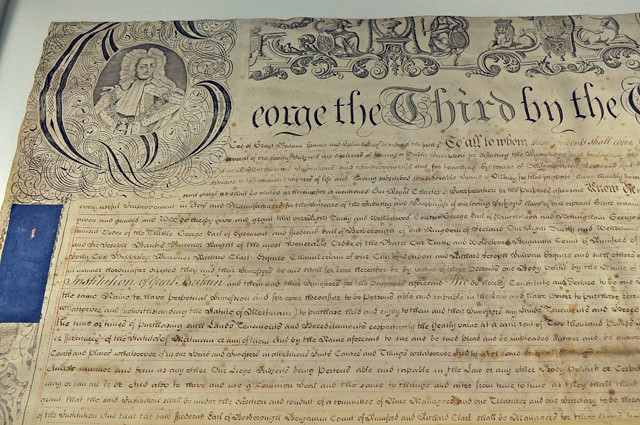
1799 The Royal Charter for the Royal Institute is promised. Ever since its founding year the Royal Institution has maintained close links with the Royal Family. On 29 June 1799, George Finch, Earl of Winchilsea (1752-1826), the President of what had until then had been called simply the “Institution” reported to a meeting of its committee of Managers ‘that he had had the Honour of mentioning this Institution to his Majesty [George III], and that his Majesty was graciously pleased to honour it with His Patronage and to allow it to be called the Royal Institution’. The actual charter was presented on January 13 in 1800. *Royal Institute web page

1803 An open letter to the public, and the Congress of the United States on the topic "Of The Construction of Iron Bridges" is posted by Thomas Paine. Paine had discussed this work with President Jefferson in a letter while he was in England. *The National Intelligencer and Washington Advertiser, (Washington, DC) Wednesday, June 29, 1803; Issue CCCCXIX;

1877 After proving that the points in a square can be put in one-to-one correspondence with the points on a line segment Cantor wrote his friend Dedekind “Je le vois, mais je ne le crois pas.” (I see it, but I don’t believe it.) [Dauben, Georg Cantor, p. 55]*VFR

1927 Gellivara 1073: Minor planet discovered September 14, 1923 by Johann Palisa at Vienna. Named for the small town  Gällivare in Swedish Lapland where in the year 1927 astronomers from several countries observed the Total Solar Eclipse of 1927 Named by the astronomer J. Rheden and endorsed by Anna Palisa.*NSEC
A Poster advertising viewing of Solar Eclipse from London, Midland, and Scotland Railway *GreatAmericanEclipse ‏@AmericanEclipse

In 1954, the Atomic Energy Commission, by a vote of 4 to1 decided against reinstating Dr. J. Robert Oppenheimer's access to classified information. The Atomic Energy Act of 1946 required consideration of  "the character, associations, and loyalty" of the individuals engaged in the work of the Commission. Substantial defects of character and imprudent and dangerous associations, particularly with known subversives who place the interests of foreign powers above those of the United States, were considered reasons for disqualification. The Commission regarded his associations with persons known to him to be Communists exceeded tolerable limits of prudence and self-restraint, and lasted too long to be justified as merely the intermittent and accidental revival of earlier friendships.*TIS

1956 The interstate highway system was signed into law by President Eisenhower. Even (odd) num­bered roads run East–West (North–South) with the numbers increasing from South to North (West to East). Roads with three digit numbers are loops around cities (when the first digit is even) or spurs (first digit odd); In either case the last two digits are the main road number.  *VFR
Eisenhower had seen the speed and efficiency in moving troops and equipment on the four-lane autobahns in Germany during WW II. The idea of federal support of interstate limited-access routes in the U.S. had begun with a study under the Federal-Aid Highway Act of 1938. Little progress was made on building these roads while federal funding was low. When the Federal-Aid Highway Act of 1956 committed federal funds to the States for 90% of the cost, construction began in earnest for the System of Interstate and Defense Highways having at least four lanes with no at-grade railroad crossings. *TIS

2016 - My Jeannie is celebrating her birthday today, and I'm celebrating having her in my life... all the good I ever do is a reflection of a single sun.


BIRTHS

1716 Joseph Stepling, (29 June 1716 in Regensburg; 11 July 1778 in Prague) His fields included astronomy, physics and mathematics. At the age of 17 he documented with great accuracy the 1733 lunar eclipse. Later Euler was among his long list of correspondents. He transposed Aristotelian logic into formulas, thus becoming an early precursor of modern logic. already adopted the atomistic conception of matter he radically refused to accept Aristotelian metaphysics and natural philosophy. In 1748, at the request of the Berlin Academy, he carried out an exact observation of a solar and lunar eclipse in order to determine the precise location of Prague. During Stepling's long tenure at Prague, he set up a laboratory for experimental physics and in 1751 built an observatory, the instruments and fittings of which he brought up to the latest scientific standard.
Even though he passed up a professorship in philosophy in favor of a chair in mathematics, Empress Maria Theresa appointed him director of the faculty of philosophy at Prague as part of the reform of higher education. He was very interested in cultivating the exact sciences and founded a society for the study of science modeled on the Royal Society of London. In their monthly sessions. over which he presided until his death, the group carried out research work and investigations in the field of pure mathematics and its appiication to physics and astronomy. A great number of treatises of this academy were published.
Stepling corresponded with the outstanding contemporary mathematicians and astronomers: Christian Wolf. Leonhard Euler. Christopher Maire, Nicolas-Louis de Lacaille, Maximilian Heli, Joseph Franz, Rudjer Boskovic, Heinrich Hiss, and others. Also, Stepling was particularly successful in educating many outstanding scientists, including Johann Wendlingen, Jakob Heinisch, Johannes von Herberstein, Kaspar Sagner, Stephan Schmidt, Johann Korber, and Joseph Bergmann. After his death, Maria Theresia ordered a monument erected in the library of the University of Prague *Joseph MacDonnell, Fairfield Univ web page

1818 Pietro Angelo Secchi (29 June 1818 – 26 February 1878) Italian Jesuit priest and astrophysicist, who made the first survey of the spectra of over 4000 stars and suggested that stars be classified according to their spectral type. He studied the planets, especially Jupiter, which he discovered was composed of gasses. Secchi studied the dark lines which join the two hemispheres of Mars; he called them canals as if they where the works of living beings. (These studies were later continued by Schiaparelli.) Beyond astronomy, his interests ranged from archaeology to geodesy, from geophysics to meteorology. He also invented a meteorograph, an automated device for recording barometric pressure, temperature, wind direction and velocity, and rainfall. *TIS

1868 George Ellery Hale (June 29, 1868 – February 21, 1938) born. American astronomer known for his development of important astronomical instruments. To expand solar observations and promote astrophysical studies he founded Mt. Wilson Observatory (Dec 1904). He discovered that sunspots were regions of relatively low temperatures and high magnetic fields. Hale hired Harlow Shapley and Edwin Hubble as soon as they finished their doctorates, and he encouraged research in galactic and extragalactic astronomy as well as solar and stellar astrophysics. Hale planned and tirelessly raised funds for the 200" reflecting telescope at the Palomar Mountain Observatory completed in 1948, after his death, and named for him - the Hale telescope.*TIS

1893 Prasanta Chandra Mahalanobis FRS[1] (29 June 1893 – 28 June 1972) was an Indian scientist and applied statistician. He is best remembered for the Mahalanobis distance, (a statistical measure of the distance between a point P and a distribution D, - a multi-dimensional generalization of the idea of measuring how many standard deviations away P is from the mean of D. ) and for being one of the members of the first Planning commission of free india. He made pioneering studies in anthropometry in India. He founded the Indian Statistical Institute, and contributed to the design of large-scale sample surveys *Wik

1893 Eduard Cech, (June 29, 1893 – March 15, 1960) Czech topologist born in Stračov, Bohemia (then Austria-Hungary, now Czech Republic). His research interests included projective differential geometry and topology. In 1921–1922 he collaborated with Guido Fubini in Turin. He died in Prague. *Wik

1904 Topologist Witold Hurewicz (June 29, 1904 - September 6, 1956) born. Hurewicz is best remembered for two remarkable contributions to mathematics, his discovery of the higher homotopy groups in 1935-36, and his discovery of exact sequences in 1941. His work led to homological algebra. It was during Hurewicz's time as Brouwer's assistant in Amsterdam that he did the work on the higher homotopy groups; "...the idea was not new, but until Hurewicz nobody had pursued it as it should have been. Investigators did not expect much new information from groups, which were obviously commutative...". *Wik He died in 1956 when he fell off a pyramid while attending a conference in Mexico.

1942 K. Jon Barwise (June 29, 1942 – March 5, 2000) an American mathematician, philosopher and logician who proposed some fundamental revisions to the way that logic is understood and used.*Wik


DEATHS

1895 T(homas) H(enry) Huxley (4 May 1825 – 29 June 1895) was an English biologist , known as "Darwin's Bulldog" for his promotion of Darwinism which led him to an advocacy of agnosticism (a word he coined). At the age of 12 he was reading advanced works on geology, and by early adolescence he recorded the results of simple self-conducted experiments. As a ship's assistant surgeon on HMS Rattlesnake he studied marine specimens by microscope. During the 1850's he published papers on animal individuality, the cephalous mollusks (ex. squids), the methods of paleontology, and the methods and principles of science and science education. *TIS

1924 Robert Simpson Woodward (July 21, 1849–June 29, 1924) was an American physicist and mathematician, born at Rochester, Michigan. He graduated C.E. at the University of Michigan in 1872 and was appointed assistant engineer on the United States Lake Survey. In 1882 he became assistant astronomer for the United States Transit of Venus Commission. In 1884 he became astronomer to the United States Geological Survey, serving until 1890, when he became assistant in the United States Coast and Geodetic Survey. In 1893 he was called to Columbia as professor of mechanics and subsequently became professor of mathematical physics as well. He was dean of the faculty of pure science at Columbia from 1895 to 1905, when he became president of the Carnegie Institution of Washington, whose reputation and usefulness as a means of furthering scientific research was widely extended under his direction. He was elected to the National Academy of Sciences in 1896. In 1898-1900 he was president of the American Mathematical Society, and in 1900 president of the American Association for the Advancement of Science. In 1915 he was appointed to the Naval Consulting Board. He died in 1924 in Washington, D.C.*Wik


Credits
*CHM=Computer History Museum
*FFF=Kane, Famous First Facts
*NSEC= NASA Solar Eclipse Calendar
*RMAT= The Renaissance Mathematicus, Thony Christie
*SAU=St Andrews Univ. Math History
*TIA = Today in Astronomy
*TIS= Today in Science History
*VFR = V Frederick Rickey, USMA
*Wik = Wikipedia
*WM = Women of Mathematics, Grinstein & Campbell