Tuesday, 8 August 2023

Not All Math Symbols are Equal, or How "=" Became Ubiquitous

 Another from the Archives:2008


I have a friend named Dave Refro who writes and edits questions for one of those high stakes tests that is used for admission into certain graduate programs and uses his job as an excuse for his fascination with archiving old math journal articles. Some folks garden, Dave archives. He spends hours pouring through journals and abstracts and fits together articles with a common theme. If you read almost any math discussion on line, you will probably have come across one of Dave's responses to a question with numerous links to how the question was addressed, discussed, and argued over through history.
Fortunately for me, Dave sometimes finds an article that he thinks might be of interest to me, and when he gets a stack of them, I get a big present in the mail and my wife knows I will be taking my meals in the den for a few days. In a stack of journal articles he sent recently, (THANKS Dave!) there was one particularly interesting article by Florian Cajori from 1923. In the article Cajori points out two interesting things about the equal sign that every one uses; and that is one of the interesting things he points out, is that EVERYONE uses it. Even in 1923, it was one of the most ubiquitous math symbols in the world and today there are still only about four math symbols that you could write and they would not only be understood, but written exactly the same way whether you found yourself in darkest Africa, the Far East, or downtown Los Angeles. It seems like the perfect symbol, and as Robert Recorde said when he created the symbol in 1557 in his "Whetstone of Witte", the use of "a pair of paralleles, or Gemowe(twin, from the same root as Gemini) lines of one length ... bicause noe 2 thynges can be moare equalle." In fact, Recorde's equal sign had much longer lines than is common today, sort of like == but longer.


Indeed, one wonders why it hadn't been thought of years before, and assume that it immediately became the most common of mathematical notations....ahhh, but not so. The other thing Cajori commented on that I think would surprise young students is that it took over a hundred years for the symbol to become accepted. So what symbol did mathematicians use before the good old == signs? Well, many of them used nothing. The early development of algebra occurred with a very rhetorical approach. When people wanted to write 7x+5 = 26, they would say," the product of seven and some quantity when added to five will equal twenty-six." Ok, they probably said it in Latin, and sometimes they did write numbers in place of the words for numbers, but for equals, they often wrote out the Latin aequales or some variation of it. Frequently they used abbreviations instead of full words and so "p" would stand for plus and "m" for minus...and they would shorten aequales as "aeq" or just "ae". By the time that Recorde had his inspirational stroke, lots of other people had decided THEY had a really good symbol. A pair of vertical lines, ||, was used by Xylander (Wilhelm Holzman) in his translation of Diophantus, Arithmetica only a few years later, and Regiomontanus had used a single horizontal line for equality almost a century earlier. Descartes used the symbol below in his Geometrie, which was probably drawn from the "ae" abbreviation for aequalis. and Johann Caramuel used equal lines where we would use a decimal point, so Pi would be 3==1415 etc.


 Descartes symbol became a popular competitor on the continent, finding favor with Huygens and the Bernoulli's, while many of the he English mathematicians, Wallis, Barrow, and Newton, followed Recorde's lead. Others used the "gemowe" lines of Recorde for other meanings, Descartes used it to mean +/- in his

So what brought the divided world into a common accord? It took a brand new idea, a revolutionary idea, the calculus. As if by divine providence, the two great minds that created the calculus, almost in unison, tended to publish their versions with a common symbol for equality, Recorde's "gemowe" lines. They disagreed on almost every other symbol they used, but in the last half of the 1600's and the early 1700's the = sign rose to world dominance. In Cajori's words, "The fact that both Newton and Leibniz used Recorde's symbol led to its general adoption."
If you can get your students to understand how long and difficult it is to get mathematicians to accept a symbol, perhaps they will not be too surprised if their College Prof goes into a rant when they use the symbol "ln" for the natural log... and if they accept that the symbol exists (honest, they don't all accept it's use), I can't begin to imagine how they will react if you pronounce it differently than they would. My advice to students; wait for them to say it first!

Friday, 4 August 2023

Politics and math, A Drama in Four Parts

  Politics and math

I received a nice e-mail from Dan MacKinnon, a Canadian math/computer teacher (who writes a nice recreational math blog)  after my blog about Karl Marx and Mathematics.  
He wrote:
I enjoyed your short post on Karl Marx's mathematics.
I first heard about Marx's mathematical work when I was a student at Dalhousie University in Halifax. While I was there, I heard a story that that back in 1970 a prof there was pushed out by the admin because he was using Marx's stuff as the basis for a course he was teaching on Real Analysis. I wish I knew the whole story - what made it more interesting was that the prof was F.W. Lawvere (pretty famous Category Theorist) and he was pushed out during the October Crisis (a terrorist incident in Montreal, 1970), which was used as a pretext to get rid of a number of radicals and undesirables in a lot of Canadian institutions.   [MY INSERT- I have found online that  “Dalhousie University in 1969 set up a group of 15 Killam-supported researchers with Lawvere at the head; but in 1971 it terminated the group. Lawvere was controversial for his political opinions, for example, his opposition to the 1970 use of the War Measures Act, and for teaching the history of mathematics without permission. (?boy they could lock me up any day?) But in 1995 Dalhousie hosted the celebration of 50 years of category theory with Lawvere and Saunders Mac Lane present.”   Not sure how long it took to be “pushed out”.]
In connection with this this story, I was told that politics and mathematics go together surprisingly often. In the early days of Category Theory, this area of mathematics was perceived as "leftist" - even Saunders Mac Lane's famous book, "Categories for the Working Mathematician" used "working" with a slightly political nuance. I was also told that while category theorists were perceived as progressives, set-theorists were perceived as reactionaries. I have no idea whether or not these supposed political distinctions among mathematicians is true today, or if they were ever true.


I got a  note from Dan McKinnon after I had written this commenting on another reader, Kevin's,  comment that, " I think the early term was "general abstract nonsense" which may still apply in my limited understanding."  Prof. McKinnon's response was, " ..my understanding is that many Category Theorists don't mind the term "abstract nonsense" and have appropriated it somewhat. While at the chalkboard and carrying out some "routine" diagram pasting they'll say "and now by the usual abstract nonsense we get the result..."


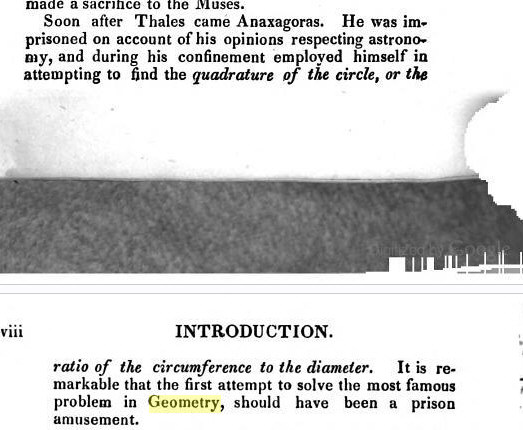
Mathematicians getting in trouble because of their political/religious views is not a new idea... as I found in this old cut from the introduction to a geometry textbook.. In this case, one might suggest that bad politics lead to good math.  

And one of my favorite math stories is  from George Gamow's autobiography and is about the Nobel Laureate, Igor Tamm.
 "Here is a story told to me by one of my friends who was at that time

a young professor of physics in Odessa. His name was Igor Tamm (Nobel
Prize laureate in Physics, 1958). Once when he arrived in a neighboring
village, at that period when Odessa was occupied by the Reds, and was
negotiating with a villager as to how many chickens he could get for
half a dozen silver spoons, the village was captured by one of the
Makhno bands, who were roaming the country, harassing the Reds. Seeing
his city clothes (or what was left of them), the capturers [sic]
brought him to the Ataman, a bearded fellow in a tall black fur
hat with machine-gun cartridge ribbons crossed on his broad chest and
a couple of hand grenades hanging on the belt.
'You son-of-a-bitch, you Communist agitator, undermining our Mother
Ukraine! The punishment is death.'
'But no,' answered Tamm, 'I am a professor at the University of Odessa
and have come here only to get some food.'
'Rubbish!' retorted the leader. 'What kind of professor are you ?'
'I teach mathematics.'
'Mathematics?' said the Ataman. 'All right! Then give me an estimate of
the error one makes by cutting off Maclaurin's series at the nth term.
Do this, and you will go free. Fail, and you will be shot!'
Tamm could not believe his ears, since this problem belongs to a rather
special branch of higher mathematics. With a shaking hand, and under
the muzzle of the gun, he managed to work out the solution and handed
it to the Ataman.
'Correct!' said the Ataman. 'Now I see that you really are a professor.
Go home!'
Who was this man? No one will ever know. If he was not killed later, he
may well be lecturing now on higher mathematics in some Ukrainian
university."
I tell this story every other year or so to my physics students when
they cannot be bothered to remember the form of the remainder in Taylor
expansions...."
-----------------------
I recently had occasion to learn of a fourth incident I wanted to include....

 In 1922 Issai Schur was elected to the Prussian Academy, proposed by Planck, the secretary of the Academy. Planck's address which listed Schur's outstanding achievements had been written by Frobenius, at least five years earlier, as Frobenius died in 1917. 

On 29 March 1938 Bieberbach wrote below Schur's signature on a document of the Prussian Academy:- "I find it surprising that Jews are still members of academic commissions."

Just over a week later, on 7 April 1938, Schur resigned from Commissions of the Academy. However, the pressure on him continued and later that year he resigned completely from the Academy. Schur left Germany for Palestine in 1939, broken in mind and body, having the final humiliation of being forced to find a sponsor to pay the 'Reichs flight tax' to allow him to leave Germany. Without sufficient funds to live in Palestine he was forced to sell his beloved academic books to the Institute for Advanced Study in Princeton. He died two years later on his 66th birthday.

Only five years earlier  "On 7 April 1933 the Nazis passed a law which, under clause three, ordered the retirement of civil servants who were not of Aryan descent, with exemptions for participants in World War I and pre-war officials. Schur had held an appointment before World War I which should have qualified him as a civil servant, but the facts were not allowed to get in the way, and he was 'retired'. M M Schiffer wrote :-When Schur's lectures were cancelled there was an outcry among the students and professors, for Schur was respected and very well liked. The next day Erhard Schmidt started his lecture with a protest against this dismissal and even Bieberbach, who later made himself a shameful reputation as a Nazi, came out in Schur's defence. Schur went on quietly with his work on algebra at home."  #SAU

----------------------------
Just one more, a famous one that many already have heard.  AndrĂ© Weil, renowned for the breadth and quality of his research output, its influence on future work, and the elegance of his exposition, was also once imprisoned.. 
To avoid the draft, he went to Finland. ''As a soldier,'' he said, ''I would be entirely useless, but as a mathematician I could be of some use.'' The Finns returned him to the French, who imprisoned him for six months. In prison, he created the Riemann hypothesis -- named for a German mathematician -- which became a basic element of number theory and is regarded as one of his most insightful mathematical achievements, .


-----------------------------------

I imagine that as long as you do math, or teach math  (or just teach) in a public environment, we will be subject to political influences. From the John Scopes Monkey Trial in Tennessee in 1925, to the current educational turmoil in the US in 2023, history reaffirms this constancy.  I’m not sure it is always bad..... but....

Wednesday, 2 August 2023

The Mathematics of Karl Marx


 Jan 31, is the birth date of Sofya Yanovskaya, who was Professor of Mathematics at Moscow State University. She received the prized Order of Lenin in 1951 and in 1959 she became the first chairperson of the newly created department of mathematical logic at Moscow State University. Wikipedia describes her as, "a mathematician and historian, specializing in the history of mathematics, mathematical logic, and philosophy of mathematics. She is best known for her efforts of restoring mathematical logic research in the USSR and publishing and editing mathematical works of Karl Marx." [emphasis added].
Go on, admit it, you didn't know Karl Marx did math did you... yeah, me neither. But it seems his math impacted on the study of math in China much later, and even has an effect on math study there today.

Here is the impact as described by Joseph W. Dauben


Title: Marx, Mao and Mathematics: The Politics of Infinitesimals

The ``Mathematical Manuscripts'' of Karl Marx were first published (in part) in Russian in 1933, along with an analysis by S.~A. Yanovskaya. Friedrich Engels was the first to call attention to the existence of these manuscripts in the preface to his Anti-D\"uhring [1885]. A more definitive edition of the ``Manuscripts'' was eventually published, under the direction of Yanovskaya, in 1968, and subsequently numerous translations have also appeared. Marx was interested in mathematics primarily because of its relation to his ideas on political economy, but he also saw the idea of variable magnitude as directly related to dialectical processes in nature. He regarded questions about the foundations of the differential calculus as a ``touchstone of the application of the method of materialist dialectics to mathematics.'' Nearly a century later, Chinese mathematicians explicitly linked Marxist ideology and the foundations of mathematics through a new program interpreting calculus in terms of nonstandard analysis. During the Cultural Revolution (1966--1976), mathematics was suspect for being too abstract, aloof from the concerns of the common man and the struggle to meet the basic needs of daily life in a still largely agrarian society. But during the Cultural Revolution, when Chinese mathematicians discovered the mathematical manuscripts of Karl Marx, these seemed to offer fresh grounds for justifying abstract mathematics, especially concern for foundations and critical evaluation of the calculus. At least one study group in the Department of Mathematics at Chekiang Teachers College issued its own account of ``The Brilliant Victory of Dialectics - Notes on Studying Marx's `Mathematical Manuscripts'.'' Inspired by nonstandard analysis, introduced by Abraham Robinson only a few years previously, some Chinese mathematicians adapted the model Marx had laid down a century earlier in analyzing the calculus, and especially the nature of infinitesimals in mathematics, from a Marxist perspective. But they did so with new technical tools available thanks to Robinson but unknown to Marx when he began to study the calculus in the 1860s. As a result, considerable interest in nonstandard analysis has developed subsequently in China, and almost immediately after the Cultural Revolution was officially over in 1976, the first all-China conference on nonstandard analysis was held in Xinxiang, Henan Province, in 1978.


In a JSROR article by Dirk J Struik in 1948 I found this: 


 and this   


Tuesday, 1 August 2023

Alternating Sets against Two Better Opponents


From my 2008 archive, while writing to avoid grading finals. Many examples of this paradox involve duels and death, so I share this with a Tennis example, because I'm all about love.... (ALL my students would agree).


Trying to avoid actually grading semester exams, I was playing around with a problem from F. Mosteller's classic, "Fifty Challenging Problems in Probability." Problem two concerns a three-set tennis match in which the player, a youth named Elmer, will alternately play against his father and the club pro, given the club pro is a better player than the father. He will win a prize if he can win two consecutive matches of the three. The question is whether he is better of playing the sequence father-pro-father or pro-father-pro.
The counter-intuitive part is that his odds of winning are better if he plays the better player, the pro, more often. (This reminds me of Parrondo's paradox, which I will try to write about some day) Here is a simple explanation (I hope). If we let f represent the probability he wins against his father, and p the probability he beats the pro, then to get two consecutive wins, he must win the first two or the last two, so we need the probability win, win added to the probability of Lose, win, win.


For the sequence father-pro-father the probability of success is fp + (1-f)pf. We can distribute the 1-f to get fp + fp - fpf, and factoring fp out of each term we get fp(2-f).


If we do the same with the sequence pro-father-pro we just interchange the p and f to get pf(2-p). Now since we are given that p is smaller than f (he is LESS likely to beat the better player) we see that 2-p must be larger than 2-f, and so the pf(2-p) is the higher probability.


The advantage when actually calculated is very small. For example, If the probability of beating his father is .4, and the probability of beating the pro is .2, his probability of winning in the father-pro-father sequence is about .128 . By switching the order to play pro-father-pro his probability of success increases to .144(which is twice what it would be if he only played a three set match against the pro).
What happens if we change these probabilities of success, but keeping the order so that the pro is better than the father? 

Letting p remain at .2 and raising his level against his father to .5 improves his chance of success to 18%. In fact, if we substitute the value .2 into the expression pf(2-p) we get .2f(1.8).... the probability of success is a linear equation, .36f. If we let his probability against his father go to one, you can see that the has a 36% chance of winning if he goes Pro-father-pro. But if you look at the other sequence, fp(2-f), and again substitute in the .2 value against the pro, the equation is quadratic, .4 f - .2f2.


Notice the pro-father-pro probability (green) intersects the father-pro-father probability (red) at (0,0) and (.07ish) .  This is the region when beating dad is less likely than beating the pro.  At father =.2, the probability of any order is like playing all three games against the pro, (or the dad  at this point since both have the same probability of beating him.


 Visualizing the graph of this negative quadratic, we can see that he vertex will occur when f= 1, so that is the maximum, and when f=1 we get a probability of success of .2, exactly what his probability against the pro in a single game would be. This makes sense if you consider that if he ALWAYS beats his dad, the match really depends on the one game in the middle against the pro.


How would a fourth game alter the mix? does it matter in which order he plays? It would seem that with four games both orders might be equal, but lets look at the possible winning paths for each.
When the order is p-f-p-f two wins can happen with probabilities pf + (1-p)fp + (1-p)(1-f)pf. Now compare the probability when the order is reversed, fp + (1-f)pf + (1-f)(1-p)fp. Note that all the terms except the second are the same. Once more the fact that 1-p must be larger than 1-f (because f is greater than p) leads us to conclude the best order is to play the pro first.