Thursday, 31 October 2013

Not Just ANY Student, and not just any Royal Road

"The great mathematician Euclid is said to have told his students 'There is no royal road to geometry."  Thus begins an otherwise nice article in the Canadian Globe and Mail newspaper on line by Anna Stokke.  The article describes her concern with what she sees as a failure of the "hands-on, manipulative approach" to math education in Alberta, and across Canada.  After thirty years of teaching, I share many of her concerns.  Read the article for yourself here.

If Ms Stokke was just any journalist, I might commend her for her (somewhat sketchy) math history connection.  But she is NOT just any journalist. She is an assistant professor at the University of Winnipeg,  and a co-founder of the non-profit organization Archimedes Math School. (I know absolutely nothing about the Archimedes Math School except that it is named for an ancient Greek Mathematician and therefore suggests a connection to math-historical knowledge.)

Perhaps the requirements of producing text for print required editing the first quote down to a triviality, and so I can not be too critical of a bit of historical vagueness without knowing the nature of her task better than I do.  For most of her readers, I am sure the omission went without note and provided a little verbal quip to support the idea of greater analytic rigor in their children's education.

I, on the other hand, am retired, write mostly for teachers and students, and fully believe that one of the things that build the interest in mathematical studies for students are stories that make the math, and the mathematicians come alive.  Just as a million kids grew to learn and love baseball sitting on the couch with dad or mom watching the home team, hearing their stories of the heroes of their youth, and maybe even memories of their own exploits.  They lean the history, and the culture of the practice, and so are more willing to spend time learning to do it well.  Few kids complain about Dad helping them learn to hit better.  To me, math teachers have a mini-opportunity to do the same thing by mixing stories of the history and development of mathematics, the false starts, and the great insights, and the mysterious connections that intertwine mathematical (and scientific and social)  topics. 

So if you are a student learning the culture, or a teacher who wants to share it, here is a little bit more that might be told about the cast off "quip" at the start of  Ms Stokke's column:

So,  in the manor of Ms. Stokke, I will begin with a well known quote, ""Neither snow nor rain nor heat nor gloom of night stays these couriers from the swift completion of their appointed rounds."  Yeah you know that one; the U. S. Postal Service motto that is inscribed on the James Farley Post Office in New York City.  You can see part of it above the beautiful Corinthian Columns in this photo from Wikipedia.
Farley was the 53rd Postmaster General of the United States, but he didn't create the quote.  He may not have even ever have heard of it.  It was supplied by one of the architects who designed the building, and then carved into the face by a designer/artist who would go on to become a designer at DC Comics.  (do you think we have the kids attention yet?)
The quote itself was from a history written by Herodotus, a 5th century BC Greek.  The couriers he was speaking of were not the US Postal Service, but the riders on Persian King Darius I road throughout his empire.  Herodotus added, " "There is nothing in the world that travels faster than these Persian couriers."  This "Royal Road" throughout the Persian Empire was over 1600 miles long, and the riders could cover it in 7 days; a very early Pony Express.

Let one hundred plus years pass and Alexander the Great has a general named Ptolemy who decides when Alexander dies to make himself the ruler of Egypt, Ptolemy I.  Also in Alexandria about this time was a mathematician who was putting together all the mathematical knowledge of the Greeks into a set of "Elements" which could be used to derive other mathematical knowledge.  Ptolemy was a big fan, but a busy man, and he found the Elements difficult to digest. 
AND..... It was this student, Ptolemy I, whose continued requests for an "easier" way to learn the Elements" that supposedly moved Euclid to remind him that there was no "Royal Road", such as the one still stretching across Persia at that time, to speed the learning of mathematics.

Did it ever really happen? Maybe not. The first known record of the event comes over five centuries later at the pen of Proclus, around 450 AD.  Even if he never said it, we imagine he would have.

I usually closed this story by reminding my students of the lost guy driving in New York City looking for Carnegie Hall as the hour of his concert approached.  The seemingly empty streets held little hope when he saw a vagrant looking fellow leaning against the wall of a building, eyes closed.  He tapped his horn and when the guy opened his eyes, asked, " Can you tell me how to get to Carnegie Hall?"
The vagrant shook his head a moment, eyes closed, then opened them again to declare , "You gotta' practice man, you gotta' really practice."

Wednesday, 30 October 2013

Great Problems for High School


Sometimes I come across problems that make me wish I was teaching High School again.  I mean I don't want to grade papers or go to staff meetings or get up every morning at 5am like I used to; but the idea of watching a bright class of kids thinking about a problem that is just different enough to make them use some of the skills they have other than their great memory was always exciting, and I guess I'll never get over it.

Ever once in awhile I come across a problem that makes me want to pop them on a HS class, but since I'm retired and too lazy to go back to work full time, I thought I would share a couple of the recent ones with the folks still out there working the front lines in case you may have missed them with all the papers to grade and such.

Not too long ago James Tanton reminded me of an old problem about chess boards  by giving a new one I had never seen.  The classic problem I refer to is the one that asks, "Is it possible to cover an 8x8 chess board with dominoes (1x2 rectangles) if the opposite corner squares are cut off.  You, and probably your clever students have already seen this, but it is still a clever problem because of the symmetry idea in the solution. Tanton threw out the question, "In tiling an 8x8 board with dominos, must there be two dominos making a 2x2 square?"
Now at this point I admit I haven't even solved the question, and I'm not sure if Professor Tanton has, (but bet he has). My first instinct is that there must, but I haven't spent the time to test the "Why?" of that. You see, that would spoil it a little. I guess I eventually will, but presenting it to a class when you DON'T know the answer makes the discovery even more exciting. You let the students work without the temptation to rush in and "guide them" to an answer. My experiences in such situations always made me proud of the kinds of thinking my kids could produce when the problem was not "textbook".

Another I saw recently was on Greg Ross' Futility Closet blog. He posted "(5/8)2 + 3/8 = (3/8)2 + 5/8."

Now giving this to students is not actually a question, unless they have a mathematical mind, in which case they will ask the question; "What does this imply?" For me the immediate question looked like two fractions a/c and b/c so that if you added either to the square of the other the results would be equal. Now the numbers a,b, and c that make that happen would be the question of interest. This might be at a slightly different level than the previous problem, but I keep thinking both would be appropriate from 7th grade to the last year of High School.

The most recent is from John Allen Paulos twitter where he posted a complete proof in the 140 characters allowed. The question was prove that there must be some irrational numbers a and b so that ab is rational. I'll give you his solution to this one because it is one of a couple that should be exposed to advanced level math students in HS so that they can see some of the beautiful proofs that are out there:

Paulos proof: expanded beyond 140 characters for greater readability, Let a and b both be sqrt2 (irrat.)
Now it may be that c=ab is rational. If it is, we are done; but if not, then c b = 2.
That is not one that will pop out as easy to most students. I played with it and decided that I would try to explain it like this:
sqrt(2) = 21/2 so sqrt(2)^sqrt(2) = 21/2sqrt(2) and using the product of powers we can get 2sqrt(2)/2. By using sqrt(2)/2 = 1/sqrt(2) we finally arrive at sqrt(2)^sqrt(2)= 21/sqrt(2).

I'm thinking that after this they will be able to see that raising that to the power of sqrt(2) will give a result of 2, a perfectly rational number.

I think at this stage in their lives many of them find rational, irrational, transcendental, imaginary and such a bit mystifying, and some controlled experiments let them gain a little confidence. I'm reminded of a recent blog I read where a teacher/researcher talking to two kids sitting across from each other asked one if she knew a name for the shape in front of her. It was a triangle arraigned so that from her view it was a nabla (∇)(had she been at all aware of the word). She replied that she only knew that from where here classmate was sitting across the table, it would be a triangle. Imagine how many times she must have seen a triangle without seeing one in different orientations. True learning spins on such delicate wheels. You can say the terms as many times as you wish, but when you get your students to describe their views of them, they may start to get a deeper understanding of what they are dealing with.
And if time allows, it is always a wonderfully amazing thing to walk students through the remarkable fact that ii is a real, and infact, is equal to e-π/2. Do point out that this is real, but not rational.

One disappointment with both of these examples is they really illustrate that there exists a number a of a certain type (irrational for instance) such that aa has a certain property (rational for instance)  . I think it would be nice to have a collection of irrational pairs a,b such that ab are rational and demonstrably so at a high school level.  Would love to hear your suggestions?

One final one just because it demonstrates how beautifully geometry can make some math problems visual. This one is also from Greg Ross.
The question is, "How can six people be organized into four committees so that each committee has three members, each person belongs to two committees, and no two committees have more than one person in common?" The question reminds me of Kirkman's schoolgirl problem which involved 15 girls walking in groups.
The geometric solution is easy if you start with the committees as lines in a plane so that no three are concurrent. Then each of the six intersections represents a person and the problem is solved.


OK, Just one more. A short time ago I came across a neat trick by Martin Gardner in Ivars Peterson's column, the Mathematical Tourist that I had never seen, and I thought I had read Gardner's stuff.
 And since all kids love Mobius strips, and this one was even new and surprising to me, I thought I would share.
Start with a simple cross of paper (make it kind of large as some cutting is involved) as shown in the illustration at right.
 

Take one cross and do the usual half-twist to make a Mobius Strip.  The other is just made into a conventional loop with no twist. 
NOW, trisect the Mobius band, and bisect the normal loop.. shake it all out... and be amazed.  Then share it with kids..

On This Day in Math - October 30


'Mathematics is the science that uses easy words for hard ideas.'
~ Edward Kasner

The 303rd day of the year; there are 303 different bipartite graphs with 8 vertices. *What's Special About This Number
303 primes are below 2000. * Derek Orr

EVENTS

1613 Kepler married his second wife (the first died of typhus). She was fifth on his slate of eleven candidates. The story that he used astrology in the choice is doubtful.*VFR Kepler married the 24-year-old Susanna Reuttinger. He wrote that she, "won me over with love, humble loyalty, economy of household, diligence, and the love she gave the stepchildren.According to Kepler's biographers, this was a much happier marriage than his first. *Wik

1710 William Whiston, whom Newton had arranged to succeeded him as Lucasian Professor at Cambridge in 1701, was deprived of the chair and driven from Cambridge for his unorthodox religious views. Whiston was removed from his position at Cambridge, and denied membership in the Royal Society for his “heretical” views. He took the “wrong” side in the battle between Arianism (a unitarian view) and the Trinitarian view, but his brilliance still made the public attend to his proclamations. When he predicted the end of the world by a collision with a comet in October 16th of 1736 the Archbishop of Canterbury had to issue a denial to calm the panic (VFR put it this way, "it is not acceptable to be a unitarian at the College of the Whole and Undivided Trinity".
His translation of the works of Flavius Josephus may have contained a version of the famous Josephus Problem, and in 1702 Whiston's Euclid discusses the classic problem of the Rope Round the Earth, (if one foot of additional length is added, how high will the rope be). I am not sure of the dimensions in Whiston's problem, and would welcome input, I have searched the book and can not find the problem in it, but David Singmaster has said it is there, and he is not an easy source to reject. It is said that Ludwig Wittgenstein was fascinated by the problem and used to pose it to students regularly.

1735 Ben Franklin published “On the Usefulness of Mathematics,” his only published article on mathematics. *VFR

1826 Abel presented a paper to the French Academy of Science that was ignored by Cauchy, who was to serve as referee. The paper was published some twenty years later.*VFR

In 1937, the closest approach to the earth by an asteroid, Hermes, was measured to be 485,000 miles, which, to an astronomer, is a mere hair's width (asteroid now lost).*TIS

1945 The first conference on Digital Computer Technique was held at MIT. The conference was sponsored by the National Research Council, Subcommittee Z on Calculating Machines and Computation. Attended by the Whirlwind team,(The Whirlwind computer was developed at the Massachusetts Institute of Technology. It is the first computer that operated in real time, used video displays for output, and the first that was not simply an electronic replacement of older mechanical systems) it influenced the direction of this computer. *CHM

1978 Laura Nickel and Curt Noll, eighteen year old students at California State at Hayward, show that 221,701 − 1 is prime. This was the largest prime known at that time. *VFR (By Feb of the next year, Noll had found another, 223209-1. By April, another larger Prime had been found.)

1992 The Vatican announced that a 13-year investigation into the Catholic Church’s condemnation of Galileo in 1633 will come to an end and that Galileo was right: The Copernican Theory, in which the Earth moves around the Sun, is correct and they erred in condemning Galileo. *New York Times for 31 October 1992.

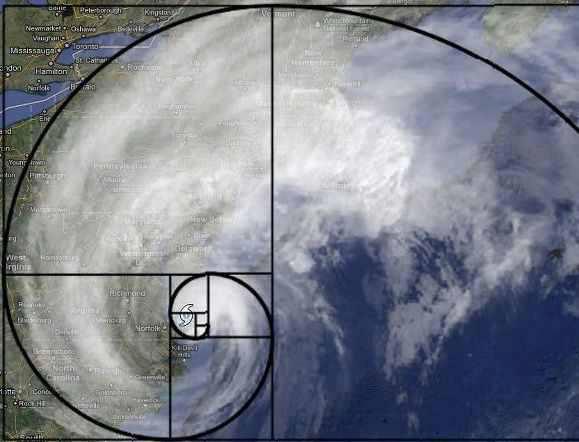
2012 After Hurricane Sandy came ashore in New Jersey on the 29th, the huge weather system was captured with an overlay to emphasize it's Fibonacci-like structure. *HT to Bob Mrotek for sending me this image


BIRTHS
1840 Joseph Jean Baptiste Neuberg (30 Oct 1840 in Luxembourg City, Luxembourg - 22 March 1926 in Liège, Belgium) Neuberg worked on the geometry of the triangle, discovering many interesting new details but no large new theory. Pelseneer writes, "The considerable body of his work is scattered among a large number of articles for journals; in it the influence of A Möbius is clear." *SAU

1844 George Henri Halphen (30 October 1844, Rouen – 23 May 1889, Versailles) was a French mathematician. He did his studies at École Polytechnique (X 1862). He was known for his work in geometry, particularly in enumerative geometry and the singularity theory of algebraic curves, in algebraic geometry. He also worked on invariant theory and projective differential geometry.*Wik

1863 Stanislaw Zaremba (3 Oct 1863 in Romanowka, Poland - 23 Nov 1942 in Kraków, Poland) From very unpromising times up to World War I, with the recreation of the Polish nation at the end of that war, Polish mathematics entered a golden age. Zaremba played a crucial role in this transformation. Much of Zaremba's research work was in partial differential equations and potential theory. He also made major contributions to mathematical physics and to crystallography. He made important contributions to the study of viscoelastic materials around 1905. He showed how to make tensorial definitions of stress rate that were invariant to spin and thus were suitable for use in relations between the stress history and the deformation history of a material. He studied elliptic equations and in particular contributed to the Dirichlet principle.*SAU

1906 Andrei Nikolaevich Tikhonov (30 Oct 1906 in Gzhatska, Smolensk, Russia - November 8, 1993, Moscow) Tikhonov's work led from topology to functional analysis with his famous fixed point theorem for continuous maps from convex compact subsets of locally convex topological spaces in 1935. These results are of importance in both topology and functional analysis and were applied by Tikhonov to solve problems in mathematical physics.
The extremely deep investigations of Tikhonov into a number of general problems in mathematical physics grew out of his interest in geophysics and electrodynamics. Thus, his research on the Earth's crust lead to investigations on well-posed Cauchy problems for parabolic equations and to the construction of a method for solving general functional equations of Volterra type.
Tikhonov's work on mathematical physics continued throughout the 1940s and he was awarded the State Prize for this work in 1953. However, in 1948 he began to study a new type of problem when he considered the behaviour of the solutions of systems of equations with a small parameter in the term with the highest derivative. After a series of fundamental papers introducing the topic, the work was carried on by his students.
Another area in which Tikhonov made fundamental contributions was that of computational mathematics. Under his guidance many algorithms for the solution of various problems of electrodynamics, geophysics, plasma physics, gas dynamics, ... and other branches of the natural sciences were evolved and put into practice. ... One of the most outstanding achievemnets in computational mathematics is the theory of homogeneous difference schemes, which Tikhonov developed in collaboration with Samarskii.
In the 1960s Tikhonov began to produce an important series of papers on ill-posed problems. He defined a class of regularisable ill-posed problems and introduced the concept of a regularising operator which was used in the solution of these problems. Combining his computing skills with solving problems of this type, Tikhonov gave computer implementations of algorithms to compute the operators which he used in the solution of these problems. Tikhonov was awarded the Lenin Prize for his work on ill-posed problems in 1966. In the same year he was elected to full membership of the USSR Academy of Sciences.*SAU

1907 Harold Davenport (30 Oct 1907 in Huncoat, Lancashire, England - 9 June 1969 in Cambridge, Cambridgeshire, England) Davenport worked on number theory, in particular the geometry of numbers, Diophantine approximation and the analytic theory of numbers. He wrote a number of important textbooks and monographs including The higher arithmetic (1952)*SAU

1946 William Paul Thurston  (October 30, 1946 – August 21, 2012) American mathematician who was awarded the Fields Medal in 1983 for his work in topology. As early as his Ph.D. thesis entitled Foliations of 3-manifolds which are circle bundles (1972) that showed the existence of compact leaves in foliations of 3-manifolds, Thurston had been working in the field of topology. In the following years, Thurston's contributions to the field of foliations were recognized to be of considerable depth, set apart by their originality. This was also true of his subsequent work on Teichmüller space. *TIS


DEATHS

1626 Willebrord van Royen Snell (13 June 1580 in Leiden, Netherlands - 30 Oct 1626 in Leiden, Netherlands) Snell was a Dutch mathematician who is best known for the law of refraction, a basis of modern geometric optics; but this only become known after his death when Huygens published it. His father was Rudolph Snell (1546-1613), the professor of mathematics at Leiden. Snell also improved the classical method of calculating approximate values of π by polygons which he published in Cyclometricus (1621). Using his method 96 sided polygons gives π correct to 7 places while the classical method yields only 2 places. Van Ceulen's 35 places could be found with polygons of 230 sides rather than 262. In fact Van Ceulen's 35 places of π appear in print for the first time in this book by Snell. *SAU

1631 Michael Mästin (30 Sept 1550 in Göppingen, Baden-Würtemberg, Germany
- 30 Oct 1631 in Tübingen, Baden-Würtemberg, Germany) astronomer who was Kepler's teacher and who publicized the Copernican system. Michael Mästin was a German astronomer who was Kepler's teacher and who publicised the Copernican system. Perhaps his greatest achievement (other than being Kepler's teacher) is that he was the first to compute the orbit of a comet, although his method was not sound. He found, however, a sun centered orbit for the comet of 1577 which he claimed supported Copernicus's heliocentric system. He did show that the comet was further away than the moon, which contradicted the accepted teachings of Aristotle. Although clearly believing in the system as proposed by Copernicus, he taught astronomy using his own textbook which was based on Ptolemy's system. However for the more advanced lectures he adopted the heliocentric approach - Kepler credited Mästlin with introducing him to Copernican ideas while he was a student at Tübingen (1589-94).*SAU

1739 Leonty Filippovich Magnitsky (June 9, 1669, Ostashkov – October 30, 1739, Moscow) was a Russian mathematician and educator. From 1701 and until his death, he taught arithmetic, geometry and trigonometry at the Moscow School of Mathematics and Navigation, becoming its director in 1716. In 1703, Magnitsky wrote his famous Arithmetic (Арифметика; 2,400 copies), which was used as the principal textbook on mathematics in Russia until the middle of the 18th century. This book was more an encyclopedia of mathematics than a textbook because most of its content was communicated for the first time in Russian literature. In 1703, Magnitsky also produced a Russian edition of Adriaan Vlacq's log tables called Таблицы логарифмов и синусов, тангенсов и секансов (Tables of Logarithms, Sines, Tangents, and Secants). Legend has it that Leonty Magnitsky was nicknamed Magnitsky by Peter the Great, who considered him a "people's magnet" *Wik

1805 Ormbsy MacKnight Mitchel (July 20, 1805 – October 30, 1862) American astronomer and major general in the American Civil War.
A multi-talented man, he was also an attorney, surveyor, and publisher. He is notable for publishing the first magazine in the United States devoted to astronomy. Known in the Union Army as "Old Stars", he is best known for ordering the raid that became famous as the Great Locomotive Chase during the Civil War. He was a classmate of Robert E. Lee and Joseph E. Johnston at West Point where he stayed as assistant professor of mathematics for three years after graduation.
The U.S. communities of Mitchell, Indiana, Mitchelville, South Carolina, and Fort Mitchell, Kentucky were named for him. A persistently bright region near the Mars south pole that was first observed by Mitchel in 1846 is also named in his honor. *TIA

1806 Alexander (Dallas) Bache (July 19, 1806 – February 17, 1867) was Ben Franklin's great grandson. A West Point trained physicist, Bache became the second Superintendent of the Coast Survey (1844-65). He made an ingenious estimate of ocean depth in 1856. He studied records of a tidal wave that had taken 12 hours to cross the Pacific. Knowing that wave speeds depend on depth, he calculated a 2 1/5-mile average depth for the Pacific (within 15% of the right value). Bache created the National Academy of Sciences, securing greater government involvement in science. Through the Franklin Institute he instituted boiler tests to promote safety for steamboats.*TIS

1975 Gustav Hertz (22 July 1887, 30 Oct 1975) German quantum physicist who, with James Franck, received the Nobel Prize for Physics in 1925 for the Franck-Hertz experiment, which confirmed the quantum theory that energy can be absorbed by an atom only in definite amounts and provided an important confirmation of the Bohr atomic model. He was a nephew of Heinrich Hertz. Although he fought on the German side in World War I, being of Jewish descent, he was forced to resign his professorship (1934) when Hitler took power. From 1945 he worked in the Soviet Union, and then in 1955 was a professor of physics in Leipzig, East Germany.*TIS

2007 Juha Heinonen, (23 July 1960 in Toivakka, Finland - 30 Oct 2007 in Ann Arbor, Michigan, USA) Professor of Mathematics passed away on October 30. He arrived in the Department in 1988 as a postdoctoral assistant professor, and became a professor in 2000. He was a leading researcher in geometric function theory, having published two books and numerous articles with many collaborators. Most recently, Juha served as Associate Chair for Graduate Studies in the Department, where he mentored many young mathematicians. *Math at U of M webpage memorial (Heinonen died at the age of 47 'after a brief but courageous battle with kidney cancer'. The Department of Mathematics at the University of Michigan established the Juha Heinonen Memorial Graduate Student Fellowship in his honour. An international conference in his memory Quasiconformal Mappings and Analysis on Metric Spaces was organised at the University of Michigan, Ann Arbor in May 2008.)


Credits :
*CHM=Computer History Museum
*FFF=Kane, Famous First Facts
*NSEC= NASA Solar Eclipse Calendar
*RMAT= The Renaissance Mathematicus, Thony Christie
*SAU=St Andrews Univ. Math History
*TIA = Today in Astronomy
*TIS= Today in Science History
*VFR = V Frederick Rickey, USMA
*Wik = Wikipedia
*WM = Women of Mathematics, Grinstein & Campbell

Tuesday, 29 October 2013

The Abacus and Counting Frame in American Education, a Brief History


 The idea that all children should learn arithmetic seems to have blossomed in the western countries around 1800. Prior to this period arithmetic training had been reserved for a small group of boys bound for mechanical or business fields. The training didn't usually begin until at least the age of twelve, and featured rote memorization of the written numerals and the rules for special cases to solve arithmetic operations.
Michalowicz and Howard (2003) have argued that “students of the 18th century rarely had a textbook,” that those who studied arithmetic “wrote in a ‘cipher’ book,” and that “the textbook was mainly for the teacher or for individuals who were self-taught.”pg 79).
Another writer quoted an educator in Boston around 1810 as stating that “printed arithmetics were not used in the Boston schools” until after he left there (p. 45). Rather, teachers set “sums” for
their pupils out of ciphering books that they had prepared at school, or had copied from textbooks or from the ciphering books of other teachers.(Monroe, 1912, pp. 5-16).

When mass arithmetic education started to become popular in the British Ilse and US, these rote memorization approaches continued and were used on even younger students. One of the first educators to influence Britain, and the US away from this structured approach toward a "mental/experiential" approach to understanding arithmetic was the famous Swiss educator, J. H. Pestalozzi. One of the tools he used as a primary instructional item was the horizontal abacus, or counting frame. But the path that brought it from its vertical Roman roots to the horizontal classroom model had a long and winding route that balanced on a narrow turn of events in the life of a French mathematician/soldier in the Napoleonic campaign in Russia. And his is the story I wish to tell here.

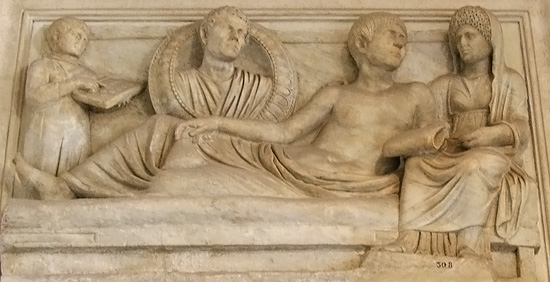
The abacus has been around, in one form or another, since at least the ancient Greeks and Romans. The image at the top appears on a second-century CE funerary relief that depicts the deceased young man reclining beneath his dead father's portrait, with his grieving mother seated on the right. The slave standing on the left is operating an abacus, which symbolizes the family's success in business. (Barbara F. McManus, The Roman Abacus on the web)
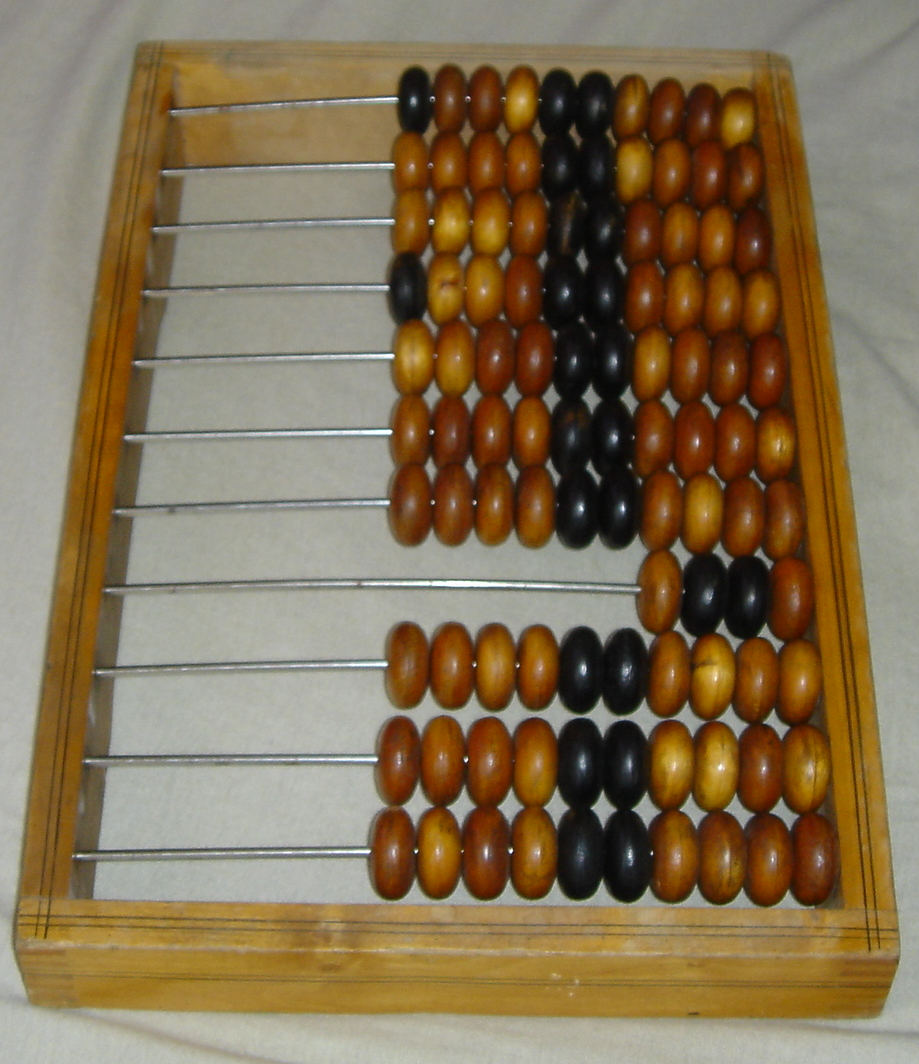
It spread throughout the European and Asian continents and by 1300 was common throughout both continents. Then the sweeping adaptation of Arabic numerals and improved computational methods led to its complete disappearance in western Europe, so that by the late 18th century it was unremembered. But in the later part of the 18th century (my best guess) a horizontal form of the Roman abacus became common for Russian classrooms (who apparently discovered the idea of "understanding arithmetic" slightly earlier). These abaci, called the schoty (счёты) were not only horizontal, the wire frames bowed out forward of the frame allowing the teacher to hold them up in front of a class without disturbing the order. In addition they were made with the fifth and sixth beads colored differently to make it easier to recognize numbers.

The single row of four beads was for working with a fractional quarter-ruble coin that existed at that time. Why it was place four rows from the bottom (commonly) has never been explained to me.

So the stage is set for an 1809 graduate of the E'cole Polytechnique in Paris, and student of Gaspard Monge to return to his home in Metz in the Alsace-Lorraine region. Then in 1812, he was called to duty with Napoleon's forces to invade Russia. If you don't remember, that didn't go well for Napoleon, and not too well for our young mathematician either. He was captured in November of that year, and sent off on a forced march of "hundreds of miles".  Keep in mind that Russia was cold and snowy that November, and weary soldiers on forced marches were prone to, and in fact did die.... but not our hearty hero. For over a year, he was kept in a Russian prison, and while there decided to reconstruct and improve and some old ideas of his teacher Monge, and the great Lazare Carnot. These writings would become a classic work in projective geometry, Traite' des propiertes projectives des figures (1822). When he was freed and repatriated to France, he returned to his home in Metz, and brought along a Russian abacus. He gave it to a teacher in Metz, and suggested that it might be useful in teaching small children. The item had been so forgotten that it was treated as a novelty as it slowly began to be reintroduced in France, then more quickly into Britain and the US under supporters of Pestalozzi.

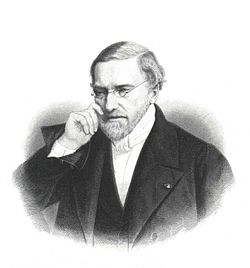
 And the weary warrior/mathematician whose survival made it all possible? If you didn't get the clue with the title to his classic work in projective geometry, it was Jean Victor Poncelet. As a mathematician, his most notable work was in projective geometry, in particular, his work on Feuerbach's theorem. He also made discoveries about projective harmonic conjugates; among these were the poles and polar lines associated with conic sections. These discoveries led to the principle of duality, and also aided in the development of complex numbers and projective geometry. And if you ever happen to be visiting the Eiffel Tower, look up, there are 72 names of scientists around the 1st stage of the tower, and yes, our hero/warrior/mathematician is one of them.
If you teach, tell this story to your students. His greatest influence may not be the mathematical writing he was recognized for, but a small item that he passed along to a teacher in his home town thinking, "It might be useful for teaching children."

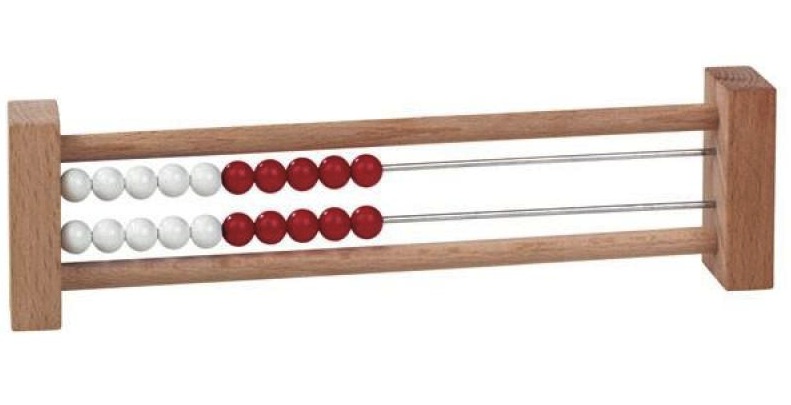
John Golden points out in a comment that a small type of counting frame is becomming very popular in elementary education again. It is called the rekenrek (which seems to have been semi-americanized from the Dutch rekentuig for abacus. The root is the same Germanic root that gives us the English term "reckon" for counting or doing arithmetic. Interestingly, its proto-Germanic root was for "motion in a straight line" which seems perfect for a counting frame.
The version I have seen promoted has only two horizontal wires, but there seem to be some available with multiple rows as well.