Showing posts with label long division. Show all posts

Saturday, 18 December 2010

"Decimal" Fractions in Other Bases

Early in my study of decimal fractions I realized that the ninths were just repeating digits of their numerators. 1/9 = .111...; 5/9 = .5555... etc. I didn't have much to apply it to, but it sort of fascinated me. Somewhere in the sixth grade or so, we were introduced to bases other than ten. Something about Sputnik made American education decide that base two and base five was important. I was fascinated again, but when I became curious about "decimal" fractions in other bases, my teacher advised me that, "We don't cover that." {If you know a good name for the general term of such fractional expansions, please advise.} Thanks to GasStationWithoutPumps, I now know this is called a radix expansion. Radix is from the same base that gives us "root".

Later I began to understand polynomials better, and realized that I could extend base n whole numbers across the "decimal" point as far as I wanted using the idea I would now describe as negative powers (not sure I had a word for it then). Armed with the idea that .1 in base 2, or .1 [2] was 1/2, and .1 in base 5, .1[5] was 1/5 I began trying to construct sets of fractions. Moving the "decimal point" one to the left in base two divided the result by two in the same way that it divided by ten in base ten. With that, I could produce most of the fractions that terminated, .0101[2] was 1/4 plus 1/16 or 5/16, .23[5] was 13/25 (2*5+3)/52.

Then I read about the formula for infinite geometric series with ratios less than one. I think the article was about Archimedes use of the series, but I couldn't understand the center of gravity approach at that time. What I did realize was that I could use the formula to convert any non-terminating decimal fraction to a rational fraction..... King of the World. I would write out strange fractions that had non-repeating prefixes to the repeat. Soon I began to wonder about repeating decimals in other bases and set out to explore. Remembering the repunit expansion for 1/9, I wondered about .1111... in other bases. I was kind of shocked to realize that .11111..[2] was =1. How could that happen? But I had already read about "proofs" that .99999..[10] = 1; and quickly convinced myself that in base n, a repetend of the digit (n-1) would also be one. But somewhere along the way, I realized that .1111...[n] would be 1/n-1. Just as it was equal to 1/9 in base ten, it was 1/4 in base five, or 1/2 in base three.

With all this experience, I still found it very hard to pick a random fraction, say 4/7, and express it in base 3 or base 5 or whatever I wished. Then one day I learned about division. Ok, I had learned long division and short division and mental division tricks, but I didn't really know how division worked. I'm not sure what I was reading, thumbing through books in the public library, and the author showed a shortcut for making "decimal" fractions in base two. What seemed like a magic trick became understanding when I began to extend it to other bases.

To understand, I want to do a simple division in base ten written a little differently than you normally would. For an example I will use 1/8. Set up the operation in four columns


Since 8 will not divide into 1, we have a fractional answer and we will multiply one by ten and try again (this is actually dividing the number of tenths by eight. This time 8 will go into ten once, with a remainder of two. This is shown in the second line.

The remainder is 2 multiplied by 10 (to get the 20) and we divide by eight again. This continues until we either terminate, or enter a repeating pattern. Here is the final table giving us the expected .125 for an answer.

The question is what is special about ten, and the big answer is ..... nothing. We could divide the fraction in any base by simply using some other multiple in place of the ten in each line. Here is 1/3 in base five.

Notice that the occurrence of the remainder of one means we will repeat the same sequence forever, so our answer is .13131313... [5] = 1/3. We can convince ourselves this is correct by using the geometric series. The first two digits are 1(5)+3=8 and represent 8/25. The next repetition of 13 is 8/252 , and each two digits in the sequence is 1/25 of the previous two. This is a geometric sequence with a first term of 8/25, and a common ratio of 1/25. Using the well known formula for such series gives 8/24 = 1/3..

Ok, one more example of the division method to help you.... this time we pick base three, and let's try to represent 2/5 in that base.

2/5 [3]= .101210121012..... OK, one more quick tip. Most students know that any repeating decimal fraction can be written as a rational by just subtracting one from the denominator of the repetend (say WHAT?) ok.. .4 repeating is 4/9 (four tenths repeating); and .232323... is 23/99. It doesn't matter how long the repeat cycle is, as long as it starts right from the decimal point; .12345 is just 12345/99999..... and you can do that in ANY base...
so a fraction like .1012 in base three can be written as its base three fraction and then apply the same rule. 1012 in base three is 1(27)+0(9) + 1(3)+2(1) so the numerator is 32 in base ten, and the denominator is 34 or 81. The rule for repeating is subtract one from the denominator, so .10121012... is 32/80 = 2/5....

Here are a couple more to help you see the pattern...

.101 repeating in [2] = 5/(23-1)= 5/7
.101 repeating in [3] = 10/(33-1)= 10/26= 5/13
.31 repeating in[4] = (3(4)+1)/(42-1)= 13/15
.31 repeating in[5] = 16/(52-1)= 16/24 = 2/3
.31 repeating in[6] = 19/(62-1)= 19/35

Fun with fractions!!!

Monday, 17 November 2008

The First Illustrated Arithmetic


I was researching problems related to the harmonic mean (more of which I hope to share in a later blog or blogs) when I came across a note in David E. Smith's "History of Mathematics" (There are actually used copies for a nickel!) about Filippo Calandri's 1492 arithmetic, Trattato di aritmetica. Smith cites it as the first "illustrated" arithmetic, and checking around, David Singmaster seems to agree.
An actual copy is in the Metropolitan Museum of Art in New York, and they have some images from the woodcuts in the book posted here . The cut above was the one of interest to me as it describes a "cistern problem" which was one of the common recreational problems since the First Century, and one of the problems I was researching when I came across this. The book has another first, it seems to have been the first book to publish an example of long division essentially as we now know it.
Here are some additional notes from my web notes on division that pertain to the long division algorithm and five early methods that were used.

..... is the true ancestor of the method most used for long division in schools today, and was called a danda, "by giving". In his Capitalism and Arithmetic, Frank J Swetz gives “The rationale for this term was explained by Cataneo (1546), who noted that during the division process, after each subtraction of partial products, another figure from the dividend is ‘given’ to the remainder.” He also says that the first appearance in print of this method was in an arithmetic book by Calandri in 1491. The method was frequently called “the Italian method” even into the 20th century (Public School Arithmetic, by Baker and Bourne, 1961) although sometimes the term “Italian method” was used to describe a form of long division in which the partial products are omitted by doing the multiplication and subtraction in one step.

The early uses of this method tend to have the divisor on one side of the dividend, and the quotient on the other as the work is finished, as shown in the image below taken from the 1822 "The Common School Arithmetic : prepared for the use of academies and common schools in the United States" by Charles Davies. Swetz suggests that it remained on the right by custom after the galley method gave way to “the Italian method” in the 17th century. It was only the advent of decimal division, he says, and the greater need for alignment of decimal places, that the quotient was moved to above the number to be divided. In a recent Greasham College lecture by Robin Wilson at Barnard's Inn Hall in London, he credited the invention of the modern long division process to Briggs, "The first Gresham Professor of Geometry, in early 1597, was Henry Briggs, who invented the method of long division that we all learnt at school." (I assume he means with the quotient on top.)

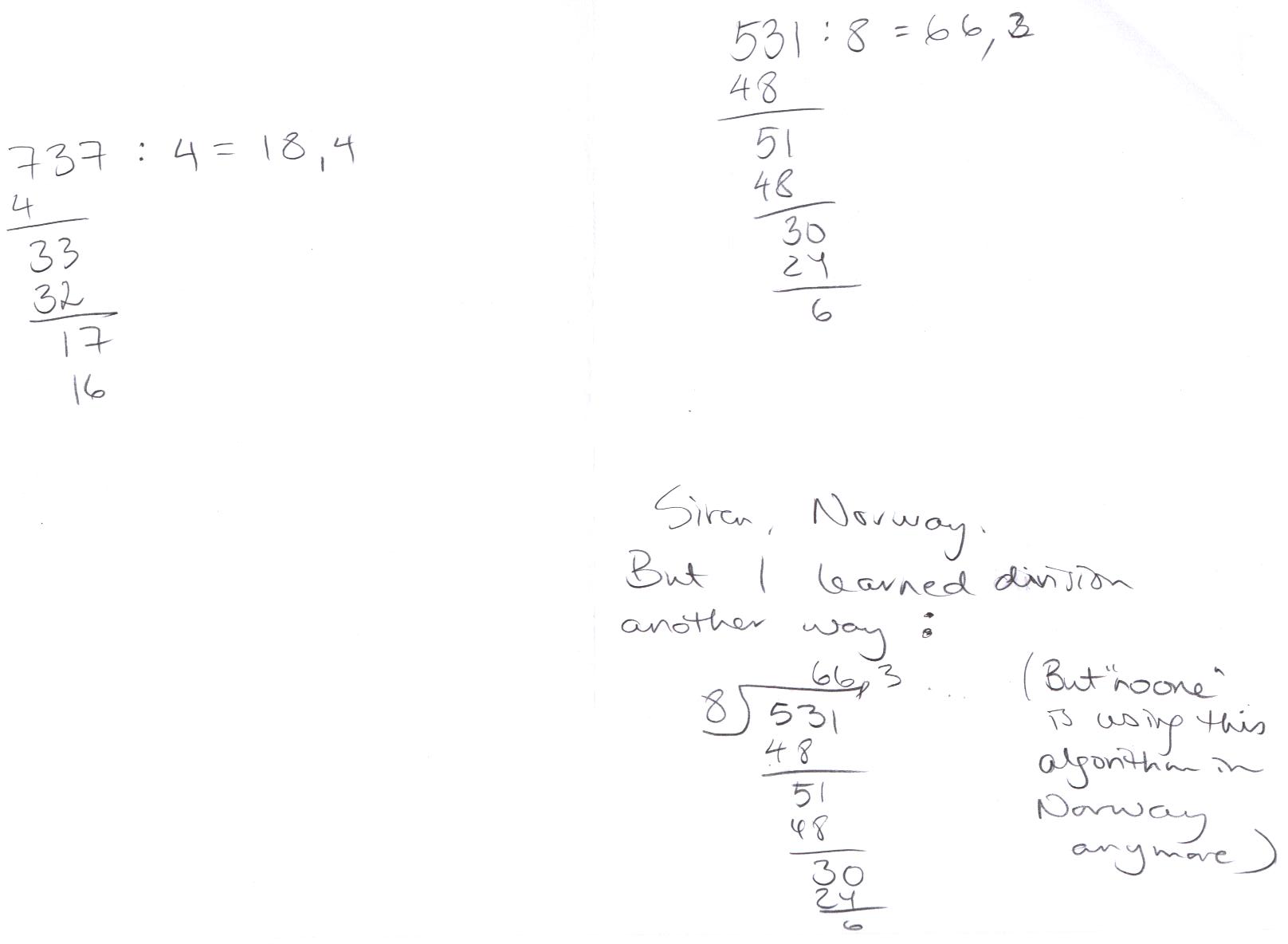
I recently found a site called The Algorithm Collection Project. where the authors have tried to collect the long division process as used by different cultures around the world. Very few of the ones I saw actually put the quotient on top as American students are usually taught. In one interesting note, a respondent from Norway showed one method, then explained that s/he had been taught another way, and then demonstrates the common American algorithm, but adds a note that says, “but ‘no one’ is using this algorithm in Norway anymore.” I might point out that the colon, ":" seems to be the division symbol of choice if this sample can be generalized as it was used in Norway, Germany, Italy, and Denmark. The Spanish example uses the obelisk (which surprised me as it was used almost exclusively in English and American textbooks, and even then seldom beyond elementary school), and the other three use a modification of the "a danda" long division process. The method labled "Catalan" is like the "Italian Method" shown above where the partial products are omitted.

Sunday, 20 July 2008

Collateral Damage in the Math Wars


I'm a victim of friendly fire in the math wars...wait, scratch that... I'm a victim of used-to-be friends fire.... you apparently have to be on one side or the other, and recently I am catching hell from both sides.

I guess it is my own fault. For the last ten-plus years I simply refused to enter into any dialog involving the "New Math/intuitive math/discovery math" camp on the one side and the "gimme that old time religion/long division or die/calculators are evil" camp on the other. The problem, at least as I see it, is that each group is assuming that it has to be all one or all the other. As one blogger put it, it is a choice between "why" vs. "how".(No one apparently envisions that a teacher might actually try to teach both how AND why.) California has fallen aside as the chief battleground after a victory, more or less, by a coalition of anti-reform elements (many of whom would not be caught dead championing the excess of the most conservative among them), and now Washington state seems to be the new battleground..(see A University View)

I can understand parents getting upset... as one observer of the process wrote, "Parents .... don’t understand what the specific tasks are, or how to perform them, or even why their kids are being taught this way instead of the older one. And again the proponents of this style (rehashing the why vs. how discussion) come off as arrogant. Their concerns aren’t for the parents’ ability to follow along with what their children are learning — and something tells me these are the same educators who insist that parental involvement is key — but just that the parents aren’t screwing up all their hard work." I admit I was shocked to read the following from the teachers resource packet for a program called "Everyday Learning"...
"The authors of Everyday Mathematics do not believe it is worth students’ time and effort to fully develop highly efficient paper-and-pencil algorithms for all possible whole-number, fraction, and decimal division problems. Mastery of the intricacies of such algorithms is a huge endeavor, one that experience tells us is doomed to failure for many students. It is simply counter-productive to invest many hours of precious class time on such algorithms. The mathematical payoff is not worth the cost, particularly because quotients can be found quickly and accurately with a calculator." I am reminded of a quote from my wall at school,” For every problem there is a solution which is quick, easy, and wrong! "

For me the intuitive learning and process learning support each other; the kids learns the multiplication algorithm, then he sees in algebra that two digit multiplication is the same as the "foil" method he is learning, and the rigor and intuition feed each other. One guy calls it the Mr. Miyagi method (from the Karate Kid movies). OK, that means teach the algorithm, but don't expect every kid to achieve 100% accuracy on the most difficult problems in the fourth grade, and then show them the intuitive approach that helps them understand WHY the algorithm works

Strangely, most of the good HS math teachers I know support a mixture approach; learn the long division algorithm, learn to multiply fractions, then use the mastery to understand concepts and big ideas..(see"Easier Than You Thought")Education Professors keep pushing the idea of concept based learning without foundation training (I think that is wrong) and Ultra conservatives keep pushing the abstract calculation as if mentioning a use of math was a sin (I think that's wrong too, most of us learn math to use it, only a very few use pure math untainted by application, and then when the least expect it, we find an application for what they did.)

So now I have two ex-correspondents who have cut me off, each because I endorse their view too weakly, or more likely, because I am too tolerant of the opposition viewpoint. But I will go on teaching long division and multiplication, factoring and all the other taboo subjects and trying my best to balance them with an intuitive understanding of why these ideas work, why the are actually esthetically beautiful ..at least until some administrative zealot of one or the other side of the math wars tells me to pack my bags and leave. But even them, look for me in your public park standing on a soap box selling my "evil" to anyone who will listen. But if you get caught in the Math wars, my best advice is from those old Uncle Remus stories by Joel Chandler Harris..."Ol’ Brer' Fox, he don't say nothing. He just lay low."