Sunday, 7 February 2016

On This Day in Math - February 7

The Frenet-Serret Frame, *Wik


A mathematician, like a painter or a poet, is a maker of patterns. If his patterns are more permanent than theirs, it is because they are made with ideas. Beauty is the first test: there is no permanent place in the world for ugly mathematics.
~Godfrey Harold Hardy

The 38th day of the year; 31415926535897932384626433832795028841 is a prime number.  BUT, It’s also the first 38 digits of pi.

38 is the largest even number so that every partition of it into two odd integers must contain a prime.
38 is the sum of squares of the first three primes \(2^2 + 3^2 + 5^2 = 38 \). *Prime Curios

At the beginning of the 21st Century there were 38 known Mersenne Primes. As of this writing, there are 49.


38 is also the magic constant in the only possible magic hexagon which utilizes all the natural integers up to and including 19. It was discovered independently by Ernst von Haselberg in 1887, W. Radcliffe in 1895, and several others. Eventually it was also discovered by Clifford W. Adams, who worked on the problem from 1910 to 1957. He worked on the problem throughout his career as a freight-handler and clerk for the Reading Rail Road by trial and error and after many years arrived at the solution which he transmitted to Martin Gardner in 1963. Gardner sent Adams' magic hexagon to Charles W. Trigg, who by mathematical analysis found that it was unique disregarding rotations and reflections.

*Wik


EVENTS
In 1812, the third day of powerful earthquakes struck, this one with an epicenter near New Madrid, Missouri, part of a three-month series in the central Mississippi River valley, known as the New Madrid earthquakes that began on 16 Dec 1811. The first two had happened on that December day, six hours apart, each with an epicenter in northeastern Arkansas, and were felt hundreds of miles away. Another followed on 23 Jan 1812, with epicenter in the far southeast corner of Missouri. All were powerful, about magnitude 7-7.5, with many aftershocks. Contemporary accounts tell of houses damaged, chimneys toppled, remarkable geological phenomena and landscapes changed. They remain among the most powerful earthquakes in the United States. The New Madrid fault remains a concern. *TIS (especially to those of us who live not far away in Possum Trot, Ky.)

1885 Hilbert promoted to Ph.D. He defended Kant's statement that man possesses, beyond logic and experience, certain a priori knowledge * Constance Reid, Hilbert, p. 16

In 1896, radiology began in England when X-rays were first used to discover the location of a bullet in a 12-yr-old boy's wrist who shot himself the previous month. When the pellet could not be found on probing, surgeon Sir Robert Jones had been consulted. Jones, having heard about the recently discovered X-rays, asked Oliver Lodge, head of the physics department at Liverpool University, if he could help with the new X-rays. On this day, the boy was brought to Lodge's laboratory. The pellet was identified embedded in the third carpo-metacarpal joint. Jones and Lodge reported the case in The Lancet on 22 Feb 1896. Charles Thurstan Holland who had been in attendance subsequently pioneered in clinical radiological examinations.*TIS

In 1932, the "neutron" was described in an article in the journal Nature by its discoverer, James Chadwick, who coined the name for this neutral particle he discovered present in the nucleus of atoms. He was an English physicist who studied at Cambridge, and in Berlin under Geiger, then worked at the Cavendish Laboratory with Ernest Rutherford, where he investigated the structure of the atom. He worked on the scattering of alpha particles and on nuclear disintegration. By bombarding beryllium with alpha particles, Chadwick discovered the neutron for which he received the Nobel Prize for Physics in 1935. He led the UK's work on the atomic bomb in WW II, and was knighted in 1945.*TIS

In 1935, Monopoly was first marketed by Charles Darrow, with the symbol of Rich Uncle Pennybags. He had invented the game on 7 Mar 1933. (See Note Below) A patent was issued for the game 31 Dec 1935, assigned to Parker Brothers, Inc.(No. 2,026,082). The patent described a "Board Game Apparatus... intended primarily to provide a game of barter, thus involving trading and bargaining" in which "much of the interest in the game lies in trading and in striking shrewd bargains." Illustrations showed the playing board, pieces, 22 "Title cards of the respective Real Estate holdings," Utilities, Chance and Community Chest cards, and scrip money. On the throw of the dice, the players may move onto Real Estate locations which may be acquired.*TIS
The history of the board game Monopoly can be traced back to the early 20th century. The earliest known design was by the American Elizabeth Magie created in 1903. A series of board games was developed from 1906 through the 1930s that involved the buying and selling of land and the development of that land. By 1934, a board game had been created much like the version of Monopoly sold by Parker Brothers and its parent companies through the rest of the 20th century, and into the 21st. Several people, mostly in the Midwestern United States and near the East Coast, contributed to the game's design and evolution.
By the 1970s, the idea that the game had been created solely by Charles Darrow had become popular folklore: it was printed in the game's instructions and even in the 1974 book The Monopoly Book: Strategy and Tactics of the World's Most Popular Game by Maxine Brady.*Wik

1956 Doug Ross Presents Gestalt Programming at the Western Joint Computer Conference in Los Angeles. Ross had experimented with the programming while working for the Air Force and Emerson Electric Co. *CHM

1975 Hungary issued a stamp commemorating the bicentenary (they were two days early) of the birth of Farkas Bolyai (1775–1856). [Scott #2347] *VFR

2015 A Mathematician wins an Oscar, FOR MATH. Robert Bridson, an adjunct professor in computer science at the University of British Columbia, was recognized for "early conceptualization of sparse-tiled voxel data structures and their application to modelling and simulation,".

BIRTHS
1816 Jean Frenet (7 Feb 1816 in Périgueux, France - 12 June 1900 in Périgueux, France) was a French mathematician best remembered for the Serret-Frenet formulas for a space-curve *SAU (Vector notation and linear algebra notation currently used to write these formulas was not yet in use at the time of their discovery.)

1824 Sir William Huggins (7 Feb 1824; 12 May 1910 at age 86) English astronomer who explored the spectra of stars, nebulae and comets to interpret their chemical composition, assisted by his wife Margaret Lindsay Murray. He was the first to demonstrate (1864) that whereas some nebulae are clusters of stars (with stellar spectral characteristics, ex. Andromeda), certain other nebulae are uniformly gaseous as shown by their pure emission spectra (ex. the great nebula in Orion). He made spectral observations of a nova (1866). He also was first to attempt to measure a star's radial velocity. He was one of the wealthy 19th century private astronomers that supported their own passion while making significant contributions. At age only 30, Huggins built his own observatory at Tulse Hill, outside London *TIS

1877 Godfrey Harold "G. H." Hardy FRS (7 February 1877 – 1 December 1947) was an English mathematician, known for his achievements in number theory and mathematical analysis.
He is usually known by those outside the field of mathematics for his essay from 1940 on the aesthetics of mathematics, A Mathematician's Apology, which is often considered one of the best insights into the mind of a working mathematician written for the layman.
Starting in 1914, he was the mentor of the Indian mathematician Srinivasa Ramanujan, a relationship that has become celebrated. Hardy almost immediately recognized Ramanujan's extraordinary albeit untutored brilliance, and Hardy and Ramanujan became close collaborators. In an interview by Paul Erdős, when Hardy was asked what his greatest contribution to mathematics was, Hardy unhesitatingly replied that it was the discovery of Ramanujan. He called their collaboration "the one romantic incident in my life."
Hardy preferred his work to be considered pure mathematics, perhaps because of his detestation of war and the military uses to which mathematics had been applied. He made several statements similar to that in his Apology:
"I have never done anything 'useful'. No discovery of mine has made, or is likely to make, directly or indirectly, for good or ill, the least difference to the amenity of the world."

However, aside from formulating the Hardy–Weinberg principle in population genetics, his famous work on integer partitions with his collaborator Ramanujan, known as the Hardy–Ramanujan asymptotic formula, has been widely applied in physics to find quantum partition functions of atomic nuclei (first used by Niels Bohr) and to derive thermodynamic functions of non-interacting Bose-Einstein systems. Though Hardy wanted his maths to be "pure" and devoid of any application, much of his work has found applications in other branches of science.*Wik

1883 Eric Temple Bell (7 Feb 1883; 21 Dec 1960 at age 77) Scottish-American mathematician and writer who contributed to analytic number theory (in which he found several inportant theorems), Diophantine analysis and numerical functions. In addition to about 250 papers on mathematical research, he also wrote for the layman in Men of Mathematics (1937) and Mathematics, Queen and Servant of Science (1951) among others. Under the name of John Taine, he also wrote science fiction. *TIS Although he was a well known mathematician in his day, he is best remembered for his popular Men of Mathematics. This book is hated by historians of mathematics for its exagerations and inaccuracies, but it is loved by high school students, and has motivated many mathematicians to become mathematicians. If you have not read it, do! *VF


1897 Maxwell Herman Alexander "Max" Newman, FRS (7 February 1897 – 22 February 1984) was a British mathematician and codebreaker. After WWII he continued to do research on combinatorial topology during a period when England was a major center of activity, notably Cambridge under the leadership of Christopher Zeeman. Newman made important contributions leading to an invitation to present his work at the 1962 International Congress of Mathematicians in Stockholm at the age of 65, and proved a Generalized Poincaré conjecture for topological manifolds in 1966. He died in Cambridge.*Wik

1898 Charles Wilderman Trigg,(Feb 7, 1898 Baltimore, Md; June 28, 1989 San Diego, Ca.) American engineer, mathematician and educator. Educated in engineering, mathematics and education at University of Pittsburgh, University of Southern California and University of California at Los Angeles. Worked as an industrial chemist and engineer, 1917-1943, and as an educator and administrator, 1946-1963. Served in the United States Navy during World War II. Book review editor of the Journal of Recreational Mathematics. Considered one of the foremost recreational mathematicians of the twentieth century. *U of Calgary Archives


1899 Hans Jenny (7 Feb 1899; 9 Jan 1992 at age 92) Swiss agricultural chemist and pedologist (soil scientist) who developed numerical functions to describe soil in terms of five interacting factors in his book Factors of Soil Formation (1941). These related Climate (temperature and moisture); Organisms (those living on the soil and in the soil, vegetation and animals, fungi algae and bacteria, decay of organic matter, humus); Relief (topography, and geomorphic landscape); Parent Material (bedrock or sediment type); and Time (ranging from 100's to 1000's of years while maturity or equilibrium of soil development is attained). He moved to the U.S. in 1926. After retirement, he studied the soil relationships in the unusual ecological community of the Pygmy Forest in California, known for its stunted and twisted confers. *TIS

1905 Lucien Alexandre Charles René de Possel (Feb 7, 1905– ?, 1974) was a French mathematician, one of the founders of the Bourbaki group, and later a pioneer computer scientist, working in particular on optical character recognition.
He had the conventional background for a member of Bourbaki: the École Normale Supérieure, agrégation, and then study in Germany. He left Bourbaki at an early stage: there was an obvious personal matter intruding between him and André Weil who had married De Possel's ex-wife Eveline following her divorce from De Possel in 1937.
De Possel published an early book on game theory in 1936 (Sur la théorie mathématique des jeux de hasard et de réflexion). His later research work in computer science at the Institut Blaise Pascal was in a position of relative isolation, as the subject strove for independence and to move away from the imposed role of service provider in the field of numerical analysis. *Wik

DEATHS
1736 Stephen Gray (December 1666 – 7 February 1736) was an English dyer and amateur astronomer, who was the first to systematically experiment with electrical conduction, rather than simple generation of static charges and investigations of the static phenomena.
Gray was born in Canterbury, Kent and after some basic schooling, he was apprenticed to his father (and later his elder brother) in the cloth-dyeing trade. His interests lay with natural science and particularly with astronomy, and he managed to educate himself in these developing disciplines, mainly through wealthy friends in the district who gave him access to their libraries and scientific instruments.
Stephen Gray produced a long series of experiments with electricity. In producing charge on a long glass tube, he discovered in 1729 that he could communicate the electrical effect to other objects by direct connection. Using string, he could charge an object over 50 feet from the rubbed tube, but oddly enough some other substances, such as silk thread, would not carry charge. Brass wire would transmit charge even better. These experiments with charged strings and glass tubes revealed the properties of conduction, insulation, and transmission. From these experiments came an understanding of the role played by conductors and insulators (names applied by John Desaguliers).
Despite the importance of his discoveries (it can be argued that he was the inventor of electrical communications) he received little credit at the time because of the factional dispute in the Royal Society, and the dominance of Newtonianism (which became the Masonic 'ideology'). By the time his discoveries were publicly recognised, experiments in electricity had moved rapidly on and his past discoveries tended to look trivial. For this reason, some historians tend to overlook his work.

There is no monument to Gray, and little recognition of what he achieved, against all odds, in his scientific discoveries. He is believed to be buried in a common grave in an old London cemetery, in an area reserved for pauper pensioners from the Charterhouse. *Wik *Yovisto
In a famous experiment Stephen Gray demonstrated static electricity
by charging a boy suspended by insulating strings in 1744 *Yovisto

1897 Galileo Ferraris (31 Oct 1847 - 7 Feb 1897 at age 49) Italian physicist who studied optics, acoustics and several fields of electrotechnics, but his most important discovery was the rotating magnetic field. He produced the field with two electromagnets in perpendicular planes, and each supplied with a current that was 90º out of phase. This could induce a current in a incorporated copper rotor, producing a motor powered by alternating current. He produced his first induction motor (with 4 poles) in May-Jun 1885. Its principles are now applied in the majority of today's a.c. motors, yet he refused to patent his invention, and preferred to place it at the service of everyone. *TIS

1948 Poul Heegaard (2 Nov 1871 in Copenhagen, Denmark - 7 Feb 1948 in Oslo, Norway) was a Danish mathematician who (with Max Dehn) was the first to classify compact surfaces.*SAU His 1898 thesis introduced a concept now called the Heegaard splitting of a 3-manifold. Heegaard's ideas allowed him to make a careful critique of work of Henri Poincaré. Poincaré had overlooked the possibility of the appearance of torsion in the homology groups of a space.
He later co-authored, with Max Dehn, a foundational article on combinatorial topology, in the form of an encyclopedia entry.
Heegaard studied mathematics at the University of Copenhagen, from 1889 to 1893 and following years of traveling, and teaching mathematics, he was appointed professor at University of Copenhagen in 1910.
Following a dispute with the faculty over, among other things, the hiring of Harald Bohr (The Brother of Niels Bohr, and Olmpic Soccer medalist) as professor at the University (Heegaard was against it); Heegaard accepted a professorship at Oslo in Norway, where he worked till his retirement in 1941.*Wik

1969 Hans Rademacher (3 April 1892 in Wandsbeck (part of Hamburg), Schleswig-Holstein, Germany - 7 Feb 1969 in Haverford, Pennsylvania, USA) It was philosophy that he intended to take as his main university subject when he entered the university of Göttingen in 1911, but he was persuaded to study mathematics by Courant after having enjoyed the excellent mathematics teaching of Hecke and Weyl. He is remembered for the system of orthogonal functions (now known as Rademacher functions) which he introduced in a paper published in 1922. Berndt writes "Since its discovery, Rademacher's orthonormal system has been utilised in many instances in several areas of analysis." Rademacher's early arithmetical work dealt with applications of Brun's sieve method and with the Goldbach problem in algebraic number fields. About 1928 he began research on the topics for which he is best known among mathematicians today, namely his work in connection with questions concerning modular forms and analytic number theory. Perhaps his most famous result, obtained in 1936 when he was in the United States, is his proof of the asymptotic formula for the growth of the partition function (the number of representations of a number as a sum of natural numbers). This answered questions of Leibniz and Euler and followed results obtained by Hardy and Ramanujan. Rademacher also wrote important papers on Dedekind sums and investigated many problems relating to algebraic number fields. *SAU


Credits :
*CHM=Computer History Museum
*FFF=Kane, Famous First Facts
*NSEC= NASA Solar Eclipse Calendar
*RMAT= The Renaissance Mathematicus, Thony Christie
*SAU=St Andrews Univ. Math History
*TIA = Today in Astronomy
*TIS= Today in Science History
*VFR = V Frederick Rickey, USMA
*Wik = Wikipedia
*WM = Women of Mathematics, Grinstein & Campbell

Saturday, 6 February 2016

On This Day in Math - February 6

Newton Statue - Trinity Chapel, Cambridge UK

The feeling of it (pure oxygen) to my lungs was not sensibly different from that of common air; but I fancied that my breast felt peculiarly light and easy for some time afterwards. Who can tell but that, in time, this pure air may become a fashionable article in luxury. Hitherto only two mice and myself have had the privilege of breathing it.~Joseph Priestley

The 37th day of the year; 37 is the only prime with a three digit period for the decimal expansion of its reciprocal, 1/37 = .027027....
Big Prime:::

n = integer whose digits are (left to right) 6424 copies of 37, followed by units digit of 3, is prime (n = 3737...373 has 12849 digits) *Republic of Math ‏@republicofmath

An amazing reversal: 37 is the 12th prime & 73 is the 21st prime . This enigma is the only known combination.

If you use multiplication and division operations to combine Fibonacci numbers, (for example, 4 = 2^2, 6 = 2·3, 7 = 21/ 3 ,...) you can make almost any other number. Almost, but you can't make 37.  In fact, there are 12 numbers less than 100 that can not be expressed as "Fibonacci Integers" *Carl Pomerance, et al.
 
EVENTS
1672 Newton wrote Henry Oldenburg about his optical theories, (including the phrase, "because that Light is a heterogenous mixture of differently refrangible rays." and Oldenburg published them a few days later in the
Philosophical Transactions. The controversy that followed dissuaded Newton from publishing on optics—and also on the calculus—until 1704 *ISIS, 69, p 134 (*VFR)
But it is requisite, that the prism and lens be placed steady, and that the paper, on which the colours are cast be moved to and fro; for, by such motion, you will not only find, at what distance the whiteness is most perfect but also see, how the colours gradually convene, and vanish into whiteness, and afterwards having crossed one another in that place where they compound whiteness, are again dissipated and severed, and in an inverted order retain the same colours, which they had before they entered the composition. You may also see, that, if any of the colours at the lens be intercepted, the whiteness will be changed into the other colours. And therefore, that the composition of whiteness be perfect, care must be taken, that none of the colours fall besides the lens.
Some of his opponents denied the truth of his experiments, refusing to believe in the existence of the spectrum. Others criticized the experiments, saying that the length of the spectrum was never more than three and a half times the breadth, whereas Newton found it to be five times the breadth. It appears that Newton made the mistake of supposing that all prisms would give a spectrum of exactly the same length;

1766 Just a few months before he returns to St. Petersburg, Euler reads his paper (E401) “A New Method for Comparing the Observation of the Moon to Theory” to the Berlin Academy. The paper proposes numerical techniques for approximating a bodys velocity and acceleration. Sandifer suggests that the paper had great influence on LaGrange’s foundational program for the Calculus. *Ed Sandifer, How Euler Did It, MAA

1828 George Biddell Airy appointed Plumian professor of astronomy at Cambridge at a salary of £500 per annum. He was appointed even after he raised a row that the previous salary of £300 was inadequate. For the previous two years he held the Lucasian professorship—the post Newton held—at a salary of £99. *VFR

1930 Kurt G¨odel received his Ph.D. from the University of Vienna for a dissertation, directed by Hans Hahn, that showed the completeness of first order logic (every valid first-order formula is provable). *VFR

1959 Kilby Files Patent For Integrated Circuit.
Jack Kilby of Texas Instruments files a patent application called "miniaturized electronic circuits" for his work on a multi-transistor device. The patent was only one of 60 that Kilby holds. While Kilby has the earliest patent on the "integrated circuit," it was Robert Noyce, later co-founder of Intel, whose parallel work resulted in a practical device. Kilby's device had several transistors connected by flying wires while Noyce devised the idea of interconnection via a layer of metal conductors. Noyce also adapted Jean Hoerni's planar technique for making transistors to the manufacture of more complex circuits. *CHM
Two drawings from Kilby's first IC patent *haverford.edu


BIRTHS
1465 Scipione del Ferro (6 February 1465 – 5 November 1526) born in Bologna, Italy. Around 1515 he solved the cubic equations x3+px = q and x3= px + q when p and q are positive. His methods are unknown. This information was passed on to his son-in-law Annibale dalla Nave who was tricked into revealing it to Cardano, who published it in his Ars magna of 1545.*VFR
There are no surviving scripts from del Ferro. This is in large part due to his resistance to communicating his works. Instead of publishing his ideas, he would only show them to a small, select group of friends and students. It is suspected that this is due to the practice of mathematicians at the time of publicly challenging one another. When a mathematician accepted another's challenge, each mathematician needed to solve the other's problems. The loser in a challenge often lost funding or his university position. Del Ferro was fearful of being challenged and likely kept his greatest work secret so that he could use it to defend himself in the event of a challenge.
Despite this secrecy, he had a notebook where he recorded all his important discoveries. After his death in 1526, this notebook was inherited by his son-in-law Hannival Nave, who was married to del Ferro's daughter, Filippa. Nave was also a mathematician and a former student of del Ferro's, and he replaced del Ferro at the University of Bologna after his death. In 1543, Gerolamo Cardano and Ludovico Ferrari (one of Cardano's students) travelled to Bologna to meet Nave and learn about his late father-in-law's notebook, where the solution to the depressed cubic equation appeared.
Del Ferro also made other important contributions to the rationalization of fractions with denominators containing sums of cube roots.
He also investigated geometry problems with a compass set at a fixed angle, but little is known about his work in this area. *Wik (Teachers may need to explain to students how suppression of the squared term allows this to solve general cubics.)

1695 Nikolaus II Bernoulli (February 6, 1695, Basel, Switzerland – July 31, 1726, St. Petersburg, Russia) was a Swiss mathematician and was one of the many prominent mathematicians in the Bernoulli family. Nicolaus worked mostly on curves, differential equations, and probability. He was a contemporary of Leonhard Euler. He also contributed to fluid dynamics.*Wik He was the oldest and favorite of three sons of Johann Bernoulli. He made important mathematical contributions to the problem of trajectories while working on the mathematical arguments behind the dispute between Newton and Leibniz.*SAU When the father was asked to come to St. Petersburg to join the Academy, he declined because of his age. He suggested that they take his son Nikolaus, but, so that he not be lonely, they should also take another son Daniel. Unfortunately, Nikolaus II drowned in 1726, only eight months after going to St. Petersburg. His professorship was succeeded in 1727 by Leonhard Euler, whom the Bernoulli brothers had recommended.

1802 Sir Charles Wheatstone, (6 Feb 1802, 19 Oct 1875) English physicist who popularized the Wheatstone bridge, a device that accurately measured electrical resistance and became widely used in laboratories. He didn't actually invent the "Wheatstone Bridge". His contemporary, Samuel Hunter Christie, came up with the idea of the bridge circuit, but Wheatstone set the precedent for using it in the way in which it has been most commonly used. Over time, the device became associated with him and took on his name. He did, however, invent the concertina (1829), the stereoscope (1838), and an early form of the telegraph. He also developed a chronoscope (1842) to determine the velocity of projectiles at an English gunnery.*TIS (For students of discrete math, or interested in codes, Wheatstone was also the creator of the Playfair Cipher.) {Wheatstone's work was so diverse that after a lecture at the Science Conference in South Kensington (London) by Prof. W. G. Adams on Wheatstone's acoustical discoveries, William Spottiswoode commented, "It must have struck all those in science... that when they fancied they had found something new, they find it was done by Sir Charles Wheatstone years ago." *Knowledge and Scientific News, Jan 1908, pg 7

1848 Adam Wilhelm Siegmund Günther (6 Feb 1848 in Nuremberg, Germany - 3 Feb 1923 in Munich, Germany) Günther's contributions to mathematics include a treatise on the theory of determinants (1875), hyperbolic functions (1881), and the parabolic logarithm and parabolic trigonometry (1882). He also wrote numerous books and journal articles [which] encompass both pure mathematics and its history and physics physics, geophysics, meteorology, geography, and astronomy. The individual works on the history of science, worth reading even today, bear witness to a thorough study, a remarkable knowledge of the relevant secondary literature, and a superior descriptive ability. *SAU

1916 John Crank (6 February 1916 – 3 October 2006) was a mathematical physicist, best known for his work on the numerical solution of partial differential equations.
He worked on ballistics during the Second World War, and was then a mathematical physicist at Courtaulds Fundamental Research Laboratory from 1945 to 1957. In 1957, he was appointed as the first Head of Department of Mathematics at Brunel College in Acton. He served two terms of office as Vice-Principal of Brunel before his retirement in 1981, when he was granted the title of Professor Emeritus.
Crank's main work was on the numerical solution of partial differential equations and, in particular, the solution of heat-conduction problems. He is best known for his work with Phyllis Nicolson on the heat equation, which resulted in the Crank–Nicolson method.*Wik


DEATHS
1612 Christopher Clavius (March 25, 1538 – February 6, 1612 {some sources give Feb 12 for the date of death}), the Euclid of the sixteenth-century, born in the German town of Bamberg, the see of the prince-bishop of Franconia. He was also the leader of the Gregorian calendar reform. Perhaps his greatest contribution was as an educational reformer. *Renaissance Mathematicus He was a German Jesuit mathematician and astronomer who was the main architect of the modern Gregorian calendar. In his last years he was probably the most respected astronomer in Europe and his textbooks were used for astronomical education for over fifty years in Europe and even in more remote lands (on account of being used by missionaries). As an astronomer Clavius held strictly to the geocentric model of the solar system, in which all the heavens rotate about the Earth. Though he opposed the heliocentric model of Copernicus, he recognized problems with the orthodox model. He was treated with great respect by Galileo, who visited him in 1611 and discussed the new observations being made with the telescope; Clavius had by that time accepted the new discoveries as genuine, though he retained doubts about the reality of the mountains on the Moon. Later, a large crater on the Moon was named in his honour. *Wik

1804 Joseph Priestley (13 Mar 1733, 6 Feb 1804) English chemist, clergyman and political theorist who discovered the element oxygen. His early scientific interest was electricity, but he is remembered for his later work in chemistry, especially gases. He investigated the "fixed air" (carbon dioxide) found in a layer above the liquid in beer brewery fermentation vats. Although known by different names at the time, he also discovered sulphur dioxide, ammonia, nitrogen oxides, carbon monoxide and silicon fluoride. Priestley is remembered for his invention of a way of making soda-water (1772), the pneumatic trough, and recognizing that green plants in light released oxygen. His political opinions and support of the French Revolution, were unpopular. After his home and laboratory were set afire (1791), he sailed for America, arriving at New York on 4 Jun 1794 *TIS He died on the morning of 6 February 1804 and was buried at Riverview Cemetery in Northumberland, Pennsylvania.

Priestley's epitaph reads:
Return unto thy rest, O my soul, for the
Lord hath dealt bountifully with thee.
I will lay me down in peace and sleep till
I awake in the morning of the resurrection. *Wik

*cometography.com
1923 Edward Emerson Barnard (16 Dec 1857; 6 Feb 1923) astronomer who pioneered in celestial photography, specializing in wide-field photography. From the time he began observing in 1881, his skill and keen eyesight combined to make him one of the greatest observers. Barnard came to prominence as an astronomer through the discovery of numerous comets. In the 1880s, a patron of astronomy in Rochester, N.Y. awarded $200 per new comet was found. Barnard discovered eight - enough to build a "comet house" for his bride. At Lick Observatory (1888-95) he made the first photographic discovery of a comet; photographed the Milky Way; and discovered the fifth moon of Jupiter. Then he joined Yerkes Observatory, making his Photographic Atlas of Selected Regions of the Milky Way.*TIS The faint Barnard's Star is named for Edward Barnard after he discovered in 1916 that it had a very large proper motion, relative to other stars. This is the second nearest star system to the Sun, second only to the Alpha Centauri system. *Wik

1965 Ernst Erich Jacobsthal (16 October 1882, Berlin – 6 February 1965, Überlingen) was a German mathematician, and brother to the archaeologist Paul Jacobsthal.
In 1906, he earned his PhD at the University of Berlin, where he was a student of Georg Frobenius, Hermann Schwarz and Issai Schur; his dissertation, Anwendung einer Formel aus der Theorie der quadratischen Reste (Application of a Formula from the Theory of Quadratic Remainders), provided a proof that prime numbers of the form 4n + 1 are the sum of two square numbers. *Wik The theory was first conjectured by Fermat and proved by Euler.

1973 Ira Sprague Bowen (21 Dec 1898; 6 Feb 1973) was an American astrophysicist. His investigation of the ultraviolet spectra of highly ionized atoms led to his explanation of the unidentified strong green spectral lines of gaseous nebulae (clouds of rarefied gas) as forbidden lines of ionized oxygen and nitrogen. This emission, appearing to match no known element, had formerly been suggested to be due to a hypothetical element, "nebulium." Bowen was able to show, that in reality, the emission lines exactly matched those calculated to be the "forbidden lines" of ionized oxygen and nitrogen under extremely low pressure. This made a major advance in the knowledge of celestial composition. He was director of the Mt. Wilson and Palomar Observatories from 1948-64.*TIS

1992 Caius Jacob (29 March 1912 , Arad - 6 February 1992 , Bucharest ) was a Romanian mathematician and member of the Romanian Academy. He made ​​contributions in the fields of fluid mechanics and mathematical analysis , in particular vigilance in plane movements of incompressible fluids, speeds of movement at subsonic and supersonic , approximate solutions in gas dynamics and the old problem of potential theory. His most important publishing was Mathematical introduction to the mechanics of fluids. *Wik


Credits :
*CHM=Computer History Museum
*FFF=Kane, Famous First Facts
*NSEC= NASA Solar Eclipse Calendar
*RMAT= The Renaissance Mathematicus, Thony Christie
*SAU=St Andrews Univ. Math History
*TIA = Today in Astronomy
*TIS= Today in Science History
*VFR = V Frederick Rickey, USMA
*Wik = Wikipedia
*WM = Women of Mathematics, Grinstein & Campbell

Friday, 5 February 2016

On This Day in Math - February 5

See Events:1897


It is a mathematical fact that the casting of this pebble from my hand alters the center of gravity of the universe.
~Thomas Carlyle

Since today is the 5th day of the 2nd month, in 2017 teachers can offer their students,  \(Sin(2017 \sqrt[5]{2}) = -1 \) (It's not, but it will give that answer on the Ti-84 calculators (mine does at least.) The true answer is

The 36th day of the year; 36 is the smallest non trivial number which is both triangular and square. What's the next?
36 is the sum of the first three cubes, \(1 ^3 + 2^3 + 3^3 = 36\)  The sums of the first n cubes is always a square number. \(\sum_{k=1}^n k^3 = (\frac{(n)(n+1)}{2}) ^2\) Note that this sequence and its formula were known to (and possibly discovered by) Nicomachus, 100 CE)

The sum of the first 36 integers, \(\sum_{k=1}^{36} k = 666\) the so called "number of the beast."

And Mario Livio pointed out in a tweet that this is 5/2 in European style dating, and 52 is the maximum number of moves needed to solve the "15" sliding puzzle from any solvable position.

The Kiwi's seeds divide the circle into 36 equal sections.  Nature's protractor. *Matemolivares@Matemolivares


A special historical tribute to 36: The thirty-six officers problem is a mathematical puzzle proposed by Leonhard Euler in 1782. He asked if it were possible to place officers of six ranks from each of six regiments in a 6x6 square so that no row or column would have an officer of the same rank, or the same regiment. Euler suspected that it could not be done. Euler knew how to construct such squares for nxn when n was odd, or a multiple of four, and he believed that all such squares with n = 4m+2 (6, 10, 14...) were impossible ( Euler didn't say it couldn't be done. He just said that his method does not work for numbers of that form.) Proof that he was right for n=6 took a while. French mathematician (and obviously a very patient man) Gaston Tarry proved it in 1901 by the method of exhaustion. He wrote out each of the 9408 6x6 squares and found that none of them worked. Then in 1959, R.C. Bose and S. S. Shrikhande proved that all the others could be constructed. So the thirty-six square is the only one that can't be done.

EVENTS
1575 Jan De Groot entered the University of Leiden, in the Netherlands, on its opening day. With Simon Stevin he later performed an experiment proving that bodies of different weights fall the same distance in the same time (published 1586 by Stevin). This anti-Aristotelian experiment anticipated Galileo’s famous, but apocryphal, experiment at the Leaning Tower of Pisa. His son Hugo De Groot was a famous jurist. *VFR Thony Christie pointed out that "The anti-Aristotle tower and ball experiment was first carried out by Johannes Philiponus in 6th century CE". Philiponus proposed a kinetic theory for motion in place of Aristotle's impetus.

1673 Robert Hooke writes in his journal that he had, "Told the Society of Arithmetick engine.‏*@HookesLondon It is said that Newton had this, and other Hooke items, including Hooke's portrait, removed from the Royal Society after Hooke's death but this does not seem to be supported by most math historians

5 Feb 1675 (OS) 15 Feb 1676(NS) Newton wrote Hooke: "What DesCartes did was a good step....If I have seen further it is by standing on ye sholders of Giants." *VFR
The letter is at the Historical Society of Pennsylvania.


1689 The Convention Parliament, with Cambridge U. MP Isaac Newton voting in the majority, declared the throne of England vacant after James II escaped to France with the permission of his Son-in-Law and daughter, William and Mary, who were offered the crown jointly. The only record of a comment by Newton during the Parliament except to ask for a servant to close a drafty window. *Thomas Levenson, Newton and The Counterfeiter.


1772 Laplace presented his first probability memoir to the Acad´emie des Sciences. *VFR

1796 Schiller (1759–1815) wrote to Goethe (1749–1832): “Wo es die Sache leidet, halte ich es immer f¨ur besser, nicht mit dem Anfang anzufangen, der immer das Schwerste ist.” (I always think it better, whenever possible, not to begin at the beginning, as it is always the most difficult part). Although this is advice from one poet to another, it seems to apply to mathematics, especially the foundations of mathematics. Quoted from Numbers (1990) by H.-D. Ebinghaus et al., p. 6. *VFR

1835 A ceremony to honor "The Genius and Discoveries of Sir Isaac Newton" was organized by the citizens of the Lincolnshire, his area of birth, a few years after the centennial of his death. By unanimous choice, the committee selected as the speaker, the 19 yr old George Boole. "All present were struck by the youthful age of the speaker and not a little amazed by both his knowledge of the subject and his confident lecturing style."
*Desmond MacHale, The Life and Work of George Boole

1840 The American Statistical Association held its first annual meeting, in Boston. "On November 27, 1839, five men held a meeting in the rooms of the American Education Society at No. 15 Cornhill in Boston, Massachusetts, to organize a statistical society. Its purpose, as stated in the society's first constitution, was to "collect, preserve, and diffuse statistical information in the different departments of human knowledge." Originally called the American Statistical Society, the organization's name was changed to the American Statistical Association (ASA) at its first annual meeting, held in Boston on February 5, 1840. " *Robert L. Mason, ASA: The First 160 Years

1843 The great comet of 1843, A night-time view showing an eyewitness account of the Great Comet of 1843, painted by the astronomer Charles Piazzi Smyth. The earliest observation occurred on the evening of 5 of February, 1843 and Smyth recorded its appearance at the Royal Observatory, Cape of Good Hope, South Africa between 3 and 6 of March. When at its greatest brilliance, it was visible only from southern latitudes. The view in the painting is probably taken from the Observatory. It shows Table Bay with Table Mountain visible in the background on the left. A large sailing ship sits in the foreground on the right, with other shipping in the distance. One of the great British astronomers, Smyth was 42 years Astronomer Royal for Scotland. *Royal Museums Greenwich

1850 D. D. Parmalee issued a patent (US Patent # 7074) for the first key-driven adding machine. *VFR
While this was the first US patent, an earlier key-driven machine had been patented "as early as 1844 by Jean-Baptiste Schwilgue´ (1776– 1856), together with his son Charles. Jean-Baptiste Schwilgue´ was the architect of Strasbourg’s third astronomical clock during the years 1838–1843. He was trained as a clockmaker,but also became professor of mathematics,weights and measures controller, and an industry man, whose particular focus was on improving scales." *Denis Roegel, An Early (1844) Key-Driven Adding Machine, IEEE Annals of the History of Computing, Volume 30, Number 1, January-March 2008, pp. 59-65

In 1897, the Indiana State House legislature presented Bill No.246 which in effect gave 3.2 exactly as the value of pi. It stated, in part, "the ratio of the diameter and circumference [pi] is as five-fourths to four." That is (4 divided by 5/4) = 16/5 = 3.2 exactly. It was introduced by Representative Taylor I. Record, a farmer and lumber merchant, on behalf of a mathematical hobbyist, Dr. Edwin J. Goodwin, M.D. Neither they, nor the House politicians, understood it was mathematically incorrect. That was shortly recognized by Clarence A. Waldo, mathematics professor at Purdue University, who advised the Indiana Senators. They indefinitely postponed the bill on 12 Feb 1897. Pi is, in fact, an irrational number, approx. 3.141592.*TIS (more detail here)

1924 The Royal Greenwich Observatory begins broadcasting the time "pips" on BBC, a series of six short tones broadcast at one-second intervals by many BBC Radio stations. The pips were introduced in 1924 and have been generated by the BBC since 1990. The pips were the idea of the Astronomer Royal, Sir Frank Watson Dyson, and the head of the BBC, John Reith.*Wik
This eight-day wall-mounted astronomical regulator by Edward John Dent & Co was originally made for use in observing the Transit of Venus in 1874. In 1923 it was adapted as the primary standard for the new six-pip time signal. The clock sent electrical impulses down a telephone wire to the BBC for conversion into audio pips for radio broadcasts. It has a zinc tube temperature-compensated pendulum and was corrected from 1929 by the Shortt master clock number 16. The three sets of contacts for closing the six-pip circuit every quarter of an hour can be seen in two of the holes within the seconds dial, and halfway down the pendulum, operated by a roller. This clock was in service for the BBC signal at the Observatory from 1924 to 1949, when it was superseded by a quartz clock. *Royal Observatory Greenwich

1958 Kilby Files a Patent for the Integrated Circuit. Jack Kilby of Texas Instruments files a patent application called miniaturized electronic circuits for his work on a multi-transistor device. The patent was only one of 60 that Kilby holds. While Kilby has the earliest patent on the integrated circuit, it was Robert Noyce, later co-founder of Intel, whose parallel work resulted in a practical device. Kilby's device had several transistors connected by flying wires while Noyce devised the idea of interconnection via a layer of metal conductors. Noyce also adapted Jean Hoerni's planar technique for making transistors to the manufacture of more complex circuits. *CHM

*Wik
In 1962, the Sun, the Moon, and the five naked-eye visible planets - Mercury, Venus, Mars, Jupiter, and Saturn - were in conjunction. Though not in a straight line along their orbital paths, as viewed in the sky, they were within 16 degrees of each other (meaning all appeared within a circle just 16 º across). This conjunction coincided with a total solar eclipse, which made viewing Mercury, Venus, Mars, Jupiter, and Saturn possible for a brief period of time from a small stretch of Earth where the eclipse's shadow hit. The five naked-eye visible planets cluster together in the sky within a circle 25 degrees or less in diameter once every 57 years, on average. The next time in the 21st century that this will happen is 8 Sep 2040. *TIS (image...In May of 2011 a planetary conjunction of Mercury, Venus, Mars and Jupiter appeared very close to each other in the sky.) And for St. Valentines day this year (2012) I have ordered up a conjunction with Mercury and Neptune less than 1.5 o apart for my beautiful Jeannie, but the rest of you may enjoy it as well.

2040 The near-Earth asteroid 2011 AG5 currently has an impact probability of 1 in 625 for Feb. 5, 2040, according to Donald Yeomans, head of the Near-Earth Object Observations Program at NASA’s Jet Propulsion Laboratory in Pasadena, California.


BIRTHS
1608 Caspar Schott SJ, and Gaspar Schott or Kaspar Schott (February 5 1608 in Königshofen, May 22 1666 in Würzburg) was a scientific author and educator.
Schott attended the Würzburg Jesuit High School and entered the Order in 1627. During his studies in Würzburg one of his teachers was Athanasius Kircher. When the Jesuits fled before the approaching Swedish army in 1631,Schott went to Palermo to complete his studies. He stayed in Sicily 20 years as a teacher of mathematics, philosophy, moral theology at the Jesuit school in Palermo. In 1652 was sent to Rome as support in the scientific work of Kircher. He decided to publish Kircher's work. In 1655, he returned as Professor in the Würzburg school, where he taught mathematics and physics. He was Hofmathematker and confessor of the Elector Johann Philipp von Schönborn who had just purchased the vacuum pump invented by Otto von Guericke and used at Magdeburg.
He corresponded with leading scientists including Otto von Guericke, Christiaan Huygens, and Robert Boyle. The term "technology" was probably invented by Schott in his "Technica curiosa" which inspired Boyle and Hooke's vacuum experiments.
In the posthumously published work Organum mathematicum he describes his Cistula invented by him, a computing device with which you can multiply and divide. *Wik

1797 Jean-Marie-Constant Duhamel (5 Feb 1797; 29 Apr 1872) French mathematician and physicist who proposed a theory dealing with the transmission of heat in crystal structures based on the work of the French mathematicians Jean-Baptiste-Joseph Fourier and Siméon-Denis Poisson. *TIS

1836 Alexander Stewart Herschel (5 February 1836 – 18 June 1907) was a British astronomer, born in Feldhausen, South Africa.
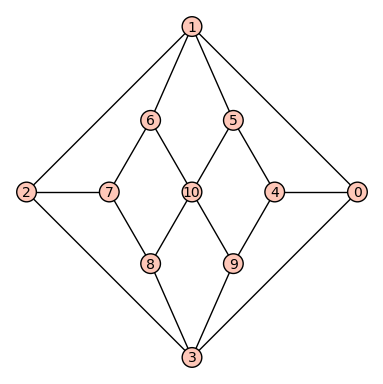
He was the son of John Herschel and the grandson of William Herschel. Although much less well known than either of them, he did pioneering work in meteor spectroscopy. He also worked on identifying comets as the source of meteor showers. The Herschel graph, the smallest non-Hamiltonian polyhedral graph, is named after Herschel due to his pioneering work on Hamilton's Icosian game. *Wik
The image of the graph at right is from Christian Perfect at the Aperiodical Blog.  You can’t draw a path on it that visits each vertex exactly once, but you can make a polyhedron whose vertices and edges correspond with the graph exactly. It’s also bipartite – you can color the vertices using two colors so that edges only connect vertices of different colors.
I think the polyhedron is the only enneahedron (9 faces children) that has all quadrilateral faces. You can see the solid here.

1907 Wilhelm Magnus (February 5, 1907, Berlin, Germany – October 15, 1990, New York City) made important contributions in combinatorial group theory, Lie algebras, mathematical physics, elliptic functions, and the study of tessellations.*Wik

1915 Robert Hofstadter (5 Feb 1915, 17 Nov 1990) American scientist who was a joint recipient of the Nobel Prize for Physics in 1961 for his investigations in which he measured the sizes of the neutron and proton in the nuclei of atoms. He revealed the hitherto unknown structure of these particles and helped create an identifying order for subatomic particles. He also correctly predicted the existence of hte omega-meson and rho-meson. He also studied controlled nuclear fission. Hofstadter was one of the driving forces behind the creation of the Stanford Linear Accelerator. He also made substantial contributions to gamma ray spectroscopy, leading to the use of radioactive tracers to locate tumors and other disorders.*TIS

1930 Urbanik Kazimierz (born 5 February 1930 in Krzemieniec - 29 May 2005 in Wrocław ) - Polish mathematician, rector of the University of Wroclaw ( 1975 - 1981 ), Doctor Honoris Causa of the University of Lodz and the Technical University of Wroclaw. He dealt with problems from different fields of mathematics, but his research interests were focused on the theory of probability . He obtained several important results in the theory of stochastic processes , information theory , theoretical physics , universal algebra , topology and measure theory . He published about 180 scientific papers. *Wik


DEATHS
1881 Thomas Carlyle (4 Dec 1795 in Ecclefechan, Dumfriesshire, Scotland - 5 Feb 1881 in Chelsea, London, England) was a Scottish writer who was also interested in mathematics. He translated Legendre's work.*SAU

1939 Gheorghe Ţiţeica ((October 4, 1873–February 5, 1939) publishing as George or Georges Tzitzeica) was a Romanian mathematician with important contributions in geometry. He is recognized as the founder of the Romanian school of differential geometry.*Wik

1977 Oskar Benjamin Klein (September 15, 1894 – February 5, 1977) was a Swedish theoretical physicist. Klein retired as professor emeritus in 1962. He was awarded the Max Planck medal in 1959. He is credited for inventing the idea, part of Kaluza–Klein theory, that extra dimensions may be physically real but curled up and very small, an idea essential to string theory / M-theory. *Wik

1980 Nachman Aronszajn (26 July 1907, Warsaw, Poland – 5 February 1980 Corvallis, Oregon, U.S) was a Polish American mathematician of Ashkenazi Jewish descent. Aronszajn's main field of study and expertise was mathematical analysis. He also contributed to mathematical logic.
He received his Ph.D. from the University of Warsaw, in 1930, in Poland. Stefan Mazurkiewicz was his thesis advisor. He also received a Ph.D. from Paris University, in 1935; this time Maurice Fréchet was his thesis advisor. He joined the Oklahoma A&M faculty, but moved to the University of Kansas in 1951 with his colleague Ainsley Diamond after Diamond, a quaker, was fired for refusing to sign a newly-instituted loyalty oath. Aronszajn retired in 1977. He was a Summerfield Distinguished Scholar from 1964 to his death.
He introduced, together with Prom Panitchpakdi, the injective metric spaces under the name of "hyperconvex metric spaces". Together with Kennan T. Smith, Aronszajn offered proof of the Aronszajn–Smith theorem. Also, the existence of Aronszajn trees was proven by Aronszajn; Aronszajn lines, also named after him, are the lexicographic orderings of Aronszajn trees.
He also has a fundamental contribution to the theory of reproducing kernel Hilbert space, the Moore–Aronszajn theorem is named after him. *Wik

1988 Dorothy Lewis Bernstein (April 11, 1914 – February 5, 1988) was an American mathematician known for her work in applied mathematics, statistics, computer programming, and her research on the Laplace transform.
Dorothy Bernstein was born in Chicago, the daughter of Russian immigrants to the US. She was a member of the American Mathematical Society and the first woman elected president of the Mathematical Association of America. Due in great part to Bernstein's ability to get grants from the National Science Foundation, Goucher College (where she taught for decades) was the first women's university to use computers in mathematics instruction in the 1960s.*Wik

1997 Frederick Justin Almgren,(3 July 1933 in Birmingham, Alabama, USA - 5 Feb 1997 in Princeton, USA) Almost certainly Almgren's most impressive and important result was only published in 2000, three years after his death. Why was this? The paper was just too long to be accepted by any journal. Brian Cabell White explains the background in a review of the book published in 2000 containing the result:
By the early 1970s, geometric analysts had made spectacular discoveries about the regularity of mass-minimizing hypersurfaces. (Mass is area counting multiplicity, so that if k sheets of a surface overlap, the overlap region is counted k times.) In particular, the singular set of an m-dimensional mass-minimizing hypersurface was known to have dimension at most m - 7. By contrast, for an m-dimensional mass-minimizing surface of codimension greater than one, the singular set was not even known to have m-measure 0. Around 1974, Almgren started on what would become his most massive project, culminating ten years later in a three-volume, 1700-page preprint containing a proof that the singular set not only has m-dimensional measure 0, but in fact has dimension at most (m - 2). This dimension is optimal, since by an earlier result of H Federer there are examples for which the dimension of the singular set is exactly (m - 2). ...
Now, thanks to the efforts of editors Jean Taylor and Vladimir Scheffer, Almgren's three-volume, 1700-page typed preprint has been published as a single, attractively typeset volume of less than 1000 pages.*SAU


Credits :
*CHM=Computer History Museum
*FFF=Kane, Famous First Facts
*NSEC= NASA Solar Eclipse Calendar
*RMAT= The Renaissance Mathematicus, Thony Christie
*SAU=St Andrews Univ. Math History
*TIA = Today in Astronomy
*TIS= Today in Science History
*VFR = V Frederick Rickey, USMA
*Wik = Wikipedia
*WM = Women of Mathematics, Grinstein & Campbell

Thursday, 4 February 2016

On This Day in Math - February 4


Archimedes *http://www.w-volk.de/museum

Technical skill is mastery of complexity while creativity is mastery of simplicity.
~ Sir Erik Christopher Zeeman

The 35th day of the year; There are 35 hexominos, the polyominoes made from 6 squares. *Number Gossip
(I only recently learned that, Although a complete set of 35 hexominoes has a total of 210 squares, which offers several possible rectangular configurations, it is not possible to pack the hexominoies into a rectangle.)

The longest open uncrossed (doesn't cross it's own path) knight's path on an 8x8 chessboard is 35 moves.   (longest cycle(end where you start) is only 32 moves)

In Base 35 (A=10, B=11, etc) NERD is Prime, \(23*35^3+14*35^2+27*35+13 = 1,004,233 \)

EVENTS
1600 Johannes Kepler arrives at Benatek Castle near Prague, where Tycho Brahe had moved his observatory, and retinue, after his benefactor King Frederick drank himself to death. *Timothy Ferris, Coming of Age in the Milky Way

1703 46 of the 47 Ronin commit seppuku (ritual suicide) as recompense for avenging their master's death. . This I mention here because one of the 47, was the greatest Asian mathematician of his age, Shigekiyo Matsumura, who among other things, approximated the value of pi as 3.141592648, which is accurate to eight significant figures..."
More of the story here.


1751 Franklin electrocutes a turkey, opines culinary improvement:
My Respects to Mr. Watson. He desir’d you to enquire what Success we had in our Attempts to kill a Turkey by the Electrical Strokes. Please to acquaint him, that we made several Experiments on Fowls this Winter; That we found two large thin glass Jars, gilt (holding each about 6 Gallons, and taking 2000 Turns of a Globe of 9 Inches Diameter to charge them full, when the Globe works very well, and will charge a common half pint Vial with 50 Turns) were sufficient to kill common Hens outright; but the Turkies, tho’ thrown into violent Convulsions, and then lying as dead for some Minutes, would recover in less than a quarter of an Hour. However, having added Mr. Kinnersley’s Jarrs and mine together, in all 5, tho’ not fully charg’d, we kill’d a Turky with them of about 10 lb.wt. and suppose they would have kill’d a much larger. I conceit that the Birds kill’d in this Manner eat uncommonly tender.
*Franklinpapers

1753 Writing about his Experiments and Observations on Electricity made at Philadelphia in America, a work Diderot called the best example of the experimental art with which he was acquainted, Benjamin Franklin (in a letter to John Perkins) boasted that he had “not, with some of our learned moderns, disguised [his] nonsense in Greek, clothed it in algebra, or adorned it with fluxions.” *Thomas L. Hankins, Jean d’Alembert, p 4 (via VFR) (This is in contrast to the quote by Lelande that d'Alembert "had never held a prism in his hand.")

1841 First recorded reference to "Groundhog Day" in America:
When German settlers arrived in the 1700s, they brought a tradition known as Candlemas Day, which has an early origin in the pagan celebration of Imbolc. It came at the mid-point between the Winter Solstice and the Spring Equinox. Superstition held that if the weather was fair, the second half of Winter would be stormy and cold. For the early Christians in Europe, it was the custom on Candlemas Day for clergy to bless candles and distribute them to the people in the dark of Winter. A lighted candle was placed in each window of the home. The day's weather continued to be important. If the sun came out February 2, halfway between Winter and Spring, it meant six more weeks of wintry weather.

The earliest American reference to Groundhog Day can be found at the Pennsylvania Dutch Folklore Center at Franklin and Marshall College:

February 4, 1841 - from Morgantown, Berks County (Pennsylvania) storekeeper James Morris' diary..."Last Tuesday, the 2nd, was Candlemas day, the day on which, according to the Germans, the Groundhog peeps out of his winter quarters and if he sees his shadow he pops back for another six weeks nap, but if the day be cloudy he remains out, as the weather is to be moderate."

According to the old English saying:
If Candlemas be fair and bright,
Winter has another flight.
If Candlemas brings clouds and rain,
Winter will not come again.
*Stormfax.com

In 1868, Charles Darwin began writing his book The Descent of Man and Selection in Relation to Sex. He was now 69 years old, working in his home in Downe, England. *TIS

1995 The Connect Four game was mathematically solved first by James D. Allen (Oct 1, 1988), and independently by Victor Allis (Oct 16, 1988). First player can force a win. Strongly solved by John Tromp's 8-ply database (Feb 4, 1995). Weakly solved for all boardsizes where width+height is at most 15 (Feb 18, 2006). *Wik


BIRTHS

1896 Friedrich (Hermann) Hund (4 Feb 1896 - 31 Mar 1997) was a German physicist known for his work on the electronic structure of atoms and molecules. He introduced a method of using molecular orbitals to determine the electronic structure of molecules and chemical bond formation. His empirical Hund's Rules (1925) for atomic spectra determine the lowest energy level for two electrons having the same n and l quantum numbers in a many-electron atom. The lowest energy state has the maximum multiplicity consistent with the Pauli exclusion principle. The lowest energy state has the maximum total electron orbital angular momentum quantum number, consistent with rule. They are explained by the quantum theory of atoms by calculations involving the repulsion between two electrons. *TIS

1906 Clyde William Tombaugh (4 Feb 1906 on Ranch near Streator, Illinois - 17 Jan 1997) was an American astronomer who discovered what was then recognized as the planet Pluto, which he photographed on 23 Jan 1930, the only planet discovered in the twentieth century, after a systematic search instigated by the predictions of other astronomers. Tombaugh was 24 years of age when he made this discovery at Lowell Observatory in Flagstaff, Ariz. He also discovered several clusters of stars and galaxies, studied the apparent distribution of extragalactic nebulae, and made observations of the surfaces of Mars, Venus, Jupiter, Saturn, and the Moon.Born of poor farmers, his first telescope was made of parts from worn-out farming equipment. *TIS
From my personal blog after a visit to Mars Hill, Flagstaff, Az. (much material from Wikipedia)
In the late 19th and early 20th century, observers of Mars drew long straight lines that appeared on the surface between 60 degrees north and south of the martian equator. Italian astronomer Giovanni Schiaparelli called these lines canali, which became canals in English. Lowell extended this observation to a theory that Mars had polar ice caps that would melt in the martian spring and fill the canals. He even extended the theory to include intelligent life on Mars that had designed the canals.
Eventually it became clear that there were no martian canals, but Mars hill went on to be the sight where a self educated Kansas schoolboy found his dream of working in astronomy in 1929, when the observatory director, V M Slipher, "handed the job of locating Planet X to Clyde Tombaugh, a 23-year-old Kansas man who had just arrived at the Lowell Observatory after Slipher had been impressed by a sample of his astronomical drawings."
On the nights of Jan 23 and 30th of January, 1830, he found a planet in the images that he thought was the Planet X. "The discovery made front page news around the world. The Lowell Observatory, who had the right to name the new object, received over 1000 suggestions, from "Atlas" to "Zymal". Tombaugh urged Slipher to suggest a name for the new object quickly before someone else did. Name suggestions poured in from all over the world. Constance Lowell proposed Zeus, then Lowell, and finally her own first name. These suggestions were disregarded.
The name "Pluto" was proposed by Venetia Burney (later Venetia Phair), an eleven-year-old schoolgirl in Oxford, England. Venetia was interested in classical mythology as well as astronomy, and considered the name, one of the alternate names of Hades, the Greek god of the Underworld, appropriate for such a presumably dark and cold world. She suggested it in a conversation with her grandfather Falconer Madan, a former librarian of Oxford University's Bodleian Library. Madan passed the name to Professor Herbert Hall Turner, who then cabled it to colleagues in America. The object was officially named on March 24, 1930."
Among the many awards Tombaugh received was a scholarship to the Univ of Kansas, where he would eventually earn a Bachelors and Masters Degree. It is said that the Astronomy Dept head refused to allow him to take the introductory astronomy class because it would be undignified for the discoverer of a planet.
Tombaugh died on January 17, 1997, when he was in Las Cruces, New Mexico, at the age of 90. A small portion of his ashes were placed aboard the New Horizons spacecraft. The container includes the inscription: "Interned (sic) herein are remains of American Clyde W. Tombaugh, discoverer of Pluto and the solar system's 'third zone'. Adelle and Muron's boy, Patricia's husband, Annette and Alden's father, astronomer, teacher, punster, and friend: Clyde W. Tombaugh

1925 Sir Erik Christopher Zeeman FRS (born 4 February 1925), is a Japanese-born British mathematician known for his work in geometric topology and singularity theory. His main contributions to mathematics were in topology, particularly in knot theory, the piecewise linear category, and dynamical systems.
Zeeman is known among the wider scientific public for his contribution to, and spreading awareness of catastrophe theory, which was due initially to another topologist, René Thom, and for his Christmas lectures about mathematics on television in 1978. He was especially active encouraging the application of mathematics, and catastrophe theory in particular, to biology and behavioral sciences.*Wik

1926 Jaroslav Hájek (4 Feb 1926 in Podebrady, Bohemia (now Czech Republic) - 10 June 1974 in Prague, Czechoslovakia) He was among the pioneers of unequal probability sampling. The name "Hájek predictor" now labels his contributions to the use of auxiliary data in estimating population means. In 1967 Hájek published (jointly with Z Sidak) Theory of rank tests but it was a work which had in fact been written four years before in 1963. Their methods use three lemmas of Le Cam in order to treat rank statistics under local alternatives and they established the efficiency of rank tests. *SAU

1927 Rolf William Landauer (4 Feb 1927; 27 Apr 1999) German-born American physicist known for his formulation of Landauer's principle concerning the energy used during a computer's operation. Whenever the machine is resetting for another computation, bits are flushed from the computer's memory, and in that electronic operation, a certain amount of energy is lost. Thus, when information is erased, there is an inevitable "thermodynamic cost of forgetting," which governs the development of more energy-efficient computers. While engineers dealt with practical limitations of compacting ever more circuitry onto tiny chips, Landauer considered the theoretical limit, that if technology improved indefinitely, how soon will it run into the insuperable barriers set by nature?*TIS

1948 Ken Thompson Is Born.  Thompson, who with Dennis Ritchie, developed UNIX at AT&T Bell Laboratories, is born. The UNIX operating system combined many of the timesharing and file management features offered by Multics, from which it took its name. (Multics, a projects of the mid - 1960s, represented the first effort at creating a multi-user, multi-tasking operating system.) The UNIX operating system quickly secured a wide following, particularly among engineers and scientists. *CHM


DEATHS

1615 Giambattista della Porta (1 November 1535 Vico Equense (near Naples), Italy
- 4 February 1615 Naples, Italy) was an Italian scholar who worked on cryptography and also on optics. He claimed to be the inventor of the telescope although he does not appear to have constructed one before Galileo.
In 1563, della Porta published De Furtivis Literarum Notis, a work about cryptography. In it he described the first known digraphic substitution cipher. Charles J. Mendelsohn commented, "He was, in my opinion, the outstanding cryptographer of the Renaissance. Some unknown who worked in a hidden room behind closed doors may possibly have surpassed him in general grasp of the subject, but among those whose work can be studied he towers like a giant."
Della Porta invented a method which allowed him to write secret messages on the inside of eggs. During the Spanish Inquisition, some of his friends were imprisoned. At the gate of the prison, everything was checked except for eggs. Della Porta wrote messages on the egg shell using a mixture made of plant pigments and alum. The ink penetrated the egg shell which is semi-porous. When the egg shell was dry, he boiled the egg in hot water and the ink on the outside of the egg was washed away. When the recipient in prison peeled off the shell, the message was revealed once again on the egg white.

Della Porta was the founder of a scientific society called the Academia Secretorum Naturae (Accademia dei Segreti). This group was more commonly known as the Otiosi, (Men of Leisure). Founded sometime before 1580, the Otiosi were one of the first scientific societies in Europe and their aim was to study the "secrets of nature." Any person applying for membership had to demonstrate they had made a new discovery in the natural sciences.
His private museum was visited by travelers and was one of the earliest examples of natural history museums. It inspired the Jesuit Athanasius Kircher to begin a similar, even more renowned, collection in Rome.
*SAU *Wik

1774 Charles-Marie de La Condamine (27 Jan 1701, 4 Feb 1774) French naturalist and mathematician who became particularly interested in geodesy (earth measurement). He was put in charge by the King of France of an expedition to Equador to measure a meridional arc at the equator (1735-43). It was wished to determine whether the Earth was either flattened or elongated at its poles. He then accomplished the first scientific exploration of the Amazon River (1743) on a raft, studying the region, and brought the drug curare to Europe. He also worked on establishment of a universal unit of length, and is credited with developing the idea of vaccination against smallpox, later perfected by Edward Jenner. However, he was almost constantly ill and died in 1773, deaf and completely paralyzed.*TIS

1895 Thomas Penyngton Kirkman FRS (31 March 1806 – 3 February 1895) was a British mathematician. Despite being primarily a churchman, he maintained an active interest in research-level mathematics, and was listed by Alexander Macfarlane as one of ten leading 19th-century British mathematicians. Kirkman's schoolgirl problem, an existence theorem for Steiner triple systems that founded the field of combinatorial design theory, is named after him.
Kirkman's first mathematical publication was in the Cambridge and Dublin Mathematical Journal in 1846, on a problem involving Steiner triple systems that had been published two years earlier in the Lady's and Gentleman's Diary by Wesley S. B. Woolhouse. Despite Kirkman's and Woolhouse's contributions to the problem, Steiner triple systems were named after Jakob Steiner who wrote a later paper in 1853. Kirkman's second research paper paper, in 1848, concerned hypercomplex numbers.
In 1850, Kirkman observed that his 1846 solution to Woolhouse's problem had an additional property, which he set out as a puzzle in the Lady's and Gentleman's Diary:
Fifteen young ladies in a school walk out three abreast for seven days in succession: it is required to arrange them daily, so that no two shall walk twice abreast.
This problem became known as Kirkman's schoolgirl problem, subsequently to become Kirkman's most famous result. He published several additional works on combinatorial design theory in later years. Kirkman also studied the Pascal lines determined by the intersection points of opposite sides of a hexagon inscribed within a conic section. Any six points on a conic may be joined into a hexagon in 60 different ways, forming 60 different Pascal lines. Extending previous work of Steiner, Kirkman showed that these lines intersect in triples to form 60 points (now known as the Kirkman points), so that each line contains three of the points and each point lies on three of the lines. *Wik

1928 Hendrik Antoon Lorentz (18 Jul 1853 - 4 Feb 1928) Dutch physicist who shared (with Pieter Zeeman) the Nobel Prize for Physics in 1902 for his theory of the influence of magnetism upon electromagnetic radiation phenomena. The theory was confirmed by findings of Zeeman and gave rise to Albert Einstein's special theory of relativity. From the start, Lorentz made it his task to extend James Clerk Maxwell's theory of electricity and of light. Already in his doctor's thesis, he treated the reflection and refraction phenomena of light from this new standpoint. His fundamental work in the fields of optics and electricity revolutionized conceptions of the nature of matter. In 1878, he published an essay relating the velocity of light in a medium, to its density and composition. *TIS

1974 Satyendra Nath Bose (1 Jan 1894; 4 Feb 1974) Indian physicist and mathematician who collaborated with Albert Einstein to develop a theory of statistical quantum mechanics, now called Bose-Einstein statistics. In his early work in quantum theory (1924), Bose wrote about the Planck black-body radiation law using a quantum statistics of photons, Plank's Law and the Light Quantum Hypothesis. Bose sent his ideas to Einstein, who extended this technique to integral spin particles. Dirac coined the name boson for particles obeying these statistics. Among other things, Bose-Einstein statistics explain how an electric current can flow in superconductors forever, with no loss. Bose also worked on X-ray diffraction, electrical properties of the ionosphere and thermoluminescence. *TIS

2003 Jean Brossel ( 15 August 1918 in Périgueux , France - 4 February 2003 in France)developed with Alfred Kastler the technique of optical pumping at origin of lasers. *Arjen Dijksman ‏@materion

2004 Valentina Mikhailovna Borok (9 July 1931, Kharkiv, Ukraine, USSR–4 February 2004, Haifa, Israel) was a Soviet Ukrainian mathematician. She is mainly known for her work on partial differential equations.*Wik


Credits :
*CHM=Computer History Museum
*FFF=Kane, Famous First Facts
*NSEC= NASA Solar Eclipse Calendar
*RMAT= The Renaissance Mathematicus, Thony Christie
*SAU=St Andrews Univ. Math History
*TIA = Today in Astronomy
*TIS= Today in Science History
*VFR = V Frederick Rickey, USMA
*Wik = Wikipedia
*WM = Women of Mathematics, Grinstein & Campbell