Tuesday, 10 July 2018

On This Day in Math - July 10


That which is not good for the bee-hive cannot be good for the bees. 

~ Marcus Aurelius

The 191st day of the year; 191 is a palindromic prime and when it is doubled and one is added to this result, the resulting number is yet another palindromic prime. (Students might consider why 11 is the only palindromic prime with an even number of digits.)

Derek Orr noticed that 199*n+(n-1) is a palindrome (not prime) for several other values of n, collect the whole set.

By adding up the values of the common US coins, one obtains 191 ¢ (silver dollar + half dollar + quarter + dime + nickel + penny) *From Number Gossip  (This ignores the once minted 5 mil, or half-cent coin and the briefly lived 2 cent coins) Canadians would have a larger sum of coins since Canada has had a $1 coin (The Loonie) since 1987 and a $2 coin (The Toonie) for about 10 years. I think the Canadian total would be 341 (no  half dollar) so maybe  we can squeeze them in by the end of the year.

191 is the smallest palindromic prime p such that neither 6p - 1 nor 6p + 1 is prime. Also, The smallest multidigit palindromic prime that yields a palindrome when multiplied by the next prime: 191 * 193 = 36863. *Prime Curios


EVENTS

1600 Kepler’s interest in optics arose as a direct result of his observations of the partial solar eclipse of 10 July 1600. Following instructions from Tycho Brahe, he constructed a pinhole camera; his measurements, made in the Graz marketplace, closely duplicated Brahe’ and seemed to show that the moon’s apparent diameter was considerably less than the sun’s. Kepler soon realized that the phenomenon resulted from the finite aperture of the instrument (see Fig. 5); his analysis, assisted by actual threads, led to a clearly defined concept of the light ray, the foundation of modern geometrical optics.
Kepler’s subsequent work applied the idea of the light ray to the optics of the eye, showing for the first time that the image is formed on the retina. He introduced the expression “pencil of light,” with the connotation that the light rays draw the image upon the retina; he was unperturbed by the fact that the image is upside down. *Encyclopedia.com

1610 Galileo receives a letter from Cosimo II agreeing to his salary requests, and confirming him as "First Mathematician of our Stadium in Pisa" but with no requirements that he live or lecture in Pisa, "except when it may please you as an honor." *The Copernican Question: Prognostication, Skepticism, and Celestial Order By Robert S. Westman

1637 First meeting of the Acad´emie Fran¸caise. *VFR

1676 Flamsteed began living at the Observatory with his two servants. On 19  July,  his long series of Greenwich  observations began?  *Rebekah Higgitt, Teleskopos

1794  Star in a crescent moon?  Astronomer Royal Investigates. The results are read to the Royal Society..."An Account of an Appearance of Light, like a Star, Seen Lately in the Dark Part of the Moon, by Thomas Stretton, in St. John's Square, Clerkenwell, London; with Remarks upon This Observation, and Mr. Wilkins's. Drawn up, and Communicated by the Rev. Nevil Maskelyne, D. D. F. R. S. and Astronomer Royal"  *Phil. Trans. R. Soc. Lond. January 1, 1794 84:435-440;

1796 Date of the entry EγPHKA! num=Δ+Δ+Δ in Gauss’s scientific diary, recording his discovery that every positive integer is the sum of three triangular numbers. [Thanks to Howard Eves] *VFR

1826 Cauchy presented a proof to the Acad´emie dealing with existence theorems for first-order dif-ferential equations. [Ivor Grattan-Guiness, Convolutions in French Mathematics, 1800–1840, pp. 758 and 1401] *VFR

1843 Jacques Philippe Marie Binet, age 57, elected to the Acad´emie des Sciences to succeed Lacroix. He is an example of a mathematician who published much late in life. He worked in mechanics, elasticity, perturbation theory, determinants, and the calculus. [Ivor Grattan-Guiness, Convo¬lutions in French Mathematics, 1800–1840, pp. 191 and 1410] *VFR

1908 at 5:45 in the morning, Kammerlingh Onnes, of Leiden, wins the race to produce liquified helium.   75 liters of liquid air is used to condense 20 liters of liquid oxygen, from which 20 milli-liters of liquid helium under reduced pressure. *Quantum Generations: A History of Physics in the Twentieth Century  By Helge Kragh

1925 The “Monkey Trial” of John T. Scopes began in Dayton, Tennessee. Clarence Darrow defended him. The prosecution, conducted by William Jennings Bryan, presented a strong case, and he was convicted of violating a state law prohibiting the teaching of evolution. Although the law was later overturned, this case provided a strong blow to science education. Scopes was not a biologist and never taught evolution. Rather he was a mathematics and physics teacher who volunteered to stand trial to furnish a test case. *VFR
The trial ran for 12 days. A local school teacher, John Scopes, was prosecuted under the state's Butler Act, but was supported by the American Civil Liberties Union. This law, passed a few months earlier (21 Mar 1925) prohibited the teaching of evolution in public schools. The trial was a platform to challenge the legality of the statute. Local town leaders,(wishing for the town to benefit from the publicity of the trial) had recruited Scope to stand trial. He was convicted (25 Jul) and fined $100. On appeal, the state supreme court upheld the constitutionality of the law but acquitted Scopes on the technicality that he had been fined excessively. The law was repealed on 17 May 1967. *TIS


1950 France honors Lazar Carnot (1753–1823) with a postage stamp. [Scott #B251]. *VFR


1950 The German Democratic Republic, to celebrate the 250th anniversary of the founding of the Academy of Sciences, Berlin, issued postage stamps picturing Leonhard Euler and Gottfried von Leibniz. [Scott #58, 66]. *VFR 


Leibniz was also honored with stamp issues in 1980 and 1996 it seems.

1993 MASH fans will remember that there was always a sign telling how many miles to Toledo and frequently they talked of the hotdogs at Tony Pacos (they are good). On this date the Cake Walk and Jazz Band (I believe the band is called "The Cakewalken Jass Band") celebrated their twenty-fifth anniversary with a live broadcast at Tony Pacos that was broadcast on public radio in Toledo. So what does this have to do with mathematics? Well, Ray Heitger, their clarinetist, leader, and one of the founding members happens to be a math teacher. If you can’t get to Toledo to hear them play, perhaps you can find one of their six LPs.*VFR
Tony Packo's Cafe is restaurant that started in the Hungarian neighborhood of Birmingham, on the east side of Toledo, Ohio at 1902 Front Street. The restaurant gained notoriety by its mention in several M*A*S*H episodes and is famous for its signature sandwich and large collection of hot dog buns signed by celebrities.     In 2011 it listed five restaurants in the Toledo area. *Wik


BIRTHS

1682 Roger Cotes born (10 July 1682 — 5 June 1716). In January 1706 he was named the first Plumian professor of astronomy and natural philosophy at Cambridge. It was Cotes who first showed that e was the natural base to choose for the logarithm. *VFR He did not realize his full potential because he died at age 33, leaving anunfinished series of imposing researches on optics and a large number of other unpublished manuscripts. Newton, who seldom spoke well of anyone else, said of Cotes, "If Cotes had lived, we might have known something."
Thony Christie at the Renaissance Mathematicus has a nice post about Cotes.

1832  Alvan Graham Clark  (July 10, 1832 – June 9, 1897)  U.S. astronomer, one of an American family of telescope makers and astronomers who supplied unexcelled lenses to many observatories in the U.S. and Europe during the heyday of the refracting telescope. He began a deep interest in astronomy while still at school, then joined the family firm of Alvan Clark & Sons, makers of astronomical lenses. In 1861, testing a new lens, he looked through it at Sirius and observed faintly beside it, Sirius B, the twin star predicted by Friedrich Bessel in 1844. Carrying on the family business, after the deaths of his father and brother, Clark made the 40" lenses of the Yerkes telescope (still the largest refractor in the world). Their safe delivery was a source of anxiety. He died shortly after their first use. *TIS

1856 Nikola Tesla (10 July 1856 – 7 January 1943)Serbian-American inventor and researcher who designed and built the first alternating current induction motor in 1883. [This statement seems to be in error,according to Wikipedia which states," In 1824, the French physicist François Arago formulated the existence of rotating magnetic fields, termed Arago's rotations, which, by manually turning switches on and off, Walter Baily demonstrated in 1879 as in effect the first primitive induction motor. Practical alternating current induction motors seem to have been independently invented by Galileo Ferraris(1885) and then Tesla (1887).]He emigrated to the United States in 1884. Having discovered the benefits of a rotating magnetic field, the basis of most alternating-current machinery, he expanded its use in dynamos, transformers, and motors. Because alternating current could be transmitted over much greater distances than direct current, George Westinghouse bought patents from Tesla the system when he built the power station at Niagara Falls to provide electricity power the city of Buffalo, NY. [Born in Croatia of Serbian parents. Some sources give birthdate as 9 Jul; he is said to have been born on the stroke of midnight.]
 

1878  Oliver Dimon Kellogg (10 July 1878 in Linwood, Pennsylvania, USA - 26 July 1932 in Greenville, Maine, USA) was appointed to the University of Missouri in 1905 where,  despite a heavy teaching and administrative load he was able to publish  impressive papers on potential theory. In 1908 he published three papers, namely Potential functions on the boundary of their regions of definition  and Double distributions and the Dirichlet problem, both in the Transactions of the American Mathematical Society, and A necessary condition that all the roots of an algebraic equation be real  in the Annals of Mathematics.  In 1912 he published the important work Harmonic functions and Green's integral  in the Transactions of the American Mathematical Society. This paper includes what today is called 'Kellogg's theorem' on harmonic and Green's functions. *SAU

1883 Frank Albert Benford, Jr., ((see note below about date of birth)1883 Johnstown, Pennsylvania – December 4, 1948) was an American electrical engineer and physicist best known for rediscovering and generalizing Benford's Law, a statistical statement about the occurrence of digits in lists of data.
Benford is also known for having devised, in 1937, an instrument for measuring the refractive index of glass. An expert in optical measurements, he published 109 papers in the fields of optics and mathematics and was granted 20 patents on optical devices.
His date of birth is given variously as May 29 or July 10, 1883. After graduating from the University of Michigan in 1910, Benford worked for General Electric, first in the Illuminating Engineering Laboratory for 18 years, then the Research Laboratory for 20 years until retiring in July 1948. He died suddenly at his home on December 4, 1948. *Wik

1928  Errett Albert Bishop (July 10, 1928 – April 14, 1983) (His) work is so wide ranging that it is difficult to give an overview in a biography such as this. Let us look at the book Selected papers which was published in 1986 and reprints some of Bishop's most significant contributions. The book divided Bishop's papers into five categories:
(1) Polynomial and rational approximation. Examples are extensions of Mergelyan's approximation theorem and the theorem of Frigyes Riesz and Marcel Riesz concerning measures on the unit circle orthogonal to polynomials. Bishop found new methods in dealing with these problems;
(2) The general theory of function algebras. Here Bishop worked on uniform algebras (commutative Banach algebras with unit whose norms are the spectral norms) proving results such as antisymmetric decomposition of a uniform algebra, the Bishop-DeLeeuw theorem, and the proof of existence of Jensen measures. In 1965 Bishop wrote an excellent survey Uniform algebras examining the interaction between the theory of uniform algebras and that of several complex variables.
(3) Banach spaces and operator theory. An examples of a paper by Bishop on this topic is Spectral theory for operators on a Banach space (1957). He introduced the condition now called the Bishop condition which turned out to be very useful in the theory of decomposable operators.
(4) Several complex variables. Examples of Bishop's papers in this area are Analyticity in certain Banach spaces (1962). He proved important results in this area such as the biholomorphic embedding theorem for a Stein manifold as a closed submanifold in Cn, and a new proof of Remmert's proper mapping theorem.
(5) Constructive mathematics. Bishop become interested in foundational issues around 1964, about the time he was at the Miller Institute. He wrote a famous text Foundations of constructive analysis (1967) which aimed to show that a constructive treatment of analysis is feasible.*SAU


DEATHS

1851 Louis-Jacques-Mandé Daguerre  (18 November 1787 – 10 July 1851) French painter and physicist who invented the daguerreotype, the first practical process of photography. Though the first permanent photograph from nature was made in 1826/27 by Joseph-Nicéphore Niepce of France, it was of poor quality and required about eight hours' exposure time. The process that Daguerre developed required only 20 to 30 minutes. The two became partners in the development of Niepce's heliographic process from 1829 until the death of Niepce in 1833. Daguerre continued his experiments, and he discovered that exposing an iodized silver plate in a camera would result in a lasting image after a chemical fixing process.*TIS

1910  Johann Gottfried Galle (9 June 1812 – 10 July 1910) German astronomer who on 23 Sep 1846, was the first to observe the planet Neptune, whose existence had been predicted in the calculations of Leverrier. Leverrier had written to Galle asking him to search for the new planet at a predicted location. Galle was then a member of the staff of the Berlin Observatory and had discovered three comets. In 1838, while assistant to Johann Franz Encke, Galle discovered the dark, inner C ring of Saturn at the time of the maxium ring opening. In 1851, he became professor of astronomy at Breslau and director of the observatory there. In 1872, he proposed the use of asteroids rather than regular planets for determinations of the solar parallax, a suggestion which was successful in an international campaign (1888-89). *TIS

1916 John Emory McClintock (19 Sept 1840 in Carlisle, Pennsylvania , USA - 10 July 1916 in Bay Head, New Jersey, USA) was for many years the leading actuary in America. He  published 30 papers between 1868 and 1877 on actuarial questions. His  publications were not confined to questions relating tolife insurance policies however. He published about 22 papers on mathematical topics. One paper treats difference equations as differential equations of infinite order and others look at quintic equations which are soluble algebraically. He published A simplified solution of the cubic  in 1900 in the Annals of Mathematics. Another work, On the nature and use of the functions employed in the recognition of quadratic residues  (1902), published in the Transactions of the American Mathematical Society, is on quadratic residues.*SAU

1936 Salvatore Pincherle (March 11, 1853 — July 10, 1936) worked on functional equations and functional analysis. Together with Volterra, he can claim to be one of the founders of functional analysis.*SAU


Credits :
*CHM=Computer History Museum
*FFF=Kane, Famous First Facts
*NSEC= NASA Solar Eclipse Calendar
*RMAT= The Renaissance Mathematicus, Thony Christie
*SAU=St Andrews Univ. Math History
*TIA = Today in Astronomy
*TIS= Today in Science History
*VFR = V Frederick Rickey, USMA
*Wik = Wikipedia
*WM = Women of Mathematics, Grinstein & Campbell

Monday, 9 July 2018

On This Day in Math - July 9


Epitaph (by Kepler, for himself)
Mensus eram coelos, nunc Terrae metior umbras.
Mens coelestis erat, corporis umbra jacet.

I used to measure the Heavens, now I measure the shadows of Earth.
The mind belonged to Heaven, the body's shadow lies here.

The 190th day of the year; 190 is the largest number with only distinct prime Roman numeral palindrome factors that is a Roman numeral palindrome (190 = CXC = II * V * XIX). *Prime Curios

190 is a Harshad or Niven number divisible by the sum of its digits. In recreational mathematics, a Harshad number (or Niven number) in a given number base, is an integer that is divisible by the sum of its digits when written in that base. Harshad numbers in base n are also known as n-Harshad (or n-Niven) numbers. Harshad numbers were defined by D. R. Kaprekar, a mathematician from India. The word "Harshad" comes from the Sanskrit harṣa (joy) + da (give), meaning joy-giver.


190 is the 19th triangular number, the sum of the first 19 integers. A nice problem relating triangular numbers to magic squares was asked in 1941 in the American Mathematical Monthly, posed by Royal Vale Heath, widely known for creating ingenious mathematical puzzles: "What is the smallest value of n for which the n2 triangular numbers 0, 1, 3, 6, 10, . . . n2(n2 – 1)/2 can be arranged to form a magic square?" An explanation, and answer is in this blog by Ivars Peterson


EVENTS

1595 Kepler gets the inspiration for his first model of the universe.. when the 23 year old Kepler, while teaching, made the first of a profound series of discoveries. Kepler fully elaborates this discovery in his Mysterium Cosmographicum, published less than a year later. It appeared to him that the respective radii of the orbits of the planets corresponded to the lengths determined by a specific sequence in which the five regular solids were placed within one another, with a sphere separating each solid from the other. The sphere (orbit) of Saturn enveloped a cube which in turn enveloped another sphere, the orbit of Jupiter. This circumscribed a tetrahedron, a sphere (the orbit of Mars), a dodecahedron, a sphere (the orbit of earth), an icosahedron, a sphere (the orbit of Venus), an octahedron, and the smallest sphere (the orbit of Mercury). The idea was the main theme of his Mysterium cosmographicum (1596). *Dave Richeson, Euler’s Gem
On that day, while standing at the blackboard drawing a geometrical figure for his class, Kepler had an epiphany. He believed it was a divine inspiration. Kepler had drawn a triangle with a circle circumscribed around it, which meant that each of the triangle's corners touched the rim of the circle. Then he inscribed another circle inside the triangle, which meant that the center of each side of the triangle touched the inner circle.
When Kepler stepped back and looked at what he had drawn, he realized with a shock that the ratios of the two circles were the same as the ratios of the orbits of Saturn and Jupiter. And with that realization, inspiration struck. Jupiter and Saturn were the outermost planets of the solar system, and the triangle was the simplest polygon. Kepler wondered whether you could fit the orbits of the other planets around other geometric figures, and tried his best inscribing circles in squares and pentagons. But the planetary orbits refused to fit.
Then Kepler had a second epiphany. The solar system was three dimensional – so why would he think that its governing pattern would be found in two dimensional figures? Kepler turned to three dimensional objects, and found his answer in the five perfect solids. A perfect solid is a three dimensional figure, such as a cube, whose sides are all identical. Conveniently for Kepler, there are only five perfect solids: the tetrahedron (which has four triangular sides), cube (six square sides), octahedron (eight triangular sides), dodecahedron (twelve pentagonal sides), and icosahedron (twenty triangular sides). Each perfect solid can be inscribed in and circumscribed around a sphere. *Spark Notes

1714 Longitude Act receives royal assent. The Longitude Act offered rewards of up to £20,000 for a method of finding longitude at sea to within half a degree (equivalent to 2 minutes of time) after a six-week voyage to the West Indies. Smaller rewards were available for methods achieving lesser accuracy. The Act also nominated a number of Commissioners of Longitude, later known as the Board of Longitude, to assess submissions and decide on rewards. They included the Astronomer Royal at Greenwich and other scientific, maritime and political leaders. The Commissioners could also grant smaller sums of money to help bring promising ideas to sea-trial. *Richard Dunn ‏@Lordoflongitude

1743 Euler, in a letter to Goldbach, He had described to Goldbach a manor by which numbers of the form \(n^2 + 1\) might be divisible. On Oct 28, 1752 Euler Published a paper listing the 161 numbers less than 15,000 for which \( n^2+1 \) is a prime. He also listed eight numbers for which \( n^4 + 1 \) is a prime; {1, 2, 4, 6, 16, 20, 24, and 34}. *L. E. Dickson, History of the Theory of Numbers

1814 Gauss made the 146th and last entry in his scientific diary. He observed a connection between biquadradic residues and the lemniscate functions. This has become the most famous entry in the diary as it led to the Weil conjectures. See Gray, Expositions Mathematicae, 2(1984), 97–130. *VFR

1857 Weierstrass, in his inaugural speech at the Berlin Academy, stated that mathematics occupies an especially high place because only through its aid can a truly satisfying understanding of natural phenomena be obtained. *VFR

1912 A letter from U.S. Department of Agriculture, Central Office of the Weather Bureau, Washington, D.C. to Dr. Walker Abbe, in Cleveland, "Enclosing some papers which 'will seem childish' but 'present the one great need of our sciences -- a school & laboratory & class of enthusiastic physics-mathematics students specially devoted to the earth's atmosphere'. He adds 'May the time soon come when you may be called home to be the leader of such men'." *Imperial College & Science Museum Libraries

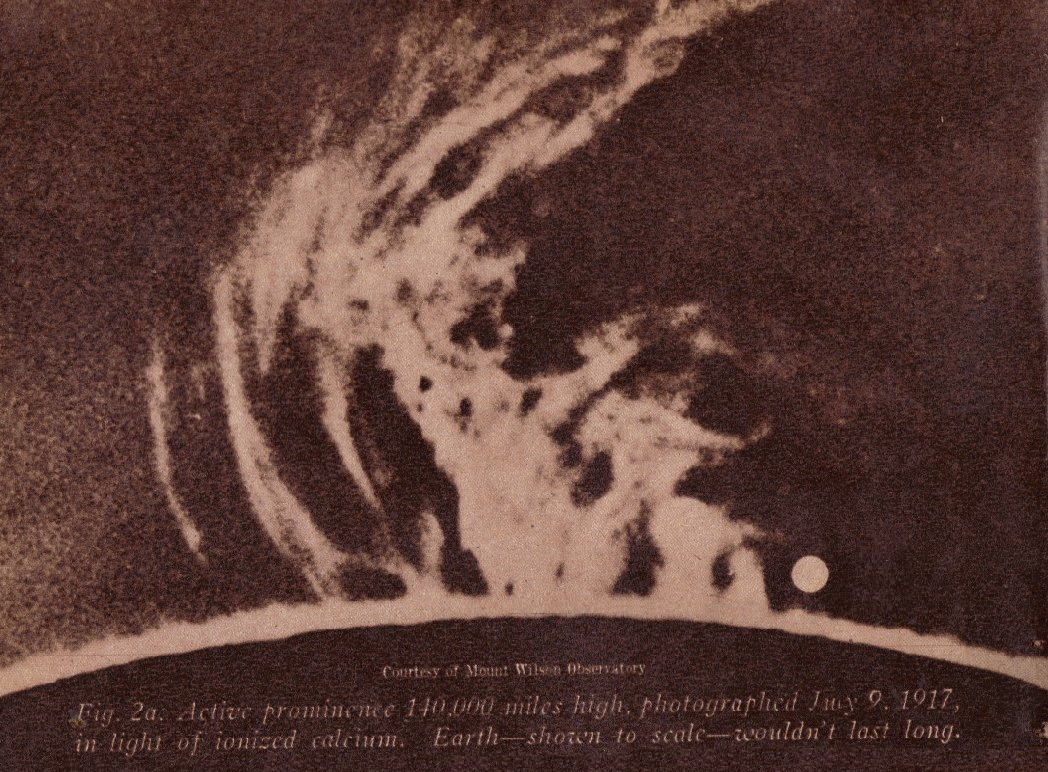
1917 This image of a solar flare taken from Mt Wilson observatory shows a solar flare 140,000 miles high. The white dot is image of the Earth drawn to scale. I came across this at a site called thegildedcentury .

1941 British cryptologists break the secret code used by the German army to direct ground-to-air operations on the Eastern front.
British experts had already broken many of the Enigma codes for the Western front. Enigma was the Germans' most sophisticated coding machine, necessary to secretly transmitting information. The Enigma machine, invented in 1919 by Hugo Koch, a Dutchman, looked like a typewriter and was originally employed for business purposes. The Germany army adapted the machine for wartime use and considered its encoding system unbreakable. They were wrong. The Brits had broken their first Enigma code as early as the German invasion of Poland and had intercepted virtually every message sent through the occupation of Holland and France. Britain nicknamed the intercepted messages Ultra.
Now, with the German invasion of Russia, the Allies needed to be able to intercept coded messages transmitted on this second, Eastern, front. The first breakthrough occurred on July 9, regarding German ground-air operations, but various keys would continue to be broken by the Brits over the next year, each conveying information of higher secrecy and priority than the next. (For example, a series of decoded messages nicknamed "Weasel" proved extremely important in anticipating German anti-aircraft and antitank strategies against the Allies.) These decoded messages were regularly passed to the Soviet High Command regarding German troop movements and planned offensives, and back to London regarding the mass murder of Russian prisoners and Jewish concentration camp victims. *History.com

1953 France issued a stamp picturing Gaspard Monge. [Scott #279].
(Does anyone else think he looks like Marlon Brando??)


1981 Nintendo releases the arcade game Donkey Kong featuring the debut of Mario. *Wik

1996 With the satellite SOHO, they discover that solar flares causes sun quakes. *NSEC Scientists have shown for the first time that solar flares produce seismic waves in the Sun's interior that closely resemble those created by earthquakes on our planet. Dr. Alexander G. Kosovichev, a senior research scientist from Stanford University, and Dr. Valentina V. Zharkova from Glasgow (United Kingdom) University found the tell-tale seismic signature in data on the Sun's surface collected by the Michelson Doppler Imager onboard the Solar and Heliospheric Observatory (SOHO) spacecraft immediately following a moderate-sized flare on July 9, 1996. "Although the flare was a moderate one, it still released an immense amount of energy," said Dr. Craig Deforest, a researcher with the SOHO project. "The energy released is equal to completely covering the Earth's continents with a yard of dynamite and detonating it all at once."

2004 The day after a transit of Venus occurred as predicted by Horrocks using William Crabtree's measures of the size of Venus and the Earth-Sun distance, a commemorative street nameplate in memory of William Crabtree was unveiled at the junction of Lower Broughton Road and Priory Grove which marks the northern boundary of Crabtree Croft where he observed the transit. *Wik


2006 Tesla Memorial at Canadian side of Niagara Falls unveiled. The bronze statue by Les Drysdale depicts Tesla atop an AC motor, in commemoration of Tesla's engineering achievements at Niagara Falls. The marker at the site credits Tesla with the " "world's first hydroelectic power system". Since this power plant suppossedly "the first power reached Buffalo at midnight, November 16, 1896" this will surprise folks who are aware that Thomas Edison's electrical power plant in New York was in 1882. (What Tesla did was momentus, whether it was first or not).


BIRTHS

1845 Birthdate of George Howard Darwin (9 July 1845 – Cambridge, 7 December 1912), fifth child of the evolutionist Charles Darwin. After graduating second wrangler and Smith’s prizeman at Cambridge in 1866 he studied law before settling down to his life work in mathematical astronomy. He addressed the Fifth International Congress of Mathematicians at Cambridge in 1912 on his work on the three body problem. *VFR  He championed a theory (no longer accepted) that the Moon was once part of the Earth, in what is now the Pacific Ocean. His was the first mathematical analysis of the evolution of Earth's Moon. He suggested that since the effect of the tides has been to slow the Earth's rotation and to cause the Moon to recede from the Earth, then by extrapolating back 4.5 billion years ago the Moon and the Earth would have been very close, with a day being less than five hours. Before this time the two bodies would actually have been one, until the Moon was torn away from the Earth by powerful solar tides that would have deformed the Earth every 2.5 hours. *TIS

1855 Spiridon Gopcevic (July 9, 1855 – ? 1928) was a Serbian astronomer and historian. He is also known by his pen name of Leo Brenner. In 1893 he founded Manora Observatory on Mali Lošinj. This observatory was named for his wife, a wealthy Austrian noblewoman. At this observatory, Spiridon used the 17.5cm refractor telescope at the observatory to make observations of Mars, the rings of Saturn, and other planets. However he would eventually close the observatory in 1909 due to financial problems.
From 1899 until 1908 he was the founder and editor of the Astronomische Rundschau, a popular scientific journal. He spent several years in America before returning to Europe and editing an army journal in Berlin during the war. The circumstances of his death are somewhat uncertain, but he appears to have been impoverished.
The crater Brenner on the Moon was named after him (based on his nom de plume) by his friend Phillip Fauth. A new observatory was built on Mali Lošinj in 1993, and was named "Leo Brenner". *Today in Astronomy

1911 John Archibald Wheeler (July 9, 1911 – April 13, 2008) was an American theoretical physicist who was largely responsible for reviving interest in general relativity in the United States after World War II. Wheeler also worked with Niels Bohr in explaining the basic principles behind nuclear fission. One of the later collaborators of Albert Einstein, he tried to achieve Einstein's vision of a unified field theory. He is also known for having coined the terms black hole, quantum foam and wormhole and the phrase "it from bit". For most of his career, Wheeler was a professor at Princeton University and was influential in mentoring a generation of physicists who made notable contributions to quantum mechanics and gravitation.*Wik  I love this Wheeler quote, "In any field, find the strangest thing and then explore it."  Thanks to

1931 Valentina Mikhailovna Borok (9 July 1931, Kharkiv, Ukraine, USSR–4 February 2004, Haifa, Israel) was a Soviet Ukrainian mathematician. She is mainly known for her work on partial differential equations.*Wik


DEATHS

1856 Count Amedeo Avogadro (9 August 1776, Turin, Piedmont – 9 July 1856) Italian chemist and physicist who found that at the same temperature and pressure equal volumes of all perfect gases contain the same number of particles,  known as Avogadro's Law (1811) leading to the Avogadro's constant being 6.022 x 10²³ units per mole of a substance. He realized the particules could be either atoms, or more often, combinations of atoms, for which he coined the word "molecule." This explained Gay-Lussac's law of combining volumes (1809). Further, Avogadro determined from the electrolysis of water that it contained molecules formed from two hydrogen atoms for each atom of oxygen, by which the individual oxygen atom was 16 times heavier than one hydrogen atom (not 8 times as suggested earlier by Dalton.) The Italian, Romano Amadeo Carlo Avogadro, had suggested [in 1811] that all gases have the same number of molecules in a given volume. Loschmidt figured out [in 1865] how many molecules that would be which is the number now known as Avogadro's constant. John D. Cook suggested that maybe it should be called Loschmidt's constant, and pointed out three interesting coincidences involving Avogadro's Constant:
NA is approximately 24! (i.e., 24 factorial.)
The mass of the earth is approximately 10 NA kilograms.
The number of stars in the observable universe is 0.5 NA.
*John D. Cook, The Endeavour Blog

1953  Henri Padé (December 17, 1863 – July 9, 1953) made important contributions to the theory of continued fractions *SAU A Padé approximant is the "best" approximation of a function by a rational function of given order – under this technique, the approximant's power series agrees with the power series of the function it is approximating. The technique was developed by Henri Padé, but goes back to Georg Frobenius who introduced the idea and investigated the features of rational approximations of power series.
The Padé approximant often gives better approximation of the function than truncating its Taylor series, and it may still work where the Taylor series does not converge. For these reasons Padé approximants are used extensively in computer calculations. *Wik

1980  Arend Heyting (May 9, 1898 – July 9, 1980) is important in the development of intuitionistic logic and algebra. (try saying that three times really fast)*SAU Heyting gave the first formal development of intuitionistic logic in order to codify Brouwer's way of doing mathematics. The inclusion of Brouwer's name in the Brouwer–Heyting–Kolmogorov interpretation is largely honorific, as Brouwer was opposed in principle to the formalisation of certain intuitionistic principles (and went as far as calling Heyting's work a "sterile exercise").*Wik

1984 Edna Ernestine Kramer Lassar (May 11, 1902 - July 9, 1984) died of pneumonia at her home in Manhattan. She graduated magna cum laude from Hunter College and earned a Ph.D. at Columbia in 1930. She is best known for her book The Nature and Growth of Modern Mathematics, which is an excellent exposition of much of modern mathematics. It is very accessible to undergraduates. For more about her, see Women of Mathematics. A Biobibliographic Sourcebook (1987), edited by Louise S. Grinstein and Paul J. Campbell. *VFR


1996 Douglas George Chapman (March 20, 1920 - July 9, 1996)was a Canadian-born U.S. mathematical statistician  and an expert on wildlife statistics. He was one of the scientific advisors to the International Whaling Commission that warned in the 1960s that the number of whales being taken by the whaling industry was far in excess of what the population could stand, and proposed annual fin whale catch quotas that would permit the depleted populations of this species to recover. His later research on fish farming expanded to include mollusk aquaculture and he directed a program to develop quantitative methods to aid in the management of fisheries resources.*TIS


Credits :
*CHM=Computer History Museum
*FFF=Kane, Famous First Facts
*NSEC= NASA Solar Eclipse Calendar
*RMAT= The Renaissance Mathematicus, Thony Christie
*SAU=St Andrews Univ. Math History
*TIA = Today in Astronomy
*TIS= Today in Science History
*VFR = V Frederick Rickey, USMA
*Wik = Wikipedia
*WM = Women of Mathematics, Grinstein & Campbell

Sunday, 8 July 2018

On This Day in Math - July 8


I never came across one of Laplace's "Thus it plainly appears"
without feeling sure that I have hours of hard work before me to fill up the chasm
and find out and show how it plainly appears.
Nathanial Bowditch, Quoted in F Cajori, The Teaching and History of Mathematics in the United States
(LaPlace's classic, "Mecanique Celeste", is a very difficult book, and Biot, who helped him prepare it for printing said that Laplace himself would frequently get lost in following his own line of reasoning  and insert, "il est aise a voir".
 Bowditch translated the work and Legendre wrote of the translation, "Your work is not merely a translation with a commentary; I regard it as a new edition, augmented and improved, and such a one as might have come from the hands of the author himself, ... if he had been solicitously studious of being clear." )


The 189th day of the year; the product of the primes in a prime quadruplet always end in 189, except for the very first quadruplet 3x5x7x11.(A prime quadruplet (sometimes called prime quadruple) is a set of four primes of the form {p, p+2, p+6, p+8} you can see some of the smaller ones listed here

There are 14 prime years in the 21st Century (2017 will be the third), but the 189th century would be the first to contain as few as five prime years (18803, 18839, 18859, 18869 and 18899).

Narayana, an Indian mathematician in the 14th century, came up with an interesting Fibonacci-like series: A cow produces one calf every year. Beginning in its fourth year, each calf produces one calf at the beginning of each year. How many cows and calves are there altogether after n years? For the 15th year, the total is 189. (How many mature and immature?)

2357 is a prime number. 23357 is also prime.  233357 is also prime but 2333357 is not, and then 23333357 is; and yes, this is somehow related to the number 189. I came across a sequence on OEIS  which gave "Numbers k such that (7*10^k + 71)/3 is prime." Like you may have, I wondered, "Why would someone search for primes of so unusual a sequence?" Well, if you take those prime numbers, and subtract 2 from them, you get the number of threes that when placed between the digit 2 and the digits 57, will produce a prime. So I can inform you today that not only is (7*10189 +71 )/3 a prime number, but that prime number is a 2 followed by 187 threes followed by 57.  And you thought 189 was just some hum-drum number!!!!!


EVENTS

1672 Newton's first publication is in a letter to the Philosophical Transactions: “A Serie’s of Quere’s Propounded by Mr. Isaac Newton, to be Determin’d by Experiments, Positively and Directly Concluding His New Theory of Light and Colours; and Here Recommended to the Industry of the Lovers of Experimental Philosophy, as they Were Generously Imparted to the Publisher in a Letter of the Said Mr. Newtons of July 8.1672” (Thanks to Thony Christie) *Philosophical Transactions

1680 Hooke demonstrates sound vibration. This was done by putting flour on a glass plate, and bowing on the edge of glass. Hooke had observed that the motion of the glass was vibrate perpendicular to the surface of the glass, and that the circular figure of the flour changed into an oval one way, and the reciprocation of it changed it into an oval the other way. This phenomenon was rediscovered by Chladni in the eighteenth century, and given his name "Chladni figures". *Daniel P McVeigh, "An Early History of the Telephone 1664-1865"

1706 de Moivre wrote to Johann Bernoulli on 8 July 1706 telling him about Machin's series for π he suggested that Johann Bernoulli might tell Jakob Hermann about Machin's unproved result. He did so and Hermann quickly discovered a proof that Machin's series converges to π. He produced techniques that show other similar series also converge rapidly to π and he wrote on 21 August 1706 to Leibniz giving details. Two years later, on 6 July 1708, de Moivre wrote again to Johann Bernoulli about Machin's series, on this occasion giving two different proofs that it converged to π.
In 1706 William Jones published a work Synopsis palmariorum matheseos or, A New Introduction to the Mathematics, Containing the Principles of Arithmetic and Geometry Demonstrated in a Short and Easie Method ... Designed for ... Beginners. (This is the book in which Jones first uses Pi in the mathematical sens it is now used) This contains on page 243 the following passage:-
There are various other ways of finding the lengths or areas of particular curve lines, or planes, which may very much facilitate the practice; as for instance, in the circle, the diameter is to the circumference as 1 to (16/5- 4/239) - 1/3(16/53- 4/2393) &c. = 3.14159 &c. = π. This series (among others for the same purpose, and drawn from the same principle) I received from the excellent analyst, and my much esteemed friend Mr John Machin; and by means thereof, van Ceulen's number, or that in Art. 64.38 may be examined with all desirable ease and dispatch.
Jones also reports that this formula allows π be calculated:-
... to above 100 places; as computed by the accurate and ready pen of the truly ingenious Mr John Machin. No indication is given in Jones's work, however, as to how Machin discovered his series expansion for π.

1831 Quetelet officially uses the term, "l'homme moyen" in an article about the different ages at which men commit crimes. *Statistics on the Table: The History of Statistical Concepts and Methods By Stephen M. Stigler

1835 Liberty bell cracked. *VFR Or maybe not In the 1830s, the bell was adopted as a symbol by abolitionist societies, who dubbed it the "Liberty Bell". It acquired its distinctive large crack sometime in the early 19th century—a widespread story claims it cracked while ringing after the death of Chief Justice John Marshall in 1835.*Wik

1842 Francis Baily (1774-1844) UK, at an eclipse in Italy, focuses attention on the corona and prominences and identifies them as part of the Sun's atmosphere. *NSEC

1842 Dominique Francois Jean Arago (1786-1853), French astronomer. Studied solar eclipse of July 08, 1842 and concluded the sun exist of gas.*NSEC

1881, a patron came into Edward Berner's drug store in Two Rivers, Wisconsin, and sat down at the soda-fountain counter. Since it was the Sabbath, the customer couldn't have the desirable, but scandalous, flavored soda water. Berner compromised by putting ice cream in a dish and poured over it the chocolate syrup that was previously only served as flavoring in ice-cream sodas. That was an ice cream Sunday! The name became "sundae", after the day on which Berner served it. TIS

1933 Jansky announced detection of radio radiation from galactic center.*VFR Before Jansky observed the Milky Way in the 1930s, physicists speculated that radio waves could be observed from astronomical sources. In the 1860s, James Clerk Maxwell's equations had shown that electromagnetic radiation is associated with electricity and magnetism, and could exist at any wavelength. Several attempts were made to detect radio emission from the Sun by experimenters such as Nikola Tesla and Oliver Lodge, but those attempts were unable to detect any emission due to technical limitations of their instruments.
Karl Jansky made the discovery of the first astronomical radio source serendipitously in the early 1930s. As an engineer with Bell Telephone Laboratories, he was investigating static that interfered with short wave transatlantic voice transmissions. Using a large directional antenna, Jansky noticed that his analog pen-and-paper recording system kept recording a repeating signal of unknown origin. Since the signal peaked about every 24 hours. *Wik

2002 Well into his mid-nineties, Donald Coxeter gives the keynote address at the Janos Bolyai Conference on Hyperbolic Geometry with a new paper on the Descartes circle theorem as extended by Phillip Beecroft. His Opening remarks:
The Absolute property of four mutally tangent circles that I am describing seems to have been discovered by Mr. Phillip Beecroft, of Hyde Academy, Cheshire, England, and published in The Lady and Gentleman's Dairy... In Beecroft's own words, "If any four circles be described to touch each other mutually, another set of four circles of mutual contact may be described whose points of contach shall coincide with those of the first four." He then proceeded to give a new and elegant proof of the 1842 theorem, which extended the four circle theorem of Descartes to be, in essence, an eight circle theorem.
*Siobhan Roberts, King of Infinite Space


BIRTHS

1760 Christian Kramp (July 8, 1760 – May 13, 1826) was a French mathematician, who worked primarily with factorials.
As Bessel, Legendre and Gauss did, Kramp worked on the generalised factorial function which applied to non-integers. His work on factorials is independent of that of James Stirling and Vandermonde. He was the first to use the notation n! (Elements d'arithmétique universelle, 1808). In fact, the more general concept of factorial was found at the same time by Arbogast.*TIS For more on the symbols and history of the factorial see here.

1777 Daniel Friedrich Hecht (8 July 1777 in Sosa – 13 March 1833 in Saxony) was a German mathematician. He was a mine manager, then a teacher and finally a professor of mathematics. He is most notable for writing high school textbooks on maths and geometry. *Wik

1838 Count Ferdinand von Zeppelin Germany aviation pioneer who built the first rigid dirigible airships, named Zeppelins. He patented his idea on 31 Aug 1895 and formed a company to build airships in 1898. Many thought his invention incredible, and called him "Foolish Count". His first airship took off in 2 Jul 1900 at Lake Constance, where it had been assembled in a floating assembly shed. He continued to improve the design and built a fleet of airships for commercial passenger service. During WW I, Zeppelins were used to bomb Britain beginning 19 Jan 1915 with attacks on Great Yarmouth and King's Lynn. After the war, passenger service included transatlantic flights. Zeppelin use ended after the 6 May 1937 Hindenburg fire disaster at Lakehurst, N.J., U.S.A.*TIS

1895 Igor Yevgenyevich Tamm (8 July 1895 – 12 April 1971) Soviet physicist who shared the 1958 Nobel Prize for Physics with Pavel A. Cherenkov and Ilya M. Frank for his efforts in explaining Cherenkov radiation. Tamm was an outstanding theoretical physicist, after early researches in crystallo-optics, he evolved a method for interpreting the interaction of nuclear particles. Together with I. M. Frank, he developed the theoretical interpretation of the radiation of electrons moving through matter faster than the speed of light (the Cerenkov effect), and the theory of showers in cosmic rays. He has also contributed towards methods for the control of thermonuclear reactions. *TIS
one of my favorite math stories is from George Gamow's autobiography and is about Tamm.
"Here is a story told to me by one of my friends who was at that time
a young professor of physics in Odessa. His name was Igor Tamm (Nobel
Prize laureate in Physics, 1958). Once when he arrived in a neighboring
village, at that period when Odessa was occupied by the Reds, and was
negotiating with a villager as to how many chickens he could get for
half a dozen silver spoons, the village was captured by one of the
Makhno bands, who were roaming the country, harassing the Reds. Seeing
his city clothes (or what was left of them), the capturers [sic]
brought him to the Ataman, a bearded fellow in a tall black fur
hat with machine-gun cartridge ribbons crossed on his broad chest and
a couple of hand grenades hanging on the belt.

'You son-of-a-bitch, you Communist agitator, undermining our Mother
Ukraine! The punishment is death.'

'But no,' answered Tamm, 'I am a professor at the University of Odessa
and have come here only to get some food.'

'Rubbish!' retorted the leader. 'What kind of professor are you ?'

'I teach mathematics.'

'Mathematics?' said the Ataman. 'All right! Then give me an estimate of
the error one makes by cutting off Maclaurin's series at the nth term.
Do this, and you will go free. Fail, and you will be shot!'

Tamm could not believe his ears, since this problem belongs to a rather
special branch of higher mathematics. With a shaking hand, and under
the muzzle of the gun, he managed to work out the solution and handed
it to the Ataman.

'Correct!' said the Ataman. 'Now I see that you really are a professor.
Go home!'

Who was this man? No one will ever know. If he was not killed later, he
may well be lecturing now on higher mathematics in some Ukrainian
university."

I tell this story every other year or so to my physics students when
they cannot be bothered to remember the form of the remainder in Taylor
expansions....


1904 Henri (-Paul) Cartan, (July 8, 1904 – August 13, 2008) mathematician born in Nancy, France. His father, Elie Cartan, was also a mathematician. Henri made fundamental advances in the theory of analytic functions, worked on the theory of sheaves, homological theory, algebraic topology and potential theory. Along with others, such as Weil and Dieudonné, Henri Cartan wrote under the name Bourbaki. Bourbaki's Eléments de mathématique contains more than 30 volumes and aims to present mathematics so as to illustrate the axiomatic structure of modern mathematics. *TIS

1915 Kenneth O. May (July 8, 1915, Portland, Or. – December 1,1977) was an American mathematician and historian of mathematics, who developed May's theorem. The Kenneth O. May Prize is awarded for outstanding contributions to the history of mathematics. Ken May established Historia Mathematica, and preserved it by separating it from its creator, "The distinguished predecessors of HM were associated with their founders and died with them.  If HM is to avoid this fate, we must prepare and carry through a prompt transfer of editorial responsibility to younger hands." His list of publications numbers above 300.  *Henry S. Tropp, E'loge, Isis 70, Sept 1979, Pgs 419-422


DEATHS

1390 Albert of Saxony died. He wrote an excellent logic text and published two works on squaring the circle. *VFR ert was born at Rickensdorf near Helmstedt, the son of a farmer in a small village; but because of his talent, he was sent to study at the University of Prague and the University of Paris.
At Paris, he became a master of arts (a professor), and held this post from 1351 until 1362. In 1353, he was rector of the University of Paris. After 1362, Albert went to the court of Pope Urban V in Avignon as an envoy of Rudolf IV, Duke of Austria, in order to negotiate the founding of the University of Vienna. The negotiations were successful, and Albert became the first rector of this University in 1365.
In 1366, Albert was elected bishop of Halberstadt (counted as Albert III), Halberstadt being the diocese in which he was born. As Bishop of Halberstadt, he allied himself with Magnus with the Necklace, Duke of Brunswick-Lüneburg, against Gebhard of Berg, Bishop of Hildesheim, and was taken prisoner by Gebhard in the battle of Dinckler in 1367.
He died at Halberstadt in 1390.*Wik

1695 Christiaan Huygens (14 April 1629 – 8 July 1695) Dutch mathematician, astronomer, and physicist, who founded the wave theory of light, discovered the true shape of the rings of Saturn, and contributed to the science of dynamics - the study of the action of forces on bodies. Using a lens he ground for himself, on 25 Mar 1655, he discovered the first moon of Saturn, later named Titan. In 1656, he patented the first pendulum clock, which he developed to enable exact time measurement while observing the heavens. Huygens studied the relation of the length of a pendulum to its period of oscillation (1673) and stated theories on centrifugal force in circular motion which influenced Sir Isaac Newton in formulating his Law of Gravity. Huygens also studied and drew the first maps of Mars. On 14 Jan 2005, a NASA space probe, named after Huygens, landed on Titan. *TIS

1902 John Daniel Runkle (October 11, 1822 – July 8, 1902) was a U.S. educator and mathematician. B.S. in mathematics, 1851, Harvard College, second president of the Massachusetts Institute of Technology, was associated with the Nautical Almanac computation project from 1849 to 1884. In 1858 he founded the journal Mathematical Monthly and edited it for three years, when publication ceased. In 1860 he was a member of the committee that prepared the “Objects and Plan of an Institute of Technology” which led to the establishment of MIT. In 1862 he became MIT’s first secretary, and in 1865 he joined the new faculty as professor of mathematics, where he remained until 1902. He served as president pro-tem, 1868-1870, and was MIT’s second president, 1870-1878. He was married to Catherine Robbins Bird Runkle. *MIT History

1971 Kurt Werner Friedrich Reidemeister (October 13, 1893 – July 8, 1971) was a mathematician born in Braunschweig (Brunswick), Germany.
He received his doctorate in 1921 with a thesis in algebraic number theory at the University of Hamburg under the supervision of Erich Hecke. In 1923 he was appointed assistant professor at the University of Vienna. While there he became familiar with the work of Hans Hahn and Wilhelm Wirtinger. In 1925 he became full professor at University of Königsberg, where he stayed until 1933, when he was forced to leave because of his opposition of the Nazis.
Reidemeister's interests were mainly in combinatorial group theory, combinatorial topology, geometric group theory, and the foundations of geometry. His books include Knoten und Gruppen (1926), Einführung in die kombinatorische Topologie (1932), and Knotentheorie (1932). He was the brother of Marie Neurath.*Wik

1979 Shin'ichiro Tomonaga (March 31, 1906 – July 8, 1979) Japanese physicist who shared the Nobel Prize for Physics in 1965 (with Richard P. Feynman and Julian S. Schwinger of the U.S.) for independently developing basic principles of quantum electrodynamics. He was one of the first to apply quantum theory to subatomic particles with very high energies. Tomonaga began with an analysis of intermediate coupling - the idea that interactions between two particles take place through the exchange of a third (virtual particle), like one ship affecting another by firing a cannonball. He used this concept to develop a quantum field theory (1941-43) that was consistent with the theory of special relativity. WW II delayed news of his work. Meanwhile, Feynman and Schwinger published their own independent solutions.

2008 Sixto Ríos García (January 4, 1913; Pelahustán, Toledo - July 8, 2008; Madrid,) was a Spanish mathematician, known as the father of Spanish statistics.
He has held the positions of Director of the School of Statistics at the University of Madrid, Director of the Institute for Operations Research and Statistics CSIC, Director, Department of Statistics, Faculty of Mathematical Sciences at the Complutense University and President of the Spanish Society Operational Research, Statistics and Information. It was academic correspondent of the National Academy of Sciences of Buenos Aires, and organizer and founder, commissioned by Unesco, School of Statistics, University of Caracas. He was a member of the drafting committee of Statistical Abstracts and fellow of the International Statistical Institute and the Institute of Mathematical Statistics. Wik-ES

2010 David Harold Blackwell (April 24, 1919 – July 8, 2010) was Professor Emeritus of Statistics at the University of California, Berkeley, and is one of the eponyms of the Rao–Blackwell theorem. Born in Centralia, Illinois, he was the first African American inducted into the National Academy of Sciences, and the first black tenured faculty member at UC Berkeley.*Wik


Credits :
*CHM=Computer History Museum
*FFF=Kane, Famous First Facts
*NSEC= NASA Solar Eclipse Calendar
*RMAT= The Renaissance Mathematicus, Thony Christie
*SAU=St Andrews Univ. Math History
*TIA = Today in Astronomy
*TIS= Today in Science History
*VFR = V Frederick Rickey, USMA
*Wik = Wikipedia
*WM = Women of Mathematics, Grinstein & Campbell

Saturday, 7 July 2018

On This Day in Math - July 7


Probability is a mathematical discipline whose aims are akin to those, 
for example, of geometry of analytical mechanics.
In each field we must carefully distinguish three aspects of the theory:
(a) the formal logical content,
(b) the intuitive background,
(c) the applications.
The character, and the charm, of the whole structure cannot be appreciated without 
considering all three aspects in their proper relation.
William Feller, An Introduction to Probability Theory and its Applications


The 188th day of the year; 188 is the largest known even number that can be expressed as the sum of two (distinct) primes in exactly five ways. *Prime Curios Students might seek smaller numbers that can be so expressed..

Neither 1882  nor 1883 contain a one or an eight. *@Derektionary

There are 188 11 bead necklaces using two colors, if the necklace can not be turned over.

188 is a Happy number: trajectory under iteration of sum of squares of digits map to 1.


EVENTS

1339 There was an annular-total eclipse, with the total part of the track finding its way between the Orkney and Shetland Islands without touching either. At this location the track of totality was only 1 km wide, with a duration of 1 second! Presuming that you could position a boat to an accuracy of 1 km, totality must have been a ring of Baily's Beads. *NSEC

1637 In 1625 (Christen Sørensen) Longomontanus suggested to the King, Christian IV, that he should build an observatory to replace Tycho’s Stjerneborg, which had been demolished in 1601. The observatory, the Rundetaarn (Round Tower), was conceived as part of the Trinitatis Complex: a university church, a library and the observatory. The foundation stone was laid on 7 July 1637 and the tower was finished in 1642. Longomontanus was appointed the first director of the observatory, after Leiden 1632 only the second national observatory in Europe. The church and Library were finished in 1657. *RMAT, Tycho’s last bastion

1668, Sir Isaac Newton received his M.A. from Trinity College in Cambridge.*TIS

1742 Goldbach's conjecture was sent in a letter to Leonhard Euler on 7 Jul 1742. Stated in modern terms it proposes that: "Every even natural number greater than 2 is equal to the sum of two prime numbers." It has been checked by computer for vast numbers - up to at least 4 x 10¹⁴ - but still remains unproved. *TIS

1747 Johann Sebastian Bach dedicated his Musikalisches Opfer (Musical Offering) to Frederick the Great. For a discussion of the mathematical significance of this cerebral music, see Godel, Escher, Bach: An Eternal Golden Braid by Douglas R. Hofstadter. *VFR

1777 Johan Bernoulli, then astronomer Royal, Berlin, is paid a sum of 84 pounds for the Sexcentenary tables.  "To Mr. John Hyacinth Magellan....for the use of Mr. Bournoulli .. as a reward for his care and trouble in constructing a manuscript Book of Tables for facilita."
Two years later they would pay 28.35 pounds to Dr. Charles Hutton for translating the preface of the tables.

1788 Caroline Herschel's nebula discovery,* History of Astronomy ‏@HistAstro

1823 William Rowan Hamilton passed into Trinity College, Dublin. He was easily first out of the 100 candidates. *VFR

1847 Lassel discovered a satellite of Neptune. *VFR (this date does not concur with other dates on these discoveries) In 1846 Lassell discovered Triton, the largest moon of Neptune, just 17 days after the discovery of Neptune itself by German astronomer Johann Gottfried Galle. In 1848 he independently co-discovered Hyperion, a moon of Saturn. In 1851 he discovered Ariel and Umbriel, two new moons of Uranus.*Wik

1855, a letter from Michael Faraday in The Times newspaper, London, described the polluted state of the River Thames he had observed on a boat trip: "The whole of the river was an opaque pale brown fluid. In order to test the degree of opacity, I ... dropped [pieces of card] into the water at every pier the boat came to; before they had sunk an inch below the surface they were indistinguishable, though the sun shone brightly at the time." His words, he said, were no exaggeration, they were "the simple truth." He asserted, "If there be sufficient authority to remove a putrescent pond from the neighborhood of a few simple dwellings, surely the river which flows for so many miles through London ought not to be allowed to become a fermenting sewer." *TIS  I wrote a few years ago about the return of the seahorse to the muddy waters of the Thames. 

1960 Press conference announces discovery of laser to the world. "VoilÁ. that Was It! The Laser was Born!" *Hughes Research Lab Web page.

BIRTHS

1638 Francois or Francois Bertrand Barrême Barrême,(7 July 1638, Tarascon, France - 1703, Paris France) is considered one of the founders of accounting . After having engaged in trading in Italy , he moved to Paris where he gave lessons in bookkeeping and became a protégé of Colbert . Expert for the accounts of the Accounting Chamber of Paris and King's ordinary arithmetician, he is the author of books of mathematical conversions. His books were so common that today his name is used for what was once in English called a "ready reckoner", a table of numbers used to facilitate simple calculations, esp one for applying rates of discount, interest, charging, etc, to different sums . *Wik

1746 Giuseppe Piazzi (July 7, 1746 - July 22, 1826) an Italian mathematician and astronomer. He discovered the asteroid Ceres and established an observatory at Palermo, now the Osservatorio Astronomico di Palermo – Giuseppe S. Vaiana. (for more detail see the source article) *Today in Astronomy


*Wik
1752 Joseph-Marie Jacquard born (7 July 1752 – 7 August 1834). *VFR French silk weaver, (born Lyons), inventor of the Jacquard programmable power loom for brocaded fabric. His loom would mechanically produce any pattern, controlled by perforated control cards (1805). This served as the impetus for the technological revolution of the textile industry and is the basis of the modern automatic loom. The concept of using punched cards was later applied by Hollerith to keeping track of the 1890 US census data. The idea futher evolved to computer input punched cards. *TIS

1816 Rudolf Wolf Swiss (7 July 1816 – 6 December 1893) astronomer and astronomical historian. Wolf's main contribution was the discovery of the 11 year sunspot cycle and he was the codiscoverer of its connection with geomagnetic activity on Earth. In 1849 he devised a system now known as Wolf's sunspot numbers. This system is still in use for studying solar activity by counting sunspots and sunspot groups. In mathematics, Wolf wrote on prime number theory and geometry, then later on probability and statistics - a long paper discussed Buffon's needle experiment. He estimated by Monte Carlo methods.*TIS

1888 Archibald Goldie (7 July 1888 in Glenisla, Angus, Scotland - 24 Jan 1964 in London, England) studied at the universities of St Andrews and Cambridge. He served in the Meteorological Service of the British Army in World War I and continued to work in various branches of the Meteorological Office.*SAU

1906 William Feller (July 7, 1906 – January 14, 1970). He once said that multiplication, especially before breakfast, is seldom commutative. He died in 1970. *VFR
Feller was one of the greatest probabilists of the twentieth century, who is remembered for his championing of probability theory as a branch of mathematical analysis in Sweden and the United States. In the middle of the 20th century, probability theory was popular in France and Russia, while mathematical statistics was more popular in the United Kingdom and the United States, according to the Swedish statistician, Harald Cramér. His two-volume textbook on probability theory and its applications was called "the most successful treatise on probability ever written" by Gian-Carlo Rota. By stimulating his colleagues and students in Sweden and then in the United States, Feller helped establish research groups studying the analytic theory of probability. In his research, Feller contributed to the study of the relationship between Markov chains and differential equations, where his theory of generators of one-parameter semigroups of stochastic processes gave rise to the theory of "Feller operators".*Wik


DEATHS

1900 Eduard Wiltheiss (12 June 1855 Worms, Germany – 7 July 1900 Halle) was a German mathematician who made major contributions to the theory of abelian functions *VFR

1927 Magnus Gustaf Mittag-Leffler died (16 March 1846 – 7 July 1927) . Swedish mathematician who founded the international mathematical journal Acta Mathematica and whose contributions to mathematical research helped advance the Scandinavian school of mathematics. Mittag-Leffler made numerous contributions to mathematical analysis (concerned with limits and including calculus, analytic geometry and probability theory). He worked on the general theory of functions, concerning relationships between independent and dependent variables. His best known work concerned the analytic representation of a one-valued function, this work culminated in the Mittag-Leffler theorem.*TIS

1930 Sir Arthur Conan Doyle (22 May 1859 – 7 July 1930) Scottish novelist, physician, spiritualist. His fictional detective, Sherlock Holmes, emulates the scientist, diligently searching through data and to make sense of it. "It is a capital mistake to theorize before one has data. Insensibly one begins to twist facts to suit theories, instead of theories to suit facts." *TIS

1942 William Henry Young (London, 20 October 1863 - Lausanne, 7 July 1942) discovered Lebesgue integration, independently but 2 years after Lebesgue. He studied Fourier series and orthogonal series in general.*SAU

1975 William Hodge (17 June 1903 – 7 July 1975) studied at Edinburgh and Cambridge Universities. After some time at Bristol and in the USA he returned to Cambridge and became Lowndean Professor of Astronomy and Geometry. His main interests were in Algebraic Geometry and Differential Geometry. He became an honorary member of the EMS in 1954. He was knighted in 1959. *SAU His discovery of far-reaching topological relations between algebraic geometry and differential geometry—an area now called Hodge theory and pertaining more generally to Kähler manifolds—has been a major influence on subsequent work in geometry. *Wik

2014 Klaus Peters,( --, July 7, 2014) mathematician and STEM Publisher for over 50 years, passed away on July 7, 2014. Klaus, who received his doctorate from University of Erlangen in 1962, became well-known in the mathematical community largely through A.K. Peters Ltd, publisher of scientific and technical books, specializing in mathematics and computer science, as well as journals Experimental Mathematics, Internet Mathematics, and the Journal of Graphics Tools. Klaus was a familiar face at mathematics meetings around the world, and recently consulted with the AMS publishing division on a number of different projects, including Really Big Numbers. He was a strong and eloquent advocate for scholarly publishing. *AMS


Credits :
*CHM=Computer History Museum
*FFF=Kane, Famous First Facts
*NSEC= NASA Solar Eclipse Calendar
*RMAT= The Renaissance Mathematicus, Thony Christie
*SAU=St Andrews Univ. Math History
*TIA = Today in Astronomy
*TIS= Today in Science History
*VFR = V Frederick Rickey, USMA
*Wik = Wikipedia
*WM = Women of Mathematics, Grinstein & Campbell