Thursday, 12 July 2018

On This Day in Math - July 12


Technical skill is mastery of complexity while creativity is mastery of simplicity.
Sir Christopher Zeeman

Today is the 193rd day of the year; 193 is one of a twin prime pair and is the sum of products of the first three twin primes pairs: 3*5 + 5*7 + 11*13 = 193. *Prime Curios

The square of 193 (37249) concatenated with its reverse (which is a prime) results in a palindrome that is the product of 2 palindromes, one non-prime (1001) and one prime (3721273).

193 is the smallest prime whose fifth power contains all digits from 1 to 9.

(I also like 193/71 is the closest ratio of two primes less than 2000 to the number e.)


EVENTS

1389 King Richard II appoints Geoffrey Chaucer to the position of chief clerk of the king's works in Westminster. Although remembered today for his unfinished "Canterbury Tales" (he had intended 200 stories but only finished 22), he achieved fame during his lifetime as a philosopher, alchemist and astronomer, composing a scientific treatise on the astrolabe for his ten year-old son Lewis.

1831 Gauss to Schumacher: “I protest against the use of an infinite quantity as an actual entity; this is never allowed in mathematics. The infinite is only a manner of speaking, in which one properly speaks of limits to which certain ratios can come as near as desired, while others are permitted to increase without bound.” *VFR

1844 Captain J.N. Taylor of the Royal Navy first demonstrated the fog horn. At the time, it was called a telephone - to mean far-signalling, thus an instrument like a fog-horn, used on ships, railway trains, etc., for signalling by loud sounds or notes. The 19 July 1844 Times (London) reported, "Yesterday week was a levee day at the Admiralty, and amongst the numerous models..was Captain J. N. Tayler's telephone instrument... The chief object of this powerful wind instrument is to convey signals during foggy weather. Also the Illustrated London News on 24 Aug. 1844 referred to "The Telephone; a Telegraphic Alarum. Amongst the many valuable inventions..that of the 'Telephone, or Marine Alarum and Signal Trumpet', by Captain J. N. Taylor."*TIS

1925 Heisenberg announced the basic principles of quantum mechanics. *VFR

1969 What is believed to be the first photo of a laser appeared on the cover of Electronics,on this date .

1979 The Gossamer Albatross completed the first wholly man-powered flight across the English Channel. See August 23, 1971. *VFR

2011  Google announces winners of Google Science Fair . The top three winners by age category are:
  • Lauren Hodge in the 13-14 age group. Lauren studied the effect of different marinades on the level of potentially harmful carcinogens in grilled chicken.
  • Naomi Shah in the 15-16 age group. Naomi endeavored to prove that making changes to indoor environments that improve indoor air quality can reduce people’s reliance on asthma medications.
  • Shree Bose in the 17-18 age group. Shree discovered a way to improve ovarian cancer treatment for patients when they have built up a resistance to certain chemotherapy drugs.

BIRTHS

1808 Reverend Robert Main (July 12, 1808 – May 9, 1878) English astronomer.
Born in Kent, the eldest son of Thomas Main, Robert Main attended school in Portsea before studying mathematics at Queens' College, Cambridge, where he graduated in 1834. He served for twenty-five years (1835-60) as First Assistant at the Royal Greenwich Observatory, and published numerous articles, particularly on stellar and planetary motion, stellar parallax, and the dimensions and shapes of the planets. From 1841 to 1861 he was successively an honorary secretary, a vice-president, and President of the Royal Astronomical Society, and in 1858 was awarded the Society's Gold Medal. In 1860 he became director of Radcliffe Observatory at Oxford University after the death of Manuel Johnson, and was elected as a Fellow of the Royal Society. *Today in Astronomy

1854 George Eastman's birthday (July 12, 1854 – March 14, 1932). Eastman was the American inventor of rolled photographic film. He formed the Eastman Kodak Company to bring photography to the average person. For \($25\), a person could buy a camera with 100 exposures. Eastman promised, "You push the button, we do the rest." Once all 100 pictures were taken, the camera and a \($10\) processing fee was returned to Kodak where they reloaded the camera with film and developed and printed the pictures. *This Day in Science History

1861 George Washington Carver African-American educator, scientist, chemist, inventor, botanist. After the Civil War, Southern farmers planted cotton year after year, and the soil lost its fertility. Yields dropped. Between 1890 and 1910, the cotton crop was devastated by the bolweevil. George Washington Carver was appointed head of the agriculture department at The Tuskegee Institute in Alabama by Booker T. Washington (1896). Carver discovered and taught how to maintain the fertility of the soil. Further, his discovered two new crops that would grow well there: peanuts and sweet potatoes. Further, Carver created a market by inventing hundreds of new uses for for these crops, from milk to printer's ink .*TIS

1875 Ernst Fischer (12 July 1875 – 14 November 1954) is best known for the Riesz-Fischer theorem in the theory of Lebesgue integration.*SAU His main area of research was mathematical analysis, specifically orthonormal sequences of functions which laid groundwork for the emergence of the concept of a Hilbert space. *Wik

1895 R(ichard) Buckminster Fuller (July 12, 1895 – July 1, 1983) was an American inventor, educator, author, philosopher, engineer and architect who developed the geodesic dome, the only large dome that can be set directly on the ground as a complete structure, and the only practical kind of building that has no limiting dimensions (i.e., beyond which the structural strength must be insufficient). He held over 2000 patents.*TIS


1913 Willis Eugene Lamb, Jr (July 12, 1913 – May 15, 2008) was an American physicist and joint winner, with Polykarp Kusch, of the Nobel Prize for Physics in 1955 "for his discoveries concerning the fine structure of the hydrogen spectrum." His experimental work spurred refinements in the quantum theories of electromagnetic phenomena.*TIS The Lamb shift was an energy difference between the 2S½ and 2P½ energy levels of the hydrogen atom. According to the current theory, these two levels should have the same amount of energy, but when the electrons were exposed to a magnetic field, the energy level of 2S½ was slightly different. This discovery led to the renormalization theory of quantum electrodynamics. *This Day in Science History

1922 Michael Ventris (12 July 1922 – 6 September 1956) English architect and cryptographer who in 1952 deciphered the Minoan Linear B script. These were the inscriptions on ancient clay tablets found in Crete and a few other locations; writings which had baffled archaeologists since their discovery in 1900. He showed the script to be Greek in its oldest known form, dating from about 1400 to 1200 BC, roughly the period of the events narrated in the Homeric epics. One of the most tantalizing riddles of classical archaeology was solved, but not without creating some puzzling situations. The reading of these tablets in the Greek language raised the question: How could a literate people in the fourteenth century BC become illiterate for almost five centuries, to regain literacy in the eighth century? Ventris died young, in an auto accident, soon after his triumph.*TIS

DEATHS

1682 Jean Picard (July 21, 1620 – July 12, 1682) French Jesuit, active astronomer, cartographer, hydraulics engineer, Jean Picard devised a movable-wire micrometer to measure the diameters of celestial objects such as the Sun, Moon and planets. For land surveying and leveling, he designed instruments that incorporated the astronomical telescope. He greatly increased the accuracy of measurements of the Earth, using Snell's method of triangulation (Mesure de la Terre, 1671). This data was used by Newton in his gravitational theory. Picard was one of the first to apply scientific methods to the making of maps. Among his other skills were hydraulics; he solved the problem of supplying the fountains at Versailles with water.*TIS

1834 David Douglas (25 June 1799 – 12 July 1834) Scottish botanist who was one of the most successful of the great 19th century plant collectors. He established about 240 species of plants in Britain. His first foreign plant-hunting expedition (1824) was made throughout the Pacific Northwest of the U.S. The Douglas fir, which he cultivated from 1827, is named after him. He introduced other conifers including the Sitka spruce, now commercially important to the timber industry, and numerous garden plants and shrubs, including the lupin, California poppy and the flowering currant. At age 35, he died in by accident in Hawaii, when he fell into a pit dug by the islanders to trap wild cattle where he was trapped with a bull that also fell into the pit. He was gored to death by the bull.*TIS (add to candidate for most unusual death. see also Eduord Lucas, and Francis Bacon, send your nominees)

1983 Ernst Gabor Straus (February 25, 1922 – July 12, 1983) was a German-American mathematician who helped found the theories of Euclidean Ramsey theory and of the arithmetic properties of analytic functions. His extensive list of co-authors includes Albert Einstein and Paul Erdős as well as other notable researchers including Richard Bellman, Béla Bollobás, Sarvadaman Chowla, Ronald Graham, László Lovász, Carl Pomerance, and George Szekeres. It is due to his collaboration with Straus that Einstein has Erdős number 2. *Wik


Credits
*CHM=Computer History Museum
*FFF=Kane, Famous First Facts
*NSEC= NASA Solar Eclipse Calendar
*RMAT= The Renaissance Mathematicus, Thony Christie
*SAU=St Andrews Univ. Math History
*TIA = Today in Astronomy
*TIS= Today in Science History
*VFR = V Frederick Rickey, USMA
*Wik = Wikipedia
Posted by Pat Ballew at 00:30

Wednesday, 11 July 2018

On This Day in Math - July 11


Ten decimal places of π are sufficient to give the circumference
of the earth to a fraction of an inch, 
and thirty decimal places would give the circumference of the visible universe
to a quantity imperceptible to the most powerful microscope.
~Simon Newcomb  

The 192nd day of the year; 192 is the smallest number that together with its double and triple contain every digit from 1-9 exactly once. There are three other values of n so that n, 2n, and 3n contain each non-zero digit exactly once. Can you find them?

192 is the sum of ten consecutive primes (5 + 7 + 11 + 13 + 17 + 19 + 23 + 29 + 31 + 37)

192 is the number of edges on a 6th dimension hypercube, it is the last day of the year which is the number of edges of a hypercube.

Diophantus probably knew, and Lagrange proved, that every positive integer can be written as a sum of four perfect squares. Jacobi] proved the stronger result that the number of ways in which a positive integer can be so written equals 8 times the sum of its divisors that are not multiples of 4. Use this theorem to prove that there are 192 ways to express 14 as a sum of four squares.


EVENTS

1663 John Wallis, Savilian Professor of Geometry at Oxford, gave a specious proof of Euclid’s parallel postulate. See W. W. Rouse Ball, Mathematical Recreations and Essays, 6th edition, pp. 314– 315.*VFR

1686 Leibniz published his first paper on the integral calculus in Acta eruditorum.*VFR  This paper contains the first appearance in print of the elongated s integral notation used today. He had used the symbol earlier in a manuscript on Oct 29, 1675.

1699 Halley's final log entry for his first voyage of discovery commanding the Paramore, “The Gunns and Gunners Stores were delivered to the Tower Officers and that Same Evening we moord our Shipp at Deptford” *halleyslog.wordpress.com

1700 Royal Prussian Academy of Sciences at Berlin founded. Leibniz was primarily responsible for the founding and directed it for sixteen years. [HM 2, p. 310; American Journal of Physics, 34(1966), p. 22]*VFR

1731 Alexis-Claude Clairaut elected to the French academy. He was only eighteen. *VFR

1738 Isaac Greenwood, the first Hollis Professor at Harvard, was “ejected” from his chair for drunk­enness. [I. B. Cohen, Some Early Tools of American Science, p. 36.]  *VFR

1747 Benjamin Franklin writes to Peter Collinson, London Businessman and member of the Royal Society, to describe the, "wonderful effects of pointed bodies, both in drawing off and throwing off the electrical fire."* A history of physics in its elementary branches By Florian Cajori

1811 Italian scientist Amedeo Avogadro published his memoire about the molecular content of gases. *TIS

1814 Amp`ere submitted a paper on general solutions of differential equations. It contains thought-provoking remarks and interesting examples which had to wait several decades for proper under­standing and recognition. [Ivor Grattan-Guiness, Convolutions in French Mathematics, 1800– 1840, pp. 700ff, 1389]*VFR

1859 The Current Big Ben (the bell) is first heard ringing in the Westminster clock tower. Why Big Ben? After Benjamin Hall (1802-67). In Aug 1856 the bell, with Hall's name inscribed on it, was cast, but cracked after tests in October 1857. The substitute was also defective but worked sufficiently well to be hung in Oct 1858. Named Big Ben, it was first heard on 11 July 1859. Two months later it too cracked & fell silent for 4 years; it was repaired with help of Sir George Airy, astronomer royal, & rings to this day. *Oxford DNB@ODNB

1976 K&E produced its last slide rule, which it presented to the Smithsonian Institution. A common method of performing mathematical calculations for many years, the slide rule became obsolete with the invention of the computer and its smaller, hand-held sibling, the calculator. (*This Day in History-Computer History Museum)

1979  U.S. space station, Skylab, re-entered the Earth's atmosphere. It disintegrated, spreading fragments across the southeastern Indian Ocean and over a sparsely populated section of western Australia, where a cow died after being struck by a piece of falling debris. *TIS (Proving the potential effectiveness of weapons in space?)

In 1991, a solar eclipse cast a blanket of darkness stretching 9,000 miles from Hawaii to South America, lasting nearly seven minutes in some places. It was the so-called eclipse of the century. A total solar eclipse - the moon passing between the sun and the earth - is the moon's shadow cast on the casting its shadow on the earth's surface. Total eclipses occur almost once per year, but are often over an ocean or remote countries. The solar eclipse on July 11, 1991, was a thrill for scientists. It traveled over the several astronomical observatories on the top of Mauna Kea. Their 14,000 feet elevation was actually above the cloud level, which obstructed the view for those below. *TIS

On this day about "one year" ago German astronomer Johanne Galle discovered Neptune ... One Neptunian year that is! *rmathematicus, Thony Christie;
On July 11, 2011, Neptune completed its first full barycentric orbit since its discovery on September 23, 1846, *Wik


BIRTHS

1732  Joseph Jérôme Le Français de Lalande, (11 July 1732 – 4 April 1807) was a an astronomer, born in Bourg-en-Bresse, France. He determined the Moon's parallax from Berlin for the French Academy (1751). He was appointed professor of Astronomy, Collège de France (1762), and subsequently, director of the Paris Observatory. He published his Traité d'astronomie in 1764 - tables of the planetary positions that were considered the best available for the rest of the century. In 1801 he also published a comprehensive star catalogue. He died in 1807, apparently of tuberculosis. *TIS

1811 Sir William Robert Grove, (11 July 1811 – 1 August 1896) British physicist and a justice of Britain's high court (from 1880), who first offered proof of the thermal dissociation of atoms within a molecule. He showed that steam in contact with a strongly heated platinum wire is decomposed into hydrogen and oxygen in a reversible reaction. In 1839, Grove mixed hydrogen and oxygen in the presence of an electrolyte, and produced electricity and water. This Grove Cell was the invention of the fuel cell. The technology was not seriously revisited until the1960s. Through the electrochemical process, the energy stored in a fuel is converted - without combusting fuel - directly into DC electricity.*TIS

1857 Sir Joseph Larmor (11 July 1857 Magheragall, County Antrim, Ireland – 19 May 1942 Holywood, County Down, Northern Ireland), Irish physicist, the first to calculate the rate at which energy is radiated by an accelerated electron, and the first to explain the splitting of spectrum lines by a magnetic field. His theories were based on the belief that matter consists entirely of electric particles moving in the ether. His elaborate mathematical electrical theory of the late 1890s included the "electron" as a rotational strain (a sort of twist) in the ether. But Larmor's theory did not describe the electron as a part of the atom. Many physicists envisioned both material particles and electromagnetic forces as structures and strains in that hypothetical fluid. *TIS

1857 Alfred Binet (July 11, 1857 – October 18, 1911) who introduced his famous IQ test in 1905. *VFR French experimental psychologist, the director of the psychological laboratory of the Sorbonne, Paris (1894). He made fundamental contributions to the measurement of intelligence.With Theodore Simon, Binet produced a series of graded tasks typical of the intellectual development of children of different ages (1905). This scale was extended (1908-11), and the tasks were assigned to the age level at which average children could manage them. Thus children could be scored for the level, or mental age, they reached. This test formed the basis for the Stanford-Binet Tests.*TIS (today in Science also gives Binet's birthdate on July 11th, with a different description:  French psychologist who was a pioneer in the field of intelligence testing of the normal mind. He took a different approach than most psychologists of his day: he was interested in the workings of the normal mind rather than the pathology of mental illness. He wanted to find a way to measure the ability to think and reason, apart from education in any particular field. In 1905 he developed a test in which he had children do tasks such as follow commands, copy patterns, name objects, and put things in order or arrange them properly. He gave the test to Paris schoolchildren and created a standard based on his data. From Binet's work, "IQ" (intelligence quotient), entered the vocabulary. The IQ is the ratio of "mental age" to chronological age, with 100 being average.)

1890 Giacomo Albanese (11 July 1890 – 8 June 1947) was an Italian mathematician known for his work in algebraic geometry. He took a permanent position in São Paulo, Brazil, in 1936. *Wik

1902 Samuel Abraham Goudsmit (The Hague, July 11, 1902 — Reno, December 4, 1978) Dutch-born U.S. physicist who, with George E. Uhlenbeck, a fellow graduate student at the University of Leiden, Neth., formulated (1925) the concept of electron spin. It led to recognition that spin was a property of protons, neutrons, and most elementary particles and to a fundamental change in the mathematical structure of quantum mechanics. Goudsmit also made the first measurement of nuclear spin and its Zeeman effect with Ernst Back (1926-27), developed a theory of hyperfine structure of spectral lines, made the first spectroscopic determination of nuclear magnetic moments (1931-33), contributed to the theory of complex atoms and the theory of multiple scattering of electrons, and invented the magnetic time-of-flight mass spectrometer (1948).*TIS

1922 John William Scott Cassels  (11 July 1922 in Durham - ) initially worked on elliptic curves. After a period when he worked on geometry of numbers and diophantine approximation, he returned in the later 1950s to the arithmetic of elliptic curves, writing a series of papers connecting the Selmer group with Galois cohomology and laying some of the foundations of the modern theory of infinite descent. His best-known single result may be the proof that the Tate-Shafarevich group, if it is finite, must have order that is a square; the proof being by construction of an alternating form. Cassels has often studied individual Diophantine equations by algebraic number theory and p-adic methods. 
His publications include 200 papers. His advanced textbooks have influenced generations of mathematicians; some of Cassels's books have remained in print for decades. *Wik


DEATHS
1382 Nicole Oresme (c. 1320–5 – July 11, 1382), was a French mathematician who invented coordinate geometry long before Descartes. He was the first to use a fractional exponent and also worked on infinite series. *SAU
Oresme was Bishop of Liseux and died there, but I was recently (2011) at the Cathedral and cold find no mark of his life there.
"His most important contributions to mathematics are contained in "Tractatus de figuratione potentiarum et mensurarum difformitatum", still in manuscript. An abridgment of this work printed as "Tractatus de latitudinibus formarum" (1482, 1486, 1505, 1515), has heretofore been the only source for the study of his mathematical ideas. In a quality, or accidental form, such as heat, the Scholastics distinguished the intensio (the degree of heat at each point) and the extensio (e.g., the length of the heated rod): these two terms were often replaced by latitudo and longitudo, and from the time of St. Thomas until far on in the fourteenth century, there was lively debate on the latitudo formæ. For the sake of lucidity, Oresme conceived the idea of employing what we should now call rectangular co-ordinates: in modern terminology, a length proportionate to the longitudo was the abscissa at a given point, and a perpendicular at that point, proportional to the latitudo, was the ordinate. He shows that a geometrical property of such a figure could be regarded as corresponding to a property of the form itself only when this property remains constant while the units measuring the longitudo and latitudo vary. Hence he defines latitudo uniformis as that which is represented by a line parallel to the longitude, and any other latitudo is difformis; the latitudo uniformiter difformis is represented by a right line inclined to the axis of the longitude. He proves that this definition is equivalent to an algebraical relation in which the longitudes and latitudes of any three points would figure: i.e., he gives the equation of the right line, and thus forestalls Descartes in the invention of analytical geometry. This doctrine he extends to figures of three dimensions.
Besides the longitude and latitude of a form, he considers the mensura, or quantitas, of the form, proportional to the area of the figure representing it. He proves this theorem: A form uniformiter difformis has the same quantity as a form uniformis of the same longitude and having as latitude the mean between the two extreme limits of the first. He then shows that his method of figuring the latitude of forms is applicable to the movement of a point, on condition that the time is taken as longitude and the speed as latitude; quantity is, then, the space covered in a given time. In virtue of this transposition, the theorem of the latitude uniformiter difformis became the law of the space traversed in case of uniformly varied motion: Oresme's demonstration is exactly the same as that which Galileo was to render celebrated in the seventeenth century. Moreover, this law was never forgotten during the interval between Oresme and Galileo: it was taught at Oxford by William Heytesbury and his followers, then, at Paris and in Italy, by all the followers of this school. In the middle of the sixteenth century, long before Galileo, the Dominican Dominic Soto applied the law to the uniformly accelerated falling of heavy bodies and to the uniformly decreasing ascension of projectiles." 
*Catholic Encyclopedia online

1733 Jakob Hermann (16 July 1678, Basel – 11 July 1733, Basel) was a Swiss mathematician who made contributions to dynamics. *SAU

1807 George Atwood was an English mathematician best known for his invention of a low-friction pulley system.*SAU He is the author of Phoronomia, an early treatise on Mechanics. In 1729, he proclaimed that it was as easy to graph a locus on the polar coordinate system as it was to graph it on the Cartesian coordinate system. However, no one listened. He was a distant relative of Euler. *Wik

1778 Joseph Stepling, (29 June 1716 in Regensburg; 11 July 1778 in Prague) His fields included astronomy, physics and mathematics. At the age of 17 he documented with great accuracy the 1733 lunar eclipse. Later Euler was among his long list of correspondents. He transposed Aristotelian logic into formulas, thus becoming an early precursor of modern logic. already adopted the atomistic conception of matter he radically refused to accept Aristotelian metaphysics and natural philosophy. In 1748, at the request of the Berlin Academy, he carried out an exact observation of a solar and lunar eclipse in order to determine the precise location of Prague. During Stepling's long tenure at Prague, he set up a laboratory for experimental physics and in 1751 built an observatory, the instruments and fittings of which he brought up to the latest scientific standard.
v Even though he passed up a professorship in philosophy in favor of a chair in mathematics, Empress Maria Theresa appointed him director of the faculty of philosophy at Prague as part of the reform of higher education. He was very interested in cultivating the exact sciences and founded a society for the study of science modeled on the Royal Society of London. In their monthly sessions. over which he presided until his death, the group carried out research work and investigations in the field of pure mathematics and its appiication to physics and astronomy. A great number of treatises of this academy were published.
Stepling corresponded with the outstanding contemporary mathematicians and astronomers: Christian Wolf. Leonhard Euler. Christopher Maire, Nicolas-Louis de Lacaille, Maximilian Heli, Joseph Franz, Rudjer Boskovic, Heinrich Hiss, and others. Also, Stepling was particularly successful in educating many outstanding scientists, including Johann Wendlingen, Jakob Heinisch, Johannes von Herberstein, Kaspar Sagner, Stephan Schmidt, Johann Korber, and Joseph Bergmann. After his death, Maria Theresia ordered a monument erected in the library of the University of Prague *Joseph MacDonnell, Fairfield Univ web page

1745 George Atwood (Baptized October 15, 1745, Westminster,London – 11 July 1807, London) was an English mathematician who invented a machine for illustrating the effects of Newton's first law of motion. He was the first winner of the Smith's Prize in 1769. He was also a renowned chess player whose skill for recording many games of his own and of other players, including François-André Danican Philidor, the leading master of his time, left a valuable historical record for future generations.

He attended Westminster School and in 1765 was admitted to Trinity College, Cambridge. He graduated in 1769 with the rank of third wrangler and was awarded the inaugural first Smith's Prize. Subsequently he became a fellow and a tutor of the college and in 1776 was elected a fellow of the Royal Society of London.

In 1784 he left Cambridge and soon afterwards received from William Pitt the Younger the office of patent searcher of the customs, which required but little attendance, enabling him to devote a considerable portion of his time to mathematics and physics.

He died unmarried in Westminster at the age of 61, and was buried there at St. Margaret's Church. Over a century later, a lunar crater was renamed Atwood in his honour. *Wik

1871 Germain Sommeiller (February 15, 1815 - July 11, 1871) French-Italian engineer who built the Mount Cenis (Fréjus) Tunnel (1857-70) through the Alps, the world's first important mountain tunnel. The two track railway tunnel unites Italian Savoy (north of the mountains) through Switzerland with the rest of Italy to the south. At 8 miles long and it was more than double the length of any previous tunnel. In 1861, after three years of tedious hand-boring a mere eight inches a day into the rock face, Sommeiller introduced the first industrial-scale pneumatics for tunnel digging. He built a special reservoir, high above the tunnel entrance, to produce a head of water that compressed air (to 6 atm.) for pneumatic drills, able to dig up to 20 times faster. Authorised on 15 Aug 1857, the tunnel opened on 17 Sep 1871, as a major triumph of engineering.*TIS Note his death was only a few months before the opening of his great project.

1909 Astronomer and mathematician Simon Newcomb (March 12, 1835 – July 11, 1909) died in Washington D.C. He was such a revered scientist that President Taft attended his funeral.*VFR  Canadian-American astronomer and and mathematician who prepared ephemerides (tables of computed places of celestial bodies over a period of time) and tables of astronomical constants. He was an astronomer (1861-77) before becoming Superintendent of the U.S. Nautical Almanac Office (1877-97). During this time he undertook numerous studies in celestial mechanics. His central goal was to place planetary and satellite motions on a completely uniform system, thereby raising solar system studies and the theory of gravitation to a new level. He largely accomplished this goal with the adoption of his new system of astronomical constants at the end of the century. *TIS
Newcomb is buried in Arlington National Cemetery 
Newcomb is often quoted as saying that heavier than air flight was impossible from a statement he made only two months before the Wright Brothers flight at Kitty Hawk, N.C.
"The mathematician of to-day admits that he can neither square the circle, duplicate the cube or trisect the angle. May not our mechanicians, in like manner, be ultimately forced to admit that aerial flight is one of that great class of problems with which men can never cope… I do not claim that this is a necessary conclusion from any past experience. But I do think that success must await progress of a different kind from that of invention."   He also is famously quoted for saying, "We are probably nearing the limit of all we can know about astronomy." 


1995 Andrzej Alexiewicz (11 February 1917, Lwów, Poland – 11 July 1995) was a Polish mathematician, a disciple of the Lwow School of Mathematics. Alexiewicz was an expert at functional analysis and continued and edited the work of Stefan Banach. *Wik


Credits
*CHM=Computer History Museum
*FFF=Kane, Famous First Facts
*NSEC= NASA Solar Eclipse Calendar
*RMAT= The Renaissance Mathematicus, Thony Christie
*SAU=St Andrews Univ. Math History
*TIA = Today in Astronomy
*TIS= Today in Science History
*VFR = V Frederick Rickey, USMA
*Wik = Wikipedia

Tuesday, 10 July 2018

On This Day in Math - July 10


That which is not good for the bee-hive cannot be good for the bees. 

~ Marcus Aurelius

The 191st day of the year; 191 is a palindromic prime and when it is doubled and one is added to this result, the resulting number is yet another palindromic prime. (Students might consider why 11 is the only palindromic prime with an even number of digits.)

Derek Orr noticed that 199*n+(n-1) is a palindrome (not prime) for several other values of n, collect the whole set.

By adding up the values of the common US coins, one obtains 191 ¢ (silver dollar + half dollar + quarter + dime + nickel + penny) *From Number Gossip  (This ignores the once minted 5 mil, or half-cent coin and the briefly lived 2 cent coins) Canadians would have a larger sum of coins since Canada has had a $1 coin (The Loonie) since 1987 and a $2 coin (The Toonie) for about 10 years. I think the Canadian total would be 341 (no  half dollar) so maybe  we can squeeze them in by the end of the year.

191 is the smallest palindromic prime p such that neither 6p - 1 nor 6p + 1 is prime. Also, The smallest multidigit palindromic prime that yields a palindrome when multiplied by the next prime: 191 * 193 = 36863. *Prime Curios


EVENTS

1600 Kepler’s interest in optics arose as a direct result of his observations of the partial solar eclipse of 10 July 1600. Following instructions from Tycho Brahe, he constructed a pinhole camera; his measurements, made in the Graz marketplace, closely duplicated Brahe’ and seemed to show that the moon’s apparent diameter was considerably less than the sun’s. Kepler soon realized that the phenomenon resulted from the finite aperture of the instrument (see Fig. 5); his analysis, assisted by actual threads, led to a clearly defined concept of the light ray, the foundation of modern geometrical optics.
Kepler’s subsequent work applied the idea of the light ray to the optics of the eye, showing for the first time that the image is formed on the retina. He introduced the expression “pencil of light,” with the connotation that the light rays draw the image upon the retina; he was unperturbed by the fact that the image is upside down. *Encyclopedia.com

1610 Galileo receives a letter from Cosimo II agreeing to his salary requests, and confirming him as "First Mathematician of our Stadium in Pisa" but with no requirements that he live or lecture in Pisa, "except when it may please you as an honor." *The Copernican Question: Prognostication, Skepticism, and Celestial Order By Robert S. Westman

1637 First meeting of the Acad´emie Fran¸caise. *VFR

1676 Flamsteed began living at the Observatory with his two servants. On 19  July,  his long series of Greenwich  observations began?  *Rebekah Higgitt, Teleskopos

1794  Star in a crescent moon?  Astronomer Royal Investigates. The results are read to the Royal Society..."An Account of an Appearance of Light, like a Star, Seen Lately in the Dark Part of the Moon, by Thomas Stretton, in St. John's Square, Clerkenwell, London; with Remarks upon This Observation, and Mr. Wilkins's. Drawn up, and Communicated by the Rev. Nevil Maskelyne, D. D. F. R. S. and Astronomer Royal"  *Phil. Trans. R. Soc. Lond. January 1, 1794 84:435-440;

1796 Date of the entry EγPHKA! num=Δ+Δ+Δ in Gauss’s scientific diary, recording his discovery that every positive integer is the sum of three triangular numbers. [Thanks to Howard Eves] *VFR

1826 Cauchy presented a proof to the Acad´emie dealing with existence theorems for first-order dif-ferential equations. [Ivor Grattan-Guiness, Convolutions in French Mathematics, 1800–1840, pp. 758 and 1401] *VFR

1843 Jacques Philippe Marie Binet, age 57, elected to the Acad´emie des Sciences to succeed Lacroix. He is an example of a mathematician who published much late in life. He worked in mechanics, elasticity, perturbation theory, determinants, and the calculus. [Ivor Grattan-Guiness, Convo¬lutions in French Mathematics, 1800–1840, pp. 191 and 1410] *VFR

1908 at 5:45 in the morning, Kammerlingh Onnes, of Leiden, wins the race to produce liquified helium.   75 liters of liquid air is used to condense 20 liters of liquid oxygen, from which 20 milli-liters of liquid helium under reduced pressure. *Quantum Generations: A History of Physics in the Twentieth Century  By Helge Kragh

1925 The “Monkey Trial” of John T. Scopes began in Dayton, Tennessee. Clarence Darrow defended him. The prosecution, conducted by William Jennings Bryan, presented a strong case, and he was convicted of violating a state law prohibiting the teaching of evolution. Although the law was later overturned, this case provided a strong blow to science education. Scopes was not a biologist and never taught evolution. Rather he was a mathematics and physics teacher who volunteered to stand trial to furnish a test case. *VFR
The trial ran for 12 days. A local school teacher, John Scopes, was prosecuted under the state's Butler Act, but was supported by the American Civil Liberties Union. This law, passed a few months earlier (21 Mar 1925) prohibited the teaching of evolution in public schools. The trial was a platform to challenge the legality of the statute. Local town leaders,(wishing for the town to benefit from the publicity of the trial) had recruited Scope to stand trial. He was convicted (25 Jul) and fined $100. On appeal, the state supreme court upheld the constitutionality of the law but acquitted Scopes on the technicality that he had been fined excessively. The law was repealed on 17 May 1967. *TIS


1950 France honors Lazar Carnot (1753–1823) with a postage stamp. [Scott #B251]. *VFR


1950 The German Democratic Republic, to celebrate the 250th anniversary of the founding of the Academy of Sciences, Berlin, issued postage stamps picturing Leonhard Euler and Gottfried von Leibniz. [Scott #58, 66]. *VFR 


Leibniz was also honored with stamp issues in 1980 and 1996 it seems.

1993 MASH fans will remember that there was always a sign telling how many miles to Toledo and frequently they talked of the hotdogs at Tony Pacos (they are good). On this date the Cake Walk and Jazz Band (I believe the band is called "The Cakewalken Jass Band") celebrated their twenty-fifth anniversary with a live broadcast at Tony Pacos that was broadcast on public radio in Toledo. So what does this have to do with mathematics? Well, Ray Heitger, their clarinetist, leader, and one of the founding members happens to be a math teacher. If you can’t get to Toledo to hear them play, perhaps you can find one of their six LPs.*VFR
Tony Packo's Cafe is restaurant that started in the Hungarian neighborhood of Birmingham, on the east side of Toledo, Ohio at 1902 Front Street. The restaurant gained notoriety by its mention in several M*A*S*H episodes and is famous for its signature sandwich and large collection of hot dog buns signed by celebrities.     In 2011 it listed five restaurants in the Toledo area. *Wik


BIRTHS

1682 Roger Cotes born (10 July 1682 — 5 June 1716). In January 1706 he was named the first Plumian professor of astronomy and natural philosophy at Cambridge. It was Cotes who first showed that e was the natural base to choose for the logarithm. *VFR He did not realize his full potential because he died at age 33, leaving anunfinished series of imposing researches on optics and a large number of other unpublished manuscripts. Newton, who seldom spoke well of anyone else, said of Cotes, "If Cotes had lived, we might have known something."
Thony Christie at the Renaissance Mathematicus has a nice post about Cotes.

1832  Alvan Graham Clark  (July 10, 1832 – June 9, 1897)  U.S. astronomer, one of an American family of telescope makers and astronomers who supplied unexcelled lenses to many observatories in the U.S. and Europe during the heyday of the refracting telescope. He began a deep interest in astronomy while still at school, then joined the family firm of Alvan Clark & Sons, makers of astronomical lenses. In 1861, testing a new lens, he looked through it at Sirius and observed faintly beside it, Sirius B, the twin star predicted by Friedrich Bessel in 1844. Carrying on the family business, after the deaths of his father and brother, Clark made the 40" lenses of the Yerkes telescope (still the largest refractor in the world). Their safe delivery was a source of anxiety. He died shortly after their first use. *TIS

1856 Nikola Tesla (10 July 1856 – 7 January 1943)Serbian-American inventor and researcher who designed and built the first alternating current induction motor in 1883. [This statement seems to be in error,according to Wikipedia which states," In 1824, the French physicist François Arago formulated the existence of rotating magnetic fields, termed Arago's rotations, which, by manually turning switches on and off, Walter Baily demonstrated in 1879 as in effect the first primitive induction motor. Practical alternating current induction motors seem to have been independently invented by Galileo Ferraris(1885) and then Tesla (1887).]He emigrated to the United States in 1884. Having discovered the benefits of a rotating magnetic field, the basis of most alternating-current machinery, he expanded its use in dynamos, transformers, and motors. Because alternating current could be transmitted over much greater distances than direct current, George Westinghouse bought patents from Tesla the system when he built the power station at Niagara Falls to provide electricity power the city of Buffalo, NY. [Born in Croatia of Serbian parents. Some sources give birthdate as 9 Jul; he is said to have been born on the stroke of midnight.]
 

1878  Oliver Dimon Kellogg (10 July 1878 in Linwood, Pennsylvania, USA - 26 July 1932 in Greenville, Maine, USA) was appointed to the University of Missouri in 1905 where,  despite a heavy teaching and administrative load he was able to publish  impressive papers on potential theory. In 1908 he published three papers, namely Potential functions on the boundary of their regions of definition  and Double distributions and the Dirichlet problem, both in the Transactions of the American Mathematical Society, and A necessary condition that all the roots of an algebraic equation be real  in the Annals of Mathematics.  In 1912 he published the important work Harmonic functions and Green's integral  in the Transactions of the American Mathematical Society. This paper includes what today is called 'Kellogg's theorem' on harmonic and Green's functions. *SAU

1883 Frank Albert Benford, Jr., ((see note below about date of birth)1883 Johnstown, Pennsylvania – December 4, 1948) was an American electrical engineer and physicist best known for rediscovering and generalizing Benford's Law, a statistical statement about the occurrence of digits in lists of data.
Benford is also known for having devised, in 1937, an instrument for measuring the refractive index of glass. An expert in optical measurements, he published 109 papers in the fields of optics and mathematics and was granted 20 patents on optical devices.
His date of birth is given variously as May 29 or July 10, 1883. After graduating from the University of Michigan in 1910, Benford worked for General Electric, first in the Illuminating Engineering Laboratory for 18 years, then the Research Laboratory for 20 years until retiring in July 1948. He died suddenly at his home on December 4, 1948. *Wik

1928  Errett Albert Bishop (July 10, 1928 – April 14, 1983) (His) work is so wide ranging that it is difficult to give an overview in a biography such as this. Let us look at the book Selected papers which was published in 1986 and reprints some of Bishop's most significant contributions. The book divided Bishop's papers into five categories:
(1) Polynomial and rational approximation. Examples are extensions of Mergelyan's approximation theorem and the theorem of Frigyes Riesz and Marcel Riesz concerning measures on the unit circle orthogonal to polynomials. Bishop found new methods in dealing with these problems;
(2) The general theory of function algebras. Here Bishop worked on uniform algebras (commutative Banach algebras with unit whose norms are the spectral norms) proving results such as antisymmetric decomposition of a uniform algebra, the Bishop-DeLeeuw theorem, and the proof of existence of Jensen measures. In 1965 Bishop wrote an excellent survey Uniform algebras examining the interaction between the theory of uniform algebras and that of several complex variables.
(3) Banach spaces and operator theory. An examples of a paper by Bishop on this topic is Spectral theory for operators on a Banach space (1957). He introduced the condition now called the Bishop condition which turned out to be very useful in the theory of decomposable operators.
(4) Several complex variables. Examples of Bishop's papers in this area are Analyticity in certain Banach spaces (1962). He proved important results in this area such as the biholomorphic embedding theorem for a Stein manifold as a closed submanifold in Cn, and a new proof of Remmert's proper mapping theorem.
(5) Constructive mathematics. Bishop become interested in foundational issues around 1964, about the time he was at the Miller Institute. He wrote a famous text Foundations of constructive analysis (1967) which aimed to show that a constructive treatment of analysis is feasible.*SAU


DEATHS

1851 Louis-Jacques-Mandé Daguerre  (18 November 1787 – 10 July 1851) French painter and physicist who invented the daguerreotype, the first practical process of photography. Though the first permanent photograph from nature was made in 1826/27 by Joseph-Nicéphore Niepce of France, it was of poor quality and required about eight hours' exposure time. The process that Daguerre developed required only 20 to 30 minutes. The two became partners in the development of Niepce's heliographic process from 1829 until the death of Niepce in 1833. Daguerre continued his experiments, and he discovered that exposing an iodized silver plate in a camera would result in a lasting image after a chemical fixing process.*TIS

1910  Johann Gottfried Galle (9 June 1812 – 10 July 1910) German astronomer who on 23 Sep 1846, was the first to observe the planet Neptune, whose existence had been predicted in the calculations of Leverrier. Leverrier had written to Galle asking him to search for the new planet at a predicted location. Galle was then a member of the staff of the Berlin Observatory and had discovered three comets. In 1838, while assistant to Johann Franz Encke, Galle discovered the dark, inner C ring of Saturn at the time of the maxium ring opening. In 1851, he became professor of astronomy at Breslau and director of the observatory there. In 1872, he proposed the use of asteroids rather than regular planets for determinations of the solar parallax, a suggestion which was successful in an international campaign (1888-89). *TIS

1916 John Emory McClintock (19 Sept 1840 in Carlisle, Pennsylvania , USA - 10 July 1916 in Bay Head, New Jersey, USA) was for many years the leading actuary in America. He  published 30 papers between 1868 and 1877 on actuarial questions. His  publications were not confined to questions relating tolife insurance policies however. He published about 22 papers on mathematical topics. One paper treats difference equations as differential equations of infinite order and others look at quintic equations which are soluble algebraically. He published A simplified solution of the cubic  in 1900 in the Annals of Mathematics. Another work, On the nature and use of the functions employed in the recognition of quadratic residues  (1902), published in the Transactions of the American Mathematical Society, is on quadratic residues.*SAU

1936 Salvatore Pincherle (March 11, 1853 — July 10, 1936) worked on functional equations and functional analysis. Together with Volterra, he can claim to be one of the founders of functional analysis.*SAU


Credits :
*CHM=Computer History Museum
*FFF=Kane, Famous First Facts
*NSEC= NASA Solar Eclipse Calendar
*RMAT= The Renaissance Mathematicus, Thony Christie
*SAU=St Andrews Univ. Math History
*TIA = Today in Astronomy
*TIS= Today in Science History
*VFR = V Frederick Rickey, USMA
*Wik = Wikipedia
*WM = Women of Mathematics, Grinstein & Campbell

Monday, 9 July 2018

On This Day in Math - July 9


Epitaph (by Kepler, for himself)
Mensus eram coelos, nunc Terrae metior umbras.
Mens coelestis erat, corporis umbra jacet.

I used to measure the Heavens, now I measure the shadows of Earth.
The mind belonged to Heaven, the body's shadow lies here.

The 190th day of the year; 190 is the largest number with only distinct prime Roman numeral palindrome factors that is a Roman numeral palindrome (190 = CXC = II * V * XIX). *Prime Curios

190 is a Harshad or Niven number divisible by the sum of its digits. In recreational mathematics, a Harshad number (or Niven number) in a given number base, is an integer that is divisible by the sum of its digits when written in that base. Harshad numbers in base n are also known as n-Harshad (or n-Niven) numbers. Harshad numbers were defined by D. R. Kaprekar, a mathematician from India. The word "Harshad" comes from the Sanskrit harṣa (joy) + da (give), meaning joy-giver.


190 is the 19th triangular number, the sum of the first 19 integers. A nice problem relating triangular numbers to magic squares was asked in 1941 in the American Mathematical Monthly, posed by Royal Vale Heath, widely known for creating ingenious mathematical puzzles: "What is the smallest value of n for which the n2 triangular numbers 0, 1, 3, 6, 10, . . . n2(n2 – 1)/2 can be arranged to form a magic square?" An explanation, and answer is in this blog by Ivars Peterson


EVENTS

1595 Kepler gets the inspiration for his first model of the universe.. when the 23 year old Kepler, while teaching, made the first of a profound series of discoveries. Kepler fully elaborates this discovery in his Mysterium Cosmographicum, published less than a year later. It appeared to him that the respective radii of the orbits of the planets corresponded to the lengths determined by a specific sequence in which the five regular solids were placed within one another, with a sphere separating each solid from the other. The sphere (orbit) of Saturn enveloped a cube which in turn enveloped another sphere, the orbit of Jupiter. This circumscribed a tetrahedron, a sphere (the orbit of Mars), a dodecahedron, a sphere (the orbit of earth), an icosahedron, a sphere (the orbit of Venus), an octahedron, and the smallest sphere (the orbit of Mercury). The idea was the main theme of his Mysterium cosmographicum (1596). *Dave Richeson, Euler’s Gem
On that day, while standing at the blackboard drawing a geometrical figure for his class, Kepler had an epiphany. He believed it was a divine inspiration. Kepler had drawn a triangle with a circle circumscribed around it, which meant that each of the triangle's corners touched the rim of the circle. Then he inscribed another circle inside the triangle, which meant that the center of each side of the triangle touched the inner circle.
When Kepler stepped back and looked at what he had drawn, he realized with a shock that the ratios of the two circles were the same as the ratios of the orbits of Saturn and Jupiter. And with that realization, inspiration struck. Jupiter and Saturn were the outermost planets of the solar system, and the triangle was the simplest polygon. Kepler wondered whether you could fit the orbits of the other planets around other geometric figures, and tried his best inscribing circles in squares and pentagons. But the planetary orbits refused to fit.
Then Kepler had a second epiphany. The solar system was three dimensional – so why would he think that its governing pattern would be found in two dimensional figures? Kepler turned to three dimensional objects, and found his answer in the five perfect solids. A perfect solid is a three dimensional figure, such as a cube, whose sides are all identical. Conveniently for Kepler, there are only five perfect solids: the tetrahedron (which has four triangular sides), cube (six square sides), octahedron (eight triangular sides), dodecahedron (twelve pentagonal sides), and icosahedron (twenty triangular sides). Each perfect solid can be inscribed in and circumscribed around a sphere. *Spark Notes

1714 Longitude Act receives royal assent. The Longitude Act offered rewards of up to £20,000 for a method of finding longitude at sea to within half a degree (equivalent to 2 minutes of time) after a six-week voyage to the West Indies. Smaller rewards were available for methods achieving lesser accuracy. The Act also nominated a number of Commissioners of Longitude, later known as the Board of Longitude, to assess submissions and decide on rewards. They included the Astronomer Royal at Greenwich and other scientific, maritime and political leaders. The Commissioners could also grant smaller sums of money to help bring promising ideas to sea-trial. *Richard Dunn ‏@Lordoflongitude

1743 Euler, in a letter to Goldbach, He had described to Goldbach a manor by which numbers of the form \(n^2 + 1\) might be divisible. On Oct 28, 1752 Euler Published a paper listing the 161 numbers less than 15,000 for which \( n^2+1 \) is a prime. He also listed eight numbers for which \( n^4 + 1 \) is a prime; {1, 2, 4, 6, 16, 20, 24, and 34}. *L. E. Dickson, History of the Theory of Numbers

1814 Gauss made the 146th and last entry in his scientific diary. He observed a connection between biquadradic residues and the lemniscate functions. This has become the most famous entry in the diary as it led to the Weil conjectures. See Gray, Expositions Mathematicae, 2(1984), 97–130. *VFR

1857 Weierstrass, in his inaugural speech at the Berlin Academy, stated that mathematics occupies an especially high place because only through its aid can a truly satisfying understanding of natural phenomena be obtained. *VFR

1912 A letter from U.S. Department of Agriculture, Central Office of the Weather Bureau, Washington, D.C. to Dr. Walker Abbe, in Cleveland, "Enclosing some papers which 'will seem childish' but 'present the one great need of our sciences -- a school & laboratory & class of enthusiastic physics-mathematics students specially devoted to the earth's atmosphere'. He adds 'May the time soon come when you may be called home to be the leader of such men'." *Imperial College & Science Museum Libraries

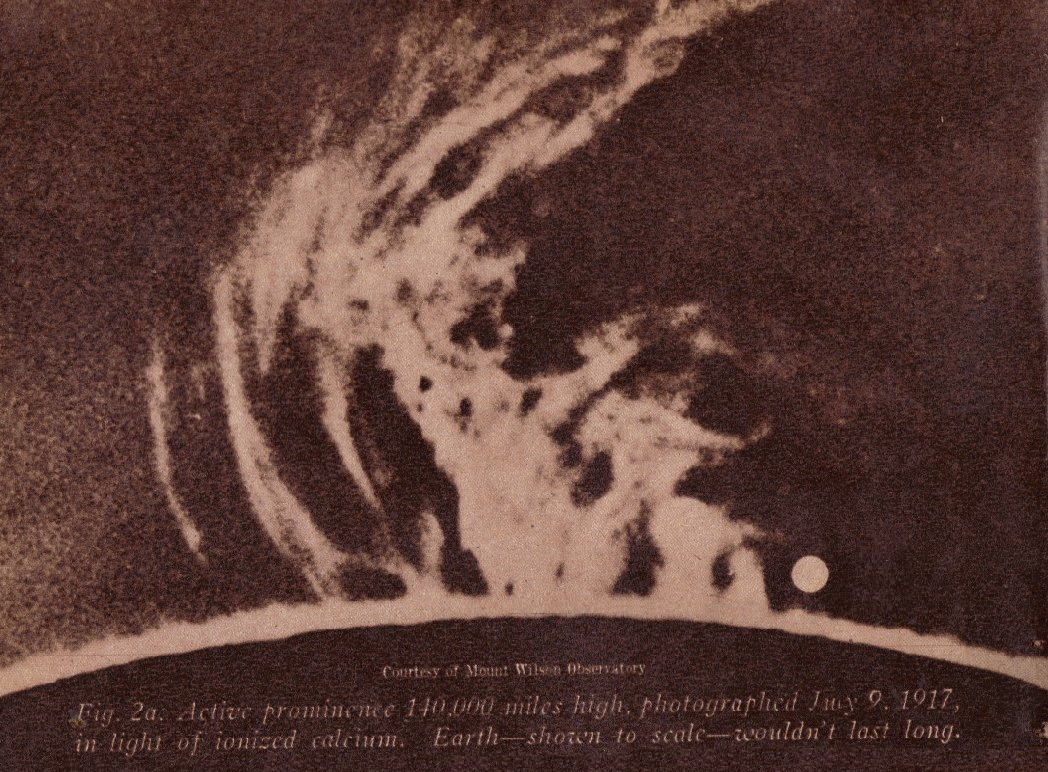
1917 This image of a solar flare taken from Mt Wilson observatory shows a solar flare 140,000 miles high. The white dot is image of the Earth drawn to scale. I came across this at a site called thegildedcentury .

1941 British cryptologists break the secret code used by the German army to direct ground-to-air operations on the Eastern front.
British experts had already broken many of the Enigma codes for the Western front. Enigma was the Germans' most sophisticated coding machine, necessary to secretly transmitting information. The Enigma machine, invented in 1919 by Hugo Koch, a Dutchman, looked like a typewriter and was originally employed for business purposes. The Germany army adapted the machine for wartime use and considered its encoding system unbreakable. They were wrong. The Brits had broken their first Enigma code as early as the German invasion of Poland and had intercepted virtually every message sent through the occupation of Holland and France. Britain nicknamed the intercepted messages Ultra.
Now, with the German invasion of Russia, the Allies needed to be able to intercept coded messages transmitted on this second, Eastern, front. The first breakthrough occurred on July 9, regarding German ground-air operations, but various keys would continue to be broken by the Brits over the next year, each conveying information of higher secrecy and priority than the next. (For example, a series of decoded messages nicknamed "Weasel" proved extremely important in anticipating German anti-aircraft and antitank strategies against the Allies.) These decoded messages were regularly passed to the Soviet High Command regarding German troop movements and planned offensives, and back to London regarding the mass murder of Russian prisoners and Jewish concentration camp victims. *History.com

1953 France issued a stamp picturing Gaspard Monge. [Scott #279].
(Does anyone else think he looks like Marlon Brando??)


1981 Nintendo releases the arcade game Donkey Kong featuring the debut of Mario. *Wik

1996 With the satellite SOHO, they discover that solar flares causes sun quakes. *NSEC Scientists have shown for the first time that solar flares produce seismic waves in the Sun's interior that closely resemble those created by earthquakes on our planet. Dr. Alexander G. Kosovichev, a senior research scientist from Stanford University, and Dr. Valentina V. Zharkova from Glasgow (United Kingdom) University found the tell-tale seismic signature in data on the Sun's surface collected by the Michelson Doppler Imager onboard the Solar and Heliospheric Observatory (SOHO) spacecraft immediately following a moderate-sized flare on July 9, 1996. "Although the flare was a moderate one, it still released an immense amount of energy," said Dr. Craig Deforest, a researcher with the SOHO project. "The energy released is equal to completely covering the Earth's continents with a yard of dynamite and detonating it all at once."

2004 The day after a transit of Venus occurred as predicted by Horrocks using William Crabtree's measures of the size of Venus and the Earth-Sun distance, a commemorative street nameplate in memory of William Crabtree was unveiled at the junction of Lower Broughton Road and Priory Grove which marks the northern boundary of Crabtree Croft where he observed the transit. *Wik


2006 Tesla Memorial at Canadian side of Niagara Falls unveiled. The bronze statue by Les Drysdale depicts Tesla atop an AC motor, in commemoration of Tesla's engineering achievements at Niagara Falls. The marker at the site credits Tesla with the " "world's first hydroelectic power system". Since this power plant suppossedly "the first power reached Buffalo at midnight, November 16, 1896" this will surprise folks who are aware that Thomas Edison's electrical power plant in New York was in 1882. (What Tesla did was momentus, whether it was first or not).


BIRTHS

1845 Birthdate of George Howard Darwin (9 July 1845 – Cambridge, 7 December 1912), fifth child of the evolutionist Charles Darwin. After graduating second wrangler and Smith’s prizeman at Cambridge in 1866 he studied law before settling down to his life work in mathematical astronomy. He addressed the Fifth International Congress of Mathematicians at Cambridge in 1912 on his work on the three body problem. *VFR  He championed a theory (no longer accepted) that the Moon was once part of the Earth, in what is now the Pacific Ocean. His was the first mathematical analysis of the evolution of Earth's Moon. He suggested that since the effect of the tides has been to slow the Earth's rotation and to cause the Moon to recede from the Earth, then by extrapolating back 4.5 billion years ago the Moon and the Earth would have been very close, with a day being less than five hours. Before this time the two bodies would actually have been one, until the Moon was torn away from the Earth by powerful solar tides that would have deformed the Earth every 2.5 hours. *TIS

1855 Spiridon Gopcevic (July 9, 1855 – ? 1928) was a Serbian astronomer and historian. He is also known by his pen name of Leo Brenner. In 1893 he founded Manora Observatory on Mali Lošinj. This observatory was named for his wife, a wealthy Austrian noblewoman. At this observatory, Spiridon used the 17.5cm refractor telescope at the observatory to make observations of Mars, the rings of Saturn, and other planets. However he would eventually close the observatory in 1909 due to financial problems.
From 1899 until 1908 he was the founder and editor of the Astronomische Rundschau, a popular scientific journal. He spent several years in America before returning to Europe and editing an army journal in Berlin during the war. The circumstances of his death are somewhat uncertain, but he appears to have been impoverished.
The crater Brenner on the Moon was named after him (based on his nom de plume) by his friend Phillip Fauth. A new observatory was built on Mali Lošinj in 1993, and was named "Leo Brenner". *Today in Astronomy

1911 John Archibald Wheeler (July 9, 1911 – April 13, 2008) was an American theoretical physicist who was largely responsible for reviving interest in general relativity in the United States after World War II. Wheeler also worked with Niels Bohr in explaining the basic principles behind nuclear fission. One of the later collaborators of Albert Einstein, he tried to achieve Einstein's vision of a unified field theory. He is also known for having coined the terms black hole, quantum foam and wormhole and the phrase "it from bit". For most of his career, Wheeler was a professor at Princeton University and was influential in mentoring a generation of physicists who made notable contributions to quantum mechanics and gravitation.*Wik  I love this Wheeler quote, "In any field, find the strangest thing and then explore it."  Thanks to

1931 Valentina Mikhailovna Borok (9 July 1931, Kharkiv, Ukraine, USSR–4 February 2004, Haifa, Israel) was a Soviet Ukrainian mathematician. She is mainly known for her work on partial differential equations.*Wik


DEATHS

1856 Count Amedeo Avogadro (9 August 1776, Turin, Piedmont – 9 July 1856) Italian chemist and physicist who found that at the same temperature and pressure equal volumes of all perfect gases contain the same number of particles,  known as Avogadro's Law (1811) leading to the Avogadro's constant being 6.022 x 10²³ units per mole of a substance. He realized the particules could be either atoms, or more often, combinations of atoms, for which he coined the word "molecule." This explained Gay-Lussac's law of combining volumes (1809). Further, Avogadro determined from the electrolysis of water that it contained molecules formed from two hydrogen atoms for each atom of oxygen, by which the individual oxygen atom was 16 times heavier than one hydrogen atom (not 8 times as suggested earlier by Dalton.) The Italian, Romano Amadeo Carlo Avogadro, had suggested [in 1811] that all gases have the same number of molecules in a given volume. Loschmidt figured out [in 1865] how many molecules that would be which is the number now known as Avogadro's constant. John D. Cook suggested that maybe it should be called Loschmidt's constant, and pointed out three interesting coincidences involving Avogadro's Constant:
NA is approximately 24! (i.e., 24 factorial.)
The mass of the earth is approximately 10 NA kilograms.
The number of stars in the observable universe is 0.5 NA.
*John D. Cook, The Endeavour Blog

1953  Henri Padé (December 17, 1863 – July 9, 1953) made important contributions to the theory of continued fractions *SAU A Padé approximant is the "best" approximation of a function by a rational function of given order – under this technique, the approximant's power series agrees with the power series of the function it is approximating. The technique was developed by Henri Padé, but goes back to Georg Frobenius who introduced the idea and investigated the features of rational approximations of power series.
The Padé approximant often gives better approximation of the function than truncating its Taylor series, and it may still work where the Taylor series does not converge. For these reasons Padé approximants are used extensively in computer calculations. *Wik

1980  Arend Heyting (May 9, 1898 – July 9, 1980) is important in the development of intuitionistic logic and algebra. (try saying that three times really fast)*SAU Heyting gave the first formal development of intuitionistic logic in order to codify Brouwer's way of doing mathematics. The inclusion of Brouwer's name in the Brouwer–Heyting–Kolmogorov interpretation is largely honorific, as Brouwer was opposed in principle to the formalisation of certain intuitionistic principles (and went as far as calling Heyting's work a "sterile exercise").*Wik

1984 Edna Ernestine Kramer Lassar (May 11, 1902 - July 9, 1984) died of pneumonia at her home in Manhattan. She graduated magna cum laude from Hunter College and earned a Ph.D. at Columbia in 1930. She is best known for her book The Nature and Growth of Modern Mathematics, which is an excellent exposition of much of modern mathematics. It is very accessible to undergraduates. For more about her, see Women of Mathematics. A Biobibliographic Sourcebook (1987), edited by Louise S. Grinstein and Paul J. Campbell. *VFR


1996 Douglas George Chapman (March 20, 1920 - July 9, 1996)was a Canadian-born U.S. mathematical statistician  and an expert on wildlife statistics. He was one of the scientific advisors to the International Whaling Commission that warned in the 1960s that the number of whales being taken by the whaling industry was far in excess of what the population could stand, and proposed annual fin whale catch quotas that would permit the depleted populations of this species to recover. His later research on fish farming expanded to include mollusk aquaculture and he directed a program to develop quantitative methods to aid in the management of fisheries resources.*TIS


Credits :
*CHM=Computer History Museum
*FFF=Kane, Famous First Facts
*NSEC= NASA Solar Eclipse Calendar
*RMAT= The Renaissance Mathematicus, Thony Christie
*SAU=St Andrews Univ. Math History
*TIA = Today in Astronomy
*TIS= Today in Science History
*VFR = V Frederick Rickey, USMA
*Wik = Wikipedia
*WM = Women of Mathematics, Grinstein & Campbell