Saturday, 7 May 2022

On This Day in Math - May 7


Scientists study the world as it is,
engineers create the world that never has been

~Theodore Von Karman

The 127th day of the year.  127 is the fourth Mersienne Prime, 27-1.   Édouard Lucas verified 2127-1 as prime in 1876. He is said to have spent 19 years in checking this 39 digit prime by hand. This remains the largest prime number discovered without the aid of a computer. (Lucas also invented the Towers of Hanoi Puzzle, and the game of dots and boxes which he called "La Pipopipette".)

20 + 21 + 22 + 23 + 24 + 25 + 26 = 127.

127 can be expressed as the sum of factorials of the first three odd numbers (1! + 3! + 5!). 

127 is the smallest odd number that can't be written as a prime P + 2ˣ for some integer.  

17=2^2+13, 19=2^4+3,... 125 =2^6+61 , 127 .....  129 = 2^5+97

127 x \(\sqrt{62}\) is almost an integer, 999.998999999...

 And in a rare equivalence, 127 cm is equal to 50 inches. HT Don S. McDonald ‏@McDONewt


EVENTS

1526 The first circumnavigation of the globe took place in 1519. In 1539 Cardano asked for the number of days spent if a ship sailed westward on January 1, 1517, and went three times around the earth, returning on May 7, 1526. See Sanford, History, pp. 214 and 377. *VFR

1660 Isaack B Fubine of Savoy, in The Hague, patents macaroni *TIS (as soon as someone invents cheese, the fun eating will begin)

1747 Johann Sebastian Bach visits King Frederick II of Prussia, the visit resulting in his Musikalische Opfer (Musical offering). See D. R. Hofstadter’s Godel, Escher, Bach, p. 4. [Manson]*VFR
1772 Read before the Royal Society, May 7, The Sieve of Eratosthenes. Being an Account of His Method of Finding All the Prime Numbers, by the Rev. Samuel Horsley, F. R. S.
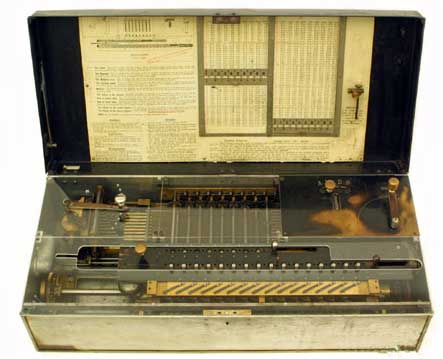
1895 Steiger Gets "Millionaire" Patent:
Otto Steiger was issued a patent for his Millionaire calculating machine. For the next 40 years, Switzerland's Hans Egli manufactured 4,700 machines, which weighed 120 pounds each. The Millionaire was notable in its ability to perform direct multiplication, which meant a user could multiply a number by a single digit with a single rotation of the handle.*CHM

In his German Patent of 1892 Steiger describes a machine which uses a mechanical representation of the multiplication table to form partial products, in the same way that a human "calculator" uses a
multiplication table committed to memory. The partial products are then transferred via a "transmitting mechanism" to a "combining and registering mechanism" for display to the operator. The Steiger's machine is to be regarded as a proper multiplication machine in that it solves problems of multiplication directly on the basis of the multiplication table, whereas other types of calculating machines are only adding machines and, as such, carry out multiplication by a continued series of additions. *Georgi Dalakov, History of Computers    
=========================================================
Radio wave coherer, built by Alexander Popov

1895 
 Nearly everyone knows that Guglielmo Marconi was the inventor of radio, but nearly everyone is wrong about this. Marconi received the Nobel Prize in 1909 for the "development" of radio, not the invention – lots of other people were ahead of him here. Nikolai Tesla has many proponents in the United States as the inventor of radio, while in England they give the credit to Oliver Lodge, who in 1894 invented the first detector, called a coherer, which reacted to the presence of radio waves, a key step if one wants to use radio waves to communicate. It is easy to generate radio waves, but detecting them is much more difficult, and Lodge's coherer allowed one to do just that.
But if you ask anyone in Russia who invented radio, they will tell you: Alexander Stepanovich Popov. And they have a good case. On May 7, 1895 (this would be after Lodge but before Tesla and Marconi), Popov demonstrated a radio receiver to the Russian Physical and Chemical Society in St. Petersburg, and he published a paper on his device later that year. In March of 1896, Popov is supposed to have transmitted the wireless message "Heinrich Hertz" between two buildings on the campus in St. Petersburg (Hertz, a German physicist, was the first to predict the possibility of radio waves in 1888). *Linda Hall Library

In 1952, the concept of the integrated circuit chip was first presented, at a Symposium on Progress in Quality Electronic Components in Washington DC., by radar scientist Geoffrey W.A. Dummer. His small team of researchers at the Royal Radar Establishment of the British Ministry of Defence, based at Malvern, Worcestershire, was working on the task of improving the reliability of the Royal Air Force's radar equipment.. He believed that it would be possible to fabricate multiple circuit elements on and into a block of silicon half an inch square. In 1956, his initial attempts to build such a circuit failed, and thereafter could get no further support for his idea. Britain lost the commercial lead. A few years later, in America, Jack Kilby of Texas Instruments was awarded a U.S. patent for essentially the same idea.*TIS

BIRTHS

Alexis Clairaut (sometimes Clairault) (7 May 1713; 17 May 1765 at age 51) was a French mathematician who worked to confirm the Newton-Huygens belief that the Earth was flattened at the poles. He was a child prodigy was studying calculus at age 10 and was admitted to the Academy of Sciences at age 18. He was the first person to estimate the mass of Venus to a close value. He also calculated the return date of Halley's comet. In about 1737, Pierre de Maupertuis led an expedition (including Clairaut) to measure a degree along a meridian in Lapland, while Bouguer and La Condamine went to Peru.  The results, even before the Peru expedition had returned, showed that Newton was correct in predicting that the earth was flattened at the poles .(various) A nice brief summary of Clairaut's life and works is here.

1774 Sir Francis Beaufort (7 May 1774; 17 Dec 1857 at age 83)British naval officer, who devised (1805) a scale of wind force from 0 (calm) to 12 (hurricane) which was based on observation and so required no special instruments. [Chase]*VFR The initial scale of thirteen classes (zero to twelve) did not reference wind speed numbers but related qualitative wind conditions to effects on the sails of a man-of-war, then the main ship of the Royal Navy, from "just sufficient to give steerage" to "that which no canvas sails could withstand".
Although he devised the scale in 1805, it would not be adopted by the Royal Navy until 1830 when was an administrator. The first official use of the scale in a ships log was on December 22, 1831 by Robert Fitzroy on the first day of Darwin's voyage on the Beagle.
In 1829 Beaufort became the British Admiralty Hydrographer of the Navy. He remained at the post for 25 years. Beaufort converted what had been a minor chart repository into the finest surveying and charting institution in the world. Some of the excellent charts the Office produced are still in use today.

During his tenure, he took over the administration of the great astronomical observatories at Greenwich, England, and the Cape of Good Hope, Africa. Beaufort directed some of the major maritime explorations and experiments of that period. For eight years, Beaufort directed the Arctic Council during its search for the explorer, Sir John Franklin, lost in his last polar voyage to search for the legendary Northwest Passage. *Wik

1832 Carl Gottfried Neumann (May 7, 1832 - March 27, 1925) He worked on a wide range of topics in applied mathematics such as mathematical physics, potential theory and electrodynamics. He also made important pure mathematical contributions. He studied the order of connectivity of Riemann surfaces.
During the 1860s Neumann wrote papers on the Dirichlet principle and the 'logarithmic potential', a term he coined. In 1890 Émile Picard used Neumann's results to develop his method of successive approximation which he used to give existence proofs for the solutions of partial differential equations.*SAU


1854 Giuseppe Veronese (7 May 1854 – 17 July 1917) invented non-Archimedean geometries which he proposed around 1890. However Peano strongly criticised the notion due to the lack of rigor of Veronese's description and also for the fact that he did not justify his use of infinitesimal and infinite segments. The resulting argument was extremely useful to mathematics since it helped to clarify the notion of the continuum. Any fears that non-Archimedean systems would not be consistent were shown to unnecessary soon after this when Hilbert proved that indeed they were consistent.*SAU

1880 Oskar Perron(7 May 1880 – 22 February 1975) was a German mathematician best known for the Perron paradox:
Suppose the largest natural number is N. Then if N is greater than 1 we have N2 greater than  N contradicting the definition.  *SAU

1911 Raymond Arthur Lyttleton (7 May 1911; 16 May 1995 at age 83) English mathematician and theoretical astronomer who researched stellar evolution and composition. In 1939, with Fred Hoyle, he demonstrated the large scale existence of interstellar hydrogen, refuting the existing belief of that space was devoid of interstellar gas. Together, in the early 1940's, they applied nuclear physics to explain how energy is generated by stars. In his own mongraph (1953) Lyttleton described stability of rotating liquid masses, which he extended later to explain that the Earth had a liquid core resulting from a phase change associated with a combination of intense pressure and temperature. With Hermann Bondi, in 1959, he proposed the electrostatic theory of the expanding universe. He authored various astronomy books.*TIS

1927 Allen Shields (7 May 1927 New York – 16 September 1989 Ann Arbor, Michigan, USA) worked on a wide range of mathematical topics including measure theory, complex functions, functional analysis and operator theory.*Wik

DEATHS

1617 David Fabricius, (March 9, 1564 – May 7, 1617)a Protestant minister, was killed by a parishioner angered upon being accused by him as a thief.   A German astronomer, friend of Tycho Brahe and Kepler, and one of the first to follow Galileo in telescope observation of the skies. He is best known for a naked-eye observation of a star on Aug 3, 1596, subsequently named Omicron Ceti, the first variable star to be discovered, and now known as Mira. Its existence with variable brightness contradicted the Aristotelian dogma that the heavens were both perfect and constant. With his son, Johannes Fabricius, he observed the sun and noted sunspots. For further observations they invented the use of a camera obscura and recorded sun-spot motion indicating the rotation of the Sun. *TIS  [re: invented, The Camera Obscura (Latin for dark room) was a dark box or room with a hole in one end. If the hole was small enough, an inverted image would be seen on the opposite wall. Such a principle was known by thinkers as early as Aristotle (c. 300 BC). It is said that Roger Bacon invented the camera obscura just before the year 1300, but this has never been accepted by scholars; more plausible is the claim that he used one to observe solar eclipses. In fact, the Arabian scholar Hassan ibn Hassan (also known as Ibn al Haitam), in the 10th century, described what can be called a camera obscura in his writings..]

1934 Karl Friedrich Geiser (26 Feb 1843 in Langenthal, Bern, Switzerland, 7 May 1934 in Küsnacht, Zürich, Switzerland) Swiss mathematician who worked in algebraic geometry and minimal sufaces. He organised the first International Mathematical Congress in Zurich.*SAU

1963  Theodore von Karman (May 11, 1881 – May 7, 1963)Hungarian-American aerospace engineer and physicist who was active primarily in the fields of aeronautics and astronautics. He is responsible for many key advances in aerodynamics, notably his work on supersonic and hypersonic airflow characterization.*Wikipedia [another who died very close to his birthday (May 11), someday I must do statistics on this.]  He was director of the Institute for Aerodynamics at the Rheinisch-Westfälische Technische Hochschule (RWTH) in AACHEN, Nordrhein-Westfalen, in 1913-1934. The main lecture theatre complex is named the Kármán Auditorium and there is a photo and a bust of him in the foyer.  He is buried in a vault in the Hollywood Forever Cemetery in Los Angeles, Ca. USA


Credits :
*CHM=Computer History Museum
*FFF=Kane, Famous First Facts
*NSEC= NASA Solar Eclipse Calendar
*RMAT= The Renaissance Mathematicus, Thony Christie
*SAU=St Andrews Univ. Math History
*TIA = Today in Astronomy
*TIS= Today in Science History
*VFR = V Frederick Rickey, USMA
*Wik = Wikipedia
*WM = Women of Mathematics, Grinstein & Campbell

Friday, 6 May 2022

On This Day in Math - May 6


When you can measure what you are talking about
and express it in numbers, 
you know something about it


Lord William Thomson Kelvin (1824-1907)


The 126th day of the year; nine points around a circle form the vertices of \( \binom{n}{k} = 126 \)  unique quadrilaterals.   That also means that if you draw all the diagonals of the nonagon, you would be using the same 126 sets of four vertices to get 126 intersections. 

126 is the first of four consecutive numbers that are the sum of a cube and a square. 5³+ 1²


In non-leap  years, there are 126 days in which the day of the month is prime.

The prime gap that covers the first century with no primes (from 1671800 to 1671899) has length 126 (from 1671781 to 1671907). 

There are 9 choose 5, or 126 ways for a random selection to pick the five spaces on a tic tac toe board for the "first player" in a random game.  36 of these configurations are a "win" for both players. They have both three x's and three O's in a line, since they don't have an order of play. Over 58% of those games are a win for the "first player". Geometrically, a student could think of each random game as a pentagon selected from nine points spaced around a circle.


EVENTS

1604 Longomontanus wrote to Kepler criticizing his attacks on Tycho's system using Tycho's data: "These and perhaps all other things that were discovered and worked out by Tycho during his restoration of astronomy for our eternal benefit, you, my dear Kepler, although submerged in shit in the Augean stable of old, do not scruple to equal." More detail at the Renaissance Mathematicus blog


1747 Euler to Goldbach, QED  Euler succeeded in proving Fermat's theorem on sums of two squares in 1747, when he was forty years old. He communicated this in a letter to Goldbach dated 6 May 1747. The proof relies on infinite descent.  Fermat's theorem on sums of two squares asserts that an odd prime number p can be expressed as
p = x2 + y2
with integer x and y if and only if p is congruent to 1 (mod 4). The statement was announced by Fermat in 1640, but he supplied no proof. *Wik

1775 After being driven out of Concord by an angry mob because of his Tory leanings, the American born Benjamin Thompson, later to become Count Rumford, sends the first invisible ink letter of the American Revolution  . Within a few days of the Battle of Lexington, British headquarters in Boston received a secret ink letter which revealed details of the military plans of the patriot forces in New England. Long suspected to have been from Thompson in his home town of Woburn, Mass, recent chemical and handwriting analysis have conclusively confirmed that it was from him. *American Journal of Police Science

1807 Bessel wrote to Gauss, "I saw with pleasure that you have calculated the orbit of Vesta; also the name chosen by you is splendid, and therefore certainly also pleasant to all your friends because it shows them to which goddess you sacrifice.". Carl Friedrich Gauss: Titan of Science  By Guy Waldo Dunnington, Jeremy Gray, Fritz-Egbert Dohse 

1840, the adhesive postage stamp was first sold in Great Britain. The "penny black" and "twopenny blue" stamps showed the profile of Queen Victoria. *TIS


1889 The Eiffel Tower, 7e, was built in 26 months and opened in Mar 1889 for the Universal Exposition.  it is 320.75 m (1051 ft) high and only weighs 7000 tons – less than the air around it!  The tower was inaugurated on 31 March 1889, and opened on 6 May. I recently read that "Gustav Eiffel included a flat for himself at the top of the Eiffel Tower, and retired there at age 62 to conduct aerodynamic experiments".
Today, after being off limits for years, the apartment is on display for visitors to come and peer into. Much of the furnishings remain the same and there are a couple of rather wan looking mannequins of Eiffel and Edison. For the right type of architectural admirer Eiffel’s secret apartment could inspire as much jealousy today as it did when it was built.
In 2016 several stories below Gustave Eiffel’s private apartment, a second Eiffel Tower apartment opened temporarily in the summer of 2016. Vacation rental company HomeAway transformed an unused conference space on the first floor of the tower into a new pop-op designer apartment as a marketing promotion. Four contest winners got a chance to stay inside the tower in July, 2016. *Atlas Obscura

1950 A famous series begins on this day. Can you guess what it is? The first terms are Nicky Hilton, Michael Wilding, Mike Todd, Eddie Fisher, Richard Burton, Richard Burton, John Warner, Larry Fortensky. Note that one term in the series repeats; that’s perfectly natural. Your are right, this is a Taylor series. More specifically, the Elizabeth Taylor series. These are her husbands (eight by last count (2010)). *VFR [sadly, Ms. Taylor has departed the matrimonial game... at least on this sphere. pb]

1949 British Computer EDSAC Performs First Calculation. The EDSAC performed its first calculation. Maurice Wilkes had assembled the machine -- the first practical stored-program computer -- at Cambridge University (an earlier machine at the University of Manchester was too small for practical purposes). His ideas grew out of the Moore School lectures he had attended three years earlier at the University of Pennsylvania. For programming the EDSAC, Wilkes established a library of short programs called subroutines stored on punched paper tapes. It performed 714 operations per second. *CHM

1954 Roger Bannister defied the general belief that it was impossible to run a mile in less than 4 minutes by running one in 3 minutes 59.4 seconds. *VFR


BIRTHS

1635 Johann Joachim Becher, (1635–1682),the German physician and alchemist who initiated the theory that became the phlogiston theory, born. William Cullen considered Becher as a chemist of first importance and Physica Subterranea as the most considerable of Bechers writings. He reintroduced Paracelsus’ tria prima in the form of three different types of Earth.
  • terra fluida or mercurial Earth giving material the characteristics, fluidity, fineness, fugacity, metallic appearance
  • terra pinguis or fatty Earth giving material the characteristics oily, sulphurous and flammable
  • terra lapidea glassy Earth, giving material the characteristic fusibility
It was the second of these, terra pingus, that  was adopted into phlogisten theory.  For a longer, clearer, and more knowledgeable look at this development read this by The Renaissance Mathematicus. Like George Box's comment on statistical models, "Wrong, but useful".
------------------------------------------------------------------------------------------
1667 Abraham De Moivre born in Vitry-le-Francois, Champagne, France. *VFR [.. a French mathematician famous for de Moivre's formula, which links complex numbers and trigonometry, and for his work on the normal distribution and probability theory. He was a friend of Isaac Newton, Edmund Halley, and James Stirling. Among his fellow Huguenot exiles in England, he was a colleague of the editor and translator Pierre des Maizeaux.
De Moivre wrote a book on probability theory, The Doctrine of Chances, said to have been prized by gamblers. De Moivre first discovered Binet's formula, the closed-form expression for Fibonacci numbers linking the nth power of φ (the so-called "golden ratio" to the nth Fibonacci number.](Wikipedia)


1769 Jean Nicolas Pierre Hachette (May 6, 1769 – January 16, 1834) worked on descriptive geometry, collected work by Monge and edited Monge's Géométrie descriptive which was published in 1799. He also published on a wide range of topics from his own major works on geometry, to works on applied mechanics including the theory of machines. His work on machines includes much in the area of applied mechanics, but he was also interested in applied hydrodynamics and steam engines. In fact he published interesting work on the history of steam engines. *SAU

1792 Martin Ohm (6 May 1792 in Erlangen, Bavaria (now Germany)- 1 April 1872 in Berlin, Prussia, German Empire) was a German mathematician and a younger brother of physicist Georg Ohm. He earned his doctorate in 1811 at Friedrich-Alexander-University, Erlangen-Nuremberg where his advisor was Karl Christian von Langsdorf. Ohm was the first to fully develop the theory of the exponential ab when both a and b are complex numbers in 1823. He is also often credited with introducing the name "golden section" (goldener Schnitt).
Ohm's students included Friedrich August, Friedrich Bachmann, Paul Bachmann, Joseph Brutkowski, Heinrich Eduard Heine, Rudolf Lipschitz, Leo Pochhammer, Friedrich Prym, Wilhelm Wagner, Hermann Waldaestel, Wilhelm Wernicke, Elena Gerz, Valentien Gerz, and Johanna Gerz. *Wik
Martin Ohm made a distinction between writing for mathematicians and writing for students, a distinction that many of his contemporaries, including Hermann Grassmann, did not consider appropriate. His colleagues Steiner and Kummer also ridiculed him for not following Alexander von Humboldt's firm belief in the unity of teaching and research. It is quite difficult to assess the importance of Ohm's mathematical contributions. The first thing to say is that they certainly weren't as important as he himself thought. He had a very high opinion of himself as the following quotation indicates. Niels Abel wrote to Christopher Hansteen, the professor of astronomy at the University of Christiania, while he was on a visit to Berlin in 1826

There is at [August Crelle's] house some kind of meeting where music is mainly discussed, of which unfortunately I do not understand much. I enjoy it all the same since I always meet there some young mathematicians with whom I talk. At Crelle's house, there used to be a meeting of mathematicians, but he had to suspend it because of a certain Martin Ohm with whom nobody could get along due to his terrible arrogance.
*SAU

1872 Willem de Sitter (6 May 1872 – 20 November 1934) Dutch mathematician, astronomer, and cosmologist who developed theoretical models of the universe based on Albert Einstein's general theory of relativity. He worked extensively on the motions of the satellites of Jupiter, determining their masses and orbits from decades of observations. He redetermined the fundamental constants of astronomy and determined the variation of the rotation of the earth. He also performed statistical studies of the distribution and motions of stars, but today he is best known for his contributions to cosmology. His 1917 solution to Albert Einstein's field equations showed that a near-empty universe would expand. Later, he and Einstein found an expanding universe solution without space curvature. *TIS

1906 André Weil was an influential mathematician of the 20th century, renowned for the breadth and quality of his research output, its influence on future work, and the elegance of his exposition. He is especially known for his foundational work in number theory and algebraic geometry. He was a founding member and the de facto early leader of the influential Bourbaki group. The philosopher Simone Weil was his sister.. *Wikipedia

1908 John Frank (Jack) Allen (6 May 1908; 22 Apr 2001 at age 92) was a Canadian physicist who codiscovered the superfluidity of liquid helium near absolute zero temperature. Working at the Royal Society Mond Laboratory in Cambridge, with Don Misener he discovered (1930's) that below 2.17 kelvin temperature, liquid helium could flow through very small capillaries with practically zero viscosity. Independently, P. L. Kapitza in Moscow produced similar results at about the same time. Their two articles were published together in the 8 Jan 1938 issue of the journal Nature. Superfluidity is a visible manifestation resulting from the quantum mechanics of Bose- Einstein condensation. By 1945, research in Moscow delved into the microscopic aspect, which Allen did not pursue.*TIS

1916 Robert Henry Dicke (6 May 1916 St. Louis, Missouri, USA - 4 Mar 1997 at age 80) American physicist who worked in such wide-ranging fields as microwave physics, cosmology, and relativity. As an inspired theorist and a successful experimentalist, his unifying theme was the application of powerful and scrupulously controlled experimental methods to issues that really matter. He also made a number of significant contributions to radar technology and to the field of atomic physics. His visualization of an oscillating universe stimulated the discovery of the cosmic microwave background, the most direct evidence that our universe really did expand from a dense state. A key instrument in measurements of this fossil of the Big Bang is the microwave radiometer he invented. His patents ranged from clothes dryers to lasers. *TIS

DEATHS

1643 Pierre Herigone, (1580–1643) the first person to use the symbol for angle. *VFR [Pierre Hérigone is actually a pseudonym for the Baron Clément Cyriaque de Mangin. In fact, just to make things even more confusing, Cyriaque de Mangin also used the pseudonym Denis Henrion. He was of Basque origin. Little is known of his life except that he taught for most of it in Paris.]*SAU
Hérigone used a symbol with an angle made by a flat line and an inclined line and also use one like the angle bracket in Cursus mathematicus. It was published in 1634 and a second edition the next year. (Cajori vol. 1, page 202) . It appears that he may have been the first to use the inverted T for perpendicular as well. {note to reader, I have frequently seen 1643 shown as his birth date but that must be an error. pb)

1856 William Stirling Hamilton (8 March 1788 in Glasgow, Scotland - 6 May 1856 in Edinburgh, Scotland) Hamilton became professor of logic and metaphysics at the University of Edinburgh, giving his inaugural lecture on 21 November. Hamilton was one of the first in a series of British logicians to create the algebra of logic and introduced the 'quantification of the predicate'. Boole, De Morgan and Venn followed him, but Hamilton helped begin this development and his work, although not of great depth, influenced Boole to produce a much more sophisticated system. Sadly, however, Hamilton claimed that De Morgan was guilty of plagiarism which was a ridiculous suggestion. *SAU

1862 Olry Terquem (16 June 1782 – 6 May 1862) was a French mathematician. He is known for his works in geometry and for founding two scientific journals, one of which was the first journal about the history of mathematics. He was also the pseudonymous author (as Tsarphati) of a sequence of letters advocating radical Reform in Judaism. He was French Jewish.
Terquem translated works concerning artillery, was the author of several textbooks, and became an expert on the history of mathematics. Terquem and Camille-Christophe Gerono were the founding editors of the Nouvelles Annales de Mathématiques in 1842. Terquem also founded another journal in 1855, the Bulletin de Bibliographie, d'Histoire et de Biographie de Mathématiques, which was published as a supplement to the Nouvelles Annales, and he continued editing it until 1861. This was the first journal dedicated to the history of mathematics.

The three marked points that lie on the nine point circle and interior to the triangle were found by Terquem. The point of convergence of the three red lines through the triangle is its orthocenter. He is also known for naming the nine-point circle and fully proving its properties. This is a circle defined from a given triangle that contains nine special points of the triangle. Karl Wilhelm Feuerbach had previously observed that the three feet of the altitudes of a triangle and the three midpoints of its sides all lie on a single circle, but Terquem was the first to prove that this circle also contains the midpoints of the line segments connecting each vertex to the orthocenter of the triangle. He also gave a new proof of Feuerbach's theorem that the nine-point circle is tangent to the incircle and excircles of a triangle.
Terquem's other contributions to mathematics include naming the pedal curve of another curve, and counting the number of perpendicular lines from a point to an algebraic curve as a function of the degree of the curve. He was also the first to observe that the minimum or maximum value of a symmetric function is often obtained by setting all variables equal to each other.
He became an officer of the Legion of Honor in 1852. After he died, his funeral was officiated by Lazare Isidor, the Chief Rabbi of Paris and later of France, and attended by over 12 generals headed by Edmond Le Bœuf.
*Wik

1916 Ágoston Scholtz (27 July 1844 in Kotterbach, Zips district, Austro-Hungary (now Rudnany, Slovakia) Died: 6 May 1916 in Veszprém, Hungary) From 1871 he was a teacher of mathematics and natural philosophy at the Lutheranian Grammar School of Budapest which at that time had been upgraded to become a so called 'chief grammar school', namely one which offered eight years of teaching. This was precisely the school which later was attended by several famous mathematicians such as Johnny von Neumann and Eugene Wigner (or Jenó Pál Wigner as he was called at that time). Scholtz became the school director of the Lutheranian Grammar School in 1875. Unfortunately this excellent school was closed in 1952, and most of its equipment was lost. Due to the initiative and support of its former well-known students, among others Wigner, it was reopened in 1989 after being closed for thirty-seven years. Scholtz's field of research was projective geometry and theory of determinants. His results were recorded by Muir in his famous work The history of determinants *SAU

1951 Élie Joseph Cartan  (9 April 1869 – 6 May 1951) worked on continuous groups, Lie algebras, differential equations and geometry. His work achieves a synthesis between these areas. He is one of the most important mathematicians of the first half of the 20C. *SAU  He was one of the earliest "Bourbaki".


1983 Yudell Leo Luke (26 June 1918 – 6 May 1983) was an American mathematician who made significant contributions to the Midwest Research Institute, was awarded the N. T. Veatch award for Distinguished Research and Creative Activity in 1975, and appointed as Curator's Professor at the University of Missouri in 1978, a post he held until his death. Luke published eight books and nearly 100 papers in a wide variety of mathematical areas, ranging from aeronautics to approximation theory. By his own estimation, Luke reviewed over 1800 papers and books throughout his career.*SAU

2009 Chuan-Chih Hsiung (15 Feb 1915 in Shefong, Jiangsi, China - 6 May 2009 in Needham, Massachusetts, USA), also known as Chuan-Chih Hsiung, C C Hsiung, or Xiong Quanzhi, is a notable Chinese-born American differential geometer. He was Professor Emeritus of Mathematics at Lehigh University, Bethleham PA USA.
He is the founder and editor-in-chief of the Journal of Differential Geometry, an influential journal in the domain. During his early age, he focused on projective geometry. His interests were largely extended after his research in Harvard, including two-dimensional Riemannian manifolds with boundary, conformal transformation problems, complex manifold, curvature and characteristic classes, etc. *Wik


Credits :
*CHM=Computer History Museum
*FFF=Kane, Famous First Facts
*NSEC= NASA Solar Eclipse Calendar
*RMAT= The Renaissance Mathematicus, Thony Christie
*SAU=St Andrews Univ. Math History
*TIA = Today in Astronomy
*TIS= Today in Science History
*VFR = V Frederick Rickey, USMA
*Wik = Wikipedia
*WM = Women of Mathematics, Grinstein & Campbell

Thursday, 5 May 2022

On This Day in Math - May 5


The man ignorant of mathematics 
will be increasingly limited in his grasp
of the main forces of civilization. 
~John Kemeny,


The 125th day of the year; 125 is a cube, and the sum of distinct squares. There is no smaller value for which this is true. 125 = 53 = 112 + 22 What's the next?
125 can also be written as a curious sort of palindrome, 125 = 5(2+1) *Jim Wilder, @wilderlab

Conjectured by Zhi-Wei Sun to be the largest power (53) for which there is no prime between it and the previous power (112). The other prime gaps between powers are in (23, 32), (25, 62) and (52, 33). 

125 and 126 are a Ruth Aaron pair of the second kind.  In the first kind prime factors are only counted once, in the second kind they are counted as often as they appear, so 5+5+5 =  2+3+3+7.  Some Ruth-Aaron pairs only have one of each factor, so they qualify under either method. The original kind were discovered for 714 Ruth's career record, and 715, the number on the day Aaron passed his record (he went on to get more).  


Several More math facts for this date at https://mathdaypballew.blogspot.com/

EVENTS 

840 A total solar eclipse was recorded over France. Known as Emperor Louis' Eclipse. NASA Eclipse map here. *David Dickinson ‏ @Astroguyz

1642 Théodore Deschamps, a physician from Bergerac, writes to Marin Mersenne that he remembered that in 1609, during his stay at Leiden University, he had not only witnessed a demonstration of a telescope by the mathematics professor, Rudolph Snellius, but had also met a Delft spectacle maker, who in his telescopes had covered up ‘the parts of the convex glass on which the rays coming from the object intersect each other too soon.’ (suggesting an early invention of a diaphragm that would allow a better image from poorer quality lenses) *Huib J. Zuidervaart, The ‘true inventor’ of the telescope. A survey of 400 years of debate,

1777 First use of i for imaginary constant: On May 5, 1777, Euler addressed to the 'Academiae' the paper "De Formulis Differentialibus Angularibus maxime irrationalibus quas tamen per logarithmos et arcus circulares integrare licet," which was published posthumously in his "Institutionum calculi integralis," second ed., vol. 4, pp. 183-194, Impensis Academiae Imperialis Scientiarum, Petropoli, 1794.
Quoniam mihi quidem alia adhuc via non patet istud praestandi nisi per imaginaria procedendo, formulam \( \sqrt{-1}\) ilittera i in posterum designabo, ita ut sit ii = -1 ideoque 1/i = -i.
According to Cajori, the next appearance of i in print is by Gauss in 1801 in the Disquisitiones Arithmeticae. Carl Boyer believes that Gauss' adoption of i made it the standard. By 1821, when Cauchy published Cours d'Analyse, the use of i was rather standard, and Cauchy defines i as "as if \( \sqrt{-1}\) was a real quantity whose square is equal to -1."
*Jeff Miller

1809 Mary Dixon Kies patent is approved and signed by President James Madison. Her patent was for a new technique for weaving straw with silk and thread to make ladies hats. This was the first US patent granted to a woman. *HistoryTime

1834, William Whewell wrote a letter to Michael Faraday concerning names to describe the process of electrolysis which he was investigating. Whewell suggest the names Anode and Cathode. The terms are based on the Greek prefixes "ana-" meaning "up" and "kata-" meaning "down." The chosen prefixes referred to the idea that (as was then applied) that electric current flowed from a battery's positive to a negative pole, in the manner that water would flow down from a hillside to a valley. He suggested a term - ion - for the two together instead of Zetodes or Stechions. Faraday replied that he was "delighted with the facility of expression which the new terms give me and I shall ever be your debtor for the kind assistance you have given me." *TIS Whewell had written on April 25th to Faraday suggesting these terms, but Faraday had been reluctant at first to use them. (PB)

1883 George Cantor writes to Mitag-Leffler that Kronecker had called his work on transfinite set theory "Humbug" in a letter to Hermite. Kronecker reserved his attacks for personal correspondence and student lectures, but said little or nothing publicly against Cantor. *From the Calculus to Set Theory, 1630-1910: An Introductory History
By I. Grattan-Guinness

1905 The trial in the Stratton Brothers case begins in London, England; it marks the first time that fingerprint evidence is used to gain a conviction for murder. *The Painter Flynn

-------------------------------------------------------------------------------------------------------------------

In 1925, a meeting of local leaders was held in Dayton, Tennessee, to plan a challenge to that state's new law, the Butler Act, which made it illegal to teach Darwin's theory of evolution in a public school. George W. Rappelyea and other local leaders of the small mining town met at Robinson's drug store. The American Civil Liberties Union in New York, concerned by the law's infringement on constitutional rights, had advertised an offer to give legal support to any teacher who would challenge the law. Rappelyea saw the publicity that would accompany such a trial as an opportunity to promote his town. He approached John T. Scopes, a 24-year-old teacher and football coach, who was hesitant at first, to test the legality of the law in court. The infamous “Scopes Monkey Trial” began on 10 Jul 1925.*TIS

1952 Dummer Proposes Integrated Circuit Concept: G. W. A. Dummer, an English electrical engineer, foresees the fabrication of all electronic components of a circuit or system in a single block of semiconductor material. Several special-function devices were developed at Bell Labs and RCA before Jack Kilby at TI demonstrated a general-purpose concept "integrated circuit" in 1958.*CHM

1961 Alan B. Shepard is the first U.S. astronaut to make a flight into space. His fifteen minute flight in Freedom 7 from Cape Canaveral, Florida, reached an altitude of 115 (116?) miles and ended 302 miles down the Atlantic missile range. [Kane, p. 373; Navy Facts, 204] *VFR

1980 Greece issued a stamp honoring the 2300th anniversary of Aristarchus of Samos, discoverer of the heliocentric theory. [Scott #1350] *VFR

1981 The German Democratic Republic issued a stamp honoring Richard Dedekind. [Scott #2181] *VFR

In 2000, a conjunction of the five bright planets - Mercury, Venus, Mars, Jupiter and Saturn - formed a rough line across the sky with the Sun and Moon. Unfortunately, nothing was visible from the earth, because the the line of planets was behind the Sun and hidden in its brilliance. Such a conjunction last happened in Feb 1962 and will not happen again until Apr 2438. Throughout former history, a conjunction event was regarded with foreboding. However, now science can be dismissive. Donald Olson, an expert on tides at Southwest Texas State University, working with the assistance of a graduate student, Thomas Lytle, calculated the stress on the Earth caused by the Moon and eight planets has often been routinely greater, most recently on 6 Jan 1990. *TIS


2012 The biggest full moon of the year, a so-called "supermoon," will take center stage when it rises this weekend (Saturday, May 5, at 11:35 p.m. EDT ). A supermoon occurs when the moon hits its full phase at the same time it makes closest approach to Earth for the month, a lunar milestone known as perigee. May's full moon timed with the moon's perigee could appear 14 percent bigger and 30 percent brighter than other full moons of 2012. *Huffington Post Science

2016 Meteor Shower from Halley's Comet at it's most active-but meteors will be visible for another few weeks as the Earth passes through the debris trail of Halley's Comet. The eta Aquarid display is one of two meteor showers created by dust from Halley's comet (the Orionid shower in October is the other). It occurs every April and May when the Earth passes through a stream of debris cast off by comet Halley during its 76-year trip around the sun. *PB


BIRTHS

1580 Johann Faulhaber (5 May 1580; Ulm, Germany – 10 September 1635; Ulm, Germany) was a German mathematician.
Born in Ulm, Faulhaber was trained as a weaver. However he was taught mathematics in Ulm and showed such promise that the City appointed him city mathematician and surveyor. He opened his own school in Ulm in 1600 but he was in great demand because of his skill in fortification work. He collaborated with Johannes Kepler and Ludolph van Ceulen. Besides his work on the fortifications of cities (notably Basel and Frankfurt), Faulhaber built water wheels in his home town and geometrical instruments for the military. Faulhaber made the first publication of Henry Briggs's Logarithm in Germany.
Faulhaber's major contribution was in calculating the sums of powers of integers, what is now called Faulhaber's formula. Jacob Bernoulli makes references to Faulhaber in his Ars Conjectandi and the Bernouli numbers arise in solving coefficients of Faulhaber's formula.
In Academia Algebra Faulhaber gives ∑ nk as a polynomial in N, for k = 1, 3, 5, ... ,17. He also gives the corresponding polynomials in n. Faulhaber states that such polynomials in N exist for all k, but gave no proof. This was first proved by Jacobi in 1834. It is not known how much Jacobi was influenced by Faulhaber's work, but we do know that Jacobi owned Academia Algebra since his copy of it is now in the University of Cambridge.
At the end of Academia Algebra Faulhaber states that he has calculated polynomials for ∑ nk as far as k = 25. He gives the formulae in the form of a secret code, which was common practice at the time. Donald Knuth suggests he is the first to crack the code: (the task [of cracking the code] is relatively easy with modern computers) and shows that Faulhaber had the correct formulae up to k = 23, but his formulae for k = 24 and k = 25 appear to be wrong.
A nice example of how to calculate sum of powers using Pascal's arithmetic triangle is given at Theorem of the Day.
*SAU *Wik

1811 John William Draper (May 5, 1811 – January 4, 1882) was an American (English-born) scientist, philosopher, physician, chemist, historian and photographer. He is credited with producing the first clear photograph of a female face (1839–40) and the first detailed photograph of the Moon (1840). He was also the first president of the American Chemical Society (1876–77) and a founder of the New York University School of Medicine. One of Draper's books, History of the Conflict between Religion and Science, received worldwide recognition and was translated into several languages, but was banned by the Catholic Church. His son, Henry Draper, and his granddaughter, Antonia Maury, were astronomers, and his eldest son, John Christopher Draper, was a chemist. *Wik

1833 Lazarus Immanuel Fuchs (5 May 1833 – 26 April 1902) was a gifted analyst whose works form a bridge between the fundamental researches of Cauchy, Riemann, Abel, and Gauss and the modern theory of differential equations discovered by Poincaré, Painlevé, and Émile Picard. *SAU

1860 Charles Chree (5 May 1860 – 12 August 1928) studied in Aberdeen and Cambridge. He became Superintendent of Kew Observatory and worked on terrestrial magnetism. *SAU

1861 Peter Cooper Hewitt (May 5, 1861 – August 25, 1921) was an American electrical engineer and inventor, who invented the first mercury-vapor lamp in 1901. Hewitt was issued U.S. patent #682692 on September 17, 1901.
In 1902 Hewitt developed the mercury arc rectifier, the first rectifier which could convert alternating current power to direct current without mechanical means. It was widely used in electric railways, industry, electroplating, and high-voltage direct current (HVDC) power transmission. Although it was largely replaced by power semiconductor devices in the 1970s and 80s, it is still used in some high power applications.
In 1907 he developed and tested an early hydrofoil. In 1916, Hewitt joined Elmer Sperry to develop the Hewitt-Sperry Automatic Airplane, one of the first successful precursors of the UAV. *wik

1877 Alexander Brown (5 May 1877 in Dalkeith, near Edinburgh, Scotland - 27 Jan 1947 in Cape Town, South Africa) In 1903 Brown was appointed as Professor of Applied Mathematics in the South African College. In 1911 he married Mary Graham; they had a son and a daughter. He remained in Cape Town until his death in 1947, but his status changed in 1918 when the South African College became the University of Cape Town.
He was a member of the Edinburgh Mathematical Society, joining the Society in December 1898. He contributed papers to meetings of the Society such as On the Ratio of Incommensurables in Geometry to the meeting on Friday 9 June 1905 and Relation between the distances of a point from three vertices of a regular polygon, at the meeting on Friday 11 June 1909, communicated by D C McIntosh.
Brown was elected a Fellow of the Royal Society of South Africa in 1918, was on its Council from 1931 to 1935 and again in 1941, was its Honorary Treasurer from 1936 to 1940, and President from 1942 to 1945. Alexander Brown was elected to the Royal Society of Edinburgh on 20 May 1907. *SAU

1883 Anna Johnson Pell Wheeler (5 May 1883 in Calliope (now Hawarden), Iowa, USA - 26 March 1966 in Bryn Mawr, Pennsylvania, USA) In 1899 she entered the University of South Dakota where she showed great promise in mathematics. The professor of mathematics, Alexander Pell, recognised her talents and helped persuade Anna Johnson that she should follow a career in mathematics. She received an A.B. degree in 1903.
After winning a scholarship to study for her master's degrees at the University of Iowa, she was awarded the degree for a thesis The extension of Galois theory to linear differential equations in 1904. A second master's degree from Radcliffe was awarded in 1905 and she remained there to study under Bôcher and Osgood.
Anna Johnson was awarded the Alice Freeman Palmer Fellowship from Wellesley College to study for a year at Göttingen University. There she attended lectures by Hilbert, Klein, Minkowski, Herglotz and Schwarzschild. She worked for her doctorate at Göttingen. While there Alexander Pell, her former mathematics professor came to Göttingen so that they could marry.
After returning to the United States, where her husband was by now Dean of Engineering, she taught courses in the theory of functions and differential equations. In 1908 Anna Pell returned to Göttingen where she completed the work for her doctorate but, after a disagreement with Hilbert, she returned to Chicago, where her husband was now on the university staff, without the degree being awarded.
At Chicago she became a student of Eliakim Moore and received her Ph.D. in 1909, her thesis Biorthogonal Systems of Functions with Applications to the Theory of Integral Equations being the one written originally at Göttingen. From 1911 Anna Pell taught at Mount Holyoke College and then at Bryn Mawr from 1918. Anna Pell's husband Alexander, who was 25 years older than she was, died in 1920. In 1924 Anna Pell became head of mathematics when Scott retired, becoming a full professor in 1925.
After a short second marriage to Arthur Wheeler, during which time they lived at Princeton and she taught only part-time, her second husband died in 1932. After this Anna Wheeler returned to full time work at Bryn Mawr where Emmy Noether joined her in 1933. However Emmy Noether died in 1935. The period from 1920 until 1935 certainly must have been one with much unhappiness for Anna Wheeler since during those years her father, mother, two husbands and close friend and colleague Emmy Noether died. Anna Wheeler remained at Bryn Mawr until her retirement in 1948.
The direction of Anna Wheeler's work was much influenced by Hilbert. Under his guidance she worked on integral equations studying infinite dimensional linear spaces. This work was done in the days when functional analysis was in its infancy and much of her work has lessened in importance as it became part of the more general theory.
Perhaps the most important honour she received was becoming the first woman to give the Colloquium Lectures at the American Mathematical Society meetings in 1927.
*SAU

1897 Francesco Giacomo Tricomi (5 May 1897 – 21 November 1978)  studied differential equations which became very important in the theory of supersonic flight. *SAU

1921 Arthur Leonard Schawlow (May 5, 1921 – April 28, 1999) was an American physicist. He is best remembered for his work on lasers, for which he shared the 1981 Nobel Prize in Physics with Nicolaas Bloembergen and Kai Siegbahn.
In 1991 the NEC Corporation and the American Physical Society established a prize: the Arthur L. Schawlow Prize in Laser Science. The prize is awarded annually to "candidates who have made outstanding contributions to basic research using lasers."
In 1951, he married Aurelia Townes, younger sister to physicist Charles Hard Townes, and together they had three children; Arthur Jr., Helen, and Edith. Arthur Jr. was autistic, with very little speech ability.
Schawlow and Professor Robert Hofstadter at Stanford, who also had an autistic child, teamed up to help each other find solutions to the condition. Arthur Jr. was put in a special center for autistic individuals, and later Schawlow put together an institution to care for people with autism in Paradise, California. It was later named the Arthur Schawlow Center in 1999, shortly before his death on the 29th of April 1999.
Schawlow died of leukemia in Palo Alto, California. *Wik

1923 Cathleen Synge Morawetz (May 5, 1923; Toronto, Canada - ) is a mathematician. Morawetz's research was mainly in the study of the partial differential equations governing fluid flow, particularly those of mixed type occurring in transonic flow. She is Professor Emerita at the Courant Institute of Mathematical Sciences at the New York University, where she has also served as director from 1984 to 1988.
Morawetz's father, John Lighton Synge was an Irish mathematician, specializing in the geometry of general relativity and her mother also studied mathematics for a time. Her childhood was split between Ireland and Canada. Both her parents were supportive of her interest in mathematics and science, and it was a woman mathematician, Cecilia Krieger, who had been a family friend for many years who later encouraged Morawetz to pursue a PhD in mathematics. Morawetz says her father was influential in stimulating her interest in mathematics, but he wondered whether her studying mathematics would be wise (suggesting they might fight like the Bernoulli brothers)
In 1981, she became the first woman to deliver the Gibbs Lecture of The American Mathematical Society, and in 1982 presented an Invited Address at a meeting of the Society for Industrial and Applied Mathematics. She was named Outstanding Woman Scientist for 1993 by the Association for Women in Science. In 1995, she became the second woman elected to the office of president of the American Mathematical Society. In 1998 she was awarded the National Medal of Science; she was the first woman to receive the medal for work in mathematics. In 2004 she received the Leroy P. Steele Prize for Lifetime Achievement. In 2006 she won the George David Birkhoff Prize in Applied Mathematics. In 2012 she became a fellow of the American Mathematical Society.*Wik

1961 G. L. Honaker, Jr., (May 5, 1961- ) in the strobogrammatic year 1961 and lives in Bristol, Virginia. Number art and design has interested him since an early age. He became fascinated when an elementary school teacher (J. N. Ely, Jr.) in his nearby birthplace of Pennington Gap drew a factor tree on the blackboard. "I saw great beauty in this 'numerical fingerprint' and was hooked." After a tour in the US Navy he became a K-12 math/science educator and created 'Prime Curios!' (primes.utm.edu/curios/) with the assistance of Chris K. Caldwell, a well-known mathematics professor and technical editor of the site at the University of Tennessee at Martin. Here, people from all over the world submit facts, curiosities, oddities, etc., about anything related to prime numbers.

BookAuthority (https://bookauthority.org/books/best-prime-numbers-books) includes it in their list of 53 Best Prime Numbers Books of All Time. 


---------------------------------------------------------------------------------------------------------


DEATHS


1859 Peter Gustav Lejeune Dirichlet  (13 Feb 1805, 5 May 1859 at age 54)   is credited with the modern formal definition of a function.   After his death, Dirichlet's lectures and other results in number theory were collected, edited and published by his friend and fellow mathematician Richard Dedekind under the title Vorlesungen über Zahlentheorie (Lectures on Number Theory).  Dirichlet's brain is preserved in the department of physiology at the University of Göttingen, along with the brain of Gauss.(Wikipedia) (Dirichlet proved in 1826 that in any arithmetic progression with first term coprime to the difference there are infinitely many primes.) *SAU [Dirichlet is buried in Bartholomaus cemetery in Gottingen]


1957 Leopold Löwenheim (26 June 1878 in Krefeld, Germany  – 5 May 1957 in Berlin) was a German mathematician who worked on mathematical logic and is best-known for the Löwenheim-Skolem paradox. *SAU  [Skolem's paradox is that every countable axiomatisation of set theory in first-order logic, if it is consistent, has a model that is countable. This appears contradictory because it is possible to prove, from those same axioms, a sentence which intuitively says (or which precisely says in the standard model of the theory) that there exist sets that are not countable. Thus the seeming contradiction is that a model which is itself countable, and which contains only countable sets, satisfies the first order sentence that intuitively states "there are uncountable sets".] *Wik


1989 Stefan E Warschawski (April 18, 1904 – May 5, 1989) With careful scholarship, he made lasting contributions to the theory of complex analysis, particularly to the theory of conformal mappings. With keen judgment, he guided two mathematics departments to eminence. With modest gratitude, he cemented many friendships along the way.*SAU  [He is buried in El Camino Memorial Park, San Diego, California.]

2001Theodore Harold "Ted" Maiman (July 11, 1927 – May 5, 2007) was an American Engineer and physicist credited with the invention of the first working laser.[ Maiman’s laser led to the subsequent development of many other types of lasers.[9][10] The laser was successfully fired on May 16, 1960. In a July 7, 1960 press conference in Manhattan,[1] Maiman and his employer, Hughes Aircraft Company, announced the laser to the world. Maiman was granted a patent for his invention, and he received many awards and honors for his work. Maiman's experiences in developing the first laser and subsequent related events are described in his book, The Laser Odyssey. *Wik


Credits :
*CHM=Computer History Museum
*FFF=Kane, Famous First Facts
*NSEC= NASA Solar Eclipse Calendar
*RMAT= The Renaissance Mathematicus, Thony Christie
*SAU=St Andrews Univ. Math History
*TIA = Today in Astronomy
*TIS= Today in Science History
*VFR = V Frederick Rickey, USMA
*Wik = Wikipedia
*WM = Women of Mathematics, Grinstein & Campbell

Wednesday, 4 May 2022

On This Day in Math - May 4


I had a feeling once about Mathematics - that I saw it all.
Depth beyond depth was revealed to me - the Byss and Abyss.
I saw - as one might see the transit of Venus or even the Lord Mayor's Show
- a quantity passing through infinity and changing its sign from plus to minus.
I saw exactly why it happened and why the tergiversation
was inevitable but it was after dinner
and I let it go.
~Winston Churchill


The 124th day of the year;124 =σ( 1! * 2! * 4!) *Prime Curios (The sigma function of a positive integer n is the sum of the positive divisors of n)

124 is also an Odious number: a number with an odd number of 1's in its binary expansion.(just recently, it occurred to me that it would be more appropriate if an Odious  number, had an odd number of "0's")

124 in base two is expressed as 1111100.

and ±1 ± 2 ± 3 ± 4 ± 5 ± 6 ± 7 ± 8 ± 9 ± 10 ± 11 ± 12 = 0 has 124 solutions (collect the whole set) *Math Year-Round ‏@MathYearRound

And for Algebra students, 124  is divisible by four so it is the difference of two squares of numbers that differ by 2, and since  124 / 4 = 31, the numbers must straddle 31, 32² - 30² = 124. 


Several More math facts for this date at https://mathdaypballew.blogspot.com/


EVENTS

1612 Galileo writing to Mark Welser, “The spots seen at sunset are observed to change place from one evening to the next, descending from the part of the sun then uppermost, and the morning spots ascend from the part then below …”, *Galileo's Sunspot Letters at http://mintaka.sdsu.edu
The Letters were written to the wealthy Augsburg Magistrate Mark Welser (1558-1614), a well-known patron of the new sciences, in responses to Christoph Scheiner's own Letters on Sunspots, published through Wesler in 1612.
Galileo and Scheiner were later to quarrel bitterly over priority of discovery of sunspots; in fact the first recorded sunspot observation is on 8 December 1610 by the Englishman Thomas Harriott (1560-1621), and the first publication by Johann Fabricius.
The title page of Galileo's letters, published by Wesler, is shown below. The lynx depicted on the Title page indicates Galileo's membership in the Lincean academy (Accademia dei Lincei, for the "sharp-eyed")
*
Groupe d\'astrophysique de l\'Université de Montréal


1675 Charles II orders Royal Greenwich Observatory be built to solve Longitude problem. * Nat. Maritime Museum@NMMGreenwich

1694 David Gregory and Newton disagree on "kissing numbers" during Gregory's visit to Newton in Cambridge. Newton asserted that 12 was the maximum number of spheres that could be placed touching around a central sphere. Gregory held out that a 13th was possible. Kepler had shown a completely rigid arrangement of 12 spheres around one in his Six-cornered Snow. His method is called a hexagonal packing. But Newton and Gregory both knew that placing the surrounding 12 spheres at the vertices of an icosahedron around the central sphere, there was enough space to move the balls around, In fact, any two balls could be moved around and interchanged while all twelve balls were still in contact with the central one. The maximum "kissing number" is known for the first four dimensions, but beyond that only the eighth (240) and twenty-fourth(196,560) are exactly known. *Plus Math, *Wik  (Newton was right, but it wasn't proven until 1953.)

1697 John Wallis sends a letter to the Royal Society "Concerning the Cycloeid Known to Cardinal Cusanus, about the Year 1450." (modern scholars can not find any evidence to support his statement.) *Wik

1756 A letter from John Elliot, a young naval officer, to his father.
"There is no News here worth troubling you with, only the discovery of the longitude by a Hanovarien, it is perform’d by an Observation of the Moon & any fix’d Star by knowing there distance at a given place & observing there diff[erence]e at Sea given the difference of time[. T]he obs[ervatio]n is simple & easey but the Calculation is extreamly perplexd. I had this from a Man that is making the Instrument."
The Hanovarien mentioned is Tobias Mayer. *Richard Dunn, Board of Longitude Project, Royal Museums Greenwich

1780 The American Academy of Arts and Sciences, the first national arts and sciences society in the U.S., was founded on this date in Boston “to cultivate every art and science which may tend to advance the interest, dignity, honor and happiness of a free, independent and virtuous people.” James Bowdoin was the first president. *VFR [The original incorporators were later joined by Benjamin Franklin, George Washington, Thomas Jefferson, Charles Bulfinch, Alexander Hamilton, and John Quincy]*TIS

1925 The ACLU found John Scopes by running a newspaper ad seeking a teacher willing to test the law about teaching human evolution in the classrooms of Tennessee. From the May 4, 1925, edition of the Chattanooga Times:
"We are looking for a Tennessee teacher who is willing to accept our services in testing this law in the courts. Our lawyers think a friendly test case can be arranged without costing a teacher his or her job. Distinguished counsel have volunteered their services. All we need now is a willing client."  
Scopes wasn't a biology teacher but had filled in for one using a textbook that accepted evolution, and that was enough to set the "monkey trial" moving forward.  *Greg Ross, Futility Closet


In 1933, the discovery of radio waves from the centre of the Milky Way galaxy was described by Karl Jansky in a paper he read to the International Radio Union in Washington. The galactic radio waves were very low intensity, short wavelength (14.6 m, frequency about 20 MHz) and required sensitive apparatus for their detection. Their intensity varied regularly with the time of day, and with the seasons. They came from an unchanging direction in space, independent of terrestrial sources. He had conducted his research on static hiss at the radio research department of Bell Telephone Labs, Holmdel, N.J. The New York Times carried a front page report the next day.*TIS

1935 Albert Einstein, in a letter to the New York Times, writes, "In the judgement of the most competent living mathematicians, Fraulein Noether was the most significant creative mathematical genius thus far produced since the higher education of women began". *Dwight E. Neuenschwander, Emmy Noether's Wonderful Theorem

In 1989, the space probe Magellan was carried in the cargo bay by the STS-30 Space Shuttle Atlantis mission launched from Kennedy Space Center in Florida. The space probe was named after the 16th-century Portuguese explorer Ferdinand Magellan. This was the first planetary spacecraft to be released from a shuttle in Earth orbit. It arrived at its planned polar orbit around Venus on 10 Aug 1990, which it circled once every 3-hr 15-min. As the planet rotated slowly beneath it, Magellan collected radar images of the surface in strips about 17-28 km (10-17 mi) wide and radioed back the information. Its mission included taking other measurements. On 11 Oct 1994, it was directed towards the surface, collecting data until it burned up in the atmosphere.*TIS

1995 Commodore Bought By German Company:
German electronics company Escom AG paid $10 million for the rights to the name, patents and intellectual property of Commodore Electronics Ltd. A pioneer in the personal computer industry, Commodore halted production in 1994 and declared bankruptcy. Escom AG planned to resume production of Commodore personal computers, including its most recent model, the Amiga. The company later sold its Amiga rights. *CHM

2000 A rare conjunction occurs on the New Moon including all seven of the traditional celestial bodies known from ancient times up until 1781 with the discovery of Uranus. The May 2000 conjunction consisted of: the Sun and Moon, Mercury, Venus, Mars, Jupiter, and Saturn. *Wik

2011 Star Wars Day, as told to me by a student..."May the Fourth be with you."


BIRTHS

1733 Jean-Charles Borda, (4 May 1733; died 20 Feb 1799 at age 65.) a major figure in the French navy who participated in sev­eral scientific voyages and the American revolution. Besides his contributions to navigational instruments he did important work on fluid mechanics, even showing that Newton’s theory of fluid resistance was untenable. He is best known for the voting system he created in 1770.*VFR [He was one of the main driving forces in the introduction of the decimal system. Borda made good use of calculus and experiment to unify areas of physics. For his surveying, he also developed a series of trigonometric tables. In 1782, while in command of a flotilla of six French ships, he was captured by the British. Borda's health declined after his release. He is one of 72 scientists commemorated by plaques on the Eiffel tower.]*TIS

1821 Pafnuty Lvovich Chebyshev (May 16 [O.S. May 4] 1821 – December 8 [O.S. November 26] 1894)Russian mathematician who founded the St. Petersburg mathematical school (sometimes called the Chebyshev school), who is remembered primarily for his work on the theory of prime numbers, including the determination of the number of primes not exceeding a given number. He wrote about many subjects, including the theory of congruences in 1849, probability theory, quadratic forms, orthogonal functions, the theory of integrals, the construction of maps, and the calculation of geometric volumes. Chebyshev was also interested in mechanics and studied the problems involved in converting rotary motion into rectilinear motion by mechanical coupling. The Chebyshev parallel motion is three linked bars approximating rectilinear motion. *Wik [I remember a poem about the Chebyshev's theorem first conjectured by Bertrand but proved by Chebyshev.... Chebyshev said it, so I'll say it again, there's always a prime, between N and 2N {there are many variants} PB]

1845William Kingdon Clifford (4 May 1845 – 3 March 1879 ) He played an important role in introducing the ideas of Riemann and other writers on non-Euclidean geometry to English mathematicians. “Clifford was a first-class gymnast, whose repertory apparently included hanging by his toes from the crossbar of a weather cock on a church tower, a feat befitting a High Churchman, as he then was.” *VFR
English mathematician and philosopher. Building on the work of Hermann Grassmann, he introduced what is now termed geometric algebra, a special case of the Clifford algebra named in his honor, with interesting applications in contemporary mathematical physics and geometry. He was the first to suggest that gravitation might be a manifestation of an underlying geometry. In his philosophical writings he coined the expression "mind-stuff". *Wikipedia {He enjoyed children and wrote children's stories including "The Little People."} "An atom must be at least as complex as a grand piano. "
Though Clifford never constructed a full theory of spacetime and relativity, there are some remarkable observations he made in print that foreshadowed these modern concepts: In his book Elements of Dynamic (1878), he introduced "quasi-harmonic motion in a hyperbola". He wrote an expression for a parametrized unit hyperbola, which other authors later used as a model for relativistic velocity. Elsewhere he states,
The geometry of rotors and motors ... forms the basis of the whole modern theory of the relative rest (Static) and the relative motion (Kinematic and Kinetic) of invariable systems.

This passage makes reference to biquaternions, though Clifford made these into split-biquaternions as his independent development. The book continues with a chapter "On the bending of space", the substance of general relativity. Clifford also discussed his views in On the Space-Theory of Matter in 1876.

1862 Alice Liddell (4 May 1852 – 16 November 1934), subject of the Alice in wonderland stories. 4 May is also probably the date on which the mad hatter's tea party took place. Charles Wells suggested to me that perhaps that was the date on which young Alice and Charles Dodgson went for a row with her dad and Dodgson first told the tale. There are, Charles points out, two references to the date being the fourth (the white rabbit for instance has a watch that tells the date, not the time and asks Alice the date) and two referring to the month of May . It turns out that that boat ride was on July 4 of 1862. There is however evidence in the book that Dodgson intended to make the story on Alice's date of birth. In that year, for example, the date of her birth there was exactly two days difference between solar and lunar time. Thus the Hatter's response to the date, "Two days wrong" perhaps. Anyway, a novel idea (bad pun) Charles, and thanks for the comment.

1876 Heinrich Jung (4 May 1876 in Essen, Germany - 1953 in Halle, Germany) was a German mathematician who worked on algebraic functions. *SAU

1926 David Allan Bromley (4 May 1926; 10 Feb 2005 at age 78) was a Canadian-American physicist who was considered the “father of modern heavy ion science” for his pioneering experiments on both the structure and dynamics of atomic nuclei. He was a leader in developing particle accelerators detection systems and computer-based data acquisition and analysis systems. While at Atomic Energy of Canada (1955-60) he installed the first tandem Van Der Graaff accelerator. He was founder and director (1963-89) of the A.W. Wright Nuclear Structure Laboratory at Yale University, which has produced more experimental nuclear physicists than any other facility. During this time he became active on numerous national and international science policy boards. From 1980-89, he was a member of the White House Science Council.*TIS


DEATHS

1615 Adriaan van Roomen (29 September 1561 – 4 May 1615) One of Roomen's most impressive results was finding π to 16 decimal places. He did this in 1593 using 230 sided polygons. Roomen's interest in π was almost certainly as a result of his friendship with Ludolph van Ceulen.*SAU [van Roomen posed a problem to solve a 45th degree polynomial set equal to a complex square root with another square root inside it (here). Viete solved the equation establishing the use of trigonometry as a tool in algebraic solutions. ] {van Roomen also found a new solution to the classic Problem of Apollonius but it was not a "classic" construction in that it could not be done with only a straightedge and compass. Gergone (see below) found a proof that was constructable with the classic tools.}

1677 Isaac Barrow (Oct 1630, 4 May 1677) died of an overdose of drugs probably opium. Neil Middlemiss ‏pointed out that the original source of this information may be Aubrey's "Brief Lives" wherein he claims, "his pill (an opiate)...he took it excessively at Mr. Wilson's...and 'twas the cause of his death."
 Barrow had taken opiates with fasting previously in Constantinople when suffering from fever. Over dosing on opiates may have been somewhat common in the period, a tweet from   casually mentions another in 1672:" Colwall at Garways. Mr Chamberlain told of Lady Viners death kild by opium."

 Isaac Barrow was an English Christian theologian, and mathematician who is generally given credit for his early role in the development of infinitesimal calculus; in particular, for the discovery of the fundamental theorem of calculus. His work centered on the properties of the tangent; Barrow was the first to calculate the tangents of the kappa curve. Isaac Newton was a student of Barrow's, and Newton went on to develop calculus in a modern form. In 1662 he was made professor of geometry at Gresham College, and in 1663 was selected as the first occupier of the Lucasian chair at Cambridge. During his tenure of this chair he published two mathematical works of great learning and elegance, the first on geometry and the second on optics. In 1669 he resigned his professorship in favor of Isaac Newton . *Wik
I just learned from a tweet from @mathshistory that Barrow was the "first to recognize that integration and differentiation are inverse operations" He is buried in the Chapel at Trinity College.


1859 Joseph Diaz Gergonne (19 June 1771 Nancy, France—4 May 1859 Montpellier, France)... Finding problems getting his mathematics papers published, Gergonne established his own mathematics journal, the first part appearing in 1810. The Journal was officially called the Annales de mathématiques pures et appliquées but became known as Annales de Gergonne . Gergonne's mathematical interests were in geometry so it is not surprising that it was this topic which figured most prominently in his journal. In fact many famous mathematicians published in the twenty-one volumes of the Annales de Gergonne which appeared during a period of twenty-two years. In addition to Gergonne himself (who published around 200 articles), Poncelet, Servois, Bobillier, Steiner, Plücker, Chasles, Brianchon, Dupin, Lamé, Galois and many others had papers appear in the Journal. Gergonne provided an elegant solution to the Problem of Apollonius in 1816. This problem is to find a circle which touches three given circles. Gergonne introduced the word polar and the principle of duality in projective geometry was one of his main contributions. *SAU

1936 Alfred Cardew Dixon (22 May 1865 in Northallerton, Yorkshire, England - 4 May 1936 in Northwood, Middlesex, England) Alfred Dixon graduated from London and Cambridge and then had professorial appointments in Galway and Belfast. He worked on ordinary and partial differential equations. *SAU

1961 Herbert Westren Turnbul (31 Aug 1885, l4 May 1961 at age 75). English mathematician who made extensive and notable contributions to the study of algebraic invariants and concomitants of quadratics. Turnbull was also interested in the history of mathematics, writing The Mathematical Discoveries of Newton (1945), and began work on the Correspondence of Isaac Newton. *TIS

1974 Otton Marcin Nikodym (13 Aug 1887 in Zablotow, Galicia, Austria-Hungary (now Ukraine) - 4 May 1974 in Utica,New York, USA) On 2 April 1919, the Polish Mathematical Society was founded by sixteen mathematicians - among them Otton Nikodym. In 1924, under strong pressure from Sierpinski, Nikodym agreed to take his doctoral examination at Warsaw University. It seems he did not care much for the title or publication - his response to Sierpinski's persuasion was, "Am I going to be any wiser because of that?"
Nikodym's name is mostly known in measure theory (e. g. the Radon-Nikodym theorem and derivative, the Nikodym convergence theorem, the Nikodym-Grothendieck boundedness theorem), in functional analysis (the Radon-Nikodym property of a Banach space, the Frechet-Nikodym metric space, a Nikodym set), projections onto convex sets with applications to Dirichlet problem, generalized solutions of differential equations, descriptive set theory and the foundations of quantum mechanics. *SAU

2001 Anne Anastasi (19 Dec 1908, 4 May 2001 at age 92) American psychologist known as the "test guru," for her pioneering development of psychometrics, the measurement and understanding of psychological traits. Her seminal work, Psychological Testing (1954), remains a classic text in the subject. In it, she drew attention to the ways in which trait development is influenced by education and heredity. She explored how variables in the measurement of those traits include differences in training, culture, and language. In 1972, she became the first woman to be elected president of the American Psychological Association in half a century. For her accomplishments, she was awarded the National Medal of Science in 1987.*TIS


Credits :
*CHM=Computer History Museum
*FFF=Kane, Famous First Facts
*NSEC= NASA Solar Eclipse Calendar
*RMAT= The Renaissance Mathematicus, Thony Christie
*SAU=St Andrews Univ. Math History
*TIA = Today in Astronomy
*TIS= Today in Science History
*VFR = V Frederick Rickey, USMA
*Wik = Wikipedia
*WM = Women of Mathematics, Grinstein & Campbell