Wednesday, 8 February 2023

Antiparallels, an Overlooked HS Beauty


I would think it is pretty fundamental in typical HS classrooms that students recognize that a line parallel to one of the sides of a triangle will cut the other two sides in a pair of angles which are congruent to the angles formed at the third side. Eventually they can prove that the triangle formed by the parallel line forms a triangle with the two sides similar to the original triangle.

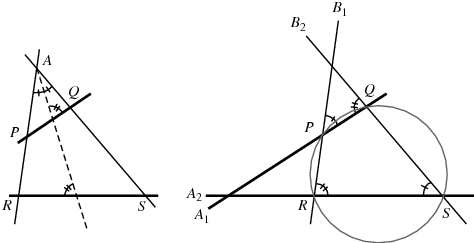
Almost none of them, and perhaps very few of their teachers, know that there is a second type of line which can be drawn to cut the two sides which will also form a similar triangle, and thus must also form angles congruent to the two base angle of the original triangle. Its called the anti-parallel now, but it used to be called a subcontrary line, at least by Apollonius.

There are several nice ways to produce an antiparallel in a triangle. A nice general way is to use the two vertices of one leg and a point on one of the other two legs to construct a circle. The circle will then cut the other leg in a fourth point which is the other vertex of the antiparallel. These four point are the vertices of a cyclic quadrilateral, for which the opposite angles are supplementary. This makes it easy to see that the antiparallel forms angles on one leg congruent to the original angle on the other leg.
A second way is to draw an altitude from two of the vertices to the opposite sides. The segment connecting the feet of these two altitudes is also antiparallel to the third side.

*image from Wolfram Mathworld

A recent note from Anthony Leonardo gave another nice way to make anti-parallels using Geogebra,  


Now you can construct any non-isoceles triangle, and then by moving point O, construct a moving set of anti-parallels.


If you construct the circumcircle of the triangle, the tangent at the vertex opposite a side will be anti-parallel to that side. (This doesn't strike me as a simple proof, but I may be overlooking something. I often do. If you have a simple proof, high school level for example, I would love to see and share it.)

Just as the median bisects all lines parallel to the base, its reflection in the angle bisector (called the symmedian) will bisect each anti-parallel.

The antiparallel shows up as the solution to an optimization problem that was first proved by Giovanni Fagnano in 1775: For a given acute triangle determine the inscribed triangle of minimal perimeter. Turns out the answer is the triangle formed by the three anti-parallels connecting the feet of the three altitudes, called the orthic triangle.

For slightly more advanced students who have been exposed to cones it is constructive to point out that for an oblique circular cone, (one in which the axis is not perpendicular to the base; and many students graduate from HS without ever having been made aware that such types of cones exist, much less those whose base is non-circular) there is more than one plane which will cut a circle. A cutting plane parallel to the base is one type, and of course by now you suspect that the other type is a plane anti-parallel to the base.

paramanands blogspot


Maybe soon I'll write about the anti-CENTER.
  Oh, heck.  Now might work.  First we need a new term for many students, maltitude.  A maltitude ("midpoint altitude") is a perpendicular drawn to a side of a quadrilateral from the midpoint M of the opposite side.  It some strange (think "fun" ) quadrilaterals a maltitude may have a foot outside the quadrilateral on the opposite side extended.  


*Wolfram Mathworld


In a cyclic quadrilateral the maltitudes all intersect in a single point, rhe anticenter.  As the image illustrates, the anticenter is the reflection of the circumcenter reflected in the geocenter G.

Addendum: After a comment by 1SAEED9, I realized a proof that the tangent at the vertex opposite a side is antiparallel to that side.

It is easy to see that angles DBA and BCA both subtend the same arc, and thus are the same measure. By using the fact that CBA, DBA and EBD add up to 180 degrees, and the three interior angles of the triangle CBA, CAB, and BCA also add up to 180 degrees. Since BCA and DBA are congruent, when we subtract these from each side, and remove CBA from both sides we are left with the fact that EBD must be congruent to CAB. We can repeat this process on the opposite angle and we are done. Easier than I imagined.

On This Day in Math - February 8


Edgeworth box; *daviddfriedman.com


The most important and urgent problems of the technology of today are no longer the satisfactions of the primary needs or of archetypal wishes, but the reparation of the evils and damages by technology of yesterday.
~Dennis Gabor

The 39th day of the year; 39 is the smallest number with multiplicative persistence 3. [Multiplicative persistence is the number of times the digits must be multiplied until they produce a one digit number; 3(9)= 27; 2(7) = 14; 1(4)=4. Students might try to find the smallest number with multiplicative persistence of four, or prove that no number has multiplicative persistence greater than 11]

For the 39th day: 39 = 3¹ + 3² + 3³ *jim wilder ‏@wilderlab

An Armstrong (or Pluperfect digital invariant) number is a number that is the sum of its own digits each raised to the power of the number of digits. For example, 371 is an Armstrong number since \(3^3+7^3+1^3 = 371\). The largest Armstrong number in decimal numbers has 39 digits. (115,132,219,018,763,992,565,095,597,973,522,401 is the largest)
 (Armstrong numbers are named for Michael F. Armstrong who named them for himself as part of an assignment to his class in Fortran Programming at the University of Rochester \)

I find it interesting that 39 = 3*13, and is the sum of all the primes from 3 to 13, 39=3+5+7+11+13  (is there a name for these kinds of numbers?)


EVENTS

1587 Mary, Queen of Scots, was beheaded after Sir Francis Walsingham did a frequency count on Mary’s cipher, read her message, and uncovered her plot to assassinate Elizabeth I, Queen of England. *VFR  a more complete version of the "Babington Plot" and Walsingham's work in deciphering the code is here


In 1672, Isaac Newton's first paper on optics read before Royal Society in London. He had been elected a member only the previous month, recognizing his original design of the first reflecting telescope. Newton had already spent several years investigating optics, beginning in 1665. His studies of the colors from glass prisms with their dispersion of light were recorded in his essay New Theory about Light and Colors (1672), and expanded later in Opticks (1704).*TIS (Always sensitive to criticism, the controversy over his theories and experiments in light would lead to his not publishing on the topic until 1704.) Thony Christie has a nice post about Newton's research on color and light here.


In 1865, Gregor Mendel, aged 42, who first discovered the laws of genetics, read his first scientific paper to the Brünn Society for the study of Natural Sciences in Moravia (published 1866). He described his investigations with pea plants. Although he sent 40 reprints of his article to prominent biologists throughout Europe, including Darwin, only one was interested enough to reply. Most of the reprints, including Darwin's, were discovered later with the pages uncut, meaning they were never read. Fortunately, 18 years after Mendel's death, three botanists in three different countries researching the laws of inheritance, in spring 1900, came to realize that Mendel had found them first. Mendel was finally acknowledged as a pioneer in the field which became known as genetics*TIS


1913 Hardy wrote a letter to Ramanujan, (actually Littlewood wrote the letter, but surely speaking their joint interest) expressing his interest for his work. Hardy also added that it was "essential that I should see proofs of some of your assertions". *Wik


1945 A Patent is Filed for the Harvard Mark I. C.D Lake, H.H. Aiken, F.E. Hamilton, and B.M. Durfee file a calculator patent for the Automatic Sequence Control Calculator, commonly known as the Harvard Mark I. The Mark I was a large automatic digital computer that could perform the four basic arithmetic functions and handle 23 decimal places. A multiplication took about five seconds. *CHM (We've come a long way, baby.)


In 1969, pieces of a large meteorite were recovered in Chihuahua, Mexico. It fell at 1:05 am as a huge fireball that scattering several tons of material over an area measuring 48 by 7 km. Named after the nearby village of Allende, samples of this carbonaceous chondrite stone contain an aggregated mass of particles several of which can be easily identified as chondrules. This ancient material comes from before our Solar System formed, thus over 4.6 billion years old. Since these remnants represent the most primitive geological material from which planets were formed, and carry information to help explain the evolution of the our galaxy, Allende is one of the most studied meteorites in the world.*TIS


1978 The first issue of the CSHPM (Canadian Society for History and Philosophy of Mathematics) newsletter is issued. The issue announced the establishment of a fund as a memorial to Ken May. The fund will be used to underwrite the Kenneth O. May Lecture series. May had been one of the primary agents in the creation of the CSHPM. *CSHPM newsletter


BIRTHS

411 Proclus Diadochus (8 Feb 411 in Constantinople (now Istanbul), Byzantium (now Turkey) - 17 April 485 in Athens, Greece) was a Greek philosopher who became head of Plato's Academy and is important mathematically for his commentaries on the work of other mathematicians. *SAU


1627 Jonas Moore (8 Feb 1627 in Whitelee, Pendle Forest, Lancashire, England - 25 Aug 1679 in Godalming, England) was an English man of science important for his support of mathematics and astronomy.*SAU He seems to have been the first to use "cot" for the cotangent function. He also founded the Royal Mathematical School at Christ's Hospital with Samual Pepys to train young men in the mathematics of navigation. *Wik He made critical contributions to the draining of the fens in England (making my daily drive from Lakenheath to Stoke Ferry much easier) and was instrumental in convincing Charles II to create the Royal Observatory and appoint Flamsteed as Astronomer Royal. *The day that Jonas died, Renaissance Mathematicus.


1630 Pierre-Daniel Huet (8 Feb 1630, 26 Jan 1721) French scholar, antiquary, scientist, and bishop whose incisive skepticism, particularly as embodied in his cogent attacks on René Descartes, greatly influenced contemporary philosophers. Huet wrote a number of philosophical works that asserted the fallibility of human reason in addition to scientific work in the fields of astronomy, anatomy, and mathematics. *TIS


1677 Jacques Cassini (8 February 1677 – 16 April 1756) was a French astronomer, son of the famous Italian astronomer Giovanni Domenico Cassini.
Cassini was born at the Paris Observatory. Admitted at the age of seventeen to membership of the French Academy of Sciences, he was elected in 1696 a fellow of the Royal Society of London, and became maître des comptes in 1706. Having succeeded to his father's position at the observatory in 1712, he measured in 1713 the arc of the meridian from Dunkirk to Perpignan, and published the results in a volume entitled Traité de la grandeur et de la figure de la terre (1720). He also wrote Eléments d'astronomie (1740), and died at Thury, near Clermont. He published the first tables of the satellites of Saturn in 1716.*Wik


1700 Daniel Bernoulli (29 January 1700 (8 Feb new style), 8 March 1782) was a Dutch-Swiss mathematician and was one of the many prominent mathematicians in the Bernoulli family. He is particularly remembered for his applications of mathematics to mechanics, especially fluid mechanics, and for his pioneering work in probability and statistics. Bernoulli's work is still studied at length by many schools of science throughout the world. The son of Johann Bernoulli (one of the "early developers" of calculus), nephew of Jakob Bernoulli (who "was the first to discover the theory of probability"), and older brother of Johann II, He is said to have had a bad relationship with his father. Upon both of them entering and tying for first place in a scientific contest at the University of Paris, Johann, unable to bear the "shame" of being compared as Daniel's equal, banned Daniel from his house. Johann Bernoulli also plagiarized some key ideas from Daniel's book Hydrodynamica in his own book Hydraulica which he backdated to before Hydrodynamica. Despite Daniel's attempts at reconciliation, his father carried the grudge until his death.
He was a contemporary and close friend of Leonhard Euler. He went to St. Petersburg in 1724 as professor of mathematics, but was unhappy there, and a temporary illness in 1733 gave him an excuse for leaving. He returned to the University of Basel, where he successively held the chairs of medicine, metaphysics and natural philosophy until his death.
In May, 1750 he was elected a Fellow of the Royal Society. He was also the author in 1738 of Specimen theoriae novae de mensura sortis (Exposition of a New Theory on the Measurement of Risk), in which the St. Petersburg paradox was the base of the economic theory of risk aversion, risk premium and utility.
One of the earliest attempts to analyze a statistical problem involving censored data was Bernoulli's 1766 analysis of smallpox morbidity and mortality data to demonstrate the efficacy of vaccination. He is the earliest writer who attempted to formulate a kinetic theory of gases, and he applied the idea to explain Boyle's law. He worked with Euler on elasticity and the development of the Euler-Bernoulli beam equation. *Wik


1834 Dmitry Ivanovich Mendeleev (8 Feb 1834; 2 Feb 1907 at age 73) (Also spelled Mendeleyev) Russian chemist who developed the periodic classification of the elements. In his final version of the periodic table (1871) he left gaps, foretelling that they would be filled by elements not then known and predicting the properties of three of those elements.*TIS


1845 Francis Ysidro Edgeworth FBA (8 February 1845, Edgeworthstown – 13 February 1926, Oxford) was an Irish philosopher and political economist who made significant contributions to the methods of statistics during the 1880s. Edgeworth was a highly influential figure in the development of neo-classical economics. He was the first to apply certain formal mathematical techniques to individual decision making in economics. He developed utility theory, introducing the indifference curve and the famous Edgeworth box, which is now familiar to undergraduate students of microeconomics. He is also known for the Edgeworth conjecture which states that the core of an economy shrinks to the set of competitive equilibria as the number of agents in the economy gets large. In statistics Edgeworth is most prominently remembered by having his name on the Edgeworth series. *Wik In 1881 he published Mathematical Psychics: An Essay on the Application of Mathematics to the Moral Sciences. This work, really on economics, looks at the Economical Calculus and the Utilitarian Calculus. In fact most of his work could be said to be applications of mathematical psychics which Edgeworth saw as analogous to mathematical physics. They were applied to the measure of utility, the measure of ethical value, the measure of evidence, the measure of probability, the measure of economic value, and the determination of economic equilibria. He formulated mathematically a capacity for happiness and a capacity for work. His conclusions that women have less capacity for pleasure and for work than do men would not be popular today. *SAU


1853 Alexander Ziwet (February 8, 1853 - No
vember 18, 1928) born in Breslau. He became professor at the University of Michigan, an editor of the Bulletin of the AMS, and a collector of mathematics text who enriched the Michigan library. *VFR His early education was obtained in a German gymnasium. He afterwards studies in the universities of Warsaw and Moscow, one year at each, and then entered the Polytechnic School at Karlsruhe, where he received the degree of Civil Engineer in 1880.
He came immediately to the United States and received employment on the United States Lake Survey. Two years later he was transferred to the United States Coast and Geodetic Survey, computing division, where he remained five years.
In 1888 he was appointed Instructor in Mathematics in the University of Michigan. From this position he was advanced to Acting Assistant Professor in 1890, to Assistant Professor in 1891, to Junior Professor in 1896, and to Professor of Mathematics in 1904.
He was a member of the Council of the American Mathematical Society and an editor of the "Bulletin" of the society. In 1893-1894 he published an "Elementary Treatise on Theoretical Mechanics" in three parts, of which a revised edition appeared in 1904. He also translated from the Russian of I. Somoff "Theoretische Mechanik" (two volumes, 1878, 1879).
*Burke A. Hinsdale and Isaac Newton Demmon, History of the University of Michigan (Ann Arbor: University of Michigan Press, 1906), pp. 320-321.


1875 Thomas John l'Anson Bromwich (8 Feb 1875 in Wolverhampton, England - 26 Aug 1929 in Northampton, England) He worked on infinite series, particularly during his time in Galway. In 1908 he published his only large treatise An introduction to the theory of infinite series which was based on lectures on analysis he had given at Galway. He also made useful contributions to quadratic and bilinear forms and many consider his algebraic work to be his finest. In a series of papers he put Heaviside's calculus on a rigorous basis treating the operators as contour integrals*SAU G. H. Hardy described him as the “best pure mathematician among the applied mathematicians at Cambridge, and the best applied mathematician among the pure mathematicians.” *VFR


1928 Ennio de Giorgi (Lecce, February 8, 1928 – Pisa, October 25, 1996) was an Italian mathematician who worked on partial differential equations and the foundations of mathematics.*SAU


DEATHS

1909 Giacinto Morera (born Novara, 18 July 1856 – died Turin, 8 February 1909), was an Italian engineer and mathematician. He is remembered for Morera's theorem in the theory of functions of a complex variables and for his work in the theory of linear elasticity. *Wik


1957 John von Neumann (28 Dec 1903, 8 Feb 1957 at age 53)Hungarian-American mathematician who made important contributions in quantum physics, logic, meteorology, and computer science. He invented game theory, the branch of mathematics that analyses strategy and is now widely employed for military and economic purposes. During WW II, he studied the implosion method for bringing nuclear fuel to explosion and he participated in the development of the hydrogen bomb. He also set quantum theory upon a rigorous mathematical basis. In computer theory, von Neumann did much of the pioneering work in logical design, in the problem of obtaining reliable answers from a machine with unreliable components, the function of “memory,” and machine imitation of “randomness.”*TIS


1974 Fritz Zwicky (14 Feb 1898, 8 Feb 1974 at age 76) Swiss-American astronomer and physicist who proposed dark matter exists in the universe, and made valuable contributions to the theory and understanding of supernovas (stars that for a short time are far brighter than normal).*TIS


1979 Dennis Gabor (5 Jun 1900, 8 Feb 1979 at age 78)  Hungarian-born British electrical engineer who won the Nobel Prize for Physics in 1971 for his invention of holography, a system of lensless, three-dimensional photography that has many applications. He first conceived the idea of holography in 1947 using conventional filtered-light sources. Because such sources had limitations of either too little light or too diffuse, holography was not commercially feasible until the invention of the laser (1960), which amplifies the intensity of light waves. He also did research on high-speed oscilloscopes, communication theory, physical optics, and television. Gabor held more than 100 patents. *TIS


2005 Germund Dahlquist (January 16, 1925 – February 8, 2005) was a Swedish mathematician known primarily for his early contributions to the theory of numerical analysis as applied to differential equations.*Wik


Credits :
*CHM=Computer History Museum
*FFF=Kane, Famous First Facts
*NSEC= NASA Solar Eclipse Calendar
*RMAT= The Renaissance Mathematicus, Thony Christie
*SAU=St Andrews Univ. Math History
*TIA = Today in Astronomy
*TIS= Today in Science History
*VFR = V Frederick Rickey, USMA
*Wik = Wikipedia
*WM = Women of Mathematics, Grinstein & Campbell
Tuesday, 7 February 2023

e-day and Andy Jackson

Adding on to the post about coincidences yesterday, this post is about a value derived from the same hyperbola, y=1/x. For the mathematician, February 7th, (or 2 - 7) is the date we decide to celebrate the constant which is the base of the natural logarithms, appx 2.71828.... (more later, and a way to memorize it). There have been LOTS of sites that explain LOTS of things (such as at Homeschool Math Blog and here at Let's Play Math.) about the value e, so I will try to not be too redundant and throw in something totally different, as the Monty Python folks used to say... The letter e was first used for the base of the natural or hyperbolic logarithms by Leonhard Euler. Earlier I had mistakenly thought that Euler was the discoverer of the value, but in fact the number was published in Edward Wright's English translation of Napier's work on logarithms in 1618, almost 100 years before Euler's birth. [and in fact, it was known to the English Mathematician Roger Cotes. Cotes is one of those many promising mathematicians who died at a young age and Newton, who seldom said anything good about anyone else, once said "Perhaps if Cotes had lived, we would have known something"..] The number represented by e is approximately 2.718281828459045... Euler actually computed the number to eight more decimal places. This was done in 1727, and would seem almost impossible accuracy for anyone else, but of Euler it was said, "Euler calculates as other men breathe." It was known from the work of Gregory of St. Vincent and others that the logarithms were somehow linked to the area under the hyperbola f(x)=1/x because the area under the curve matched the logarithmic property Log(AB)= Log(A)+Log(B). The Area under the curve from 1 to x=ab is equal to the areas from 1 to x=a plus the area from 1 to x=b. The value of e is such that the area under the hyperbola from 1 to e is 1 square unit. It has been conjectured that Euler may have used e as an abbreviation of the word Eins, the German word for one. One oddity that students and teachers may use to remember the first 15 digits of e, given above, is to recognize their relationship with Andrew Jackson's presidency and an isosceles right triangle. Confusing? Just wait, all will be clear. We begin with 2, because Jackson was president for two terms. The 7 tells us he was the seventh president of the US. 1828 is the year he was elected, and we repeat this because of the two terms. Then we give the three angles of an isosceles right triangle, 45, 90, 45, and we have completed 15 digits of the base of the natural logarithms. I am almost 100% sure I picked that up from one of Martin Gardner's Scientific American columns. Euler was one of the most influential mathematicians of the period and his prestige was sufficient that his use of a variable often marked it for posterity, but there were other symbols that were suggested occasionally. D'Alembert used c for the same constant in 1747, and Benjamin Peirce suggested a symbol that looked like a paper clip, or the @ symbol now used for e-mail addresses instead of pi, and the same symbol reflected in a vertical line for e. But now I have to bring up the fact that in my new (winter) home town of Paducah, Ky, e-day is for Engineers Day. The University of Kentucky College of Engineering has a branch campus at Paducah, and they are having their open house on February 21 at Crounse Hall. They have, among other things, an Edible car contest (would I kid you?) as well as an Egg Drop contest, A Popsicle Stick bridge contest, and of course (drum roll please...) A Duct Tape Challenge...... I had a student only a few years ago who was a master of duct-tape-utilization. He would make roses out of duct tape to impress the ladies, (and did) and had a duct tape wallet... and once came to school in a sport coat made entirely of duct tape... I imagine he could have had one in cashmere for about the same price.

On This Day in Math - February 7


The Frenet-Serret Frame, *Wik


A mathematician, like a painter or a poet, is a maker of patterns. If his patterns are more permanent than theirs, it is because they are made with ideas. Beauty is the first test: there is no permanent place in the world for ugly mathematics.
~Godfrey Harold Hardy


The 38th day of the year; 31415926535897932384626433832795028841 is a prime number.  BUT, It’s also the first 38 digits of pi.

38 is the largest even number so that every partition of it into two odd integers must contain a prime.

38 is the sum of squares of the first three primes \(2^2 + 3^2 + 5^2 = 38 \). *Prime Curios

At the beginning of the 21st Century there were 38 known Mersenne Primes. As of this writing, there are 51, the last being discovered in Dec of 2018..


Although we've had some unusual shaped flags, usually the star field is in a rectangle with the stars displaying some kind of (generally rectangular) similarity. Some have strayed greatly from the rectangle form however. This one with 38 stars from 1877 until 1890 is an example.


38 is also the magic constant in the only possible magic hexagon which utilizes all the natural integers up to and including 19. It was discovered independently by Ernst von Haselberg in 1887, W. Radcliffe in 1895, and several others. Eventually it was also discovered by Clifford W. Adams, who worked on the problem from 1910 to 1957. He worked on the problem throughout his career as a freight-handler and clerk for the Reading Rail Road by trial and error and after many years arrived at the solution which he transmitted to Martin Gardner in 1963. Gardner sent Adams' magic hexagon to Charles W. Trigg, who by mathematical analysis found that it was unique disregarding rotations and reflections.

*Wik


EVENTS

In 1812, the third day of powerful earthquakes struck, this one with an epicenter near New Madrid, Missouri, part of a three-month series in the central Mississippi River valley, known as the New Madrid earthquakes that began on 16 Dec 1811. The first two had happened on that December day, six hours apart, each with an epicenter in northeastern Arkansas, and were felt hundreds of miles away. Another followed on 23 Jan 1812, with epicenter in the far southeast corner of Missouri. All were powerful, about magnitude 7-7.5, with many aftershocks. Contemporary accounts tell of houses damaged, chimneys toppled, remarkable geological phenomena and landscapes changed. They remain among the most powerful earthquakes in the United States. The New Madrid fault remains a concern. *TIS (especially to those of us who live not far away in Possum Trot, Ky.)

1885 Hilbert promoted to Ph.D. He defended Kant's statement that man possesses, beyond logic and experience, certain a priori knowledge * Constance Reid, Hilbert, p. 16

In 1896, radiology began in England when X-rays were first used to discover the location of a bullet in a 12-yr-old boy's wrist who shot himself the previous month. When the pellet could not be found on probing, surgeon Sir Robert Jones had been consulted. Jones, having heard about the recently discovered X-rays, asked Oliver Lodge, head of the physics department at Liverpool University, if he could help with the new X-rays. On this day, the boy was brought to Lodge's laboratory. The pellet was identified embedded in the third carpo-metacarpal joint. Jones and Lodge reported the case in The Lancet on 22 Feb 1896. Charles Thurstan Holland who had been in attendance subsequently pioneered in clinical radiological examinations.*TIS

In 1932, the "neutron" was described in an article in the journal Nature by its discoverer, James Chadwick, who coined the name for this neutral particle he discovered present in the nucleus of atoms. He was an English physicist who studied at Cambridge, and in Berlin under Geiger, then worked at the Cavendish Laboratory with Ernest Rutherford, where he investigated the structure of the atom. He worked on the scattering of alpha particles and on nuclear disintegration. By bombarding beryllium with alpha particles, Chadwick discovered the neutron for which he received the Nobel Prize for Physics in 1935. He led the UK's work on the atomic bomb in WW II, and was knighted in 1945.*TIS

In 1935, Monopoly was first marketed by Charles Darrow, with the symbol of Rich Uncle Pennybags. He had invented the game on 7 Mar 1933. (See Note Below) A patent was issued for the game 31 Dec 1935, assigned to Parker Brothers, Inc.(No. 2,026,082). The patent described a "Board Game Apparatus... intended primarily to provide a game of barter, thus involving trading and bargaining" in which "much of the interest in the game lies in trading and in striking shrewd bargains." Illustrations showed the playing board, pieces, 22 "Title cards of the respective Real Estate holdings," Utilities, Chance and Community Chest cards, and scrip money. On the throw of the dice, the players may move onto Real Estate locations which may be acquired.*TIS
The history of the board game Monopoly can be traced back to the early 20th century. The earliest known design was by the American Elizabeth Magie created in 1903. A series of board games was developed from 1906 through the 1930s that involved the buying and selling of land and the development of that land. By 1934, a board game had been created much like the version of Monopoly sold by Parker Brothers and its parent companies through the rest of the 20th century, and into the 21st. Several people, mostly in the Midwestern United States and near the East Coast, contributed to the game's design and evolution.
By the 1970s, the idea that the game had been created solely by Charles Darrow had become popular folklore: it was printed in the game's instructions and even in the 1974 book The Monopoly Book: Strategy and Tactics of the World's Most Popular Game by Maxine Brady.*Wik

1956 Doug Ross Presents Gestalt Programming at the Western Joint Computer Conference in Los Angeles. Ross had experimented with the programming while working for the Air Force and Emerson Electric Co. *CHM

1975 Hungary issued a stamp commemorating the bicentenary (they were two days early) of the birth of Farkas Bolyai (1775–1856). [Scott #2347] *VFR

2015 A Mathematician wins an Oscar, FOR MATH. Robert Bridson, an adjunct professor in computer science at the University of British Columbia, was recognized for "early conceptualization of sparse-tiled voxel data structures and their application to modelling and simulation,".
Bridson is being honoured for his ‘pioneering’ work in developing the algorithms and code behind fluid and smoke simulations used in a long string of major movies, including The Hobbit, Gravity and The Adventures of Tintin.


BIRTHS

1816 Jean Frenet (7 Feb 1816 in Périgueux, France - 12 June 1900 in Périgueux, France) was a French mathematician best remembered for the Serret-Frenet formulas for a space-curve *SAU (Vector notation and linear algebra notation currently used to write these formulas was not yet in use at the time of their discovery.)

1824 Sir William Huggins (7 Feb 1824; 12 May 1910 at age 86) English astronomer who explored the spectra of stars, nebulae and comets to interpret their chemical composition, assisted by his wife Margaret Lindsay Murray. He was the first to demonstrate (1864) that whereas some nebulae are clusters of stars (with stellar spectral characteristics, ex. Andromeda), certain other nebulae are uniformly gaseous as shown by their pure emission spectra (ex. the great nebula in Orion). He made spectral observations of a nova (1866). He also was first to attempt to measure a star's radial velocity. He was one of the wealthy 19th century private astronomers that supported their own passion while making significant contributions. At age only 30, Huggins built his own observatory at Tulse Hill, outside London *TIS

1877 Godfrey Harold "G. H." Hardy FRS (7 February 1877 – 1 December 1947) was an English mathematician, known for his achievements in number theory and mathematical analysis.
He is usually known by those outside the field of mathematics for his essay from 1940 on the aesthetics of mathematics, A Mathematician's Apology, which is often considered one of the best insights into the mind of a working mathematician written for the layman.
Starting in 1914, he was the mentor of the Indian mathematician Srinivasa Ramanujan, a relationship that has become celebrated. Hardy almost immediately recognized Ramanujan's extraordinary albeit untutored brilliance, and Hardy and Ramanujan became close collaborators. In an interview by Paul Erdős, when Hardy was asked what his greatest contribution to mathematics was, Hardy unhesitatingly replied that it was the discovery of Ramanujan. He called their collaboration "the one romantic incident in my life."
Hardy preferred his work to be considered pure mathematics, perhaps because of his detestation of war and the military uses to which mathematics had been applied. He made several statements similar to that in his Apology:
"I have never done anything 'useful'. No discovery of mine has made, or is likely to make, directly or indirectly, for good or ill, the least difference to the amenity of the world."

However, aside from formulating the Hardy–Weinberg principle in population genetics, his famous work on integer partitions with his collaborator Ramanujan, known as the Hardy–Ramanujan asymptotic formula, has been widely applied in physics to find quantum partition functions of atomic nuclei (first used by Niels Bohr) and to derive thermodynamic functions of non-interacting Bose-Einstein systems. Though Hardy wanted his maths to be "pure" and devoid of any application, much of his work has found applications in other branches of science.*Wik

1883 Eric Temple Bell (7 Feb 1883; 21 Dec 1960 at age 77) Scottish-American mathematician and writer who contributed to analytic number theory (in which he found several inportant theorems), Diophantine analysis and numerical functions. In addition to about 250 papers on mathematical research, he also wrote for the layman in Men of Mathematics (1937) and Mathematics, Queen and Servant of Science (1951) among others. Under the name of John Taine, he also wrote science fiction. *TIS Although he was a well known mathematician in his day, he is best remembered for his popular Men of Mathematics. This book is hated by historians of mathematics for its exagerations and inaccuracies, but it is loved by high school students, and has motivated many mathematicians to become mathematicians. If you have not read it, do! *VF


1897 Maxwell Herman Alexander "Max" Newman, FRS (7 February 1897 – 22 February 1984) was a British mathematician and codebreaker. After WWII he continued to do research on combinatorial topology during a period when England was a major center of activity, notably Cambridge under the leadership of Christopher Zeeman. Newman made important contributions leading to an invitation to present his work at the 1962 International Congress of Mathematicians in Stockholm at the age of 65, and proved a Generalized Poincaré conjecture for topological manifolds in 1966. He died in Cambridge.*Wik

1898 Charles Wilderman Trigg,(Feb 7, 1898 Baltimore, Md; June 28, 1989 San Diego, Ca.) American engineer, mathematician and educator. Educated in engineering, mathematics and education at University of Pittsburgh, University of Southern California and University of California at Los Angeles. Worked as an industrial chemist and engineer, 1917-1943, and as an educator and administrator, 1946-1963. Served in the United States Navy during World War II. Book review editor of the Journal of Recreational Mathematics. Considered one of the foremost recreational mathematicians of the twentieth century. *U of Calgary Archives


1899 Hans Jenny (7 Feb 1899; 9 Jan 1992 at age 92) Swiss agricultural chemist and pedologist (soil scientist) who developed numerical functions to describe soil in terms of five interacting factors in his book Factors of Soil Formation (1941). These related Climate (temperature and moisture); Organisms (those living on the soil and in the soil, vegetation and animals, fungi algae and bacteria, decay of organic matter, humus); Relief (topography, and geomorphic landscape); Parent Material (bedrock or sediment type); and Time (ranging from 100's to 1000's of years while maturity or equilibrium of soil development is attained). He moved to the U.S. in 1926. After retirement, he studied the soil relationships in the unusual ecological community of the Pygmy Forest in California, known for its stunted and twisted confers. *TIS

1905 Lucien Alexandre Charles René de Possel (Feb 7, 1905– ?, 1974) was a French mathematician, one of the founders of the Bourbaki group, and later a pioneer computer scientist, working in particular on optical character recognition.
He had the conventional background for a member of Bourbaki: the École Normale Supérieure, agrégation, and then study in Germany. He left Bourbaki at an early stage: there was an obvious personal matter intruding between him and André Weil who had married De Possel's ex-wife Eveline following her divorce from De Possel in 1937.
De Possel published an early book on game theory in 1936 (Sur la théorie mathématique des jeux de hasard et de réflexion). His later research work in computer science at the Institut Blaise Pascal was in a position of relative isolation, as the subject strove for independence and to move away from the imposed role of service provider in the field of numerical analysis. *Wik

DEATHS

1736 Stephen Gray (December 1666 – 7 February 1736) was an English dyer and amateur astronomer, who was the first to systematically experiment with electrical conduction, rather than simple generation of static charges and investigations of the static phenomena.
Gray was born in Canterbury, Kent and after some basic schooling, he was apprenticed to his father (and later his elder brother) in the cloth-dyeing trade. His interests lay with natural science and particularly with astronomy, and he managed to educate himself in these developing disciplines, mainly through wealthy friends in the district who gave him access to their libraries and scientific instruments.
Stephen Gray produced a long series of experiments with electricity. In producing charge on a long glass tube, he discovered in 1729 that he could communicate the electrical effect to other objects by direct connection. Using string, he could charge an object over 50 feet from the rubbed tube, but oddly enough some other substances, such as silk thread, would not carry charge. Brass wire would transmit charge even better. These experiments with charged strings and glass tubes revealed the properties of conduction, insulation, and transmission. From these experiments came an understanding of the role played by conductors and insulators (names applied by John Desaguliers).
Despite the importance of his discoveries (it can be argued that he was the inventor of electrical communications) he received little credit at the time because of the factional dispute in the Royal Society, and the dominance of Newtonianism (which became the Masonic 'ideology'). By the time his discoveries were publicly recognised, experiments in electricity had moved rapidly on and his past discoveries tended to look trivial. For this reason, some historians tend to overlook his work.

There is no monument to Gray, and little recognition of what he achieved, against all odds, in his scientific discoveries. He is believed to be buried in a common grave in an old London cemetery, in an area reserved for pauper pensioners from the Charterhouse. *Wik *Yovisto
In a famous experiment Stephen Gray demonstrated static electricity
by charging a boy suspended by insulating strings in 1744 *Yovisto

1897 Galileo Ferraris (31 Oct 1847 - 7 Feb 1897 at age 49) Italian physicist who studied optics, acoustics and several fields of electrotechnics, but his most important discovery was the rotating magnetic field. He produced the field with two electromagnets in perpendicular planes, and each supplied with a current that was 90º out of phase. This could induce a current in a incorporated copper rotor, producing a motor powered by alternating current. He produced his first induction motor (with 4 poles) in May-Jun 1885. Its principles are now applied in the majority of today's a.c. motors, yet he refused to patent his invention, and preferred to place it at the service of everyone. *TIS

1948 Poul Heegaard (2 Nov 1871 in Copenhagen, Denmark - 7 Feb 1948 in Oslo, Norway) was a Danish mathematician who (with Max Dehn) was the first to classify compact surfaces.*SAU His 1898 thesis introduced a concept now called the Heegaard splitting of a 3-manifold. Heegaard's ideas allowed him to make a careful critique of work of Henri Poincaré. Poincaré had overlooked the possibility of the appearance of torsion in the homology groups of a space.
He later co-authored, with Max Dehn, a foundational article on combinatorial topology, in the form of an encyclopedia entry.
Heegaard studied mathematics at the University of Copenhagen, from 1889 to 1893 and following years of traveling, and teaching mathematics, he was appointed professor at University of Copenhagen in 1910.
Following a dispute with the faculty over, among other things, the hiring of Harald Bohr (The Brother of Niels Bohr, and Olmpic Soccer medalist) as professor at the University (Heegaard was against it); Heegaard accepted a professorship at Oslo in Norway, where he worked till his retirement in 1941.*Wik

1969 Hans Rademacher (3 April 1892 in Wandsbeck (part of Hamburg), Schleswig-Holstein, Germany - 7 Feb 1969 in Haverford, Pennsylvania, USA) It was philosophy that he intended to take as his main university subject when he entered the university of Göttingen in 1911, but he was persuaded to study mathematics by Courant after having enjoyed the excellent mathematics teaching of Hecke and Weyl. He is remembered for the system of orthogonal functions (now known as Rademacher functions) which he introduced in a paper published in 1922. Berndt writes "Since its discovery, Rademacher's orthonormal system has been utilised in many instances in several areas of analysis." Rademacher's early arithmetical work dealt with applications of Brun's sieve method and with the Goldbach problem in algebraic number fields. About 1928 he began research on the topics for which he is best known among mathematicians today, namely his work in connection with questions concerning modular forms and analytic number theory. Perhaps his most famous result, obtained in 1936 when he was in the United States, is his proof of the asymptotic formula for the growth of the partition function (the number of representations of a number as a sum of natural numbers). This answered questions of Leibniz and Euler and followed results obtained by Hardy and Ramanujan. Rademacher also wrote important papers on Dedekind sums and investigated many problems relating to algebraic number fields. *SAU


Credits :
*CHM=Computer History Museum
*FFF=Kane, Famous First Facts
*NSEC= NASA Solar Eclipse Calendar
*RMAT= The Renaissance Mathematicus, Thony Christie
*SAU=St Andrews Univ. Math History
*TIA = Today in Astronomy
*TIS= Today in Science History
*VFR = V Frederick Rickey, USMA
*Wik = Wikipedia
*WM = Women of Mathematics, Grinstein & Campbell