Tuesday, 2 June 2026

On This Day in Math - June 2


"See if you can use this proof to show the square root of three is irrational. Then try the square root of four. 
If it works, you did something wrong." 
~ Jim Wisemant, *Quotes from Honors Linear Algebra


The 153rd day of the year. 153 is the fixed point attractor of any multiple of three under the process of summing the cubes of the digits. For more detail and explanation see,"The Cubic Attractiveness of 153" ,


 13+53 + 33 = 153. Numbers which are the sum of their own digits raised to the power of the number of digits are called Armstrong numbers. Except for the trivial one digit numbers, it is also the smallest. There are only three other numbers greater than one which are the sum of the cubes of their digits (Go forth and seek them. hint: this is the only one which is a year date) This makes 153 a narcissistic or Armstrong number. There are 89 narcissistic numbers in base 10, but only 11 in base 4.
And to extend that, the amazing Cliff Pickover shared this:(although the digits are taken in sets)


ALSO, 153 = 1! + 2! + 3! +4! +5!, *Jim Wilder@wilderlab

I had never observed that 153 = 3 x 51, a product that uses all the digits of the number.  HT to INDER J. TANEJA @IJTANEJA There are no numbers below 1000 that have the same digits as their prime factorization in a simple product (no powers) but there is one lingering just above that number, can you find it?

*HT to Shyam Sunder Gupta who sent me this curiosity:153 added to its reversal, 351 = 504.  The square of 504, 254016, is the smallest square that is factorable into two numbers which are the reversal of each other; 288 x 882.  Anyone curious about the next square that is so factorable... and is there another that is the square of the sum of reversible numbers?

I found another interesting factoid about 153 in Gupta's new book, Exploring the Beauty of Fascinating Numbers.  153 is the smallest triangular number in a string of three consecutive triangular numbers which have three prime factors; 153 = 3 x 3 x 17, 171 = 3 x 3 x 19, and 190 = 2 x 5 x 19.  


More Math facts here


EVENTS

1661 An eager Isaac Newton departs his farm home at Woolsthorpe for Trinity College, Cambridge, although the term would not begin until September. He would remain at Trinity for thirty-five years. He took almost nothing with him. *Thomas Levenson, Newton and The Counterfeiter  (I assume he allows for the period when he went home to avoid the plague.)


1666 John Wallis writes to Oldenburg at the Royal Society on the topic of tides.  "Wallis adopts Galileo’s technique of explaining the tides through the motions of the earth, focusing on a third tidal cycle that Galileo’s theory did not adequately explain: the “menstrual” (i.e., monthly) cycle in which the tides change in accordance with the position of the moon. Wallis argues that the earth and moon revolve once a month around a common centre of gravity, and it is this point that revolves around the sun. The earth is therefore on a small epicycle with a period of one month, and this additional motion affects the timing and level of the tides. " (From PhD thesis of Adam D Richter, with my thanks). This was well before the universal reach of gravity was understood or accepted.  Wallis gives a very mathematical response to inquiries about how he explains this "action at a distance." Wallis maintain that "his goal as a natural philosopher is to recognize phenomena and describe them mathematically, rather than to explain their underlying physical causes. " (A. Richter). 
In addition, he points out that his approach is widely supported by Natural Philosophers acceptance of action at a distance in magnets.


In 1686, the publication of Newton's Principia was arranged in London at the Royal Society. The minutes of the meeting record that the astronomer Edmund Halley would "undertake the business of looking after it and printing it at his own charge."   (As Newton was finalising his work the Royal Society was printing a book called The History of Fishes. "This book is quite lavishly illustrated and unfortunately the Society didn’t have enough budget to publish Principia,” Ms Sommerfeldt said.)

Image: Sir Isaac Newton's own first edition copy of his Philosophiae Naturalis Principia Mathematica with his handwritten corrections for the second edition. The first edition was published under the imprint of Samuel Pepys who was president of the Royal Society. By the time of the second edition, Newton himself had become president of the Royal Society, as noted in his corrections.


1692 – Bridget Bishop is the first person to go to trial in the Salem witch trials in Salem, Massachusetts. Found guilty, she is hanged on June 10. Nineteen were hanged, and one, Giles Corey, was pressed to death. Altogether, about 200 people were tried.

Bridget was about sixty years old at her death.


1739, the Royal Swedish Academy of Sciences (Kungl. Vetenskapsakademien) was founded. Inspired by the Royal Society of London and l'Académie Royale des Sciences in Paris, it was created as an independent and non-governmental scientific society, with the overall objective of promoting the sciences. Founding members included the world-famous naturalist Carl Linnaeus. In its early years, it took a great interest in encouraging the uses of scientific discoveries in society, as for example in agriculture, ship building and mining. At the beginning of the 19th century, its Permanent Secretary was the distinguished chemist, Jons Berzelius. It is now known for its annual role in awarding the Nobel Prizes established in the will of inventor Alfred Nobel.


1858, The Donati Comet was first seen and named after its discoverer, Giovanni Battista Donati, at Florence. It was the second-brightest comet of the nineteenth century It reached perihelion on 30 Sep 1858. When nearest the earth on 9 Oct 1858, it was about 0.5 AU away, and had developed a scimitar-shaped triple tail. At that time, its very prominent dust tail had with an apparent length of 50°, more than half the distance from the horizon to the zenith, a linear distance of over 72 million km (about 45 million mi). It was the first comet to be photographed. With an orbital period estimated at more than 2000 years, it will not return until about the year 4000. An astronomical unit, AU, equals 93 million miles, the Sun-Earth distance.  On Sep 14th, the night before his third debate with Stephen Douglas, Abraham Lincoln sat on the porch of the Jonesboro, Illinois hotel and viewed the comet with a friend.  


1889, a hydroelectric power plant generated alternating current electricity which was for the first time made available to  and Sullivan Power Plant, were the event happened, gives the date as June 3 at a significant distance from its origin. A 13 mile power line linked the Willamette Falls Electric Co. power plant to Portland, Ore. Two 300 h.p. Stilwell & Bierce waterwheels together drove a single phase, 720 kilowatt generator. It was not the first hydroelectric power plant, for one had been demonstrated in Appleton, Wisc., 30 Sep 1882 with a small dynamo. Rather, it is the use of alternating current that is significant, for this makes possible long-distance transmission that overcomes the problems of direct current. AC generators driven by steam power had been in use elsewhere since 1886. *TIS   
The Willamette Falls and Sullivan Power Plant gives the date of the event as June 3 at their on line history page.  Using generators originally employed in a Portland sawmill, the Willamette Falls Electric Company, a precursor of Portland General Electric, produced the nation’s first long-distance transmission of electricity on June 3, 1889. Power traveled from Station A in Oregon City to the streetlights in Portland 14 miles away.
part of the plant today shown below.  
Willamette Falls hydro-electric plant


1890 The first census compiled by machine was started. The previous census took nearly a decade to compute. The 1890 census recorded the U.S. population at 62,979,766. See 8 January 1889. [Kane, p. 169] *VFR ... The 2010 census reported the population of the USA as 308,745,538.  (*****NOTE... 
@thepainterflynn
 gives this date as the first use of "Hollerith's tabulating machine to count census returns." Wikipedia says the census for 1990 BEGAN on June 2, 1990, and took six years to complete.This last fact is confirmed by "Report of the Commissioner of Labor in Charge of The Eleventh Census to the Secretary of the Interior for the Fiscal Year Ending June 30, 1895"  saying the census would end "during the present calendar year. ... " )
1890 Hollerith census card with fields coded

1913 Millikan announced the results of his experiment to measure the electron charge. *VFR


1924 – U.S. President Calvin Coolidge signs the Indian Citizenship Act into law, granting citizenship to all Native Americans born within the territorial limits of the United States.


1925 – Because of a lineup revision by Miller Huggins, Wally Pipp is replaced by Lou Gehrig at first base for the New York Yankees, beginning a streak of 2,130 consecutive games played, topped only by Cal Ripken, Jr. in 1995. Exactly 16 years later to the day, in 1941, Gehrig dies from Amyotrophic lateral sclerosis (ALS).

Gehrig 1923 *Wik


Wally Pip *Wik


1963 Between May 11 and June 2, Donald B. Gillies found three new primes. When the primes were confirmed the UIUC Math dept (which has a postal branch) used this cancellation stamp on all mail from roughly 1964 - 1976, when Appel and Haken proved the four color theorem ("Four Colors Suffice") and a new stamp was created. Trivia question : how far away from Gillies did Appel live in Urbana Illinois ??
Answer : He lived 3 houses away. *Wik

*Wik courtesy of Chris Caldwell


1966 Surveyor 1 Makes soft-landing on the moon. It was the first lunar soft-lander in the unmanned Surveyor program of the National Aeronautics and Space Administration (NASA, United States). It gathered data about the lunar surface that would be needed for the manned Apollo Moon landings that began in 1969. The successful soft landing of Surveyor 1 on the Ocean of Storms was the first by an American space probe onto any extraterrestrial body, and it occurred just four months after the first Moon landing by the Soviet Union's Luna 9 probe.

Surveyor 1 was launched May 30, 1966 and landed on the Moon on June 2, 1966. It transmitted 11,237 still photos of the lunar surface to the Earth by using a television camera and a sophisticated radio-telemetry system. *Wik

*Wik


BIRTHS

1817 George Henry Corliss (June 2, 1817 – February 21, 1888) was an American mechanical engineer and inventor, who developed the Corliss steam engine, which was a great improvement over any other stationary steam engine of its time.  In 1849, Corliss applied for a patent for a novel kind of valve gear for a stationary steam engine (second image).  The steam engine was then almost 75 years old, and steam engines still used a sliding valve system that had changed little since the days of James Watt.   Four of them were required to admit and exhaust steam for both the up and down strokes.  The problem with sliding valves is that they are constantly exposed to a wide temperature range, as the steam cools and condenses, which means they expand and contract incessantly, and it is difficult to regulate the beginning and end of each cycle with precision.

Corliss invented a set of four rotary valves, each linked to a central rotating device called a wrist plate, as we can see in one of his patent illustrations (third image).   Each valve stays at a constant temperature, and the intake cutoff points can be regulated with great precision. As a result, a Corliss engine is about 30% more efficient than a Watt engine. In manufacturing, increased efficiency is the blessing of all blessings. Corliss engines could also run at a constant speed under a variety of loads, due to a clever system of governors that were also included in the 1849 patent, which was a very useful feature for an engine being used to power a factory. So Corliss engines took over the place of honor in the factory workplace, in the first great steam engine revolution since Watt invented the thing in the first place.

At the 1876 Centennial Exhibition in Philadelphia, meant to showcase America's newfound industrial power, the central fixture was a mammoth operating Corliss steam engine, which powered everything else at the fair .  It was built by Corliss at his factory in Rhode Island and donated to the Exhibition. 
The Science Museum in London also has an operating Corliss engine, which they call "Big Red"


1884  Henry Thomas Herbert Piaggio(2 June 1884–26 June 1967) graduated from Cambridge and then worked at the University of Nottingham. He is best known for his text-book on Differential Equations.


1895 Tibor Radó (June 2, 1895 – December 29, 1965) was a Hungarian mathematician who moved to the USA after World War I. He was born in Budapest and between 1913 and 1915 attended the Polytechnic Institute. In World War I, he became a First Lieutenant in the Hungarian Army and was captured on the Russian Front. He escaped from a Siberian prisoner camp and, traveling thousands of miles across Arctic wasteland, managed to return to Hungary.
He received a doctorate from the University of Szeged in 1923. He taught briefly at the university and then became a research fellow in Germany for the Rockefeller Foundation. In 1929, he moved to the United States and lectured at Harvard University and the Rice Institute before obtaining a faculty position in the Department of Mathematics at Ohio State University in 1930. In 1935 he was granted American citizenship.
In the 1920s, he proved that surfaces have an essentially unique triangulation.
In 1933, Radó published "On the Problem of Plateau" in which he gave a solution to Plateau's problem, and in 1935, "Subharmonic Functions".
In World War II he was science consultant to the United States government, interrupting his academic career.
He became Chairman of the Department of Mathematics at Ohio State University in 1948.
His work focused on computer science in the last decade of his life and in May 1962 he published one of his most famous results in the Bell System Technical Journal: the Busy Beaver function and its non-computability ("On Non-Computable Functions").
In computability theory, a busy beaver (from the colloquial expression for an "industrious person") is a Turing machine that attains the maximum "operational busyness" (such as measured by the number of steps performed, or the number of nonblank symbols finally on the tape) among all the Turing machines in a certain class. The Turing machines in this class must meet certain design specifications and are required to eventually halt after being started with a blank tape. *Wik

Tibor Radó, shown here in an undated photo, invented the busy beaver game as a way of making the theoretical notion of uncomputability concrete. Courtesy of The Ohio State University Archives


1916 Abraham Seidenberg  (June 2, 1916 – May 3, 1988)  was known for his research to commutative algebra, algebraic geometry, differential algebra, and the history of mathematics. He published Prime ideals and integral dependence written jointly with I S Cohen which greatly simplified the existing proofs of the going-up and going-down theorems of ideal theory. He also made important contributions to algebraic geometry. In 1950, he published a paper called The hyperplane sections of normal varieties which has proved fundamental in later advances. In 1968, he wrote Elements of the theory of algebraic curves, a book on algebraic geometry. He published several important papers.*Wik


1975 Taira Honda (本田 平 Honda Taira?, 2 June 1932 Fukui, Japan – 15 May 1975 Osaka, Japan) was a Japanese mathematician working on number theory who proved the Honda–Tate theorem classifying abelian varieties over finite fields. *Wik His mathematical research was mainly devoted to the investigation of the arithmetic properties of commutative formal groups. A brilliant career was cut short when he took his own life.*SAU


DEATHS

1785
Jean Paul de Gua de Malves
, (1713, Carcassonne – June 2, 1785, Paris) In 1740 he published a work on analytic geometry which, without the differential calculus, he found tangents, asymptotes, and various singular points of an algebraic function. He gave the proof of Descartes rule of signs which is found in modern texts. It is not known if Descartes ever proved it, and Newton seemed to think it was "obvious". (A short account of the history of mathematics By Walter William Rouse Ball)

 de Malves discovered this three-dimensional analogue of the Pythagorean theorem in the 18th century.

If a tetrahedron has a right-angled corner (such as the corner of a cube), then the square of the area of the face opposite that corner is the sum of the squares of the areas of the other three faces.


1917 William Henry Besant FRS (1 November 1828, Portsea, Portsmouth – 2 June 1917, Cambridge) was a British mathematician, brother of novelist Walter Besant.
In a competition, William won a scholarship to Corpus Christi College, Cambridge in 1844. He took part in Cambridge Mathematical Tripos in 1850, gaining the title of Senior Wrangler. He was also winner of Smith's Prize.
In 1853 William became a Fellow of Saint John's College, Cambridge where he was a lecturer in mathematics until 1889. His pupils included William Burnside, A. W. Flux and G. B. Mathews. Besant served as an examiner for Tripos in 1856, 1857, and 1885. He was also an examiner for University of London from 1859 to 1864. Besant was also a coach for students taking the Tripos; twenty-one of his students placed in the ranks of top ten wranglers. According to Mathews, "he had the great advantage (for a coach) of being equally good in geometry, analysis, and dynamics."
In 1859 Besant vacated his Fellowship with Saint John's college to marry Margaret Elizabeth Willis, daughter of Rev. Robert Willis, a professor of natural philosophy at Cambridge. They had two sons and a daughter. In 1863 Besant published Elementary Hydrostatics, a textbook on fluid statics containing mathematical exercises such as students might face in examination. The book was reprinted several times, and revised in 1892. He also wrote Treatise on Hydromechanics (1867) covering fluid mechanics. His book Elementary Conics came out in 1901.
Besant was a Fellow of the Royal Astronomical Society from 10 February 1854. He became a Fellow of the Royal Society in 1871. In 1883 Cambridge University bestowed upon him, and Edward Routh, the degree Sc.D.. He died on 2 June 1917 and is buried at the Parish of the Ascension Burial Ground in Cambridge.

He created the term Glissettes for his studies on the objects for Notes on Roulettes and Glissettes(1871). He writes in the preface:

*Wik


1929 Otto Schreier (3 March 1901 in Vienna, Austria - 2 June 1929 in Hamburg, Germany) He will be best remembered for his work on subgroups of free groups which he studied in his habilitation thesis. He published the results in 1927 in the paper Die Untergruppen der freien Gruppe which is described as "... one of the most important papers ever published on combinatorial group theory. It took a long time for all its aspects to become effective, and it contains much more than the title indicates. "
In January 1926 Schreier attended a lecture given by Reidemeister in Hamburg on finding presentations for normal subgroups of finitely presented groups. Reidemeister published his method later in 1926. Schreier, who took a more algebraic approach compared to Reidemeister's geometrical approach, was able to extend Reidemeister's method to arbitrary subgroups and, by cleverly choosing generators for the subgroup, was able to greatly simplify the presentation obtained. Schreier published his method in his 1927 paper Die Untergruppen der freien Gruppe.
Other work of Schreier is described as follows:

... Schreier made important contributions to other parts of group theory. The classical Lie groups ... can be considered as topological spaces. Schreier (1927) showed that the fundamental group of such a space is always abelian. Schreier (1928) found an important refinement of the fundamental Jordan-Hölder theorem, 39 years after the publication of Hölder's paper. It is rare that such a widely used and basic theorem can be deepened after such a long time. (In this case, something even more unusual happened. Zassenhaus (1934) discovered a second improvement of the theorem.)

*SAU


1942 Andrew Russell Forsyth (18 June 1858, Glasgow – 2 June 1942, South Kensington)   was a Scottish mathematician. He worked in differential equations, and function theory.
He studied at Liverpool College and was tutored by Richard Pendlebury before entering Trinity College, Cambridge, graduating senior wrangler in 1881. He was elected a fellow of Trinity and then appointed to the chair of mathematics at the University of Liverpool at the age of 24. He returned to Cambridge as a lecturer in 1884 and became Sadleirian Professor of Pure Mathematics in 1895. He resigned his chair in 1910 after an affair with Marion Amelia Boys, the wife of C. V. Boys, who divorced her husband to marry him: this was unacceptable in Edwardian Cambridge. He became professor at the Imperial College of Science in 1913 and retired in 1923, remaining mathematically active into his seventies. He was elected a Fellow of the Royal Society in 1886 and won its Royal Medal in 1897.
He is now remembered much more as an author of treatises, than as an original researcher. His books have, however, often been criticized (for example by J. E. Littlewood, in his Mathematician's Miscellany). E. T. Whittaker was his only official student, according to the Mathematical Genealogy site. *Wik


1946 William Peddie FRSE LLD (31 May 1861 – 2 June 1946) was a Scottish physicist and applied mathematician, known for his research on colour vision and molecular magnetism.

He studied Mathematics and Physics at the University of Edinburgh graduating BSc in 2022 and gaining a doctorate (DSc) in 1888. He had been assisting in lectures in Natural Philosophy (Physics) since 1883 and became a formal lecturer in 1892. In 1907 he succeeded J. P. Kuenen as Professor of Physics at University College, Dundee, a post he would hold for 35 years.
He wrote numerous scientific papers and several books. He annotated the 5th edition of Tait's Properties of Matter.

In 1887 he was elected a Fellow of the Royal Society of Edinburgh. His proposers were Peter Guthrie Tait, Sir Thomas Muir, George Chrystal, and Alexander Crum Brown. He was awarded the Society's Makdougall-Brisbane Prize for 1896–1898, and served as the Society's vice president from 1919 to 1922. He was President of the Edinburgh Mathematical Society 1896/97. He was an Invited Speaker of the ICM in 1912 at Cambridge, UK. 

He retired in 1942 and died at Ninewells Hospital on 2 June 1946. *Wik


1991 Bibha Chowdhuri (3 July 1913 – 2 June 1991) was an Indian particle physicist known for her investigations into cosmic rays. Working with D. M. Bose, she was the first to discover mesons and proving Hideki Yukawa mesons theory.  [ Chowdhuri didn't "discover" mesons alone, but she, with D.M. Bose, published pioneering research around 1942-1944, providing crucial evidence for the pi-meson (π-meson) using cosmic rays and photographic plates, work that paved the way for C.F. Powell's Nobel-winning discovery later. Her team's experiments showed particles with decaying mass, suggesting new particles, though they lacked resources for full confirmation, and Powell later credited their early findings. ]

Chowdhuri demonstrated that the density of penetrating events is proportional to the total particle density of an extensive air shower. She was interviewed by The Manchester Herald in an article called "Meet India's New Woman Scientist – She has an eye for cosmic rays", saying that "it is a tragedy that we have so few women physicists today."

 Chowdhuri's cosmic ray studies contributed heavily to the discovery of K mesons. Bibha temporarily left TIFR in 1953 and subsequently joined cosmic ray physicist L. Leprince Ringuet’s lab under the Centre National de la Recherche Scientifique (Paris). She studied and identified many new K mesons in cloud chambers on the Alps, publishing the research in the Nuovo Cimento in 1957. In 1954 she was a visiting researcher at the University of Michigan. She was appointed because Homi Bhabha was still establishing the Tata Institute of Fundamental Research, and contacted her thesis examiners for advice on outstanding graduate students. She joined the Physical Research Laboratory and became involved with the Kolar Gold Fields experiments. She moved to Kolkata to work at the Saha Institute of Nuclear Physics. She taught physics in French  She continued to publish until she died in 1991.*Wik


2000 Gerald James Whitrow (9 June 1912 – 2 June 2000) was a British mathematician, cosmologist and science historian.

After completing school at Christ's Hospital, he obtained a scholarship at Christ Church, Oxford in 1930, earning his first degree in 1933; he was a Harmsworth Senior Scholar at Merton College, Oxford, from 1935 to 1937, taking his MA in 1937, and was awarded his PhD in 1939. At Oxford he worked on an alternative theory of relativity with Professor Edward Arthur Milne. During World War II, he worked as a scientific officer for the Ministry of Supply. His work was on defence research, including ballistics, and he worked at Fort Halstead (near Sevenoaks) and Cambridge. After the war, he taught at the Imperial College, London, first as a lecturer, then as reader of applied mathematics (1951), and as professor of the history of mathematics in 1972.

In 1955 Whitrow investigated the possibility of extradimensional space in "Why Physical Space Has Three Dimensions." He argued that if space has four dimensions and the laws of gravitation and electromagnetism remain unchanged, the inverse square law would be transformed into an inverse cube law, leading to unstable planetary orbits and atomic structures. These instabilities would worsen for dimensions larger than four. If spatial dimensions were reduced to two, the propagation and reflection of waves would be more difficult, which would reduce coherent behavior of complex systems. He concluded that life would not be possible in other than three space dimensions.

His main contributions were in the fields of cosmology and astrophysics, but his interests included the history and philosophy of science, with a particular focus on the concept of time. Among his publications, The Natural Philosophy of Time received special attention. His work placed him at the centre of the study of time and this led, in 1966, to his becoming the first president of the newly founded International Society for the Study of Time.

Whitrow died on 2 June 2000 and, following a private funeral, his ashes were scattered on Christ Church Meadow. The Royal Astronomical Society awards a biennial lectureship in his name.  *Wik


Credits
*CHM=Computer History Museum
*FFF=Kane, Famous First Facts
*NSEC= NASA Solar Eclipse Calendar
*RMAT= The Renaissance Mathematicus, Thony Christie
*SAU=St Andrews Univ. Math History
*TIA = Today in Astronomy
*TIS= Today in Science History
*VFR = V Frederick Rickey, USMA
*Wik = Wikipedia
*WM = Women of Mathematics, Grinstein & Campbell


Monday, 1 June 2026

On This Day in Math - June 1


There are certainly people who regard √2
as something perfectly obvious but jib at √-1.
This is because they think they can visualise 
the former as something in physical space 
but not the latter. 
Actually √-1 is a much simpler concept. 
~Edward Titchmarsh


The 152nd day of the year; the eighth prime number is 19, and 8 x 19 = 152.... 152 is also the largest known even number that can be expressed as the sum of two primes in exactly four ways. (Students should find all four ways. And how many ways can 152 be expressed as the sum of two odd numbers only one of which is prime?)

152 is a refactorable number since it is divisible by the total number of divisors (8) it has, and in base 10 it is divisible by the sum of its digits(8), making it a Niven number.

There are 152  mm tick marks on a six-inch ruler.

152 is the smallest number you can make as the sum of two distinct odd primes cubed.

152 is the sum of four consecutive primes, starting with 31.

the digits 152 occur beginning at the digit of e, that is the 152nd prime number (881).


EVENTS

1495 – A monk, John Cor, records the first known batch of Scotch whisky. *@eventsonthisday 
("Can I get an Amen?")


1631 Pierre de Fermat married Louise de Long (his mother’s cousin), who gave him three sons. *VFR One of them (Samuel) edited and published his father’s mathematical letters and papers in 1679. It was in these publications that Samuel revealed the marginal note in his father's copy of Diophantus's Arithmetica which became known to the world as Fermat’s Last Theorem.


1639 At the request of his dying mentor, the acclaimed mathematician, astronomer, and polymath Peter Krüger, Johannes Hevelius meticulously observed the solar eclipse, then decided to dedicate the rest of his life to understanding the cosmos. *Maria Popova at brainpickings.org
Crüger's Azimuthal Quadrant, completed by Johannes Hevelius 1644 (the observer is Hevelius) *Wik


1658 Pascal posed six questions related to the cycloid as challenge problems. They dealt with area, volume of solids of revolution, and center of gravity. See Scripta Mathematica, 26(1963), 297– 298 for a list of the problems.*VFR
Pascal used the pseudonym Amos Dettonville, which is an anagram of the name Louis de Montalt, under which he wrote his “letters provinciales”. Wren, Huygens, and de Sleuse gave partial solutions.
The famous toothache had occurred earlier that year and caused him to return to mathematics and to study the cycloid. 
In 1654, late in the evening Pascal experienced a religious ecstasy that called him to give up his intermittent interest in mathematics and to devote his time to religious contemplation. For years he devoted no time to mathematics. Then one night, unable to sleep because of an abscessed tooth, Pascal began to think about some problems about the cycloid. His pain disappeared and he interpreted this as a sign that God was pleased by his mathematical studies. In a brief time he completed the investigation of the cycloid. Then he established a contest about the cycloid with himself and Roberval as the judges
 Pascal answered all six questions in publications the next year under the same pseudonym. (The Early Mathematical Manuscripts of Leibniz By Gottfried Wilhelm Leibniz, J. M. Child)
There is a famous statue by Pajou in the Louvre of Pascal in which he is contemplating the Roulette (cycloid). (And in this photo, I am contemplating Pascal contemplating the roulette)
*PatB


1709 The Rev. John Colson becomes the first headmaster of Sir Joseph Williamson's Free Mathematical School. He held the position until he was elected Lucasian Professor on March 1, of 1739(1740 NS). *Correspondence of Sir Isaac Newton and Professor Cotes, pg 2


1761 The existence of an atmosphere on Venus was concluded by Rusian Polymath Mikhail Lomonosov on the basis of his observation of the transit of Venus of 1761 from the Imperial Academy of Sciences of St. Petersburg. He used a two-lens achromat refractor and a weak solar filter (smoked glass) and reported seeing a bump or bulge of light ("Lomonosov's arc") off the solar disc as Venus began to exit the Sun. Lomonosov attributed that effect to refraction of solar rays through an atmosphere; he also reported the appearance of a sliver around the part of Venus that had just entered the Sun's disk during the initial phase of transit. *Wik


1809 The word Tangram emerged in American vocabulary about this time. According to various dictionaries, the word may be derived from a Chinese word tang, or it may be derived from the obsolete English word trangam, meaning a trinket or a gimcrack. Merriam-Webster says the word is of unknown origin.

Trangam is found in a 1658 dictionary.

On June 1, 1809, the American Citizen reported, “Vast numbers of those ‘tangrams and gimcracks’ are piled up in the office, of every shape and size, making it a great toy shop. [Joel S. Berson]

A classified advertisement in the Franklin Gazette of Feb. 24, 1818, offers “Chinese Tangrams,” which were probably puzzles [Bill Mullins].

According to Wikipedia and this web page, the word tangram was coined by Dr. Thomas Hill in 1848 for his book Geometrical Puzzles for the Young. [Perhaps this is the first use of the word with its modern meaning.] According to the same web page, the device was invented between 1796 and 1802 in China by Yang-cho-chu-shih, who published the book Ch'i ch'iao t'u (Pictures using seven clever pieces). * Jeff Miller


In 1869, Thomas Edison of Boston, Mass., received his first patent. It was for an "electrographic vote recorder." The device was the first of its kind, and would enable a legislator to register a vote either for or against an issue by turning a switch to the right or left. His application was executed on 13 Nov 1868 and submitted to the U.S. Patent Office on 28 Nov 1868 (No. 90646).   Edison's invention stirred little interest and was never manufactured.


1889 Charles P. Steinmetz arrived in New York City, having fled Breslau because of his socialist views. He went to work for the Eickenmeyer Dynamo Machine Company, later General Electric, as an electrical engineer. In spite of a natural inclination to mathematics, circumstances forced him to become the most distinguished and highest paid electrical engineer in the world. [A Century of Mathematics in America, Part I, p. 14]. *VFR

Steinmetz is the very short man in the center.
Einstein to his right.


1890 The first census compiled by machine was started. The previous census took nearly a decade to compute. The 1890 census recorded the U.S. population at 62,979,766. See 8 January 1889. [Kane, p. 169] *VFR ... The 2010 census reported the population of the USA as 308,745,538.  (*****NOTE... 
@thepainterflynn
 gives this date as the first use of "Hollerith's tabulating machine to count census returns." Wikipedia says the census for 1990 BEGAN on June 2, 1990, and took six years to complete.This last fact is confirmed by "Report of the Commissioner of Labor in Charge of The Eleventh Census to the Secretary of the Interior for the Fiscal Year Ending June 30, 1895"  saying the census would end "during the present calendar year. ... " )

After using census data in many years of teaching AP stats, I had a chance to actually work on the 2020 census as an enumerator. All I can say is quote from Billy Currington's country song, " Beer is Good, God is Great, and people are crazy!"

1890 Hollerith census card with fields coded


1912 The famous problem of the division of coconuts with leftovers going to a monkey seems to have first been printed in English around this date, in School Science and Mathematics by N. Anning. The problem is known to have existed back to the 8th century when Mahavira wrote the recreational math book: Ganita-sara-sangraha. *Singmaster
 In 1926 Saturday Evening Post prints "Coconuts" story by Ben Ames Williams with problem of five men and a monkey and a pile of coconuts. In the following week 2000 letters to the Post demand to know the answer. Editor-in-chief Horace Latimore sent Williams an emphatic telegram, "FOR THE LOVE OF MIKE, HOW MANY COCONUTS? HELL POPPING AROUND HERE."
For those who seek the problem:  see this date 


1936 Einstein first, and perhaps only, paper ever subjected to peer review. It would be rejected, with good reason, and he would not take it well. The Physical Review received Einstein’s submission on 1 June 1936, according to the journal’s logbook. Tate returned the manuscript to Einstein on 23 July with a critical review and the mild request that he “would be glad to have [Einstein’s] reaction to the various comments and criticisms the referee has made.” Einstein wrote back on 27 July in high dudgeon, withdrawing the paper and dismissing out of hand the referee’s comments. In the paper it seems Einstein thought he had a proof that gravity waves, something of his own creation, could not exist. *Physics Today


1944 First COLOSSUS Mark II works.
The Colossus machines were electronic computing devices used by British codebreakers to help read encrypted German messages during World War II. They used vacuum tubes (thermionic valves) to perform the calculations.
Colossus was designed by engineer Tommy Flowers with input from Harry Fensom, Allen Coombs, Sid Broadhurst and Bill Chandler at the Post Office Research Station, Dollis Hill to solve a problem posed by mathematician Max Newman at Bletchley Park. The prototype, Colossus Mark 1, was shown to be working in December 1943 and was operational at Bletchley Park by February 1944. An improved Colossus Mark 2 first worked on 1 June 1944, just in time for the Normandy Landings. Ten Colossi were in use by the end of the war.   The Colossus was used to find possible key combinations for the Lorenz machines – rather than decrypting an intercepted message in its entirety.
In spite of the destruction of the Colossus hardware and blueprints as part of the effort to maintain a project secrecy that was kept up into the 1970s—a secrecy that deprived some of the Colossus creators of credit for their pioneering advancements in electronic digital computing during their lifetimes—a functional replica of a Colossus computer was completed in 2007. *Wik

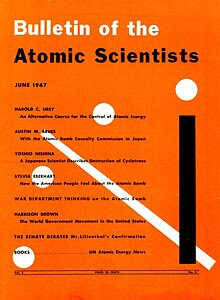
In 1947, the Doomsday Clock appeared for the first time, as the fourth quadrant of a clock face with its hands at 7 min.  to midnight. It was the background image on the cover of the June issue of the Bulletin of the Atomic Scientists. From then to the present, the Doomsday Clock image has been on the cover of the Bulletin, though the hands over the years have been shown moving forward or back to conveyy how close humanity is to catastrophic destruction. Midnight represents Doomsday. The closest approach, two minutes to midnight began on the Sep 1953 cover. Russia's first hydrogen bomb test the previous month (12 Aug 1953) within nine months of an American H-bomb test (1 Nov 1952). In  Dec 1991, the clock was set at 17 min. to midnight marking the Strategic Arms Reduction Treaty.
The Bulletin has reset the minute hand on the Doomsday Clock 25 times since its debut in 1947, most recently in 2023 when we moved it from 100 seconds to midnight to 90 seconds to midnight. 


1957 The June issue of Mad Magazine carried, among several other unusual features, the first published work of 19 year old Case Western Reserve Freshman, Donald Knuth. His article developed the "Potrzebie System of Weights and Measures". The base of this new revolutionary system is the potrzebie, which equals the thickness of Mad issue 26, or 2.263348517438173216473 mm.  Google's calculator and Wolfram Alpha can perform conversions between potrzebies and other units.*Wik


Hat Tip to *Hania Uscka-Wehlou sent this additional information: I was intrigued by the Polish word "potrzebie" (funnily, not in its basic form [nominative]: "potrzeba", but in locative) and I have found this: https://en.wikipedia.org/wiki/Potrzebie.
  
Just wondering what percent of readers actually ever read a Mad Magazine,


In 1965, A. Penzias and R. Wilson detected a 3 degree kelvin primordial background radiation using a horn reflector antenna built for radio astronomy. The Big Bang description of the origin of the universe took place 15 to 20 billion years ago in an explosion from a hot dense state. The high energy radiation produced when the universe was very young and very hot would have been absorbed and degraded as the universe expanded and cooled. The microwave background radiation first observed by Penzias and Wilson is thought to be a relic of this very early state, when the universe was only about a million years old. The uniformity of microwave background indicates that the universe was homogeneous until it was a few million years old.*TIS

1966 Surveyor I was launched. It was the first American spacecraft to make a soft landing on the Moon. Curiously, the word “spaceship” was defined by the 1958 edition of Webster’s New Collegiate Dictionary as “An imaginary aircraft of the future for interplanetary travel outside the earth’s atmosphere.” *VFR

2003  Jean-Pierre Serre became the first recipient of the Abel Prize. The ceremony was held at the Abel Monument in Slottsparken, Oslo.


BIRTHS


1796 Nicolas-Leonard Sadi Carnot, (1 June 1796 — 24 August 1832) was a French physicist. He became a captain of engineers in the army, and spent much of his life investigating the design of steam engines. His book Reflections on the Motive Power of Heat (1824) contained a theorem which says that a maximum efficiency of heat engine can be obtained by a reversible engine, and that efficiency depends only on the temperatures of the hot and the cool sources of the engine. This theorem played an essential role for the subsequent development of thermodynamics. It was written to promote the construction of steam engines and other heat engines in France, whose industrial development was lagging behind England's. *TIS The name Carnot is listed among the seventy-two names of French scientists, engineers and other notable people On the Eiffel Tower, however it honors the father of Sadi Carnot, Lazare Nicholas Marguerite Carnot.


1843 Henry Faulds (1 Jun 1843, 19 Mar 1930 at age 86) Scottish physician who, from 1873, became a missionary in Japan, where he worked as a surgeon superintendent at a Tokyo hospital, taught at the local univeristy, and founded the Tokyo Institute for the Blind. In the late 1870s, his attention was drawn to fingerprints of ancient potters remaining on their work that he helped unearth at an archaeological dig site in Japan. He commenced a study of fingerprints, and became convinced that each individual had a unique pattern. He corresponded on the subject with Charles Darwin, and published a paper about his ideas in Nature (28 Oct 1880). When he returned to Britain in 1886, he unsuccessfully offered his fingerprinting identification scheme for forensic uses to Scotland Yard. Undeserved confusion on priority for the discovery with Francis Galton and Sir William J. Herschel lasted until 1917. *TIS


1851 Edwin Bailey Elliott (1 June 1851, Oxford, England - 21 July 1937 in Oxford, England)After outstanding achievements at university, Elliott became a Fellow and Mathematical Tutor of Queen's College, Oxford, in 1874.
In addition to his Fellowship at Queen's College, Elliott was appointed a lecturer in mathematics at Corpus Christi College in Oxford in 1884. These appointments came to an end in 1892 when Elliott became the first Waynflete professor of Pure Mathematics. This chair was named after William of Waynflete, the English lord chancellor and bishop of Winchester who founded Magdalen College in the 15th century. The Waynflete chair came with a Fellowship at Magdalen College so Elliott was again attached to his old College. One year after being appointed to the Waynflete Chair of Pure Mathematics, Elliot married Charlotte Amelia Mawer.
Elliott held the Waynflete chair for 29 years until his retirement in 1921. During this time he was much involved with the London Mathematical Society, being President of the Society from 1896 to 1898. A few years before this, in 1891, he had been honoured by being elected a Fellow of the Royal Society. As Chaundy writes-
Elliott's mathematical life circulated round the twin foci of Oxford and London. Besides his work in formal teaching and lecturing at Oxford, he was one of the founders (1888) of the Oxford Mathematical Society, its first secretary, and later its president.
His mathematical work included algebra, algebraic geometry, synthetic geometry, elliptic functions and the theory of convergence. However his most important contribution was the book An introduction to the algebra of quantics which was first published in 1895. This work was a major contribution to invariant theory. *SAU


1866 Charles Benedict Davenport (1 Jun 1866, 18 Feb 1944 at age 77) American zoologist who contributed substantially to the study of eugenics (the improvement of populations through breeding) and heredity and who pioneered the use of statistical techniques in biological research. Partly as a result of breeding experiments with chickens and canaries, he was one of the first, soon after 1902, to recognize the validity of the newly discovered Mendelian theory of heredity. In Heredity in Relation to Eugenics (1911), he compiled evidence concerning the inheritance of human traits, on the basis of which he argued that the application of genetic principles would improve the human race. These data were at the heart of his lifelong promotion of eugenics, though he muddled science with social philosophy. *TIS


1868  Annie Louise MacKinnon Fitch (June 1, 1868 – September 12, 1940) was a Canadian-born American mathematician who worked with Felix Klein and became a professor of mathematics at Wells College. She was the third woman to earn a mathematics doctorate at an American university.
She graduated in 1889, and remained at the University of Kansas for graduate study in mathematics, becoming the third mathematics graduate student at the university and the first woman. She earned a master's degree in 1891, remaining one more year at the university to work there with Henry Byron Newson.

In 1892, MacKinnon transferred to Cornell University. She finished her doctorate there in 1894, supported as an Erastus Brooks fellow. Her dissertation, Concomitant Binary Forms in Terms of the Roots, was supervised by James Edward Oliver, and also thanked James McMahon as a faculty mentor. This made her the third woman to earn a mathematics doctorate at an American university, following Winifred Edgerton Merrill in 1886 at Columbia University in 1886 and Ida Martha Metcalf at Cornell in 1893.

MacKinnon taught high school mathematics in Lawrence, Kansas from 1890 to 1892. After her return from Europe in 1896, she became professor of mathematics at Wells College, a women's college in Aurora, New York; she was the only mathematician on the faculty. She also served as registrar for the college for 1900–1901.

In 1901, MacKinnon married Edward Fitch, an American classics scholar who had been at Göttingen at roughly the same time as MacKinnon, and later taught at Hamilton College. After marrying, she gave up her mathematical career.

She died on September 12, 1940, in Clinton, New York. A scholarship in mathematics at Hamilton College was established in her name by her husband.


1899 Edward Charles Titchmarsh (1 June 1899 in Newbury, -  died 18 January 1963 at Oxford) English mathematician whose contributions to analysis placed him in the forefront of his profession. His contributions helped resolve the differences between the general theory of quantum mechanics and the methods used to solve particular problems in quantum theory. All Titchmarsh's work is in analysis. His early studies were on Fourier series, Fourier integrals, functions of a complex variable, integral equations and the Riemann zeta function. From 1939, Titchmarsh concentrated on the theory of series expansions of eigenfunctions of differential equations, work which helped to resolve problems in quantum mechanics. His work on this topic occupied him for the last 25 years of his life. *TIS


John Vincent Pardon ( June 1, 1989,  ) is an American mathematician who works on geometry and topology. He is primarily known for having solved Gromov's problem on distortion of knots, for which he received the 2012 Morgan Prize. He is a permanent member of the Simons Center for Geometry and Physics in Stony Brook, New York. He was awarded the Fields Medal in 2026.

Pardon's mother, Joyce Eileen Maggio Pardon, was a math teacher. She introduced him to basic arithmetic, trigonometry, and calculus. His interest in math was also encouraged by his father, William Pardon, a mathematics professor at Duke University. When he was a high school student at the Durham Academy in Durham, North Carolina, Pardon took classes at Duke.

Pardon was a three-time gold medalist at the International Olympiad in Informatics, in 2005, 2006, and 2007. In 2007, he placed second in the Intel Science Talent Search competition, with a generalization to rectifiable curves of the carpenter's rule problem for polygons. In the project, he showed that every rectifiable Jordan curve in the plane can be continuously deformed into a convex curve without changing its length and without ever allowing any two points of the curve to get closer to each other. He published this research in the Transactions of the American Mathematical Society in 2009.

Next, Pardon went to Princeton University and after his sophomore year he primarily took graduate-level mathematics classes there. At Princeton, he solved a problem in knot theory posed by Mikhail Gromov in 1983 about whether every knot can be embedded into three-dimensional space with bounded stretch factor. He showed that on the contrary, the stretch factor of certain torus knots could be arbitrarily large. His proof was published in the Annals of Mathematics in 2011, and it earned him the Morgan Prize of 2012. Pardon took part in a Chinese-language immersion program at Princeton, and was part of Princeton's team at an international debate competition in Singapore, broadcast on Chinese television. As a cello player, he was a two-time winner of the Princeton Sinfonia concerto competition. He graduated in 2011 and was the valedictorian.

He went to Stanford University for his graduate studies. His accomplishments there included solving the three-dimensional case of the Hilbert–Smith conjecture. He completed his Ph.D. in 2015, under the supervision of Yakov Eliashberg, and continued at Stanford as an assistant professor. In 2015, he was also appointed to a five-year term as a Clay Research Fellow.

In the fall of 2016, he became a full professor of mathematics at Princeton University. He is currently a permanent member of the Simons Center for Geometry and Physics in Stony Brook, New York. In 2023, he proved the MNOP conjecture, which posited an equivalence between two different curve enumeration invariants of Calabi–Yau threefolds. He is currently working on a book about the foundations of symplectic geometry.

Pardon's sister, Mireille Pardon, is an assistant professor of history at Berea College. *Wik


DEATHS

1815  James Gillray, a British caricaturist and etcher, died June 1, 1815, at age 58.  In the opinion of many modern political cartoonists, Gillray was the father of their craft,  outdistancing other worthy candidates such as William Hogarth and George Cruickshank by his composition, his satirical wit, and his skill at portraiture.  His primary targets were the Royal family (that of King George III), political figures, the excesses of the British peerage, and Napoleon, who crowned himself Emperor when Gillray was at the height of his powers. *Linda Hall Org
Image:  Detail of the laughing gas demonstration depicted in the fifth image, caricaturing (right to left) Benjamin Thompson, Count Rumford; Humphry Davy; Thomas Garnett or James Watt; and James Coxe Hippisley (npg.uk.org)


1861 Kurt Hensel  (29 December 1861 – 1 June 1941) He is best known for his work on p-adic numbers. *VFR  First described by Kurt Hensel in 1897, the p-adic numbers were motivated primarily by an attempt to bring the ideas and techniques of power series methods into number theory. Their influence now extends far beyond this. For example, the field of p-adic analysis essentially provides an alternative form of calculus.


1867 Karl George Christian von Staudt (January 24, 1798 – June 1, 1867) German mathematician who developed the first complete theory of imaginary points, lines, and planes in projective geometry. His early work was on determining the orbit of a comet and, based on this work, he received his doctorate. He showed how to construct a regular inscribed polygon of 17 sides using only compasses. He turned to projective geometry and Bernoulli numbers. An important work on projective geometry, Geometrie der Lage was published in 1847. It was the first work to completely free projective geometry from any metrical basis. He also gave a geometric solution to quadratic equations.*TIS


1918 Eduardo Torroja Caballe (February 1, 1847 – June 1, 1918) was a Spaniard mathematician born in the city of Tarragona, Spain. His father was Juan Torroja, a Professor of Geography and History. He continued his studies at Complutense University, where he obtained the degrees of Bachelor of Science (1864), Masters of Science (1866), Architect (1869) and Doctor of Science (1873) in Mathematics.
Very early in his studies he became a disciple of Karl Georg Christian von Staudt (who also died on this same date), whose ideas of Geometry he embraced and promoted among his fellow mathematicians for the rest of his life. The strong presence of Geometry in Spain's mathematical curriculum, even to this day, can be traced back to Torroja's influence. *Wik


1997  Robert Serber (March 14, 1909 – June 1, 1997) was an American physicist who participated in the Manhattan Project. He gave lectures (5-14 Apr 1943) at Los Alamos, on the design and construction of atomic bombs as background for the Manhattan Project. Notes were typed and mimeographed as The Los Alamos Primer, technical report LA-1, given to scientists newly arriving at the top-secret laboratory. Serber coined the code-names of the three bomb designs: “Little Boy” (uranium gun), “Thin Man” (plutonium gun), and “Fat Man” (plutonium implosion). He helped assemble atomic bombs on Tinian Island that were dropped on Japan. He was part of the first American team visiting to assess their damage at Hiroshima and Nagasaki. After WW II, he returned to academia, and by 1951 was a professor of physics at Columbia University. *TIS


2006 Shokichi Iyanaga (April 2, 1906 – June 1, 2006) was a Japanese mathematician. Iyanaga published many papers which arose through several courses such as algebraic topology, functional analysis, and geometry, which he taught. He became Professor at the University of Tokyo in 1942. It was during World War II. Towards the end of the war, many Japanese cities were bombarded and he had to find refuge in the countryside. He was busy in editing textbooks from primary and secondary schools and he continued to give courses and organise seminars.*Wik


*CHM=Computer History Museum
*FFF=Kane, Famous First Facts
*NSEC= NASA Solar Eclipse Calendar
*RMAT= The Renaissance Mathematicus, Thony Christie
*SAU=St Andrews Univ. Math History
*TIA = Today in Astronomy
*TIS= Today in Science History
*VFR = V Frederick Rickey, USMA
*Wik = Wikipedia
*WM = Women of Mathematics, Grinstein & Campbell