 |
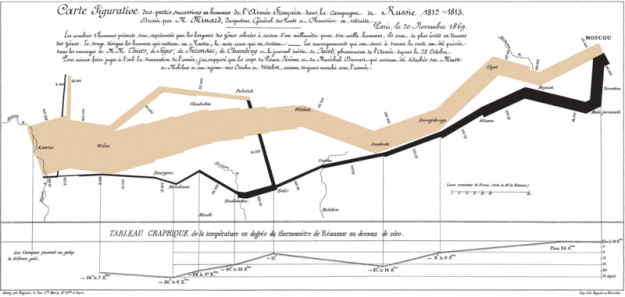
| Charles Minard's Napoleon's March, |
Modern science, as training the mind to an exact and impartial analysis of facts, is an education specially fitted to promote citizenship.
~Karl Pearson
The 86th day of the year; 86 is conjectured to be the largest number n such that 2n (in decimal) doesn't contain a 0. *Tanya Khovanova, Number Gossip
The 86th prime is 443, and 4433 = 86,938,307. There is no other two digit n, such that the cube of the nth prime starts with n.
86 is the sum of four consecutive integers, 86= 20 + 21 + 22 + 23
and of four consecutive squares, 86= 32 + 42 + 52 + 62
The multiplicative persistence of a number is the number of times the iteration of finding the product of the digits takes to reach a one digit number. For 86, with persistence of three, we produce 8*6= 48, 4*8 = 32, and 3*2 = 6.... and 48+32+6 = 86. (how frequently does that occur?)
There are 86 abundant numbers(the sum of the proper divisors is greater than the number) in a non-leap year, but 86 is not one of them. All the abundant year days are even numbers. The smallest odd abundant number is 945.

-3.jpg)
1878 Christine Ladd to JJ Sylvester:


1936 The Associated Press released a story that a new 155 digit perfect number had been found by Dr. S. I. Krieger of Chicago. The number was \(2^{256}(2^{257} - 1)\) by proving the \(2^{257} -1\) was prime. This was shocking since D. H. Lehmer and M. Kraitcik had announced that the number was composite in 1922. The perfection of the number was doubted by most mathematicians, but the actual factoring to prove it was composite didn't happen until 1952 when the SWAC confirmed it was composite by finding a proper divisor. *Beiler, Recreations in the Theory of Numbers.
 |
| D. H. Lehmer |
1958 The first national high-school mathematics competition in the U.S. was held. Since 1983 it has been known as the American High School Mathematics Examination (AHSME). [The College Mathematics Journal, 16 (1985), p. 331] *VFR
1976 20-Year Old Bill Gates Gives Opening Address to Hobbyists:
Bill Gates gives the opening address at the First Annual World Altair Computer Convention in Albuquerque, N.M. MITS, the company that developed the Altair, had set up shop in the southwestern city to develop its kit computer, which was a hit among hobbyists after it graced the cover of "Popular Mechanics" magazine. Gates, then a 20-year-old erstwhile Harvard student, had helped develop the form of BASIC sold with the Altair. *CHM

1824 Johann Wilhelm Hittorf (27 Mar 1824, 28 Nov 1914) German physicist who was a pioneer in electrochemical research. His early investigations were on the allotropes (different physical forms) of phosphorus and selenium. He was the first to compute the electricity- carrying capacity of charged atoms and molecules (ions), an important factor in understanding electrochemical reactions. He investigated the migration of ions during electrolysis (1853-59), developed expressions for and measured transport numbers. In 1869, he published his laws governing the migration of ions. For his studies of electrical phenomena in rarefied gases, the Hittorf tube has been named for him. Hittorf determined a number of properties of cathode rays, including (before Crookes) the deflection of the rays by a magnet. *TIS

1845 Wilhelm Conrad Röntgen (27 Mar 1845 - 10 Feb 1923 at age 77) was a German physicist who discovered the highly penetrating form of radiation that became known as X-rays on 8 Nov 1895. He received the first Nobel Prize for Physics (1901), “in recognition of the extraordinary services he has rendered by the discovery of the remarkable rays subsequently named after him.” This high-energy radiation, though first called Röntgen rays, became known as X-rays. His discovery initiated revolutionary improvements in making medical diagnoses and enabled many new advances in modern physics. *TIS "In 1901 he became the first physicist to receive a Nobel prize." *VFR


1855 Sir Alfred Ewing (27 Mar 1855, 7 Jan 1935) was a Scottish physicist who discovered and named hysteresis (1881), the resistance of magnetic materials to change in magnetic force. Ewing was born and educated in Dundee and studied engineering on a scholarship at Edinburgh University. He helped Sir William Thomson, later Lord Kelvin in a cable laying project. In 1878 he became professor of Mechanical Engineering and Physics at Tokyo University, where he devised instruments for measuring earthquakes. In 1903 he moved to the Admiralty as head of education and training, where during WW I, he and his staff took on the task of deciphering coded messages. *TIS

1857 Karl Pearson (27 Mar 1857; 27 Apr 1936 at age 79) English mathematician who was one of the founders of modern statistics. His lectures as professor of geometry evolved into The Grammar of Science (1892), his most widely read book and a classic in the philosophy of science. Stimulated by the evolutionary writings of Francis Galton and a personal friendship with Walter F.R. Weldon, Pearson became immersed in the problem of applying statistics to biological problems of heredity and evolution. The methods he developed are essential to every serious application of statistics. From 1893 to 1912 he wrote a series of 18 papers entitled Mathematical Contributions to the Theory of Evolution, which contained much of his most valuable work, including the chi-square test of statistical significance. *TIS

1897 Douglas Rayner Hartree PhD, FRS (27 March 1897 – 12 February 1958) was an English mathematician and physicist most famous for the development of numerical analysis and its application to the Hartree-Fock equations of atomic physics and the construction of the meccano differential analyser.

1905 László Kalmár (27 March 1905 in Edde (N of Kaposvar), Hungary - 2 Aug 1976 in Mátraháza, Hungary) worked on mathematical logic and theoretical computer science. He was acknowledged as the leader of Hungarian mathematical logic. *SAU


1850 Wilhelm Beer (4 Jan 1797, 27 Mar 1850 at age 53) German banker and amateur astronomer who owned a fine Fraunhofer refractor which he used in his own a private observatory. He worked jointly with Johann Heinrich von Mädler, to produce the first large-scale moon map to be based on precise micrometric measurements. Their four-year effort was published as Mappa Selenographica (1836). This fine lithographed map provided the most complete details of the Moon's surface in the first half of the 19th century. It was the first lunar map divided in quadrants, and recorded the Moon's face in great detail detail. It was drawn to a scale of scale of just over 38 inches to the moon's diameter. Mädler originated a convention for naming minor craters with Roman letters appended to the name of the nearest large crater (ex. Egede A,B, and C).


1888 Francesco Faà di Bruno (29 March 1825–27 March 1888) was an Italian mathematician and priest, born at Alessandria. He was of noble birth, and held, at one time, the rank of captain-of-staff in the Sardinian Army. He is the eponym of Faà di Bruno's formula. In 1988 he was beatified by Pope John Paul II. Today, he is best known for Faà di Bruno's formula on derivatives of composite functions, although it is now certain that the priority in its discovery and use is of Louis François Antoine Arbogast: Faà di Bruno should be only credited for the determinant form of this formula. However, his work is mainly related to elimination theory and to the theory of elliptic functions.
He was the author of about forty original articles published in the "Journal de Mathématiques" (edited by Joseph Liouville), Crelle's Journal, "American Journal of Mathematics" (Johns Hopkins University), "Annali di Tortolini", "Les Mondes", "Comptes rendus de l'Académie des sciences", etc.*Wik

1923 Sir James Dewar (20 Sep 1842; 27 Mar 1923) British chemist and physicist. Blurring the line between physics and chemistry, he advanced the research frontier in several fields at the turn of the century, and gave dazzling lectures. His study of low-temperature phenomena entailed making an insulating double-walled flask of his own design by creating a vacuum between the two silvered layers of steel or glass (1892). This Dewar flask that has been named for him led to the domestic Thermos bottle. In June 1897, The Scientific American reported that "Dewar has just succeeded in liquefying fluorine gas at a temperature of -185 degrees C." He obtained liquid hydrogen in 1898. Dewar also invented cordite, the first smokeless powder.*TIS


1925 Carl Gottfried Neumann,(7 May 1832 in Königsberg, Germany (now Kaliningrad, Russia) - 27 March 1925 in Leipzig, Germany) He worked on a wide range of topics in applied mathematics such as mathematical physics, potential theory and electrodynamics. He also made important pure mathematical contributions. He studied the order of connectivity of Riemann surfaces.
During the 1860s Neumann wrote papers on the Dirichlet principle and the 'logarithmic potential', a term he coined. In 1890 Émile Picard used Neumann's results to develop his method of successive approximation which he used to give existence proofs for the solutions of partial differential equations.*SAU

1929 Samuil Shatunovsky (25 March 1859 – 27 March 1929) was a Russian mathematician. focused on several topics in mathematical analysis and algebra, such as group theory, number theory and geometry. Independently from Hilbert, he developed a similar axiomatic theory and applied it in geometry, algebra, Galois theory and analysis. However, most of his activity was devoted to teaching at Odessa University and writing associated books and study materials.*Wik

1972
 Maurits Cornelius Escher (17 June 1898 in Leeuwarden, Netherlands - 27 March 1972 in Laren, Netherlands) an artist whose works have included a considerable mathematical content. He is known for his often mathematically inspired woodcuts, lithographs, and mezzotints. These feature impossible constructions, explorations of infinity, architecture, and tessellations. *Wik
2010 Sheila Christina Tinney (née Power; 15 January 1918 – 27 March 2010) was an Irish mathematical physicist. Her 1941 PhD from the University of Edinburgh, completed under the supervision of Max Born in just two years, is believed to make her the first Irish-born and -raised woman to receive a doctorate in the mathematical sciences.
 |
| With Dirac and Eddington |
 |
2025 Shmuel Agmon (February 1922 – 21 March 2025) was an Israeli mathematician who was known for his work in analysis and partial differential equations.
Shmuel Agmon was born in Tel Aviv to writer Nathan Agmon and Chaya Gutman. During his childhood, the family moved to Nazareth for a few years before settling in Jerusalem. A member of the HaMahanot HaOlim youth movement, Agmon studied at the Gymnasia Rehavia and joined a hakhshara program at kibbutz Na'an after graduating from high school.
He began his studies in mathematics at the Hebrew University of Jerusalem in 1940 but enlisted in the British Army before graduating, serving in an anti-aircraft unit and then the Jewish Brigade. He served for four years in Cyprus, Italy and Belgium during World War II.
After his discharge, he completed his undergraduate and master's degrees at the Hebrew University and went to France for further studies. He obtained a PhD from Paris-Sorbonne University in 1949, under the supervision of Szolem Mandelbrojt. He returned to Jerusalem after working as a visiting scholar at Rice University from 1950 to 1952, and was appointed full professor at the Hebrew University in 1959.
Agmon died on 21 March 2025, at the age of 103.
Agmon's contributions to partial differential equations include Agmon's method for proving exponential decay of eigenfunctions for elliptic operators.
Agmon was awarded the 1991 Israel Prize in mathematics. He received the 2007 EMET Prize "for paving new paths in the study of partial-elliptical differential equations and their problematic language and for advancing the knowledge in the field, as well as his essential contribution to the development of the Spectral Theory and the Distribution Theory of Schrödinger Operators." He has also received the Weizmann Prize and the Rothschild Prize. In 2012, he became a fellow of the American Mathematical Society. *Wik

Credits :
*CHM=Computer History Museum
*FFF=Kane, Famous First Facts
*NSEC= NASA Solar Eclipse Calendar
*RMAT= The Renaissance Mathematicus, Thony Christie
*SAU=St Andrews Univ. Math History
*TIA = Today in Astronomy
*TIS= Today in Science History
*VFR = V Frederick Rickey, USMA
*Wik = Wikipedia
*WM = Women of Mathematics, Grinstein & Campbell


No comments:
Post a Comment