Thursday, 4 December 2008

More Detail on Birthday Problems

A couple of email questions asked about the birthday problems... One questioned the assumption that births are not uniformly distributed in the months (or days of the month)... which is quite true, and worth backing up with some info, but it actually makes the probability of a match MORE likely at n=23 than it would be if the births were uniformly distributed.

A Math Trek article by Ivars Peterson has a table of monthly probabilities showing the daily frequency of birth each month. September seems to be the most popular month, but the differences are almost negligible in the total probability calculation.

A greater difference is due to the fact that in modern times, far fewer people are born on a weekend. Induced labor saves many doctors from a spoiled yachting weekend. The Fathom Graph below shows the distribution of birthdays for births in the U.S. in 1978. It was used by Professor Geoffrey Berresford in his article: "The uniformity assumption in the birthday problem, Math. Mag. 53 1980, no. 5, 286-288." If you plot a times series of the data you will have a nice example of periodic data. The saturdays and sundays show up well below the others, (yearday.jpg)... The atctual data can be found at the Chance Data Base at Dartmoth.

One more graph, this one from the Skeptical Inquirer on line magazine. It relates to the probabilty of a match or near match (one day apart) with n people. The curve shows the probability of a match on the vertical axis, and the number of people on the horizontal. The dots are for the traditional problem, and the solid line is the "near match" probability.

Wednesday, 3 December 2008

North of the Border, A visit to Scotland


Took a trip up to Edinburgh over the holiday (Thanksgiving in America, but it was St. Andrews day in Scotland) and had a wonderful time. Must have walked past the Sheraton five times before I noticed that they had huge models of the Neolithic Stone balls that resemble the Platonic Solids. In the picture above I am standing by one that shows the symmetry of the dodecahedron, and others show all the Platonic solids, as well as some other polyhedral models. The actual balls range from two to eight inches in diameter.

Historians usually date the knowledge of all five Platonic solids no earlier than about 500 BC, but the dates of man's discovery (creation) of the Platonic solids is made more complicated by the existance of these neolithic Scottish balls (the real ones, not the ones at the Sheraton) that have been unearthed dating back to about 2000 BC. I was made aware of these a few years ago by discussions on the Historia Matematica discussion group, and quote here from a posting of Dick Tahta:

"On neolithic carved stone balls: There are nearly 400 of these objects found in various sites in Scotland and now in various museums and private collections. They include various regular and semi-regular solids, alternatively they can be seen as arrangements of knobs - from 3 to 10 and then various numbers up to 160! Some of them are decorated, notably the tetrahedral Towie stone. now in the Edinburgh museum (which stocks an excellent coloured postcard). . I have a baked clay model of this stone, bought from a shop in Avebury, Wiltshire."

"J Frazer is quoted as taking the grooves to be meant for thongs so that the balls could be hurled through the air "uttering oracles in a whistling voice which a wizard was able to interpret". I have been unable to trace this quotation, and the author was unable to help me at the time I inquired. The Ashmolean museum, Oxford, has a number of balls, kept in a drawer - I have handled these and they are certainly as remarkable as Keith Critchlow has pointed out. "These neolithic objects display the regular mathematical symmetries normally associated with the Platonic solids, yet appear to be at least a thousand years before the time of either Pythagoras or Plato." (K Critchlow, Time stands still, London - Gordon Fraser, 1979, p133 - this book has some splendid photos of various stone balls.)"


There have been various attempts to guess at what the balls might have beenmade for. The nineteenth century archeologists who excavated them thought they might be weapons - whether as pike heads, or hurled from slings, or used in games or perhaps for divination. It seems that the balls were never found in personal graves, so it has been suggested they were a sort of ceremonial conch, a prized possession of the tribe. Contemporary archeologists tend to be more cautious. According to Dorothy Marshall, "there is so little hard fact to be extracted from the evidence available about the carved stone balls that postulation as to their evolution and use if very difficult." ( D Marshall, Carved stone balls, Proc Soc Antiq Scotland, 108 (1976-7) 40-72 - this is the most up-to-date and authoritative account. Some previous papers in the same journal are to be found in 11 (1874-6) 29-62 and 48 (1913-4) 407-20.)"

Edinburgh is also home to several campuses of the Napier University, one of which includes the home of the famous inventor of the logarithm, John Napie, Merchiston Tower, at Napier University, just off hwy 702 (Morningside drive) two miles or so from downtown Edinburgh...
. Nearby on Morningside Drive is the Eric Liddell Center, a living memorial to Eric Liddell, the rugby star and first Scottish Olympic gold-medalist (you remember, "Chariots of Fire!") which has been serving the local and wider Edinburgh community for more than twenty five years. (Liddell died in 1945 in China just before the end of the war). In an August 8, 2008 poll in The Scotsman newspaper Eric Liddell was voted as the most popular athlete Scotland has ever produced. Sometimes good guys finish first.

Tuesday, 2 December 2008

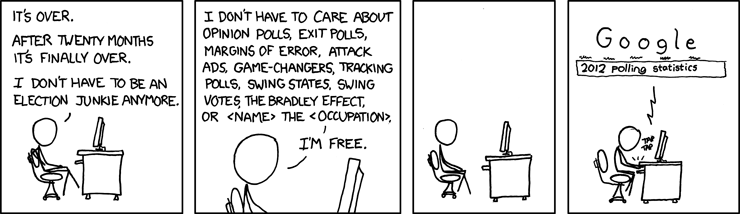
Sarah Palin is NOT alone!

Click on image to see full picture


It started out as just a joke. I sent a copy of a cartoon from xkcd (see above) to the local Gov/History teacher who is my resident Election junkie, Mike Keegan, that I thought he would like. He Responded with a survey that apparently was failed by most Americans and the people they elected to represent them.


The Story caption reads: "WASHINGTON (AFP) – US elected officials scored abysmally on a test measuring their civic knowledge, with an average grade of just 44 percent, the group that organized the exam said Thursday." It continues to add that "Ordinary citizens did not fare much better, scoring just 49 percent correct on the 33 exam questions compiled by the Intercollegiate Studies Institute (ISI)."

He also sent me a link to the quiz, so if you are brave enough to face the truth about what you know about Government and US History, click here... and good luck

Monday, 1 December 2008

More on Birthday Problems...


Four questions about Birthdays left unanswered, so I wanted to get to that. The first:

"What happens to the birthday problem if you switch to a different number of days in the year (say 400 or 1000) or what if we use weeks or months... in short, is there a general formula for the number of people to reach the p=1/2 that there is at least one match?" The problem can be attacked in the same way as shown above for any number of categories, but a nice approximation (I believe this was from Perci Diaconis) is that for n categories, the approximate number of selections to have a probability of 1/2 of a match is 1.2 times the square root of n. So for 1000 days it would be about 38 people. You can reach 95% confindence of a match by adjusting the formula to 2.5 times the square root of n. This means that you can be 95% sure of a match for the conventional 365 day case with only 48 people.

The second problem asks, "what is the number of people needed to make the probability that EVERYONE has a match equal to or greater than 1/2?" This is called the "Strong Birthday Problem." I will leave it to you to search the derivation of the solution, but it seems that with more than 3064 people, the probability becomes more than 1/2 that ALL of them share a common birthday.

"And what if we only wanted to have two people who came close. What is the number of people that must be present to make the probaiblity that at least two have birthdays no more than one day apart?" Well, a little research led me to this, "It turns out, for example, that it takes just 14 people in a room to have even odds of finding two birthdays that are identical or fall on consecutive days. Among seven people, there is about a 60 percent probability that two will have birthdays within a week of each other. Among four people, the probability that two will have birthdays within 30 days of each other is about 70 percent. " I was a little surprised that it took so few to have either a match or adjacent days. I would think that means that with the traditional 25 person classroom, you might not get a match, but you would almost certainly get a "near-match."

"...suppose a group (several hundred) are entering an auditorium, and you know that the first person to enter having a birthday that matches someone already inside will win a prize. Ok, you know not to go first, and if you go too late, it will already be gone.... so where in the line do you insert yourself to have the highest probability of being the first to enter and have a birthday match in the room? " Well if you look at the change in the probability of a match after each person enters the room. This requires only that we calculate p(n) − p(n − 1) and find its max value. It turns out to be twenty, so if you are the twentieth person in line you have a slightly higher chance of being the first match than people before or after you.